

 United Kingdom (UK)
 United States (US)
 Canada
 South Africa
 India
India Australia
 New Zealand
 China
China Russia
 Germany
 France
 Spain
Spain Netherlands
 Vietnam
 United Arab Emirates
 Italy
Italy Poland
 Thailand
 Türkiye




 Algeria


Classroom behavior management ideas for ESL teachers
Classroom behavior management ideas for ESL teachers

Managing classroom behavior effectively remains one of the most critical challenges ESL teachers face in 2026. Without solid strategies, even the most engaging lessons can dissolve into chaos, leaving both you and your students frustrated. This article presents practical, research-backed behavior management ideas specifically designed for ESL contexts. You’ll discover actionable techniques that boost student engagement, reduce disruptions, and create the positive learning environment your diverse learners need to thrive.
Table of Contents
- Criteria For Choosing Effective Classroom Behavior Management Ideas
- Top Classroom Behavior Management Ideas For ESL Teachers
- Comparing Classroom Behavior Management Strategies: Pros, Cons, And Suitability
- Choosing The Best Classroom Behavior Management Ideas For Your ESL Classroom
- Enhance Your ESL Teaching Skills With TEFL Institute
- Frequently Asked Questions
Key takeaways
| Point | Details |
|---|---|
| Balance rules with engagement | Effective strategies combine clear expectations with interactive activities that keep ESL students motivated and focused. |
| Positive reinforcement works | Praise and rewards consistently improve behavior while building student confidence in language learning environments. |
| Cultural awareness matters | Understanding diverse backgrounds helps you respond appropriately and prevents behavior issues rooted in cultural misunderstandings. |
| Adapt to proficiency levels | Successful management adjusts complexity based on student language abilities, from visual aids for beginners to verbal contracts for advanced learners. |
Criteria for choosing effective classroom behavior management ideas
Selecting the right behavior management approach for your ESL classroom requires understanding what makes strategies work for language learners specifically. The most effective classroom management integrates clear expectations with engagement techniques and cultural sensitivity.
Start with clarity. ESL students need crystal-clear expectations because language barriers can turn vague instructions into confusion. Post visual rules using simple words and pictures. Demonstrate desired behaviors rather than just explaining them. When students understand exactly what you expect, half your behavior challenges disappear.
Engagement strategies keep diverse language learners motivated and on task. Passive students sitting through lectures get bored and act out. Active learners participating in games, pair work, and hands-on activities stay focused. Your management approach should include interactive elements that match your students’ energy levels and learning styles.
Cultural sensitivity prevents misunderstandings that trigger behavior problems. What counts as respectful eye contact, appropriate volume, or polite disagreement varies dramatically across cultures. Research your students’ backgrounds and adjust your responses accordingly. A student avoiding eye contact might show respect in their culture, not defiance.
Consistency builds trust while flexibility acknowledges reality. Apply consequences fairly every time so students know what to expect. However, recognize that language barriers sometimes cause genuine confusion rather than deliberate misbehavior. Adjust your response when a student truly didn’t understand versus deliberately ignored instructions.
Building genuine rapport creates the foundation for positive behavior. Students who feel respected and valued want to please you. Learn names quickly, show interest in their lives, and celebrate small victories in their language learning journey.
Pro Tip: Younger ESL students and beginners need more visual cues and physical demonstrations, while older or advanced learners respond better to verbal explanations and written contracts. Adjust your management style as proficiency grows.
Top classroom behavior management ideas for ESL teachers
Implementing proven strategies transforms chaotic classrooms into productive learning spaces. These five ideas address the unique challenges ESL teachers face with diverse language learners.
Establish clear rules using visual aids that transcend language barriers. Create a poster with 3 to 5 simple rules illustrated with pictures and icons. “Listen when others speak” shows an ear and a person talking. “Raise your hand” displays a raised hand. Review these daily during the first week, then reference them when redirecting behavior. Students who can’t yet read English fluently still understand expectations through images.
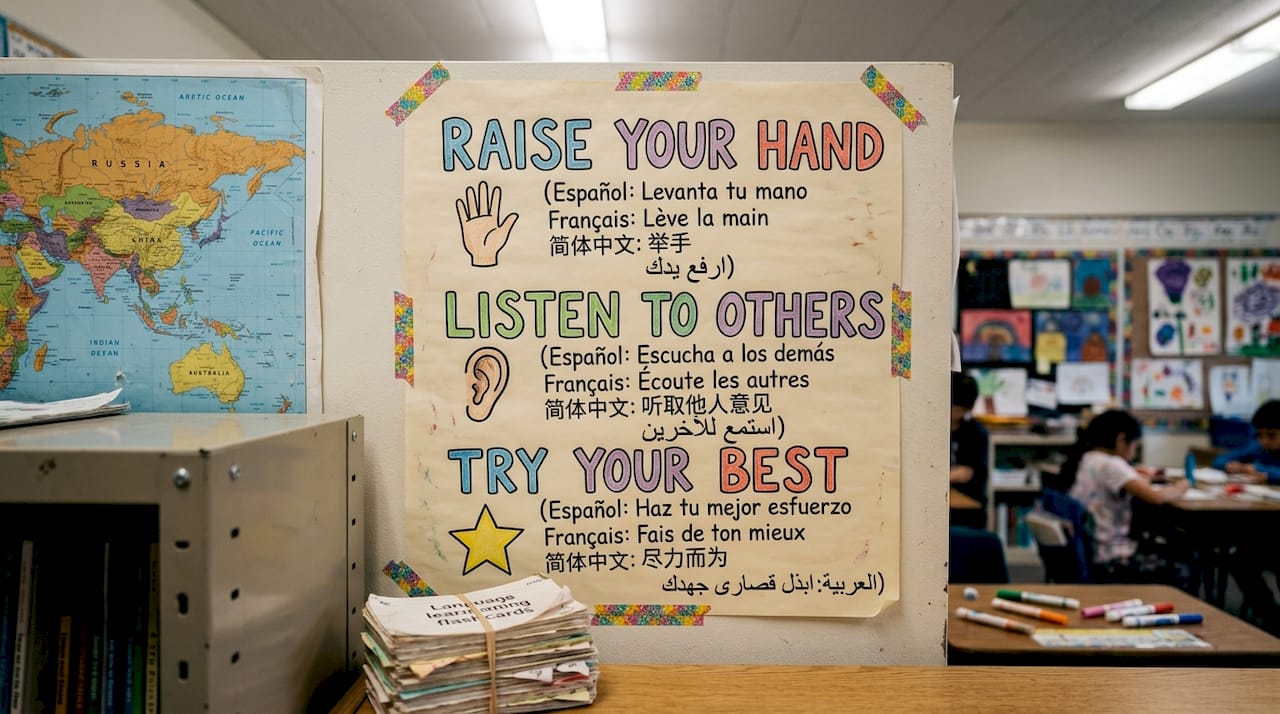
Use positive reinforcement strategically to encourage desired behaviors. Positive reinforcement increases motivation and reduces disruptions in ESL settings. Praise specific actions immediately: “Great job waiting your turn to speak, Maria.” Implement a token system where students earn points for participation, helping classmates, or staying on task. Exchange points weekly for small privileges like choosing a game or leading an activity. This concrete reward system works across cultures and language levels.
Incorporate interactive activities that maintain focus and participation naturally. Students engaged in information gap exercises, role plays, or competitive team games have less opportunity and motivation to misbehave. Structure lessons with frequent activity changes every 10 to 15 minutes. Movement breaks between seated work prevent restlessness from building into disruption.
Apply calm and consistent consequences for misbehavior without anger or lengthy explanations. A simple three-step system works well: first offense gets a verbal warning, second brings a brief timeout or loss of privilege, third involves contacting parents or administration. Keep consequences immediate and proportional. Avoid long lectures that waste class time and confuse language learners.
Build relationships through culturally aware communication that shows genuine interest. Greet students individually as they enter. Learn a few phrases in their native languages. Share appropriate personal stories that help them see you as human. Students who feel connected to you naturally want to cooperate and succeed.
Comparing classroom behavior management strategies: pros, cons, and suitability
Evaluating different approaches helps you select strategies that fit your specific teaching context. Comparison enables teachers to tailor management for their unique ESL classroom challenges.
| Strategy | Pros | Cons | Best For |
|---|---|---|---|
| Visual rule systems | Works across language barriers, easy to reference, reduces verbal explanations | Requires upfront creation time, needs regular reinforcement | Beginners, young learners, large mixed-level classes |
| Positive reinforcement | Builds motivation, creates positive atmosphere, culturally universal | Can become expected entitlement, requires consistent tracking | All levels, especially students lacking confidence |
| Interactive activities | Prevents boredom-based misbehavior, increases engagement naturally | Demands more planning, can feel chaotic without clear structure | Energetic classes, kinesthetic learners, afternoon sessions |
| Calm consequences | Maintains authority without confrontation, teaches accountability | Requires emotional control, may seem cold in relationship-focused cultures | Older students, repeated offenders, serious disruptions |
| Relationship building | Creates intrinsic motivation, reduces defiance, improves classroom culture | Time intensive, benefits appear gradually not immediately | Long-term classes, students with trauma, culturally diverse groups |
Simpler strategies like visual rules require minimal resources and work immediately, making them ideal for new teachers or challenging classes. More complex approaches like relationship building demand sustained effort but create lasting behavioral improvements and a supportive learning environment.
Age and proficiency dramatically affect strategy suitability. Young children and absolute beginners need concrete, visual, and physical management techniques. Teenagers and advanced learners respond better to verbal reasoning, written behavior contracts, and appeals to their maturity and goals.
Long-term impact matters more than quick fixes. Token systems and consequences stop immediate problems but don’t change underlying attitudes. Relationship building and culturally responsive teaching create students who self-regulate because they value the learning community you’ve built together.
Pro Tip: Combine multiple strategies rather than relying on one approach. Use visual rules for clarity, positive reinforcement for motivation, interactive activities for engagement, and relationship building for long-term success. This layered approach addresses behavior from multiple angles simultaneously.
Recognize when to adapt or abandon strategies that aren’t working. If students ignore your token system after three weeks, switch to different rewards or try a new approach entirely. Flexibility separates effective teachers from those who stubbornly persist with failed methods.
Choosing the best classroom behavior management ideas for your ESL classroom
Your specific teaching situation determines which strategies deliver the best results. Tailoring classroom management to specific conditions enhances teacher confidence and student outcomes significantly.
Assess your classroom environment honestly before selecting strategies. Large classes of 30 or more students need whole-group systems like visual rules and token economies that you can manage efficiently. Small groups of 8 to 12 allow individualized attention, relationship building, and personalized behavior plans. Your physical space matters too. Cramped rooms require more structured activities while spacious classrooms support movement-based management.
Student age and maturity level shape appropriate techniques. Elementary students respond to games, songs, and colorful visual systems. Middle schoolers need more sophisticated approaches that respect their growing independence while maintaining clear boundaries. Adults require professional treatment and strategies that acknowledge their life experience and intrinsic motivation.
Mixed proficiency levels demand differentiated management approaches within the same class. Provide visual supports for beginners while giving advanced students written expectations. Use peer support strategically, pairing stronger students with those still developing language skills. This builds community while addressing different comprehension levels.
Your teaching personality and cultural competence influence which strategies feel authentic. Naturally warm, expressive teachers excel at relationship building and positive reinforcement. More reserved personalities might prefer structured systems with clear rules and consistent consequences. Neither approach is superior, but forcing yourself into an unnatural style creates inconsistency that students exploit.
Continuous reflection and improvement plans keep your management evolving. Track which strategies reduce specific behavior problems over several weeks. Survey students anonymously about what helps them focus and learn. Adjust techniques based on evidence rather than assumptions. Join teacher communities online or locally to share challenges and learn from colleagues managing similar ESL contexts.
Consider your energy and time resources realistically. Elaborate behavior tracking systems and individualized plans work wonderfully but require significant effort. Simple, consistent approaches often outperform complex systems you can’t maintain. Start with basic strategies you can implement reliably, then add complexity as you gain experience and efficiency.
Enhance your ESL teaching skills with TEFL Institute
Mastering classroom behavior management transforms your teaching effectiveness and student success. TEFL Institute offers practical courses specifically designed to build the management skills ESL teachers need in real classrooms.
Our comprehensive TEFL courses in Newcastle include dedicated modules on classroom management techniques for diverse language learners. You’ll practice strategies with experienced instructors who’ve managed ESL classrooms worldwide. The training covers everything from establishing routines to handling challenging behaviors with cultural sensitivity.

Expand your expertise with course extensions that let you specialize in areas like young learners or business English, each with tailored management approaches. These focused modules help you adapt core strategies to specific teaching contexts and student populations.
Gain hands-on experience through internship programs that place you in real ESL classrooms where you’ll apply behavior management ideas under expert supervision. This practical training builds confidence and skills that translate directly into teaching success when you launch your career.
Frequently asked questions
What are the most effective classroom behavior management ideas for ESL teachers?
The most effective ideas combine visual rule systems, positive reinforcement, interactive activities, consistent consequences, and relationship building. Visual aids work across language barriers while positive reinforcement motivates diverse learners. Interactive lessons prevent boredom-based disruptions, and building genuine connections creates students who want to cooperate.
How can positive reinforcement improve behavior in ESL classrooms?
Positive reinforcement motivates students by acknowledging desired behaviors immediately with specific praise or tangible rewards. This approach reduces disruptions because students repeat actions that earn recognition. ESL learners especially benefit since praise provides clear feedback about expectations without requiring complex language explanations.
What role does cultural sensitivity play in managing ESL classroom behavior?
Cultural sensitivity helps you interpret behaviors correctly and respond appropriately rather than misreading cultural differences as defiance. Understanding diverse communication styles, authority concepts, and social norms prevents misunderstandings that trigger unnecessary conflicts. Students from cultures where questioning teachers is disrespectful need different handling than those from debate-oriented educational backgrounds.
How can I adapt behavior management strategies for different ESL proficiency levels?
Use simpler visual instructions, physical demonstrations, and shorter explanations for beginners while expecting more verbal understanding and independence from advanced learners. Beginners need concrete token systems and picture-based rules, whereas advanced students respond to written behavior contracts and discussions about classroom community. Adjust language complexity in your redirections and explanations to match comprehension levels.
