

 United Kingdom (UK)
 United States (US)
 Canada
 South Africa
 India
India Australia
 New Zealand
 China
China Russia
 Germany
 France
 Spain
Spain Netherlands
 Vietnam
 United Arab Emirates
 Italy
Italy Poland
 Thailand
 Türkiye










 Algeria



What Is Global English? A TEFL Teacher’s Guide (2026)
What Is Global English? A TEFL Teacher’s Guide (2026)

TL;DR:
- Most English interactions worldwide occur between non-native speakers, emphasizing the need for Global English.
- Global English prioritizes mutual understanding and functional communication over native-speaker norms.
- TEFL training should incorporate ELF principles, focusing on intelligibility and diverse language use.
Most TEFL teachers enter their first classroom expecting to teach “correct” English, meaning the grammar, accent, and vocabulary of a native speaker. That assumption is worth reconsidering. 80 to 90% of English interactions worldwide occur between non-native speakers, not between a native speaker and a learner. This means the English your students will actually use in their careers, travels, and daily lives looks quite different from what a textbook modeled on British or American norms might suggest. This guide explains what Global English is, how it functions in practice, and what it means for your TEFL certification and classroom strategy.
Table of Contents
- Defining Global English: Meaning and scope
- Key characteristics of Global English in practice
- Teaching Global English: Classroom strategies and methods
- Certification implications for TEFL teachers
- Why understanding Global English is the TEFL must-know of the next decade
- Advance your TEFL career with Global English expertise
- Frequently asked questions
Key Takeaways
| Point | Details |
|---|---|
| Global English basics | It is a simplified, neutral form focused on clear communication, not native-speaker mimicry. |
| Key classroom features | Expect flexible grammar, clear pronunciation, and strategies that support mutual understanding. |
| Teaching methodology | Integrate exposure to English varieties, pragmatic skills, and prioritize intelligibility in lessons. |
| Certification impact | TEFL programs now recognize Global English skills as vital for international teaching careers. |
Defining Global English: Meaning and scope
With that context set, let’s get clear on exactly what Global English means and why the term matters for today’s TEFL teachers.
Global English is a simplified, clear form of English designed for international communication, emphasizing mutual intelligibility over native-speaker norms. In practical terms, this means prioritizing whether a message is understood over whether it follows the grammar rules of a particular national variety.
Several related terms appear in academic and teaching literature, and it helps to distinguish them:
- Global English: A neutral, simplified form of English used for cross-cultural communication. It does not belong to any one country or culture.
- English as a Lingua Franca (ELF): English used as a shared communication tool between speakers who do not share a first language.
- World Englishes: The many regional and national varieties of English that have developed globally, such as Nigerian English, Singaporean English, or Indian English.
The definition of Global English is sometimes confused with the idea of “dumbed-down” English, but that misses the point entirely. Global English is not about lowering standards. It is about shifting the standard from native-speaker accuracy to functional communication across diverse contexts.
Another common misconception is that native-speaker norms represent the correct benchmark for all learners. In reality, a Brazilian engineer negotiating a contract with a Korean supplier does not need to sound like a BBC presenter. They need to be understood clearly and efficiently.
For TEFL teachers, understanding this distinction shapes everything from lesson design to assessment. Exploring ESL teaching methodologies that align with Global English principles can help you build a more relevant and effective curriculum from the start.
“The goal of Global English is not to replace regional varieties or native-speaker norms entirely, but to provide a functional framework that allows speakers from any background to communicate effectively.”
Understanding the scope of Global English also means recognizing how widely it has spread. English is now an official or co-official language in over 50 countries, and it functions as the primary language of international business, science, aviation, and diplomacy. The teachers who understand this landscape are better equipped to prepare students for real-world communication.
Key characteristics of Global English in practice
Now that we understand the scope, let’s get specific about how Global English looks and sounds in real-life contexts.
Pronunciation in ELF contexts prioritizes tonic stress, vowel length variation, and core consonants. This framework is known as the Lingua Franca Core (LFC), developed by linguist Jennifer Jenkins. The LFC identifies which pronunciation features are essential for mutual intelligibility and which can vary without causing confusion.

For example, the “th” sounds in words like “think” and “this” are not part of the LFC because most non-native speakers substitute them with sounds like /t/, /d/, or /f/ without losing intelligibility. In contrast, consonant clusters and vowel length distinctions are considered core features that do affect comprehension.
ELF studies show grammar variations and lexical innovations do not hinder intelligibility. This is a significant finding for TEFL teachers. It means that a student who says “she go” instead of “she goes” is not necessarily failing to communicate. The message remains clear.
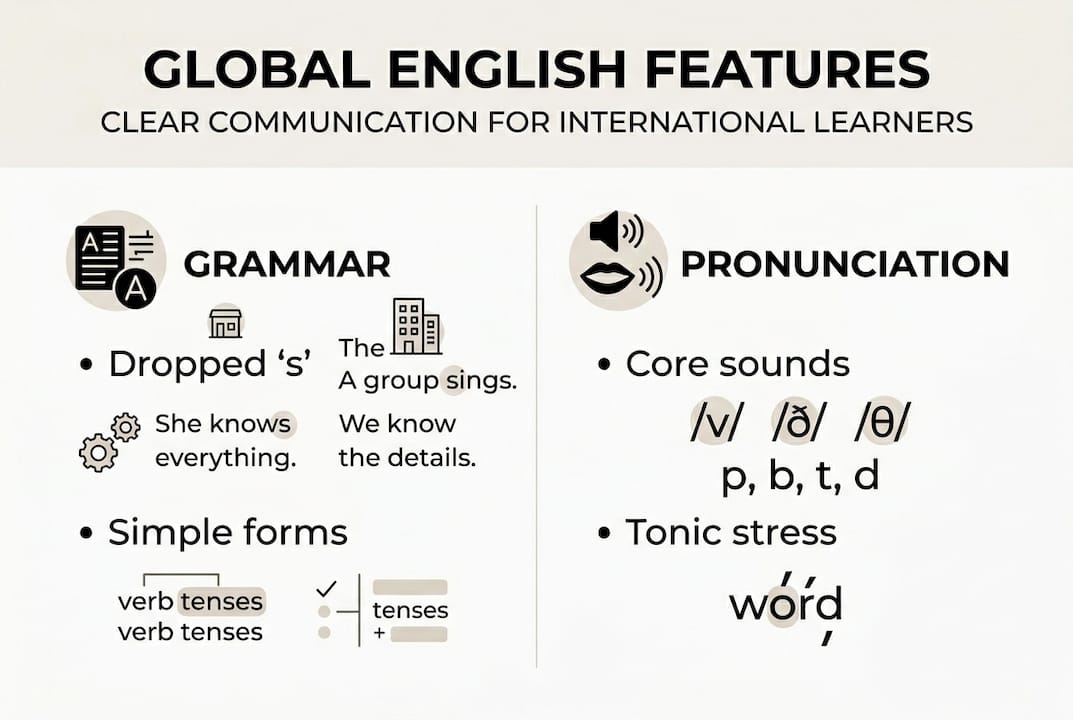
Here is a summary of common Global English features:
| Feature | Standard native-speaker form | Global English variation |
|---|---|---|
| Third-person singular | She works here | She work here |
| Articles | I need the information | I need information |
| Relative clauses | The man who called | The man called |
| Plural marking | Two chairs | Two chair |
| “Th” sounds | Think /θɪŋk/ | Tink /tɪŋk/ |
These variations are not errors in a Global English framework. They are predictable adaptations that emerge when speakers from different language backgrounds use English together.
Key features of Global English in practice include:
- Clear, deliberate pronunciation of core consonants
- Simplified grammar structures that reduce ambiguity
- Avoidance of idioms and culturally specific references
- Slower speech rate and shorter sentences when needed
- Willingness to paraphrase and confirm understanding
Understanding these features also informs how you approach ESL methodologies in your classroom. Teachers who are familiar with the LFC and ELF research are better positioned to set realistic, functional goals for their students.
Pro Tip: When evaluating student speech, ask yourself whether the message was understood, not whether it matched a native-speaker model. Intelligibility is the primary measure of success in Global English communication.
Teaching Global English: Classroom strategies and methods
Understanding these characteristics leads directly to the next question: how do you actually teach Global English in class?
The most relevant framework is Global Englishes Language Teaching (GELT), which contrasts with traditional English Language Teaching (ELT) in several important ways. Traditional ELT typically positions the native speaker as the target model and treats deviations as errors. GELT, by contrast, proposes increased exposure to WE/ELF, respect for multilingualism, raising awareness, and teaching ELF communication strategies.
Hiring windows close while you scroll.
Deadlines, salaries and visa notes for teaching jobs worldwide, checked against official sources and sent free every two weeks.
Get on the WireHere is a comparison of the two approaches:
| Priority | Traditional ELT | GELT |
|---|---|---|
| Target model | Native speaker | Functional intelligibility |
| Error correction | Corrects all deviations | Focuses on communication breakdown |
| Cultural content | Anglo-American bias | Multicultural and global |
| Learner identity | Assimilation to native norms | Respect for L1 background |
| Assessment | Accuracy-based | Intelligibility-based |
To integrate Global English concepts into your lessons, follow these steps:
- Audit your materials. Review textbooks and resources for native-speaker bias. Replace or supplement with content that reflects diverse English users.
- Introduce ELF awareness. Teach students that English has many valid forms and that their goal is clear communication, not imitation.
- Use authentic ELF interactions. Incorporate recordings or transcripts of non-native speakers communicating in English across different contexts.
- Shift error correction focus. Only correct errors that cause genuine communication breakdown, not those that simply differ from native norms.
- Build negotiation skills. Teach students to ask for clarification, paraphrase, and confirm understanding. These are core ELF competencies.
Exploring effective ESL teaching methods and staying current with ESL teaching trends will help you apply these principles across different learner groups and contexts.
Pro Tip: Encourage students to negotiate meaning rather than mimic native speakers. Role-play scenarios where students practice asking for clarification or rephrasing, as these skills are far more useful in global communication than a perfect accent.
Certification implications for TEFL teachers
With methodologies in mind, the final step is to understand what Global English means for your TEFL journey, from certification to career.
TEFL courses should integrate GE/ELF modules to prepare teachers for global contexts and benchmark against ELF core principles rather than Received Pronunciation (RP) or General American (GA) standards. This represents a meaningful shift in how teacher training is structured and evaluated.
For TEFL candidates, this has several practical implications:
- Assessment redesign: Evaluating student performance on intelligibility rather than native-speaker accuracy requires teachers to develop new assessment rubrics.
- Curriculum awareness: Understanding that textbook English may not reflect the English students will encounter in real-world international settings.
- Classroom diversity: Preparing to teach students from multiple language backgrounds who will use English with each other, not just with native speakers.
- Professional development: Staying current with ELF research and ELF core principles as part of ongoing teacher training.
Certification bodies are gradually updating standards to reflect these realities. Teachers who understand Global English are better prepared to work in international schools, corporate training environments, and online platforms where learners come from diverse linguistic backgrounds.
“Benchmarking teacher training against ELF core principles rather than native-speaker norms positions TEFL graduates to serve the actual global demand for English communication skills.”
A practical checklist for preparing for a global, diverse classroom includes:
- Familiarize yourself with the Lingua Franca Core and its implications for pronunciation teaching
- Practice assessing communication on intelligibility, not accent
- Source materials that include diverse English speakers
- Learn to distinguish between errors that impede understanding and those that simply differ from native norms
- Explore ESL teaching opportunities that specifically value Global English competence
Teachers who enter the field with this knowledge have a clear advantage. They are prepared for the classroom realities of 2026 and beyond, not a model of English teaching that reflects a world that no longer exists.
Why understanding Global English is the TEFL must-know of the next decade
Having explored the practical side, let’s step back and reconsider what really matters in global English teaching.
The persistent attachment to native-speaker models in TEFL is not just outdated. It actively disadvantages learners. When a student in Vietnam is told their English is incorrect because it does not sound like a speaker from Ohio, that feedback is not just unhelpful. It undermines confidence and misrepresents the goal.
The teachers who will be most effective in the next decade are those who recognize that English belongs to everyone who uses it. Intelligibility, not imitation, is the measure of success. This is not a lowering of standards. It is a more accurate and more useful standard.
Experience in diverse classrooms consistently shows that students who are taught to communicate clearly, negotiate meaning, and adapt to different interlocutors outperform those trained to mimic a native accent. Reviewing best TEFL teaching methods through a Global English lens reveals just how much room there is to improve on conventional approaches. The teachers who embrace this shift will be the ones students remember.
Advance your TEFL career with Global English expertise
If you’re ready to integrate Global English into your own teaching or training journey, the next step starts here.
The TEFL Institute offers certification programs designed to prepare teachers for the realities of international English communication. Whether you are starting out or looking to expand your credentials, our courses address the methodologies, classroom strategies, and assessment practices that matter in today’s global teaching environment.

Explore our full range of TEFL certification courses to find the program that fits your goals. If you are already certified and want to deepen your expertise, our course extensions offer targeted modules to strengthen your professional profile. Advancing your career in TEFL starts with the right preparation.
Frequently asked questions
How is Global English different from traditional native-speaker English?
Global English prioritizes clear communication and mutual understanding over mimicking native-speaker grammar or accent. It is designed for use across diverse linguistic backgrounds, not as a replica of any single national variety.
Why is Global English important for TEFL teachers?
It prepares teachers to meet the needs of a diverse, international classroom where most students will use English with other non-native speakers. 80 to 90% of global English interactions occur between non-native speakers, making native-speaker benchmarks an unreliable standard for most real-world contexts.
What are some common grammar or pronunciation features of Global English?
Simplified grammar such as dropping the third-person singular “s” and pronunciation based on intelligibility rather than accent are common features. These variations do not hinder communication and are recognized in ELF research as functional adaptations.
How should TEFL certification adapt for Global English?
Certification should include GE/ELF module integration, focus on functional communication skills, and assess student performance on intelligibility rather than native-speaker accuracy. This better reflects the environments where graduates will actually teach.
Recommended
- ESL Teaching Opportunities Explained: Global Paths | TEFL Institute
- English as a Second Language Teacher Certification: Boost Your Global Career | TEFL Institute
- What is a TEFL resource guide: Your 2026 teaching tool | TEFL Institute
- Why Teach English Abroad: Complete Guide for 2024 | TEFL Institute