

 United Kingdom (UK)
 United States (US)
 Canada
 South Africa
 India
India Australia
 New Zealand
 China
China Russia
 Germany
 France
 Spain
Spain Netherlands
 Vietnam
 United Arab Emirates
 Italy
Italy Poland
 Thailand
 Türkiye









 Algeria


What is cultural sensitivity: A guide for TEFL teachers
What is cultural sensitivity: A guide for TEFL teachers

TL;DR:
- Cultural sensitivity involves recognizing how your own cultural assumptions influence teaching and adjusting accordingly.
- It requires ongoing self-reflection, adapting communication styles, and understanding diverse cultural norms to foster meaningful student connections.
Cultural sensitivity is one of those terms that gets thrown around in education circles without much precision. Many aspiring TEFL teachers assume it means memorizing a list of cultural dos and don’ts for each country they plan to work in. That interpretation is understandable, but it misses the point entirely. What is cultural sensitivity, really? At its core, it is about recognizing how your own cultural assumptions shape the way you teach and interact, and then adjusting your behavior accordingly. For TEFL teachers, this distinction matters more than most people realize.
Table of Contents
- Understanding cultural sensitivity in TEFL teaching
- Cultural sensitivity vs. cultural responsiveness and humility
- Applying cultural sensitivity in the TEFL classroom
- Summary of cultural sensitivity concepts for TEFL teachers
- Why cultural sensitivity is a dynamic skill, not a checkbox
- Enhance your TEFL skills with cultural sensitivity training
- Frequently asked questions
Understanding cultural sensitivity in TEFL teaching
Cultural sensitivity is not a database of cultural trivia. It is a professional mindset. A teacher who knows that students from Japan tend to avoid direct disagreement has useful information, but that knowledge alone does not make them culturally sensitive. Sensitivity requires applying that knowledge in real time, adjusting tone, pacing, and expectations to meet the student where they are.
According to the APA, cultural sensitivity requires acknowledging how your own worldviews can affect interaction with diverse students, avoiding bias, and actively adapting your approach. This framing places the responsibility firmly on the teacher, not the student. Your classroom is not a neutral space. Every example you choose, every joke you make, and every participation format you use carries cultural weight.
For TEFL teachers, this plays out in very specific ways:
- Communication style: Direct feedback that feels constructive to a Western learner can feel deeply disrespectful to a student from a collectivist culture.
- Participation norms: Calling on students randomly is standard practice in many Western classrooms but can cause significant anxiety in cultures where public mistakes carry social cost.
- Eye contact: In some cultures, sustained eye contact signals attentiveness. In others, it signals disrespect or aggression.
- Silence: A pause after a question may mean a student is processing carefully, not that they are confused or disengaged.
“A culturally attuned communicator builds meaningful connections by understanding cultural values and communication norms.”
Reading these cues correctly requires more than a general awareness of cultural differences. It requires you to question your own defaults constantly. Your cultural competence guide for TEFL development begins with this self-examination, and it is reinforced through the cultural sensitivity best practices you build over time in the classroom.
With the basics clear, let’s explore how educators specifically put cultural sensitivity into practice.
Cultural sensitivity vs. cultural responsiveness and humility
These three concepts are often used interchangeably, but they describe different things. Understanding where each one fits helps you develop a more complete professional framework.
| Concept | Focus | Application |
|---|---|---|
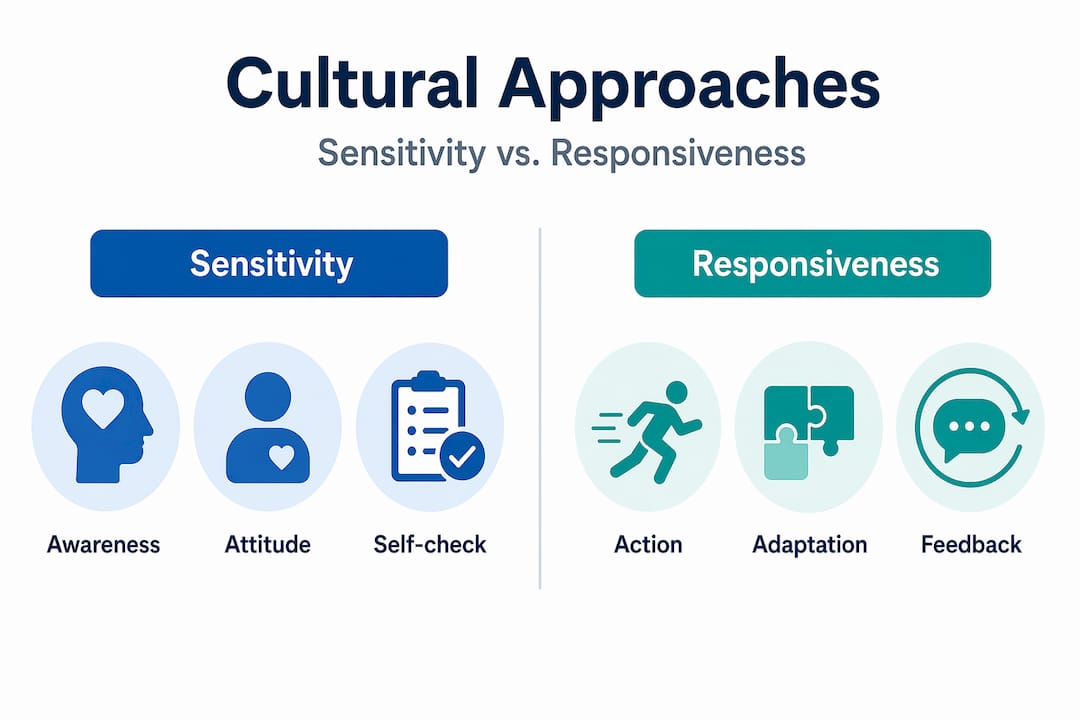
| Cultural sensitivity | Awareness and attitude | Recognizing cultural differences without stereotyping |
| Culturally responsive teaching | Instructional adaptation | Adjusting curriculum and methods to student backgrounds |
| Cultural humility | Ongoing self-reflection | Continuously questioning your own assumptions and limits |
The California Learning Resource Network notes that cultural sensitivity is an attitude of awareness and responsiveness, while culturally responsive teaching uses that attitude to adapt instruction meaningfully. In other words, sensitivity is the mindset; responsiveness is the method.
Cultural humility adds a third layer. Research from the National Collaborating Centre for Indigenous Health indicates that cultural humility centers on ongoing self-reflection and critique of one’s own limitations, unlike cultural competence, which risks treating understanding as a fixed goal.
This distinction matters enormously for TEFL teachers. Competence suggests you reach a level and stop. Humility suggests you never stop questioning. For teachers who will encounter dozens of different cultural contexts across a career, humility is the more durable and honest framework.
Key principles to carry into your classroom:
- Cultural sensitivity prevents you from projecting your own cultural assumptions onto students.
- Culturally responsive teaching gives you concrete tools to act on that awareness.
- Cultural humility keeps you from becoming overconfident after a few successful cross-cultural interactions.
Pro Tip: After completing a unit with a new group of students, spend five minutes journaling about one moment where a student’s response surprised you. That surprise is usually where your unexamined cultural assumption surfaced.
For a deeper look at developing this skill set, the cultural competence in TEFL resource covers how these concepts translate into lesson planning and daily instruction.
Understanding these distinctions sharpens how you approach cultural sensitivity in the classroom.
Applying cultural sensitivity in the TEFL classroom
Knowing what cultural sensitivity means is one thing. Knowing how to practice it during a 60-minute class with learners from five different countries is another. The following steps provide a practical framework for doing exactly that.
Step 1: Identify your cultural communication style before class.
Every teacher defaults to a communication style shaped by their own background. Before your lesson, ask yourself whether your planned examples, humor, or discussion prompts assume a shared cultural reference point your students may not have.

Step 2: Learn whether your students come from high-context or low-context cultures.
Research shows teachers should adjust communication styles based on high-context versus low-context cultural communication norms. In high-context cultures (common in East Asia, the Middle East, and Latin America), much meaning is communicated indirectly through tone, relationship, and context. In low-context cultures (common in Northern Europe and North America), communication is explicit and direct. Mixing these approaches without awareness causes confusion.
Step 3: Watch for behavioral cues during the lesson.
Silence, avoidance of eye contact, and low participation are not always signs of disinterest. They can signal discomfort with a culturally unfamiliar format. When you notice these cues, adjust your delivery rather than your assessment of the student.
Step 4: Reflect after class on student reactions.
Effective TEFL teachers habitually self-check before class for assumptions and after class to observe student reactions and adapt next lessons accordingly. This two-step reflection habit is what separates teachers who improve steadily from those who repeat the same mistakes across cohorts.
Step 5: Re-brief expectations using culturally neutral language.
When a classroom norm is not being followed, avoid framing the correction as “this is how it works.” Instead, explain the purpose: “In this class, I ask everyone to speak up so each of you gets practice. Mistakes are expected and welcome.”
| Cultural cue | Possible meaning | Suggested response |
|---|---|---|
| Consistent silence after questions | High-context processing style | Increase wait time before calling on students |
| Avoidance of direct disagreement | Face-saving cultural norm | Offer anonymous written feedback options |
| Reluctance to ask questions | Respect for teacher authority | Build in structured peer discussion before open Q&A |
| Over-reliance on group consensus | Collectivist cultural background | Design group tasks before asking for individual opinions |
Pro Tip: Use the classroom engagement TEFL guide to identify specific participation strategies that work across diverse cultural contexts, not just in Western-style classrooms.
For additional strategies, the TEFL classroom cultural sensitivity tips resource provides scenario-based examples drawn directly from TEFL practice, and the cultural competence practical guide connects these behaviors to formal professional development frameworks.
With practical steps clear, let’s summarize the key takeaways to keep your cultural sensitivity effective.
Summary of cultural sensitivity concepts for TEFL teachers
Cultural sensitivity is not something you master and then set aside. It is a continuous professional practice. The APA frames it clearly: ongoing self-awareness, adjustment, and respect are required to support diverse learners effectively. Each teaching context introduces new variables, new student backgrounds, and new opportunities for misunderstanding or connection.
| Concept | Core requirement | Benefit for TEFL teachers |
|---|---|---|
| Cultural sensitivity | Self-awareness and bias recognition | Prevents class friction and misunderstanding |
| Cultural responsiveness | Curriculum and method adaptation | Increases student engagement and outcomes |
| Cultural humility | Continuous self-reflection | Supports long-term growth and openness |
| High-context/low-context awareness | Communication style adjustment | Reduces confusion in mixed-culture classrooms |
| Pre and post-class reflection | Habit of self-evaluation | Builds stronger teacher-student rapport over time |
Two principles summarize the practical core of this work. First, effective TEFL teaching adapts to students’ cultural contexts, not the other way around. Second, regular self-evaluation is what keeps cultural sensitivity functional rather than theoretical.
For ongoing development, the cultural competence guide provides structured frameworks you can return to at each stage of your teaching career.
Having reviewed these concepts, here’s a unique perspective to deepen your understanding.
Why cultural sensitivity is a dynamic skill, not a checkbox
Many educators approach cultural sensitivity the way they approach a training certification: complete the module, receive the badge, move on. This mindset is the single biggest obstacle to genuine cultural competence in the classroom.
The reality is that cultural sensitivity in TEFL is less about memorization and more about managing interpersonal details like directness, silence, and participation that vary widely across cultures. These details shift every time you walk into a new classroom. A strategy that worked perfectly with a group of adult learners in South Korea may create confusion with teenage learners in Brazil. The variables change constantly.
The teachers who handle this well are not the ones who studied the most cultural fact sheets before their first placement. They are the ones who developed a habit of honest self-evaluation. Building a habit of self-check before and after teaching aligns with the cultural humility approach and is the most durable preparation for TEFL teachers. This habit does not require special resources. It requires discipline and honesty about where your defaults come from.
There is also a career argument here. TEFL teachers who internalize cultural sensitivity as a dynamic skill become measurably better at building classroom rapport, managing student anxiety, and retaining students in courses. Those outcomes matter to employers, institutions, and learners. Cultural sensitivity is not a soft professional virtue; it is a functional teaching competency with real performance implications.
The cultural competence guide outlines how to make this kind of ongoing development a structured part of your professional practice rather than an informal aspiration.
Enhance your TEFL skills with cultural sensitivity training
Developing cultural sensitivity as a TEFL teacher is significantly more effective when it is built into your formal training from the start, rather than treated as something to figure out on the job.

TEFL Institute’s certification programs integrate cultural sensitivity and competence development throughout the curriculum, equipping you to handle diverse classroom environments from day one. Programs are available across multiple locations, including TEFL courses in Newcastle, TEFL certification in New York City, and TEFL courses in Houston, Texas. Each program prepares you to recognize cultural cues, adapt your instruction, and build strong rapport with learners from diverse backgrounds. Begin your TEFL journey fully prepared to connect with students worldwide.
Frequently asked questions
What exactly does cultural sensitivity mean for TEFL teachers?
It means being aware of your own cultural biases and adjusting your teaching to respect and respond to students’ diverse cultural backgrounds. As research confirms, cultural sensitivity involves awareness and responsiveness to cultural differences while avoiding stereotypes.
How can cultural sensitivity improve classroom engagement?
By adapting communication and teaching methods to align with students’ cultural norms, you build trust and reduce misunderstandings, which increases participation. Research confirms that adjusting communication styles and understanding cultural cues enhances meaningful connections and classroom outcomes.
Why is cultural humility important for TEFL teachers?
Because it encourages ongoing self-reflection and learning about your own limitations, helping you avoid overconfidence and stay open to students’ unique cultural backgrounds. Studies show that cultural humility centers on continuous self-evaluation rather than static competence, which is critical for teachers encountering diverse cultures.
What are some practical ways to practice cultural sensitivity in class?
Identify your assumptions before class, observe student reactions during lessons, adjust communication styles for cultural context, and re-brief expectations clearly. Research supports that ongoing self-check before and after teaching and adapting lesson delivery are key practical strategies.
Can cultural sensitivity be learned, or is it innate?
It can definitely be learned through intentional training, self-reflection, and everyday practice in diverse teaching environments. Structured professional development, such as TEFL certification programs, provides the frameworks that accelerate this learning significantly.
Recommended
TEFL Institute guides

Vietnam
Work permits and requirements
Thailand
Visas and teaching licences
Italy
Jobs, pay and visa routes
Spain
Jobs, pay and visa routes
Portugal
Jobs, pay and visa routes