

 United Kingdom (UK)
 United States (US)
 Canada
 South Africa
 India
India Australia
 New Zealand
 China
China Russia
 Germany
 France
 Spain
Spain Netherlands
 Vietnam
 United Arab Emirates
 Italy
Italy Poland
 Thailand
 Türkiye





 Algeria


Advantages of Hybrid Learning for Educators and Students
Advantages of Hybrid Learning for Educators and Students

TL;DR:
- Hybrid learning combines in-person and online sessions, enabling students to attend the same class remotely or physically. Its success relies on active engagement and well-designed interactive lessons for both modalities, fostering personalization and inclusivity. Institutional support and faculty training are essential to optimize hybrid education’s effectiveness and equity.
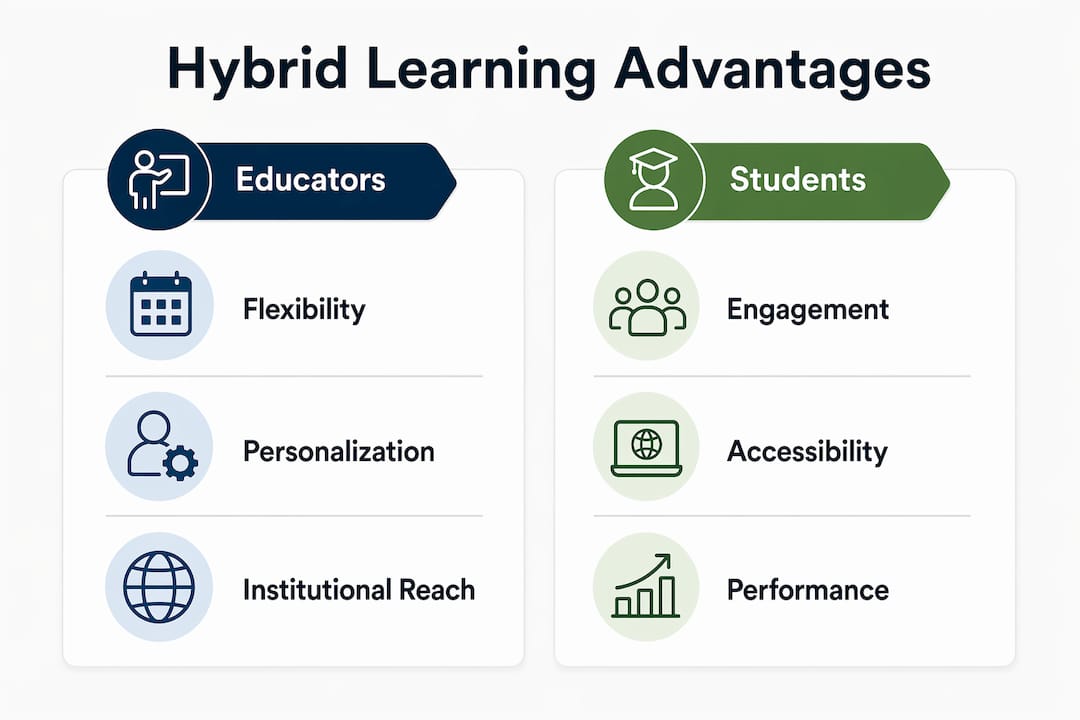
Hybrid learning is defined as an instructional model that combines synchronous in-person and online participation, allowing students to attend the same class session from either location simultaneously. The core advantages of hybrid learning are flexibility, sustained engagement, and personalized instruction. These benefits are not theoretical. A 2025 natural-experiment study found that modality alone does not determine exam outcomes. What determines outcomes is whether students actively engage during synchronous sessions. This distinction matters for educators designing courses and for students choosing how to learn. The hybrid learning model in TEFL and broader education contexts delivers measurable results when structured correctly, using tools like LMS platforms, formative assessments, and collaborative teacher workflows.
What are the main advantages of hybrid learning?
Hybrid learning’s primary advantage is that it preserves the interpersonal quality of face-to-face instruction while removing the geographic and scheduling constraints of a fully in-person model. Students attending remotely and those in the physical classroom receive the same live instruction at the same time. This is the defining feature that separates hybrid from asynchronous online learning, where recorded content replaces real-time interaction.

Research from a 2026 large-scale study conducted during COVID-19 disruptions found that hybrid mode exhibits more pronounced personalized learning activities and teacher collaboration than either fully online or fully offline modes. The study also found that 86.17% of students found HyFlex platforms helpful for accessing course content, with no significant grade differences between online and in-person attendees. That result confirms that well-designed hybrid instruction produces consistent academic performance across both groups.
The advantages of blended learning and hybrid formats also extend to institutional outcomes. Broader student access, higher retention rates, and improved satisfaction scores are documented benefits. For educators, the model creates opportunities to teach diverse cohorts without requiring every student to be physically present, which expands reach without sacrificing instructional quality.
How does hybrid learning improve student engagement and academic performance?
Student engagement during synchronous hybrid sessions is the single most important variable in academic performance. The 2025 study on synchronous hybrid instruction confirmed no significant direct effect of attendance mode on exam scores. Engagement during those sessions, however, mediated performance directly. Students who participated actively, whether online or in-person, achieved comparable outcomes.
This finding reframes how educators should think about hybrid learning effectiveness. The question is not whether students attend in person or remotely. The question is whether the lesson design compels participation from both groups simultaneously. Interactive lesson elements such as discussion prompts, live polling, breakout activities, and formative assessments are the mechanisms that drive this engagement.
Remote participants face a specific challenge. Research identifies opportunity gaps in engagement among female students, Black and African American students, and first-generation college students in synchronous hybrid courses. These groups are more likely to disengage when lesson design does not explicitly include them. Educators must account for this when structuring participation.
Key strategies for maintaining engagement across both modalities include:
- Designing every lesson with at least one interactive activity that remote students can complete through the LMS or a live response tool such as Mentimeter or Poll Everywhere
- Using formative assessments at regular intervals rather than relying solely on end-of-unit exams
- Assigning discussion roles to remote participants so they are not passive observers
- Recording sessions and making them available within 24 hours for students who experience technical disruptions
Pro Tip: Build your participation structure before you build your content. Decide how remote students will respond, contribute, and be assessed during each segment of the lesson, then layer the content around those interaction points.
What personalized learning advantages does hybrid education offer?
Hybrid education benefits include a level of personalization that neither fully online nor fully in-person models replicate consistently. The 2026 study cited above found that hybrid mode specifically supports tailored learning activities and continuous teacher monitoring, which are harder to sustain in asynchronous online formats and often impractical in large in-person classes.
Personalization in hybrid contexts operates through several mechanisms. Teachers can use LMS data to identify which students are accessing materials, completing formative tasks, and participating in discussions. This data is available in real time, allowing instructors to intervene before a student falls behind rather than after an exam reveals the gap. In a traditional classroom, this level of monitoring requires significant manual effort.
The hybrid model also accommodates highly modified practical curriculum components, which supports experiential learning for students with different skill levels or learning needs. A student who needs additional scaffolding can access supplementary materials through the LMS while in-person peers work on advanced tasks. This differentiation happens within the same class session without disrupting the group.
For educators managing dual modalities, a practical personalization workflow looks like this:
- Review LMS engagement data before each class to identify students who have not completed preparatory tasks
- Prepare one alternative entry point for the lesson that accommodates students at different readiness levels
- Use breakout groups strategically, mixing in-person and remote students to build peer accountability
- Provide written feedback through the LMS within 48 hours of any assessed activity so remote students receive the same quality of response as those who can speak with the instructor directly
- Collect brief exit surveys at the end of each week to track student confidence and adjust pacing accordingly
Pro Tip: Use your LMS analytics dashboard weekly, not just before assessments. Patterns in login frequency and task completion predict disengagement two to three weeks before it shows up in grades.
How does hybrid learning enhance accessibility and inclusivity?
Hybrid learning environments deliver greater flexibility and inclusivity by broadening access for students who cannot consistently attend in person. This includes students managing work schedules, caregiving responsibilities, chronic health conditions, or geographic distance from a campus. The HyFlex model, a specific hybrid format, allows students to choose their attendance mode without prior notice, which removes the administrative friction of requesting accommodations.
The hybrid TEFL certification model at Teflinstitute reflects this principle directly. Aspiring teachers who cannot relocate or commit to fixed schedules can complete structured training that includes both online and in-person components, accessing recorded sessions and live instruction through the same program.
Technology is the primary enabler of this accessibility. Recorded lessons, asynchronous discussion boards, and mobile-compatible LMS platforms allow students to engage with course content at times that fit their circumstances. Access to learning resources and timely feedback uniquely contributes to higher engagement and attendance in hybrid models compared to fully asynchronous formats.
The limitations of this model are real and must be acknowledged:
- Students without reliable internet access or adequate devices cannot participate equitably in synchronous sessions
- Technology access disparities disproportionately affect students in lower-income households and rural areas
- Institutions must provide loaner devices, subsidized internet access, or on-campus connectivity options to close this gap
- Without these supports, hybrid learning’s inclusivity advantage becomes theoretical rather than practical
What challenges must educators address to maximize hybrid learning effectiveness?
Hybrid learning effectiveness depends on institutional infrastructure as much as individual instructor skill. Successful hybrid implementation requires robust digital infrastructure, faculty skill development, and sustained institutional support. These three conditions must advance together. Strong pedagogy without reliable technology produces frustration. Strong technology without pedagogical training produces underutilization.
The table below compares the primary implementation challenges against the strategies that address them:
| Challenge | Strategy |
|---|---|
| Inconsistent digital access for students | Provide loaner devices and on-campus Wi-Fi as institutional baseline supports |
| Faculty unfamiliar with hybrid pedagogy | Require structured professional development before hybrid course delivery begins |
| Unequal participation between modalities | Design lesson plans with explicit participation roles for remote students |
| Student workload confusion across modalities | Publish a single, unified course schedule that applies to all attendance modes |
| Technical failures during synchronous sessions | Establish a backup protocol, such as a recorded alternative, communicated to students in advance |
Faculty professional development is the most frequently underinvested area. Instructors who teach hybrid courses without training in dual-modality facilitation tend to default to in-person-centric delivery, which marginalizes remote students. This is not a technology problem. It is a pedagogical design problem. Institutions that treat hybrid teaching as a minor variation of traditional instruction consistently produce weaker outcomes than those that treat it as a distinct skill set requiring dedicated training.
Curriculum design also requires adjustment. Assignments and assessments built for in-person delivery often do not translate directly to hybrid formats. Educators should audit existing course materials against ESL teaching methodologies and hybrid-specific frameworks before deploying them in a mixed-modality environment.
Key takeaways
Hybrid learning’s effectiveness is determined by active engagement design during synchronous sessions, not by the attendance mode students choose.
| Point | Details |
|---|---|
| Engagement drives outcomes | Modality alone does not affect exam performance; active participation during synchronous sessions does. |
| Personalization is a structural advantage | Hybrid models support tailored activities and real-time teacher monitoring better than fully online formats. |
| Accessibility requires institutional support | Flexibility benefits only reach all students when devices, connectivity, and LMS access are provided equitably. |
| Faculty training is non-negotiable | Hybrid pedagogy is a distinct skill set; instructors need structured development before delivering mixed-modality courses. |
| Lesson design precedes content | Interactive participation structures for both remote and in-person students must be built before course content is finalized. |
Why engagement design matters more than modality
After working closely with hybrid learning frameworks across TEFL and broader education contexts, the pattern that stands out most clearly is this: institutions that invest in modality infrastructure but neglect lesson design consistently underperform. They build the technology stack, equip the classrooms, and then hand instructors a traditional syllabus and expect equivalent results. It does not work that way.
The research is unambiguous on this point. The active participation elements in a lesson, discussion, practice, and formative assessment, are what produce learning gains. The camera and the microphone are neutral. What happens through them is not.
What I find most underappreciated about hybrid education benefits is the equity dimension. The same model that offers flexibility to students with demanding schedules also creates structural disadvantages for students who lack reliable technology or who are less likely to self-advocate in a remote setting. Designing for engagement is also designing for equity. These are not separate concerns.
My practical recommendation for educators new to hybrid delivery is to start with classroom engagement principles and build outward from there. Decide how you will know whether every student, remote or in-person, is actively processing the material at each stage of the lesson. Then build the technology and content choices around that requirement. The institutions and instructors who approach hybrid learning this way produce consistently stronger outcomes than those who treat it as a scheduling convenience.
— Muller
Advance your teaching with flexible TEFL certification
Teflinstitute offers TEFL certification programs designed around the same principles that make hybrid learning effective: structured flexibility, practical skill development, and access to instruction regardless of location.
The 120 Hour Elective TEFL Course provides a focused pathway for educators who want to build practical teaching skills in online, in-person, or hybrid settings. For those seeking a more advanced credential, the 240 Hour Master TEFL Course delivers externally accredited training with flexible delivery modes that reflect hybrid learning principles directly. Both programs are built for educators who need certification that fits around existing commitments without compromising instructional quality.
FAQ
What is hybrid learning and how does it differ from blended learning?
Hybrid learning allows students to attend the same live session either in person or online simultaneously. Blended learning typically combines in-person instruction with asynchronous online components rather than synchronous dual-modality delivery.
Does attending a hybrid class online produce worse academic results?
No. A 2025 study found no significant difference in exam outcomes between online and in-person students in synchronous hybrid courses when engagement during sessions was controlled for.
What are the biggest challenges of hybrid learning for educators?
The primary challenges are managing participation across two modalities simultaneously, maintaining equitable engagement for remote students, and adapting lesson design to support both groups within a single session.
How does hybrid learning support students with different needs?
Hybrid models allow students to choose their attendance mode based on personal circumstances, access recorded sessions, and receive individualized feedback through LMS platforms, making education more accessible for students with health, work, or geographic constraints.
What does research say about the pros and cons of hybrid learning?
Research confirms that hybrid learning improves flexibility, personalization, and access while also identifying challenges including technology access disparities and engagement gaps for underrepresented student groups. Outcomes depend heavily on lesson design and institutional support rather than the model itself.
