
 United Kingdom (UK)
 United States (US)
 Canada
 South Africa
 India
India Australia
 New Zealand
 China
China Russia
 Germany
 France
 Spain
Spain Netherlands
 Vietnam
 United Arab Emirates
 Italy
Italy Poland
 Thailand
 Türkiye





 Algeria


What Is a Teaching Portfolio? A Guide for Educators
What Is a Teaching Portfolio? A Guide for Educators

TL;DR:
- A teaching portfolio is a reflective collection of evidence demonstrating an educator’s effectiveness, values, and impact beyond a resume. It includes core components such as a teaching philosophy, tailored CV, sample lesson plans, anonymized student work, and professional development records, tailored for specific purposes. Maintaining and updating a portfolio over time supports professional growth, provides compelling evidence for evaluations, and showcases teaching identity and evolution.
A teaching portfolio is a narrative-driven collection of professional materials that documents an educator’s teaching effectiveness, pedagogical values, and student impact. Unlike a resume or CV, which lists credentials and roles, a portfolio shows the why behind instructional choices through concrete evidence such as annotated lesson plans, student feedback, and reflective commentary. For aspiring and current educators, understanding what a teaching portfolio contains and how to build one is a direct path to stronger job applications, tenure reviews, and long-term professional growth.

What is a teaching portfolio and why does it matter?
A teaching portfolio is defined as a structured, reflective compilation of artifacts that demonstrates how an educator teaches, what they believe about learning, and what results their students achieve. Brandeis University describes it as supplementing a resume by providing context and proof that credentials alone cannot convey. This distinction is significant: a hiring committee reviewing two candidates with identical qualifications will rely on portfolio evidence to differentiate between them.
The portfolio also functions as a professional development tool. Educators who maintain one over time develop a clearer understanding of their own growth, identify patterns in student outcomes, and build a record that supports performance reviews and promotion applications. George Brown Polytechnic notes that portfolios empower educators to control their professional narrative beyond what standard application documents can capture. That agency matters in competitive hiring environments and institutional evaluations alike.
What are the main components of a teaching portfolio?
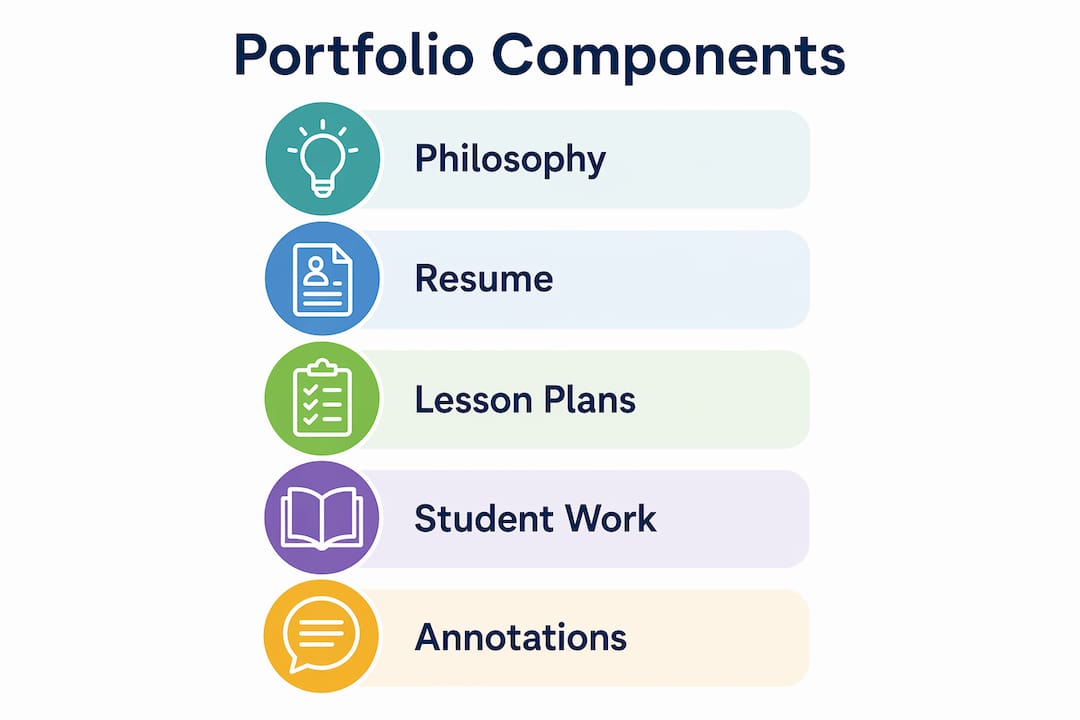
Standard professional guidance identifies five core components every teaching portfolio should include. Each element serves a distinct purpose, and together they create a coherent picture of teaching quality and professional identity.
-
Teaching philosophy statement. This is the most critical component. Brandeis University describes it as the “legend” of the portfolio, providing context for every other artifact. A strong philosophy statement articulates your beliefs about how students learn, what your role as an educator is, and how those beliefs shape your classroom decisions. It helps hiring committees evaluate not just past performance but future potential. For guidance on structuring this statement, resources from Astor Education offer useful frameworks on the relationship between teaching and learning.
-
Resume or CV tailored for teaching roles. This should highlight instructional experience, subject specializations, certifications, and relevant professional development. It provides the factual backbone that the rest of the portfolio supports with evidence.
-
Sample lesson plans or course outlines. These demonstrate instructional design skills and show how you translate curriculum goals into classroom practice. Annotated versions that explain your reasoning are more persuasive than bare templates. Educators building TEFL portfolios can reference effective TEFL curricula design as a model for this section.
-
Anonymized student work or feedback. This is your proof of impact. Including samples of student writing, project outcomes, or survey responses shows that your methods produce measurable results. All student data must be anonymized to comply with FERPA or equivalent privacy standards, a requirement that hiring committees recognize as a mark of professionalism.
-
Professional development records. Certificates, workshop attendance records, conference presentations, and continuing education credits demonstrate commitment to growth. Educators pursuing continuous professional development in TEFL will find this section particularly relevant for international teaching roles.
Additional elements that strengthen competitive portfolios include classroom management strategies, documentation of technology use in instruction, awards or recognitions, and evidence of community or family engagement.
Pro Tip: Write a two-to-three sentence annotation for every artifact you include. Explain what the artifact demonstrates and why you selected it. This context transforms a collection of documents into a coherent professional argument.
What are the types of teaching portfolios?
Two primary portfolio types exist, and choosing the right one depends on your purpose and audience.
| Portfolio type | Best use case | Key characteristics |
|---|---|---|
| Cumulative portfolio | Ongoing professional record across a career | Comprehensive, includes all artifacts over time, not curated for a specific audience |
| Presentation portfolio | Job applications, promotions, tenure reviews, evaluations | Selective, purpose-driven, organized around themes or achievements rather than chronology |
The cumulative portfolio functions as a lifelong archive. It captures everything: early lesson plans, mid-career professional development records, student feedback from multiple years, and evolving philosophy statements. Its value lies in completeness and the ability to draw from it when assembling targeted materials.
The presentation portfolio is what most hiring committees and review panels actually see. It is curated from the cumulative record and organized to tell a specific story. For a job application at an international school, you might foreground language acquisition strategies and multilingual classroom experience. For a tenure review, you would emphasize longitudinal student outcome data and peer observation reports. The presentation portfolio enables focused storytelling, and that focus is what makes it persuasive.
Selectivity is the defining discipline of a strong presentation portfolio. Hiring committees prefer three to five high-quality artifacts that demonstrate pedagogical growth and student impact over exhaustive collections that require significant time to review. Quality signals judgment; quantity signals uncertainty about what matters.
How to create and organize a teaching portfolio effectively
Building a portfolio that works requires more than gathering documents. The following steps provide a structured approach.
-
Clarify your purpose and audience. Before selecting a single artifact, define what the portfolio needs to accomplish. A new teacher applying for a first position has different priorities than an experienced educator seeking promotion. Your purpose determines which materials belong and how they should be framed.
-
Audit your existing materials. Collect lesson plans, student feedback forms, professional development certificates, observation reports, and any other relevant documents. This audit forms the raw material for your cumulative record.
-
Select artifacts that demonstrate growth and impact. Choose materials that show a progression in your teaching practice, not just a snapshot of your best day. Committees want to see that you reflect on your work and improve over time. Evidence of teaching quality is most persuasive when it shows development rather than static competence.
-
Write reflective annotations for each artifact. Explain the context, your instructional goals, what happened, and what you learned. This narrative layer is what separates a portfolio from a file folder. Including teaching aids documentation with reflective notes, for example, shows both creativity and analytical thinking.
-
Incorporate visual and multimedia evidence where appropriate. Anonymized photos of classroom activities, short video clips of instruction, or digital student project samples add depth that text alone cannot provide. Visual evidence of engagement increases the likelihood of standing out with hiring panels who review materials quickly.
-
Prepare both digital and print-ready versions. Digital portfolios are preferred for sharing and multimedia integration, but a PDF version remains necessary for applicant tracking systems. A hybrid approach covers both hiring workflows without requiring you to maintain two entirely separate documents.
-
Update and customize for each opportunity. A portfolio is not a static document. Tailor the selection and framing of artifacts for each application or review, and schedule a regular update cycle, at minimum once per academic year.
Pro Tip: Keep your portfolio scannable. Use clear section headings, brief introductory paragraphs for each section, and consistent formatting. A reviewer who can navigate your portfolio in ten minutes is more likely to engage with its content than one who has to search for key information.
What are the benefits of maintaining a teaching portfolio over time?
The benefits of a teaching portfolio extend well beyond the job application process. Educators who treat their portfolio as a living document gain advantages that accumulate over a career.
-
Structured self-reflection. Assembling and updating a portfolio requires you to evaluate your own practice systematically. This process surfaces patterns, such as which instructional strategies consistently produce strong student outcomes and which need revision, that informal reflection rarely reveals.
-
Support for performance reviews and promotion. Institutional evaluations increasingly require documented evidence of teaching effectiveness. A well-maintained portfolio provides that evidence in an organized format, reducing the preparation burden when review cycles arrive.
-
Accountability beyond student ratings. Student satisfaction scores are one data point, but they do not capture instructional design quality, professional development engagement, or curriculum contributions. A portfolio provides a fuller picture of teaching quality that complements quantitative metrics.
-
Professional agency and narrative control. Standard application materials give hiring committees a limited view of who you are as an educator. A portfolio lets you frame your experience, highlight your growth, and present your teaching identity on your own terms.
-
Career-long development record. A portfolio that evolves over a career becomes a record of professional transformation. It documents not just what you have done but how your thinking about teaching has changed, which is precisely what senior roles and leadership positions require candidates to demonstrate.
What common mistakes should you avoid in a teaching portfolio?
Even experienced educators make avoidable errors when assembling their portfolios. The following pitfalls reduce portfolio effectiveness and, in some cases, raise professional concerns.
-
Including too many artifacts. More is not more persuasive. An overloaded portfolio signals poor editorial judgment and makes it harder for reviewers to identify your strongest work. Limit presentation portfolios to three to five artifacts per section.
-
Failing to anonymize student work. Including identifiable student data without consent violates FERPA and equivalent privacy laws. Anonymizing all student materials is a non-negotiable requirement and a visible marker of professional ethics.
-
Being vague without evidence. Statements like “I use student-centered approaches” carry no weight without artifacts that demonstrate what that looks like in practice. Every claim in your portfolio needs supporting evidence.
-
Omitting context and reflection. An artifact without explanation is just a document. Without a reflective annotation explaining why it is included and what it demonstrates, reviewers cannot assess its significance.
-
Failing to tailor for the audience. A portfolio submitted for a K-12 position should foreground different evidence than one submitted for a university teaching role or an international ESL position. Generic portfolios read as generic candidates.
-
Including irrelevant personal information. Hobbies, personal photographs, and unrelated community activities dilute the professional focus of the portfolio and consume reviewer attention without adding value.
Key takeaways
A teaching portfolio is most effective when it combines selective, high-quality artifacts with reflective annotations that demonstrate pedagogical growth, student impact, and professional identity.
| Point | Details |
|---|---|
| Core definition | A teaching portfolio documents teaching effectiveness through evidence, not just credentials. |
| Five essential components | Include a teaching philosophy, CV, lesson plans, anonymized student work, and professional development records. |
| Two portfolio types | Use a cumulative portfolio for ongoing records and a presentation portfolio for specific applications or reviews. |
| Quality over quantity | Three to five strong artifacts outperform exhaustive collections with hiring committees. |
| Living document | Update and tailor your portfolio regularly to reflect growth and match each opportunity. |
Why your teaching philosophy is the most underestimated portfolio element
Most educators spend the majority of their portfolio preparation time gathering artifacts and formatting documents. The teaching philosophy statement gets written last, often quickly, and it shows. This is the single most consequential mistake I see in portfolio development.
The philosophy statement is not a formality. It is the interpretive frame through which every other artifact in the portfolio is read. A committee that understands your beliefs about learning will evaluate your lesson plans, your student feedback, and your professional development choices through that lens. Without it, they are reading isolated documents. With it, they are reading a coherent professional argument.
The most effective philosophy statements I have encountered are specific, not aspirational. They do not say “I believe all students can learn.” They say “I structure my lessons around retrieval practice because my students retain vocabulary more effectively when they encounter it in multiple low-stakes contexts over time.” That specificity signals both self-awareness and evidence-based practice, two qualities that distinguish strong candidates from average ones.
Multimedia matters more than most educators realize, particularly for digital portfolios. A thirty-second anonymized video clip of a classroom discussion communicates energy, classroom management, and student engagement in ways that no written description can replicate. The teacher-student relationship is visible in those moments, and visibility is persuasive.
Start building your portfolio before you need it. The educators who struggle most with portfolio preparation are those who begin the process when a deadline is imminent. A portfolio assembled under pressure is a portfolio that omits your best work because you cannot locate it quickly enough.
— Muller
Strengthen your portfolio with Teflinstitute certification
Building a teaching portfolio requires more than collecting documents. It requires credentials and practical skills that demonstrate genuine classroom competence to hiring committees worldwide.
Teflinstitute offers the 120-hour Elective TEFL Course and the 240-hour Master TEFL Course, both of which generate portfolio-ready certifications recognized by international schools and language programs. These courses cover instructional design, classroom management, and assessment strategies, producing exactly the kind of documented professional development that strengthens the professional development section of any teaching portfolio. Educators who complete Teflinstitute programs gain credentials that signal both subject expertise and commitment to ongoing growth, two qualities that hiring committees consistently prioritize.
FAQ
What is a teaching portfolio used for?
A teaching portfolio documents an educator’s teaching effectiveness, philosophy, and professional development for use in job applications, tenure reviews, and performance evaluations. It provides evidence that a resume or CV alone cannot supply.
What should I include in a teaching portfolio?
The five core components are a teaching philosophy statement, a tailored resume or CV, sample lesson plans, anonymized student work or feedback, and professional development records. Additional materials such as classroom management strategies and technology documentation strengthen competitive portfolios.
How long should a teaching portfolio be?
A presentation portfolio should include three to five high-quality artifacts per section rather than exhaustive documentation. Hiring committees have limited review time, and selective portfolios demonstrate better editorial judgment than comprehensive ones.
What is the difference between a cumulative and a presentation portfolio?
A cumulative portfolio is a comprehensive, lifelong record of all teaching materials and professional development. A presentation portfolio is a curated selection drawn from the cumulative record and tailored for a specific purpose, such as a job application or promotion review.
Do new teachers need a teaching portfolio?
New teachers benefit significantly from building a portfolio early, even with limited classroom experience. A strong teaching philosophy statement, practicum documentation, and professional development certificates from programs like those offered by Teflinstitute provide credible evidence of readiness and commitment.
