United Kingdom (UK)
 United States (US)
 Canada
 South Africa
 India
India Australia
 New Zealand
 China
China Russia
 Germany
 France
 Spain
Spain Netherlands
 Vietnam
 United Arab Emirates
 Italy
Italy Poland
 Thailand
 Türkiye









 Algeria



How to create effective TEFL curricula step by step
How to create effective TEFL curricula step by step

TL;DR:
- Effective TEFL curricula start with a thorough understanding of learners’ context, goals, and beliefs to ensure alignment and purpose. Gathering comprehensive needs data from stakeholders and mapping content with flexible scaffolding supports progressive skill development and responsiveness to diverse classroom realities. Regular assessment and reflection, combined with adaptable planning, facilitate continuous improvement and effective teaching outcomes.
Many aspiring English teachers invest significant time and energy into course preparation, only to find their curricula produce inconsistent results. Students plateau, engagement drops, or assessments reveal that core objectives were never truly met. The problem is rarely a lack of effort. More often, it stems from skipping foundational design steps, misaligning content with learner needs, or relying on generic templates that were never built for a specific context. This guide presents a clear, structured approach to building TEFL curricula that actually work, covering every phase from initial goal-setting through continuous evaluation and improvement.
Table of Contents
- Know your context and goals before you start
- Gather input and identify learner needs
- Map your curriculum: sequence, materials, and scaffolding
- Assess and iterate: measuring effectiveness and improving your curriculum
- Why flexibility beats rigid TEFL curriculum design
- Advance your teaching practice with TEFL Institute resources
- Frequently asked questions
Key Takeaways
| Point | Details |
|---|---|
| Start with clear goals | Always define your context, beliefs, and SMART objectives before creating your TEFL curriculum. |
| Conduct a thorough needs assessment | Gather input from all stakeholders to build a student-centered and responsive course. |
| Use structured frameworks | Sequence content logically and select/adapt materials to support diverse learning paths. |
| Plan for ongoing assessment | Apply backward design and continuous reflection to ensure your curriculum achieves its objectives. |
| Build in flexibility | Stay adaptable so you can revise and scaffold lessons for different classrooms and student profiles. |
Know your context and goals before you start
Before you design a curriculum template or choose teaching materials, begin with a deep understanding of your learners and your professional priorities.
Effective curriculum design does not begin with a lesson plan or a textbook selection. It begins with a thorough examination of context. In TEFL, context means understanding who your learners are, where they come from, what motivates them, and what environment they will learn in. A classroom of working adults in South Korea preparing for TOEIC exams presents an entirely different set of variables than a group of young learners in Brazil studying English for general purposes.
The key contextual factors to document before designing your curriculum include:
- Learner age and developmental stage: Children, teenagers, and adults require fundamentally different instructional approaches.
- Current proficiency level: Use the Common European Framework of Reference (CEFR) scale (A1 through C2) to categorize learners accurately.
- Cultural and linguistic background: L1 interference patterns, attitudes toward authority in classrooms, and cultural norms around participation all shape how instruction should be delivered.
- Learning goals: Are learners pursuing academic English, business communication, exam preparation, or conversational fluency?
- Teaching environment: Online, face-to-face, hybrid, large classes, or one-on-one settings each call for different structural decisions.
Alongside learner context, teachers must examine their own instructional beliefs. Research on TPACK (Technological Pedagogical Content Knowledge) shows that a teacher’s beliefs about language learning directly influence how they select and use curriculum materials. Teachers who hold beliefs that contradict their chosen methodologies tend to implement materials inconsistently, reducing overall effectiveness. Making your beliefs explicit, and ensuring they align with evidence-based practice, prevents this disconnect.
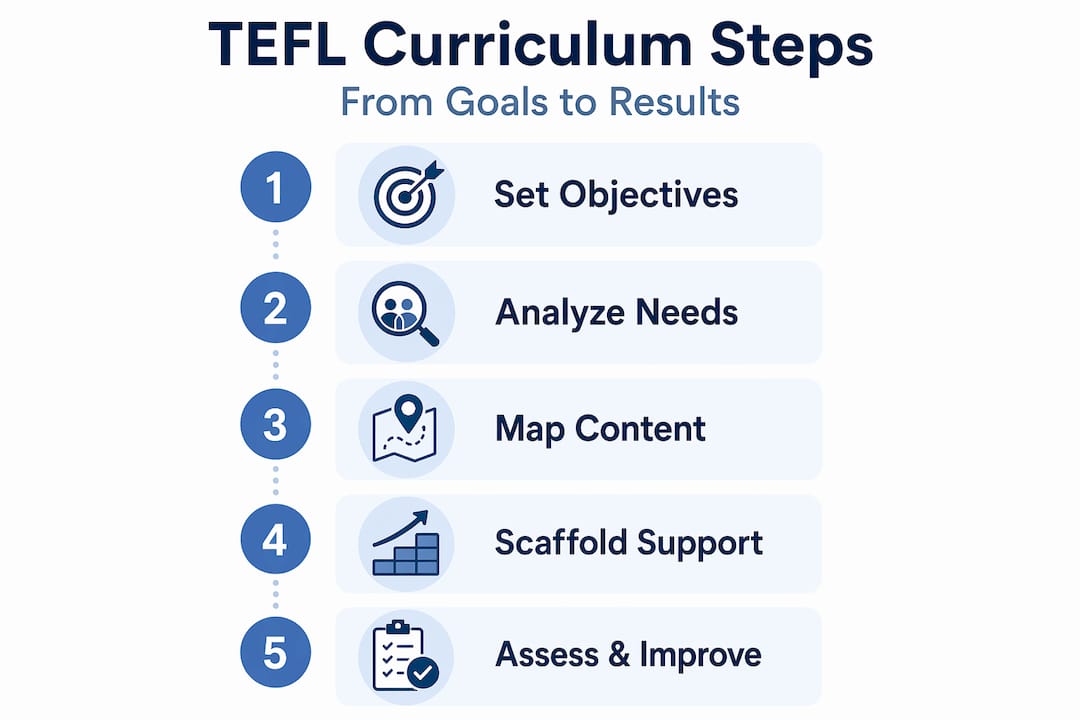
Effective TEFL curricula start with defining context, beliefs, goals, and SMART objectives, followed by needs assessment, course organization, materials development, and an assessment plan. SMART objectives (Specific, Measurable, Achievable, Relevant, and Time-bound) give your curriculum direction and make evaluation possible. An objective such as “students will improve speaking” is too vague to assess. A SMART version would be: “By week eight, learners at the A2 level will deliver a two-minute spoken presentation on a familiar topic with minimal prompting.” Understanding the role of TEFL in education broadly also helps teachers frame their individual curriculum decisions within larger pedagogical goals.
Strong curricula are built on explicit goals. If you cannot measure it, you cannot improve it. Document your SMART objectives in writing before moving to the next design phase.
Pro Tip: Review your stated beliefs against your curriculum design at the start and end of each course. Inconsistencies between what you believe and what you teach are often the source of persistent student underperformance.
Gather input and identify learner needs
Once your foundational beliefs and intended outcomes are clear, turn outward to collect vital context from your target learners and other stakeholders.

Needs assessment is the process of gathering data to understand the gap between where learners currently are and where they need to be. This step is frequently skipped by teachers under time pressure, but it is one of the highest-leverage activities in curriculum design. A curriculum built without needs data is essentially a guess.
There are four primary data-gathering methods:
- Learner surveys: Short, anonymous questionnaires covering prior English learning, self-assessed strengths, learning preferences, and expectations.
- Placement tests: Objective measures of current proficiency using standardized tasks aligned to CEFR descriptors.
- Stakeholder interviews: Conversations with employers, school administrators, or education partners who can clarify real-world performance expectations.
- Direct observation or diagnostic activities: Early classroom tasks that reveal learner behavior and skill gaps before formal instruction begins.
The following table illustrates how input from different stakeholders typically differs and how to reconcile those differences during curriculum planning:
| Stakeholder | Primary concern | Typical input | Curriculum implication |
|---|---|---|---|
| Students | Practical communication skills | Speaking, listening fluency | Prioritize task-based activities |
| Employers | Professional language competence | Writing, vocabulary accuracy | Include business writing units |
| Education partners | Exam scores, certification | Grammar, reading comprehension | Align assessments to target exams |
| Teachers | Pedagogical scope and sequence | Balanced skills coverage | Structure modular units by skill |
DELTA Module 3 emphasizes needs analysis, syllabus design principles, course design, and assessment for specialisms as core competencies for advanced English language teachers. The same framework prioritizes student-centered, iterative design with stakeholder input over rigid top-down approaches, a principle that applies regardless of whether you are designing a course for academic purposes or general English.
When writing a formal needs assessment, keep these steps in sequence:
- Identify all key stakeholder groups relevant to your course.
- Design data collection instruments for each group (surveys, tests, interview guides).
- Administer instruments and compile results systematically.
- Identify patterns and priority gaps across all data sources.
- Translate findings into ranked learning objectives for the curriculum.
Teachers designing courses for younger students should explore TEFL strategies for young learners to inform how needs data is gathered and interpreted for that specific population. Similarly, teaching methods for young learners shape how curricular objectives translate into classroom practice for children and adolescents.
Pro Tip: Use a simple priority matrix after your needs analysis. List each identified gap on one axis and urgency or frequency on the other. Focus your curriculum design on high-frequency, high-urgency skills first.
Map your curriculum: sequence, materials, and scaffolding
With clear learner data and goals, you can start developing the structure and flow that will support actual learning in your classroom.
Curriculum mapping refers to the process of organizing content, skills, and materials into a coherent sequence that builds learner competence progressively. Choosing the right organizational framework for your context is a critical decision. Three frameworks are most commonly used in TEFL:
- Module-based design: Content is organized into self-contained units or modules, each focused on a theme or topic. Works well for short courses or topic-specific programs.
- Skills-based design: The curriculum is structured around the four language skills (reading, writing, listening, speaking) with grammar integrated as a support system. Suitable for exam preparation or general English courses.
- Spiral curriculum: Key language items and skills are revisited at progressively higher complexity across the course. Particularly effective for long-term programs where retention and depth are priorities.
| Framework | Best suited for | Sequencing logic | Risk |
|---|---|---|---|
| Module-based | Short or thematic courses | Topic progression | Lack of skill integration |
| Skills-based | Exam prep, general English | Skill complexity | Compartmentalized learning |
| Spiral curriculum | Long-term programs | Graduated repetition | Requires careful tracking |
Research on EFL curricula identifies common weaknesses including poor assessment design, insufficient instructional hours, mismatch with the CEFR, and inadequate materials selection. These failures typically emerge during the mapping phase, when teachers either over-rely on a single textbook or sequence content without accounting for cumulative learning demands.
Sound curriculum mapping also draws on design principles from evidence-based education: evidence-informed foundations, collaborative consensus-building among educators or institutions, and iterative development rather than a one-time build. Applying these principles means selecting materials that have demonstrated effectiveness for your learner population, consulting with colleagues or curriculum specialists, and planning regular review cycles.
Scaffolding deserves specific attention during this phase. Scaffolding means providing structured support that gradually decreases as learners gain competence. For mixed-ability classrooms, this might include graphic organizers for reading tasks, sentence starters for speaking activities, or tiered writing prompts. For adult learners, who often bring prior knowledge and transferable skills, scaffolding should acknowledge existing competence while targeting specific gaps.
Teachers can deepen this phase by learning more about using TEFL resources effectively and by exploring TEFL specializations that may inform decisions about specialised content areas such as English for Academic Purposes or Business English.
Pro Tip: Build your curriculum map in a visual format, such as a grid showing weeks, topics, skills, and materials across the horizontal axis and learning objectives on the vertical axis. This single document makes alignment problems immediately visible.
Assess and iterate: measuring effectiveness and improving your curriculum
Structuring lessons is only half the process. True effectiveness depends on how you measure and revise your work for continued growth.
Assessment planning should begin at the same time as, or even before, content design. This principle is the foundation of backward design, a well-established approach in which teachers first identify their desired results, then determine acceptable evidence of learning, and finally plan instructional activities. When assessment is treated as an afterthought, there is a strong risk that teaching activities will not actually target the stated objectives.
Backward design ensures alignment between outcomes and assessments, and using variety in assessment types including tests, portfolios, and self-assessments strengthens the overall measurement system. A balanced assessment plan for a TEFL course might include:
- Placement or diagnostic assessment: Administered before instruction to establish baseline proficiency and confirm initial placement.
- Formative assessments: Ongoing low-stakes tasks such as peer feedback, exit tickets, short writing responses, or speaking checks that provide real-time data on learning progress.
- Summative assessments: End-of-unit or end-of-course evaluations that measure cumulative achievement against SMART objectives.
- Self-assessments: Structured reflection tools such as “can-do” checklists aligned to CEFR descriptors, which develop learner metacognition and accountability.
- Portfolio assessments: Collections of learner work over time that demonstrate growth and support more nuanced evaluation than a single test can provide.
Evidence consistently shows that reflective practice and TPACK mediate how effectively teachers use curriculum materials. This means that even a well-designed assessment system will underperform if teachers do not engage in regular reflection about what the data reveals. Scheduling deliberate review points into your course calendar, such as a mid-course audit of formative data and a post-course review of summative results, ensures that reflection becomes structural rather than incidental.
Common assessment pitfalls to avoid include overreliance on a single test format, failing to share feedback with students in actionable form, and ignoring patterns in learner errors that suggest a materials or sequencing problem. Resources on TEFL course evaluation provide additional frameworks for conducting thorough post-course reviews.
Pro Tip: At the end of each instructional unit, complete a brief three-question reflection: What did learners achieve relative to objectives? What evidence supports this conclusion? What would you change in the materials or sequence before teaching this unit again?
Why flexibility beats rigid TEFL curriculum design
Even after careful planning and measurement, real classrooms will always present new challenges and exceptions. This is where adaptive thinking changes the game.
The most technically sound curriculum still encounters unpredictable variables: a group of learners who arrive at a lower proficiency than testing predicted, a cultural dynamic that makes certain task types ineffective, or a shift in learner goals mid-course. Rigid, top-down curricula are particularly vulnerable to these disruptions because they leave no structural room for adjustment without destabilizing the entire course.
Static curricula also carry a specific institutional risk. When a course is designed once and deployed repeatedly without revision, it gradually drifts out of alignment with learner realities, updated language standards, and evolving professional expectations. A curriculum that was excellent three years ago may no longer reflect current CEFR-aligned expectations or the communication demands of contemporary workplaces.
For diverse adult learners especially, it is essential to anticipate difficulties, scaffold appropriately, and include flexibility and contingency plans. Practical ways to build adaptability into your curriculum include writing alternative activity versions at different difficulty levels, building buffer sessions into your course schedule to allow for reteaching, and establishing a clear protocol for responding to unexpected learner needs without abandoning core objectives.
Teachers who pursue hybrid TEFL programs often develop stronger adaptive capacities because blended learning environments require constant calibration between online and face-to-face components. This cross-modal experience translates directly into more flexible curriculum thinking overall.
The most effective TEFL educators treat their curricula not as fixed documents but as working tools that improve with each iteration. Planning for flexibility from the outset, rather than treating it as a response to failure, is what separates consistently high-performing curricula from those that work well only under ideal conditions.
Advance your teaching practice with TEFL Institute resources
If you’re ready to transform your TEFL teaching with world-class resources and training, explore what TEFL Institute offers.
TEFL Institute provides a structured range of training options designed to help teachers move from curriculum theory to confident classroom practice. Whether you are building your first course or refining an existing program, the tools and training available through TEFL Institute support every phase of the curriculum design process covered in this guide.
For teachers seeking in-person training and practical experience, TEFL courses in Newcastle offer a structured pathway with direct classroom application. Teachers who have already completed core certification can expand their credentials and deepen their curriculum design expertise through TEFL course extensions, which cover specialized areas including assessment design, materials development, and teaching specific learner populations. Investing in advanced training is one of the most direct ways to strengthen your capacity to design curricula that consistently deliver measurable learner outcomes.
Frequently asked questions
What is the first step in creating an effective TEFL curriculum?
Start by defining your teaching context, core beliefs, and establishing clear SMART objectives. Effective TEFL curricula begin with this foundational phase before any materials selection or lesson planning takes place.
How do I ensure my TEFL curriculum meets international standards?
Match your curriculum to the CEFR or a comparable framework, ensure assessment quality, and allocate sufficient teaching hours. Common weaknesses in EFL curricula include poor assessment design and a mismatch between stated standards and actual course content.
What role does assessment play in TEFL curriculum design?
Assessment ensures that learning objectives are being met and reveals where materials or sequencing need adjustment. Backward design places assessment planning at the start of the curriculum development process to guarantee alignment throughout.
How can I make my TEFL curriculum flexible for different learner needs?
Incorporate scaffolded tasks at varied difficulty levels, build buffer time into your schedule, and revise materials based on formative feedback. Lesson planning for adult learners recommends anticipating specific difficulties and including contingency activities to maintain instructional momentum when unexpected challenges arise.