
 United Kingdom (UK)
 United States (US)
 Canada
 South Africa
 India
India Australia
 New Zealand
 China
China Russia
 Germany
 France
 Spain
Spain Netherlands
 Vietnam
 United Arab Emirates
 Italy
Italy Poland
 Thailand
 Türkiye









 Algeria



TEFL Certification Cheap: Affordable Paths to Teaching
TEFL Certification Cheap: Affordable Paths to Teaching

Looking to launch your teaching career abroad or online without overspending? Choosing the right TEFL certification can feel unpredictable, especially with so many providers across North America, Europe, and Asia offering a huge variety of courses and costs. For career changers and recent graduates, affordable TEFL certification is the gateway to better job offers and higher salaries worldwide. This guide explains how budget programs work, what makes an option credible, and how to avoid hidden challenges as you work toward becoming a confident English teacher.
Table of Contents
- Understanding TEFL Certification and Affordability
- Types of Cheap TEFL Courses Explained
- Accreditation, Quality, and Certification Validity
- Requirements for Low-Cost TEFL Programs
- Hidden Costs and Common Pitfalls to Avoid
Key Takeaways
| Point | Details |
|---|---|
| TEFL Certification Importance | TEFL certification is essential for teaching English abroad or online and is accessible to individuals from various backgrounds. |
| Affordability vs. Quality | Investing in affordable TEFL programs can enhance earning potential, with certified teachers earning significantly more than their uncertified peers. |
| Course Formats | Various affordable TEFL course formats exist, such as online asynchronous and accelerated courses, offering flexibility based on personal learning preferences. |
| Accreditation Is Key | Choose accredited TEFL courses to ensure the certification is recognized by employers, enhancing job prospects and teaching opportunities. |
Understanding TEFL Certification and Affordability
TEFL stands for Teaching English as a Foreign Language, and it represents a formal qualification that validates your ability to teach English to non-native speakers. This certification has become increasingly relevant for anyone seeking teaching positions abroad or in online educational environments. The credential itself doesn’t require a background in linguistics or education—it’s designed for people from all professional backgrounds who want to transition into English teaching. What makes TEFL distinct is that it focuses on practical teaching methodology rather than deep linguistic theory, making it accessible to career changers and recent graduates alike.
Affordability in TEFL certification doesn’t mean compromising on quality or legitimacy. The cost spectrum is genuinely wide, ranging from budget-friendly options to premium programs, and your choice depends on several factors. Timeframe matters significantly—accelerated courses compressed into a few weeks cost less than part-time programs spread over several months. Accreditation level also affects pricing; basic 120-hour certifications are typically cheaper than advanced diplomas with 250+ hours. Geographic location plays a role too, with some countries offering substantially lower tuition than others. What’s important to understand is that how much TEFL courses cost varies widely based on these factors, so comparing options across different providers gives you real perspective on what’s available in your budget range.
The affordability question becomes less daunting when you realize that investing in TEFL certification directly impacts your earning potential. Teachers with recognized TEFL qualifications typically earn 20-40 percent more than uncertified instructors, particularly in competitive markets like the Middle East and East Asia. Many affordable programs still deliver internationally recognized credentials from accredited bodies, meaning you’re not sacrificing legitimacy for lower costs. The key is identifying which programs offer the best balance between price and credibility—something that requires understanding what accreditation bodies actually verify and what employers genuinely look for when hiring.
Pro tip: Compare program costs against the hourly rate increases you’ll achieve after certification; a $300 budget course that enables you to earn an additional $8 per hour quickly pays for itself within the first weeks of teaching abroad.
Types of Cheap TEFL Courses Explained
Cheap TEFL courses come in several distinct formats, each offering different value propositions depending on your timeline and learning preferences. The most affordable option is the online asynchronous course, where you complete modules at your own pace without scheduled live classes. These typically cost between $200 and $500 and work well if you have a flexible schedule and prefer independent learning. Another budget-friendly format is the accelerated intensive course, usually completed in two to four weeks of full-time study. While the hourly time commitment is high, the overall cost remains low because you’re paying for a compressed timeframe rather than extended instruction. A third type gaining popularity is the hybrid model, which combines some online components with limited in-person or virtual live sessions. This approach splits the difference between cost and personalized feedback, making it appealing for those on moderate budgets who want some instructor interaction.
Self-paced online programs dominate the affordable market because they eliminate overhead costs associated with physical facilities and full-time instructors. You can study from anywhere, pause when life gets busy, and resume without pressure. The downside is that you receive minimal feedback on practice lessons and rely heavily on self-discipline to complete the program. Group online courses offer another budget option where you join cohorts of 10-30 students in live virtual sessions at set times. This format costs more than pure asynchronous learning but less than one-on-one tutoring, and it provides real-time interaction with instructors and peers. When choosing the best TEFL course, understanding these distinctions helps you avoid common pitfalls and select the format that matches both your financial constraints and learning style.

Some providers offer entry-level certifications that cost substantially less than comprehensive programs. A 120-hour basic TEFL is cheaper than a 250-hour diploma, though both are legitimate. The trade-off is that employers in competitive markets increasingly prefer the longer certification, so a cheap 120-hour course might limit your opportunities in higher-paying regions. You’ll also encounter regional variations where certain countries offer significantly lower tuition. Teaching English from the Philippines or Vietnam, for instance, provides courses at roughly half the price of equivalent programs in North America or Europe. Finally, corporate bundles and payment plans allow you to spread costs over months rather than paying upfront, making expensive programs more affordable without compromising on quality or accreditation.
Pro tip: Calculate the return on investment by comparing course cost against the salary premium you’ll earn in your target teaching market; a $300 course that qualifies you for jobs paying $18 per hour instead of $12 generates your investment back in just 50 hours of teaching.
Here’s a quick reference summarizing the main formats of cheap TEFL courses:
| Course Format | Typical Cost Range | Instructor Interaction | Flexibility |
|---|---|---|---|
| Online Asynchronous | $200–$500 | Minimal to none | Study any time |
| Accelerated Intensive | $300–$600 | Some live feedback | Fixed fast pace |
| Hybrid Model | $400–$800 | Mixed online and live | Flexible + scheduled |
| Group Online Sessions | $350–$700 | Real-time with cohort | Scheduled sessions |
Accreditation, Quality, and Certification Validity
Not all cheap TEFL courses are created equal, and the difference between a legitimate bargain and a worthless certificate often comes down to accreditation. Accreditation is the formal recognition that a course meets established teaching standards set by independent bodies. The major accrediting organizations include the British Council, Trinity College London, and the Accrediting Council of Continuing Education and Training. When you enroll in an accredited program, you’re essentially getting a guarantee that the course content covers essential teaching methodologies, lesson planning, classroom management, and student assessment techniques. A low-cost course with proper accreditation carries far more weight with employers than an expensive unaccredited program. Understanding how employers verify TEFL credibility helps you recognize which certifications actually matter in the job market.
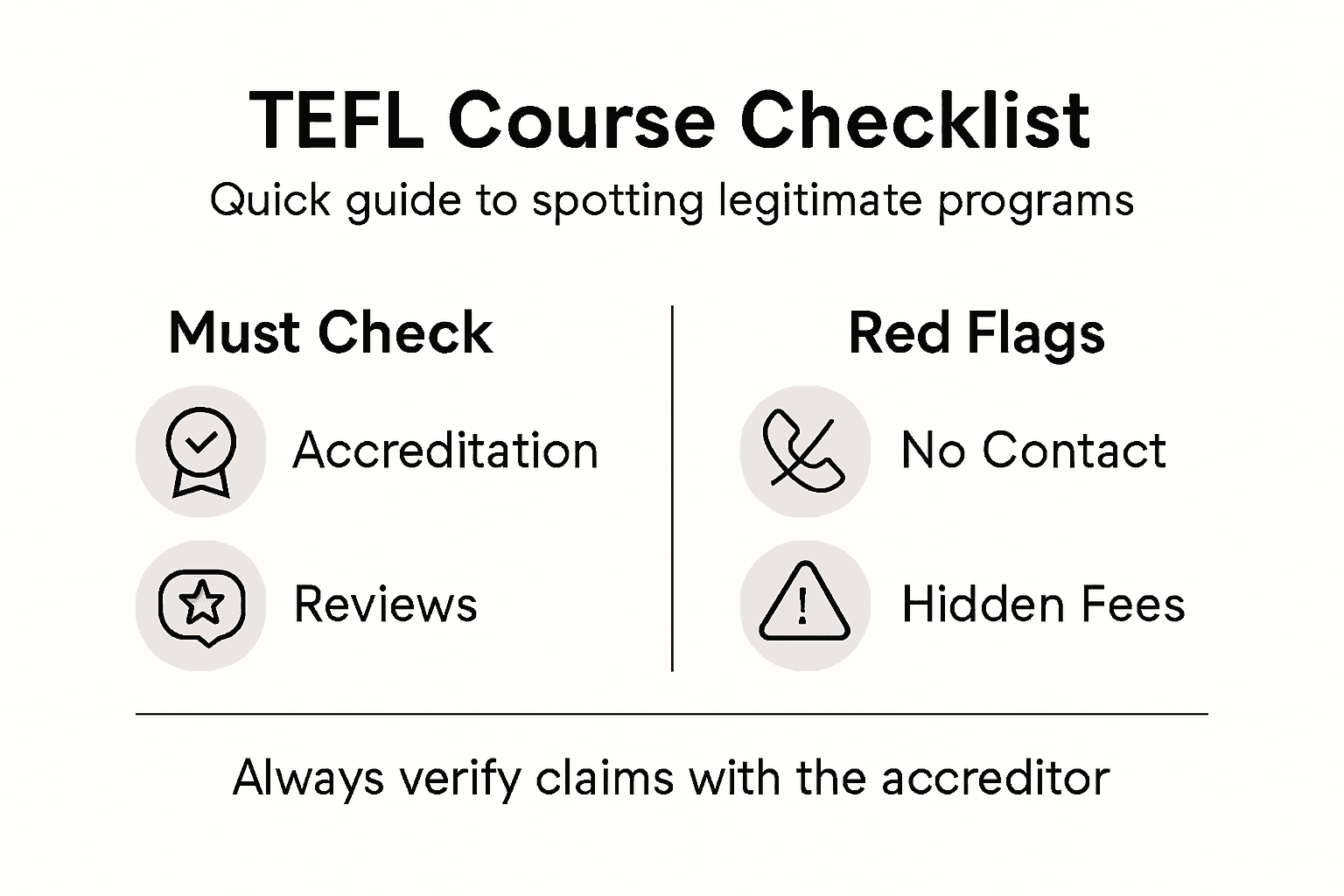
The relationship between price and quality in TEFL certification is not linear. A cheap course can deliver legitimate quality if the provider has streamlined operations through online delivery and automated grading systems. What you’re actually paying for is instructor time, course development, and accreditation fees, not necessarily course length or prestige. Some budget providers achieve lower costs by using experienced former teachers who work part-time rather than full-time staff, which can actually benefit students who learn from practitioners with recent classroom experience. The real danger lies in programs that sacrifice content to hit a price point. Red flags include courses offering certification in under 80 hours when industry standards recommend 120 hours minimum, or providers that claim accreditation without verifiable proof from recognized bodies. You can verify accreditation directly by checking the British Council’s database or contacting Trinity College London rather than trusting the provider’s claims alone.
Validity and employer recognition depend on both accreditation status and the specific region where you plan to teach. A TEFL certificate from an accredited provider is recognized internationally for teaching English abroad, but some regions have preferences. Middle Eastern schools often prioritize CELTA or Trinity CertTESOL, while Southeast Asian employers are more flexible and accept various accredited certifications. Online teaching platforms like VIPKid and Cambly accept accredited TEFL certificates from most providers, making geography less relevant for remote work. The key distinction is between internationally recognized accreditation and provider-specific certification. Cheap courses sometimes offer their own internal certificates that carry no external validity because nobody has independently verified the program’s quality. Before enrolling, confirm that the accrediting body is recognized by major teaching institutions and platforms in your target market.
Pro tip: Request a copy of the accreditation certificate from any provider before paying, then independently verify it by contacting the accrediting body directly—this takes five minutes and protects you from fraudulent claims that cost you money without delivering legitimate credentials.
Compare leading accreditation bodies and what employers value most:
| Accrediting Body | Global Recognition | Typical Employer Preference |
|---|---|---|
| British Council | Very high | Prioritized in Europe/Asia |
| Trinity College London | High | Top choice in Middle East |
| Accrediting Council of CE&T | Moderate to high | Accepted for online roles |
| Provider-specific Certificate | Low | Seldom if ever recognized |
Requirements for Low-Cost TEFL Programs
Most legitimate low-cost TEFL programs share common structural requirements that keep expenses manageable while maintaining educational quality. The first requirement is minimum course hours, which typically falls between 100 and 150 hours for basic certifications. While you might encounter programs claiming to offer full TEFL certification in 50 hours, industry standards from recognized accrediting bodies specify that adequate teacher training requires at least 100 hours of instruction and practice. This isn’t arbitrary—the hours cover essential components like teaching methodology, classroom management techniques, lesson planning, grammar instruction, and practical teaching experience through recorded or live practice sessions. A legitimate low-cost program won’t artificially compress content into unrealistic timeframes because doing so sacrifices the depth needed for actual classroom readiness.
Second, programs must include practical teaching components where you deliver actual lessons, even if only to other trainees or recorded demonstrations. This hands-on requirement differentiates real TEFL training from theoretical modules alone. Some budget providers use peer teaching, where you practice with fellow students in the same program and receive feedback from instructors. Others employ recorded lesson submissions where you teach real or mock students and instructors evaluate your performance asynchronously. Without this practical element, you’re learning theory without developing the confidence and classroom management skills that employers actually assess. Third, affordable programs typically require self-directed learning to keep instructor costs down. You’ll complete reading assignments, watch instructional videos, and work through written exercises independently, with instructors focused on evaluating your practical teaching and providing feedback rather than delivering live lectures. Finally, top TEFL facts you need to know include understanding that even budget programs must include proper assessment mechanisms to verify you’ve mastered the material, whether through written exams, teaching evaluations, or portfolio reviews.
Additional baseline requirements include access to course materials throughout your study period and some form of instructor support, even if asynchronous. You shouldn’t be abandoned once enrolled. Low-cost programs reduce costs by limiting one-on-one attention, not by eliminating it entirely. You should have mechanisms to ask questions, get feedback on your teaching practice, and receive guidance on course content. A final requirement is certification documentation that clearly states the course hours completed, accreditation status, and competencies achieved. This isn’t just a certificate that looks official—it needs verifiable backing and transparent information about what you actually learned and completed.
Pro tip: Before enrolling in any cheap program, request syllables showing hour breakdowns between teaching methodology (minimum 20 hours), practice teaching (minimum 10 hours), and assessments, then verify the total meets 100 hour minimums for legitimate worldwide recognition.
Hidden Costs and Common Pitfalls to Avoid
The advertised price of a TEFL course rarely tells the whole financial story. Hidden costs often emerge after enrollment, transforming what seemed like a bargain into an expensive commitment. Many budget providers quote a base price but exclude essential materials, practice lesson fees, or proctoring charges for final exams. Some charge separate fees for certificate delivery, credential verification requests, or access extensions if you need extra time completing the program. A course advertised at $199 might actually cost $350 once you add required textbooks, video lesson platform access, and exam administration fees. Always request an itemized breakdown of all costs before enrolling, not just the tuition price. Ask explicitly about fees for practice teaching supervision, certificate issuance, transcript requests, and any technology platforms required for lesson submission.
Beyond financial hidden costs, several common pitfalls can waste your money entirely. The first is enrolling in unaccredited programs that sound legitimate but carry no external validation. Scam operations use official sounding names, professional websites, and fake testimonials to appear credible. When choosing the best TEFL course, always verify accreditation with independent bodies rather than accepting the provider’s claims. Another pitfall is selecting programs that offer inadequate practical teaching requirements. You might complete 120 hours of theory, videos, and reading but teach only two or three practice lessons to other trainees. Employers recognize this immediately and pay less for teachers who haven’t developed real classroom experience. A third trap is choosing courses with minimal instructor feedback on your teaching practice. Some budget providers employ automated grading systems that score your lessons but provide no constructive comments on what you did well or what needs improvement. This leaves you without the guidance necessary to actually improve your teaching skills.
Time commitment represents another hidden pitfall many overlook. A program advertised as “120 hours” might take 200 actual hours when you factor in reading assignments, forum discussions, assignment revisions, and waiting for feedback. If you’re working while studying, underestimating the time requirement leads to stress, rushed work, and a lower quality certification. Additionally, watch for limited access periods where your course materials disappear after completion. Budget programs sometimes provide access for only 30 or 60 days post-completion, meaning you lose course videos, lesson plans, and reference materials just when you need them most for actual teaching. Read the terms carefully about how long you retain access after finishing.
Pro tip: Create a spreadsheet comparing true total costs (tuition plus all fees), minimum teaching hours required, accreditation body, and instructor feedback mechanisms across three providers before deciding—this prevents emotional enrollment decisions that cost you hundreds in hidden expenses.
Discover Affordable TEFL Certification That Pays Off Fast
Navigating the world of cheap TEFL courses can feel overwhelming with so many options that vary in price, accreditation, and teaching practice requirements. If you are seeking a legitimate and affordable path to start teaching English abroad or online, understanding how to balance cost with quality is key. Avoid hidden fees and uncertified programs that waste your time and money. Instead, focus on programs that offer at least 100 hours of training, real teaching practice, and recognized accreditation. These are the factors that will boost your confidence and maximize your earning potential in international classrooms or virtual teaching platforms.
Take control of your TEFL training journey today with TEFL Institute. Our comprehensive catalog of affordable online and hybrid courses includes clear curriculum outlines, practical teaching components, and verification tools to ensure you earn credible certification employers trust. Explore our detailed course prospectuses that highlight pricing, hands-on experience opportunities, and accreditation status. Whether you want a fast-track program or an advanced diploma, find a transparent and supportive program that fits your budget and learning style. Start your application now and turn your TEFL investment into rewarding teaching opportunities worldwide by visiting TEFL Institute’s main site and learning more about choosing the best TEFL course and how much TEFL courses cost.
Frequently Asked Questions
What is TEFL certification?
TEFL certification stands for Teaching English as a Foreign Language and validates your ability to teach English to non-native speakers, regardless of your professional background.
How can I find affordable TEFL courses?
Affordable TEFL courses vary widely in price. Look for programs that offer online asynchronous courses, accelerated intensive formats, or hybrid models to meet different budget and learning needs.
What factors influence the cost of TEFL certification?
The cost of TEFL certification is influenced by several factors, including course duration, accreditation level, geographical location, and the type of program offered (online, hybrid, or in-person).
What should I check regarding a TEFL program’s accreditation?
Verify that the TEFL program is accredited by recognized bodies like the British Council or Trinity College London. Always request proof of accreditation and confirm its validity with the accrediting organization.
Recommended
- Best TEFL Certification for Online Teaching in 2026
- 7 Essential Steps for Landing Teaching Overseas Jobs | TEFL Institute
- 180 Hour Level 5 TEFL Diploma | Ofqual Regulated | USA
- Best TEFL Certifications for Teaching English in Asia 2026: Japan, Korea, China, Thailand, Vietnam & Cambodia | TEFL Institute