

 United Kingdom (UK)
 United States (US)
 Canada
 South Africa
 India
India Australia
 New Zealand
 China
China Russia
 Germany
 France
 Spain
Spain Netherlands
 Vietnam
 United Arab Emirates
 Italy
Italy Poland
 Thailand
 Türkiye








 Algeria


Salary Negotiation for TEFL Teachers: A Practical Guide
Salary Negotiation for TEFL Teachers: A Practical Guide

TL;DR:
- Most TEFL teachers assume asking for more will cost them the job, but salary negotiation is expected by schools.
- Waiting for a formal offer before negotiating increases leverage, and framing requests as questions fosters collaboration.
Most TEFL teachers accept the first offer they receive, assuming that asking for more will cost them the job. That assumption is wrong. Salary negotiation for TEFL positions is a normal part of the hiring process, and schools expect counter-offers. What separates teachers who earn competitive compensation from those who leave money on the table is not luck or credentials alone. It is knowing when to negotiate, what to ask for, and how to frame the conversation. This guide covers all of it.
Table of Contents
- Key takeaways
- Salary negotiation for TEFL: understanding your full package
- When to negotiate: timing is everything
- Negotiating salary and benefits professionally
- Evaluating your final offer: red flags and benchmarks
- My take on negotiating TEFL salaries
- Build your credentials to negotiate from a position of strength
- FAQ
Key takeaways
| Point | Details |
|---|---|
| Negotiation is expected | Most international schools anticipate counter-offers and will not withdraw an offer over a respectful salary discussion. |
| Total package matters | Housing, flights, health insurance, and bonuses can add significant value beyond the base monthly salary. |
| Timing changes outcomes | Waiting until after a formal offer is extended gives you maximum leverage during any salary discussion. |
| Frame it as flexibility | Asking “Is there flexibility in…” positions you as collaborative rather than demanding, which protects the offer. |
| Research before responding | Benchmarking local market salaries and cost of living helps you set realistic, justifiable targets before negotiating. |
Salary negotiation for TEFL: understanding your full package
Before you negotiate anything, you need to know what you are actually negotiating. The monthly salary figure on an offer letter tells only part of the story. TEFL teacher compensation packages frequently include elements that either significantly raise or lower the real value of a contract.
Benchmark any offer: compare it with the official pay and benefits of programmes such as JET, EPIK and NET in our TEFL Salary Index.
Here is what to look for when you review an offer:
- Base salary: The fixed monthly payment in local currency or USD/GBP equivalent
- Housing allowance: Provided as free accommodation or a monthly cash supplement
- Flights: Whether the employer covers your initial flight, return flight, or both
- Health insurance: Employer-sponsored coverage versus out-of-pocket private insurance
- Paid leave: Annual vacation days, national holidays, and sick leave entitlements
- Signing or completion bonuses: Lump-sum payments for completing a contract term
- Relocation support: Visa fees, airport pickup, and initial settling-in costs
- Tuition or professional development: Whether the school covers additional training or certifications
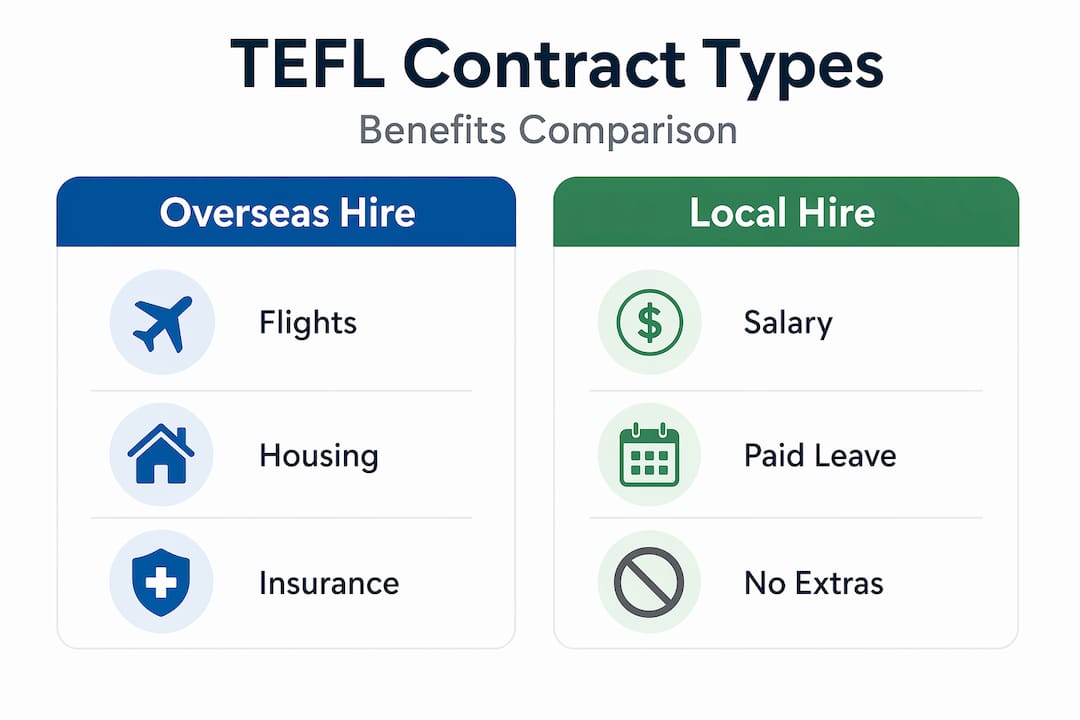
One critical distinction that many teachers overlook is the difference between overseas-hire contracts and local-hire contracts. Local hire contracts typically offer fewer benefits than overseas hire contracts, even when the headline salary appears comparable. A local hire position in South Korea might pay a competitive monthly rate but require you to fund your own flights, accommodation, and insurance, costs that can total several thousand dollars per year.
The table below illustrates how two offers with similar salaries can have very different real-world values:
| Compensation element | Offer A (overseas hire) | Offer B (local hire) |
|---|---|---|
| Monthly salary | $1,800 | $2,100 |
| Housing | Provided | Not included |
| Round-trip flights | Covered | Not covered |
| Health insurance | Employer-sponsored | Self-funded |
| Estimated annual benefit value | $8,000+ | $0 |
Pro Tip: Always request the full contract details in writing before beginning any negotiation. A verbal summary of benefits is not a reliable basis for comparison.
Teacher Horizons recommends asking detailed questions about every element of the compensation package before signing, not just about the salary figure. That practice protects you from accepting an offer that looks attractive until the out-of-pocket costs become clear.
When to negotiate: timing is everything
The single most effective thing you can do to improve your negotiation outcome is to wait for the formal offer before raising any salary discussion. This is not just a courtesy convention. It is a strategic decision that changes your leverage position entirely.

Here is why the timing matters so much. Once a school extends a formal offer, they have already invested time in reviewing your application, conducting interviews, and deciding you are the right candidate. That investment creates motivation on their side to reach a workable agreement. Raising salary expectations too early in the process, such as during a first interview, signals either inexperience or misplaced priorities. Edvectus advises avoiding salary negotiation during the interview unless the employer raises it explicitly.
Follow these steps once a formal offer arrives:
- Acknowledge the offer positively. Reply promptly to thank the school for the offer and confirm you are reviewing it carefully. This keeps the tone warm and professional.
- Take 24 to 48 hours to evaluate. Use this time to research the local market, calculate the total package value, and identify the specific areas you want to address.
- Respond in writing. Email is ideal for salary negotiations because it gives both parties time to think clearly and creates a record of the discussion.
- Make a single, specific counter-proposal. Vague requests are harder to act on. Ask for a specific salary figure, a specific benefit, or both.
- Express continued enthusiasm for the role. Reinforce that you want the position and that the negotiation is about finding the right terms, not reconsidering your interest.
Research indicates that foreign teachers can secure 10 to 20% higher salaries by negotiating after a formal offer, particularly when they address both base salary and benefits together.
Pro Tip: If a school asks about your salary expectations before making an offer, provide a researched range rather than a fixed number. This keeps the conversation open without anchoring too low.
Negotiating salary and benefits professionally
The language you use during a negotiation determines whether the conversation feels collaborative or confrontational. Schools are far more likely to engage constructively with a teacher who frames requests as questions about flexibility rather than demands for more money.
Effective negotiating TEFL pay comes down to three core principles: tone, justification, and patience.
Use question-based language. Asking “Is there any flexibility in the base salary?” or “Would the school be open to covering the initial flight?” invites a conversation. Stating “I need a higher salary” closes it. Framing negotiations as exploring flexibility consistently produces better outcomes than direct demands because it positions both parties as working toward an agreement rather than against each other.
Justify your request with evidence. Your qualifications, years of experience, specialist skills such as exam preparation or young learner instruction, and relevant certifications all serve as legitimate grounds for requesting above-scale pay. Justifying salary increases with qualifications is the clearest way to avoid appearing entitled while making a strong case for better compensation.
Shift to benefits when salary is fixed. Many schools operate on structured salary scales that leave little room to increase base pay. That does not mean the negotiation is over. Benefits are often more flexible than base salary, particularly for experienced teachers. Housing allowances, completion bonuses, extra paid leave, or professional development funding may all be negotiable even when the monthly number is not.
Here is an example of a well-structured counter-offer message:
Hiring windows close while you scroll.
Deadlines, salaries and visa notes for teaching jobs worldwide, checked against official sources and sent free every two weeks.
Get on the Wire“Thank you for the offer. I am very excited about this opportunity and I believe I would contribute strongly to your program. Based on my [X years of experience / TEFL qualification level / specialist skills], I wanted to ask whether there is any flexibility in the base salary or the housing allowance. I would welcome the chance to discuss this further at your convenience.”
This kind of message does three things well. It expresses genuine interest, provides a clear reason for the request, and leaves the door open without creating pressure.
Avoid common mistakes that undermine negotiations. Do not make multiple counter-offers in quick succession. Do not compare the school’s offer to competitor schools by name. Do not present ultimatums. And do not negotiate verbally in the moment if you received the offer by phone. Ask for time to review and respond in writing.
Pro Tip: If you have competing offers, you may mention that fact without naming the other school. Saying “I have another offer I am considering” is legitimate leverage. Naming the competitor is not necessary and rarely helps.
Evaluating your final offer: red flags and benchmarks
Once negotiations are complete and you receive a revised or confirmed offer, the work is not done. Verifying that the final package represents fair compensation for your specific market requires deliberate research, not assumptions.
Start with salary benchmarking. Researching local market salaries and cost of living before you respond to any offer gives you a factual foundation for both the negotiation and the final evaluation. Teflinstitute publishes a detailed TEFL teacher salary guide that breaks down average earnings by country, which is a practical starting point for benchmarking.
Beyond salary benchmarks, review these elements carefully before signing:
- Contract duration and renewal terms: What are the conditions for contract renewal and are there salary increments built in?
- Paid leave entitlements: Does the contract clearly specify vacation days, national holiday coverage, and sick leave?
- Deduction transparency: Are there taxes, union fees, or accommodation deductions that reduce the stated salary?
- Probationary period terms: Some contracts include reduced pay or withheld benefits during an initial probationary period.
- Early termination clauses: Understand the financial and visa consequences of leaving a contract early.
Red flags worth noting include offers with no written contract prior to arrival, verbal promises of benefits that do not appear in writing, unusually high salaries that seem inconsistent with the local market, and vague descriptions of working hours or teaching load. You can also review top-paying countries for TEFL teaching to confirm whether the country you are considering is realistic for your financial goals.
Experienced teachers focus on total package value rather than the headline salary number. Adding up the monetary value of housing, flights, insurance, and bonuses alongside the base salary gives you a far more accurate picture of what the role is actually worth.
My take on negotiating TEFL salaries
In my experience, the biggest obstacle in TEFL salary negotiation is not the school. It is the teacher’s own reluctance to start the conversation. I have seen highly qualified teachers accept the first offer without a single question, leaving housing allowances, completion bonuses, and even extra paid leave on the table that the school had full authority to offer.
What I have learned is that negotiation in the TEFL sector rarely goes wrong when it is done with professionalism and specificity. Schools are not looking for pushback. They are looking for evidence that you understand your own value. A teacher who can clearly articulate why their experience justifies a specific request comes across as confident and professional, not difficult.
The leverage point most teachers miss is the timing of the ask. Once an offer is extended, you are not a candidate anymore. You are the chosen candidate. That shift in status changes the dynamic entirely. Use it.
My advice is to prepare your justification before the offer arrives, not after. Know your qualifications, know the market rate for your destination, and know which benefits matter most to you. When the offer comes, you will be ready to respond with a clear, evidence-based counter-proposal rather than an emotional reaction in either direction.
— Muller
Build your credentials to negotiate from a position of strength

Strong salary negotiation starts long before the offer letter arrives. The more credentials and specialized skills you bring to the table, the stronger your justification for above-scale compensation. TEFL Institute offers accredited TEFL certification courses designed to help both aspiring and experienced teachers build the qualifications that schools value most. For teachers in the UK, TEFL courses in Newcastle provide a structured, in-person pathway to certification. If you want to expand your existing qualification, course extension options allow you to deepen your specialization and increase your market value before your next negotiation.
FAQ
Is it acceptable to negotiate a TEFL salary offer?
Yes. Most international schools expect candidates to negotiate after receiving a formal offer. Responding with a respectful counter-proposal is a standard part of the hiring process and will not typically result in a withdrawn offer.
What should I negotiate beyond base salary?
Housing allowances, return flights, health insurance, completion bonuses, and additional paid leave are all commonly negotiable, particularly when the school’s salary scale leaves little room to adjust base pay.
How much can I realistically increase a TEFL offer?
Research indicates that teachers who negotiate after a formal offer can achieve 10 to 20% higher compensation, especially when benefits are included in the counter-proposal alongside or instead of base salary.
What is the difference between a local hire and an overseas hire contract?
Overseas hire contracts typically include benefits such as flights, housing, and insurance that local hire contracts do not, meaning a lower headline salary on an overseas contract can still represent better total compensation.
When should I bring up salary during the application process?
Wait until a formal offer is extended before raising salary. Discussing pay during interviews is generally discouraged unless the employer raises the topic directly, as it can signal misaligned priorities at a critical stage of the process.
Recommended
TEFL Institute guides

Germany
Freelance work and pay
Dubai
Pay, requirements and visas
Estonia
Jobs, pay and work routes
Spain
Jobs, pay and visa routes
Mexico
Jobs, pay and cities