

 United Kingdom (UK)
 United States (US)
 Canada
 South Africa
 India
India Australia
 New Zealand
 China
China Russia
 Germany
 France
 Spain
Spain Netherlands
 Vietnam
 United Arab Emirates
 Italy
Italy Poland
 Thailand
 Türkiye









 Algeria


Master key ESL industry terminology for TEFL success
Master key ESL industry terminology for TEFL success

Navigating the ESL teaching world can feel overwhelming when you encounter acronyms like ESL, EFL, TESOL, and ELT at every turn. These terms often appear interchangeable, yet subtle distinctions matter for your certification path, job applications, and professional credibility. Whether you’re starting your teaching journey or refining your expertise, understanding this terminology empowers you to communicate confidently with colleagues, employers, and training providers. This guide breaks down the most important ESL industry terms, clarifies their contexts, and shows you how mastering this language elevates your teaching career in 2026 and beyond.
Table of Contents
- Understanding The Core ESL Industry Acronyms
- Navigating Teaching Approaches And Learner-Centered Terminology
- Clarifying Native And Non-Native Speaker Concepts And Their Impact
- Comparing ESL Industry Terms And Teaching Contexts
- Advance Your Teaching Career With TEFL Institute Courses
- FAQ
Key takeaways
| Point | Details |
|---|---|
| Core acronyms clarified | ESL, EFL, TESOL, and ELT serve distinct but overlapping purposes in language education contexts. |
| Context determines usage | ESL applies to English-speaking environments while EFL fits non-English-speaking countries, shaping teaching approaches. |
| Teaching methods matter | Task-based language teaching (TBLT) and ESP (English for Specific Purposes) represent learner-centered approaches gaining traction globally. |
| Native status myths debunked | Teaching effectiveness depends on qualifications and skills rather than native speaker origin, despite persistent hiring biases. |
| Regional terminology varies | North American and British English contexts use different terms, affecting certification names and professional communication standards. |
Understanding the core ESL industry acronyms
The alphabet soup of ESL terminology starts with English Language Teaching (ELT), the broadest umbrella term covering all instruction for non-native English speakers. Publishers, training programs, and educators worldwide use ELT to describe the entire field, making it your go-to term when discussing the profession at large. This term sidesteps regional variations and captures both classroom instruction and curriculum development.
TESOL (Teaching English to Speakers of Other Languages) operates differently depending on your location. In North America, TESOL includes both TESL and TEFL plus ESL contexts, functioning as an all-encompassing professional designation. British English speakers typically favor ELT instead, creating potential confusion when North American certified teachers seek positions in UK schools or Commonwealth countries. Understanding this regional split prevents miscommunication during job searches.
The distinction between ESL and EFL hinges entirely on learner context. ESL and EFL are subcategories of ELT, differentiated by whether students learn English within or outside English-speaking communities. ESL (English as a Second Language) describes teaching immigrants, refugees, or international students in countries like the United States, Canada, or Australia where English dominates daily life. Students absorb English naturally through immersion while receiving formal instruction.
EFL (English as a Foreign Language) applies when you teach in countries where English remains a foreign language with limited daily exposure. Think of teaching in Japan, Brazil, or Saudi Arabia where students return home to their native language after class. This context demands different strategies since learners lack the immersion advantage ESL students enjoy. Your lesson planning adjusts to compensate for reduced authentic language exposure outside the classroom.
Two additional terms appear frequently in specific regions. EAL (English as an Additional Language) gained popularity in UK and Australian education systems, emphasizing that English adds to rather than replaces a student’s first language. ESOL (English for Speakers of Other Languages) serves similar purposes in British contexts, often appearing in adult education programs. These terms reflect evolving attitudes toward multilingualism and cultural sensitivity in language education.
Key acronym distinctions include:
- ELT encompasses all English teaching to non-native speakers regardless of context
- TESOL certification prepares teachers for both ESL and EFL environments
- ESL focuses on immersion contexts within English-speaking countries
- EFL targets foreign language contexts with limited English exposure
- EAL and ESOL represent British and Australian terminology preferences
Recognizing these overlaps helps you navigate esl teaching terminology basics and communicate precisely with international colleagues. The terms intersect constantly in practice since many teachers work in both ESL and EFL contexts throughout their careers. Your certification typically covers multiple contexts, preparing you for diverse teaching environments worldwide.
Navigating teaching approaches and learner-centered terminology
Beyond basic acronyms, methodology terms shape how you actually teach. ESP (English for Specific Purposes) represents a learner-centered approach developing communicative competence in particular disciplines like business, medicine, or aviation. Rather than teaching general English, ESP instructors tailor vocabulary, grammar, and scenarios to professional or academic needs. A business English course might focus on negotiation language and report writing while medical ESP emphasizes patient interaction and clinical terminology.

This specialization demands deeper subject knowledge beyond language teaching skills. You research industry-specific communication patterns, collaborate with subject experts, and design authentic materials reflecting real workplace demands. ESP courses attract motivated adult learners with clear goals, making them rewarding but challenging teaching contexts. The specificity also opens lucrative career paths in corporate training and university programs.
Task-based language teaching (TBLT) focuses on authentic language use to complete meaningful tasks, building fluency and confidence through practical application. Instead of drilling grammar rules in isolation, TBLT students might plan a trip, solve a workplace problem, or conduct a survey using English as their communication tool. Language emerges naturally from task demands rather than predetermined lesson structures.
TBLT benefits include:
- Increased student engagement through purposeful communication
- Natural integration of multiple language skills simultaneously
- Reduced anxiety since focus shifts from correctness to task completion
- Better retention through meaningful context and real-world relevance
- Enhanced fluency development over accuracy-focused approaches
The approach works particularly well with adult learners who appreciate practical applications over abstract grammar explanations. You design tasks matching student proficiency levels while gradually increasing complexity. A beginner task might involve ordering food at a restaurant while advanced learners negotiate a business contract or debate environmental policy.
Pro Tip: Start each unit with a simple task to assess current abilities, then teach language elements students need for a more complex final task, creating a natural learning cycle.
Learner-centered terminology reflects broader shifts in ESL teaching philosophy. Terms like communicative competence, learner autonomy, and authentic materials signal movement away from teacher-dominated, grammar-translation methods toward student-driven, interaction-focused classrooms. Understanding these concepts helps you align with current esl teaching terminology basics and demonstrate modern pedagogical awareness to employers.
The terminology evolution continues as research reveals more about language acquisition. Concepts like comprehensible input, noticing hypothesis, and interlanguage now appear regularly in training materials and job descriptions. Staying current with methodology terminology positions you as a knowledgeable professional committed to evidence-based teaching practices.
Clarifying native and non-native speaker concepts and their impact
The native speaker concept generates ongoing controversy in ESL circles. Technically, the term ‘native’ describes language origins but is often misused to imply language proficiency level, creating false equivalencies between birthplace and teaching ability. A native speaker learned English from birth in an English-speaking environment, but this origin guarantees neither grammatical knowledge nor pedagogical skill.
Many native speakers struggle to explain grammar rules they use instinctively. They might say “that sounds wrong” without articulating why, limiting their effectiveness in explicit instruction contexts. Meanwhile, non-native teachers who learned English formally often possess superior metalinguistic awareness, understanding grammar systems deeply enough to explain them clearly. This knowledge proves invaluable when students ask detailed questions about language patterns.
Distinctions between native and non-native teachers can lead to discrimination in job opportunities, with some employers explicitly requesting native speakers regardless of qualifications. This practice ignores research showing non-native teachers offer unique advantages including shared language learning experience, cultural mediation skills, and realistic role models for students. The bias persists despite professional organizations condemning it as discriminatory and counterproductive.
Addressing native speaker terminology professionally requires:
- Emphasizing qualifications, certifications, and teaching experience over origin
- Highlighting language proficiency through standardized test scores when needed
- Demonstrating pedagogical knowledge and classroom management skills
- Building a strong teaching portfolio showcasing student outcomes
- Networking with institutions valuing skills over native status
The industry slowly shifts toward competency-based hiring as awareness grows. Forward-thinking schools recognize that effective teaching depends on training, experience, and dedication rather than birthplace. Your professional development, continuous learning, and qualifications for esl teaching matter far more than native speaker status in determining your success and impact.
Some experts advocate abandoning native and non-native labels entirely, preferring terms like expert user or proficient speaker that focus on actual ability. This terminology change reflects growing recognition that English belongs to all its users worldwide, not just those born in traditionally English-speaking countries. As a teacher, you can contribute to this shift by emphasizing skills and qualifications in your professional communications.
“The most effective language teachers combine deep language knowledge with pedagogical training and cultural sensitivity, regardless of whether they learned English as a first or additional language.”
This perspective reframes the conversation around what truly matters in language education. Your commitment to professional growth, understanding of language acquisition principles, and ability to connect with diverse learners define your teaching quality far more than your linguistic origin.
Comparing ESL industry terms and teaching contexts
Direct comparison clarifies how these terms function in practice. The following table outlines key distinctions:
| Term | Definition | Primary Context | Regional Preference |
|---|---|---|---|
| ESL | English as a Second Language | English-speaking countries with immigrant populations | North America, Australia |
| EFL | English as a Foreign Language | Non-English-speaking countries | Global, especially Asia |
| EAL | English as an Additional Language | Multilingual education settings | UK, Australia |
| ESOL | English for Speakers of Other Languages | Adult education programs | United Kingdom |
| ELT | English Language Teaching | Universal professional term | Global, especially UK |
| TESOL | Teaching English to Speakers of Other Languages | Professional certification and training | North America |
ESL applies when learning English in an English-speaking community while EFL applies outside such communities, fundamentally shaping curriculum design and teaching strategies. This distinction affects everything from materials selection to assessment approaches. ESL teachers leverage the surrounding English environment through field trips, authentic interactions, and media exposure. EFL teachers create English-rich classroom environments compensating for limited outside exposure.
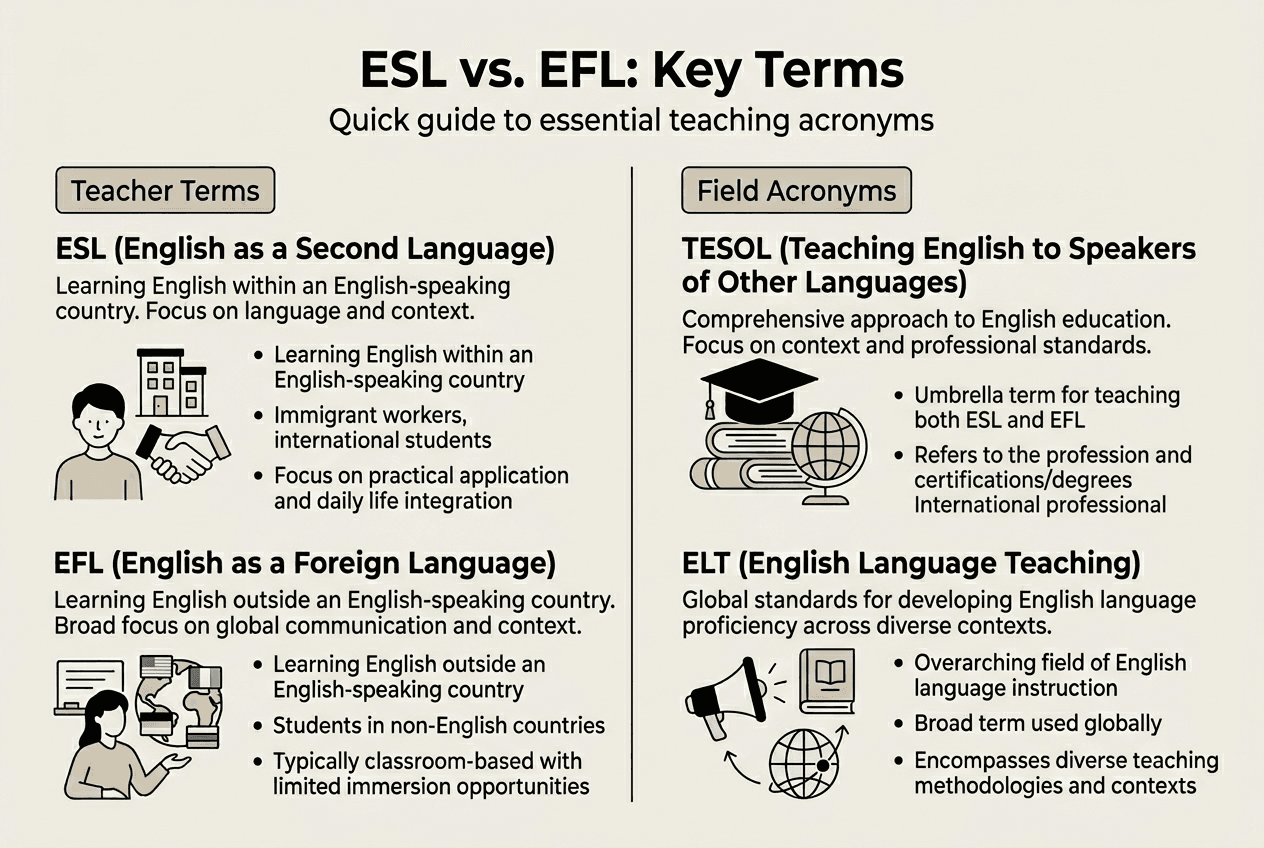
TESOL certification programs typically cover both contexts, preparing you for diverse teaching situations worldwide. Your training addresses ESL-specific challenges like cultural adjustment and community integration alongside EFL concerns like maintaining student motivation without immersion benefits. This dual preparation makes tesol certification global careers accessible across multiple countries and teaching contexts.
Identifying appropriate terminology for your situation involves:
- Determine your teaching location (English-speaking country or not)
- Assess student exposure to English outside your classroom
- Research regional terminology preferences for job applications
- Match your certification language to employer expectations
- Use broader terms like ELT when uncertain about regional preferences
Regional preferences significantly impact professional communication. North American job postings frequently request TESOL or ESL certification while UK positions specify ELT or ESOL qualifications. These differences reflect historical development of language teaching professions in different countries rather than substantive training variations. Your certification content likely covers similar material regardless of naming conventions.
Understanding these nuances prevents confusion during job searches and professional development. When applying internationally, research terminology used in your target country and mirror that language in your application materials. This attention to detail demonstrates cultural awareness and professional adaptability, qualities employers value highly in language teachers.
The terminology landscape continues evolving as the field matures and globalizes. New terms emerge while others fade from use, requiring ongoing attention to current professional language. Staying informed through professional organizations, academic journals, and teaching communities keeps your terminology current and your professional communication sharp.
Advance your teaching career with TEFL Institute courses
Mastering ESL terminology represents just the beginning of your professional development journey. TEFL Institute offers specialized certification options designed for educators seeking to deepen their expertise in ESL methods, terminology, and practical teaching skills. Our programs cover the full spectrum of language teaching contexts, from ESL environments in English-speaking countries to EFL positions worldwide, ensuring you’re prepared for diverse career opportunities.

Whether you’re starting your teaching career or expanding your qualifications, our tefl courses in Newcastle and online programs provide flexible pathways to professional certification. Explore our tefl course extensions for specialized training in areas like business English, young learners, or exam preparation that set you apart in competitive job markets. Visit TEFL Institute today to discover how our comprehensive training programs can transform your understanding of ESL terminology into practical classroom success and open doors to rewarding teaching positions globally.
FAQ
What is the difference between ESL and EFL?
ESL (English as a Second Language) refers to teaching English in countries where English is the primary language, such as teaching immigrants in the United States or Canada. EFL (English as a Foreign Language) describes teaching English in countries where it’s not the dominant language, like teaching in Japan or Mexico. The terms sometimes overlap in North American usage, but the key distinction lies in whether students have daily exposure to English outside the classroom through immersion.
Why is TESOL sometimes used differently in the US and UK?
In North America, TESOL (Teaching English to Speakers of Other Languages) serves as an umbrella term encompassing both ESL and EFL teaching contexts, making it the preferred certification designation. British English speakers typically use ELT (English Language Teaching) instead to describe the same broad field. This regional difference impacts certification naming, professional organization titles, and job posting language, though the actual training content remains largely similar across both terminology systems.
How does task-based language teaching benefit ESL learners?
TBLT (Task-Based Language Teaching) promotes practical English use through real-world tasks like planning events, solving problems, or conducting research projects. This approach enhances fluency and confidence by shifting focus from grammatical accuracy to meaningful communication, reducing learner anxiety. Students develop communicative competence naturally while completing purposeful tasks, leading to better retention and more authentic language use than traditional grammar-focused instruction methods.
Are native English speakers always better ESL teachers?
Native speaker status doesn’t guarantee teaching skill, grammatical knowledge, or pedagogical effectiveness in ESL classrooms. Non-native English teachers often bring valuable advantages including shared language learning experience, deeper metalinguistic awareness, and ability to explain grammar rules explicitly. Research shows teaching quality depends on professional training, classroom experience, and dedication rather than linguistic origin, though hiring discrimination based on native status unfortunately persists in some markets despite lacking educational justification.
Recommended
TEFL Institute guides

Taiwan
Buxibans, pay and visas
Mexico
Jobs, pay and cities
Czech Republic
Pay, visas and cities
Estonia
Jobs, pay and work routes
Cambodia
Pay, requirements and visas