

 United Kingdom (UK)
 United States (US)
 Canada
 South Africa
 India
India Australia
 New Zealand
 China
China Russia
 Germany
 France
 Spain
Spain Netherlands
 Vietnam
 United Arab Emirates
 Italy
Italy Poland
 Thailand
 Türkiye





 Algeria


Master the ESL teaching checklist for classroom success
Master the ESL teaching checklist for classroom success

New ESL teachers often feel overwhelmed juggling lesson planning, student engagement, and classroom management. Without a clear roadmap, you risk spending hours preparing materials that miss the mark or struggling to keep learners motivated. A structured ESL teaching checklist transforms this chaos into confidence. By following proven preparation steps, management strategies, and teaching methodologies, you can deliver effective lessons that resonate with students while building your professional skills. This guide offers actionable frameworks and practical checklists to help you navigate common challenges and create engaging learning environments from day one.
Table of Contents
- Key takeaways
- Building your ESL teaching checklist: preparation essentials
- Effective ESL classroom management checklist
- Choosing and applying ESL teaching methodologies
- Troubleshooting common ESL teaching challenges
- Grow your skills with TEFL Institute courses
- FAQ
Key Takeaways
| Point | Details |
|---|---|
| Connection time | Begin each session with five minutes of connection time to reduce anxiety and show that personal engagement is valued over perfection. |
| Simple greetings with visuals | Teach basic greetings with clear pronunciation and pair them with visuals such as flashcards or real objects. |
| Total Physical Response | Demonstrate actions for target verbs using Total Physical Response so students mirror movements and strengthen memory. |
| High frequency language | Focus on high frequency words and simple sentence structures to support daily communication. |
| Choral repetition practice | Use choral repetition and group practice before individual turns to reduce performance pressure. |
Building your ESL teaching checklist: preparation essentials
Your first lessons set the tone for everything that follows. Starting with a core ESL teaching checklist for beginners ensures you cover essential elements without overwhelming yourself or your students. Begin each session with five minutes of connection time where you greet students individually, ask simple questions, and create a welcoming atmosphere. This brief interaction reduces anxiety and signals that your classroom values personal engagement over perfection.
Simple greetings form the foundation of beginner lessons. Teach phrases like “Hello,” “How are you?” and “Good morning” using clear pronunciation and repetition. Pair these with basic vocabulary words related to everyday objects students can see and touch. When introducing new words, always use visuals alongside spoken language. Flashcards, real objects, or digital images help learners connect sounds to meanings without relying on translation.

Total Physical Response transforms passive listening into active learning. When teaching action verbs like “stand,” “sit,” or “walk,” demonstrate each movement while saying the word. Students mirror your actions, creating muscle memory that reinforces vocabulary retention. This kinesthetic approach works especially well with beginners who lack confidence speaking but can follow physical cues. TPR activities also inject energy into lessons, preventing the fatigue that comes from extended listening periods.
Your language choices matter enormously at this level. Use simple, clear sentences with consistent structure. Instead of saying “Could you possibly hand me that book over there?” try “Give me the book, please.” Focus on high-frequency words that students will encounter repeatedly in daily life. Words like “have,” “go,” “like,” and “want” appear constantly in conversation, making them more valuable than obscure vocabulary that rarely surfaces outside textbooks.
Repetition builds neural pathways for language acquisition. When you introduce a new phrase, have the whole class repeat it three times together, then ask individual students to say it. This choral response removes the pressure of solo performance while giving everyone practice. Circle back to previously taught vocabulary throughout the lesson, weaving old words into new contexts so students recognize them in different situations.
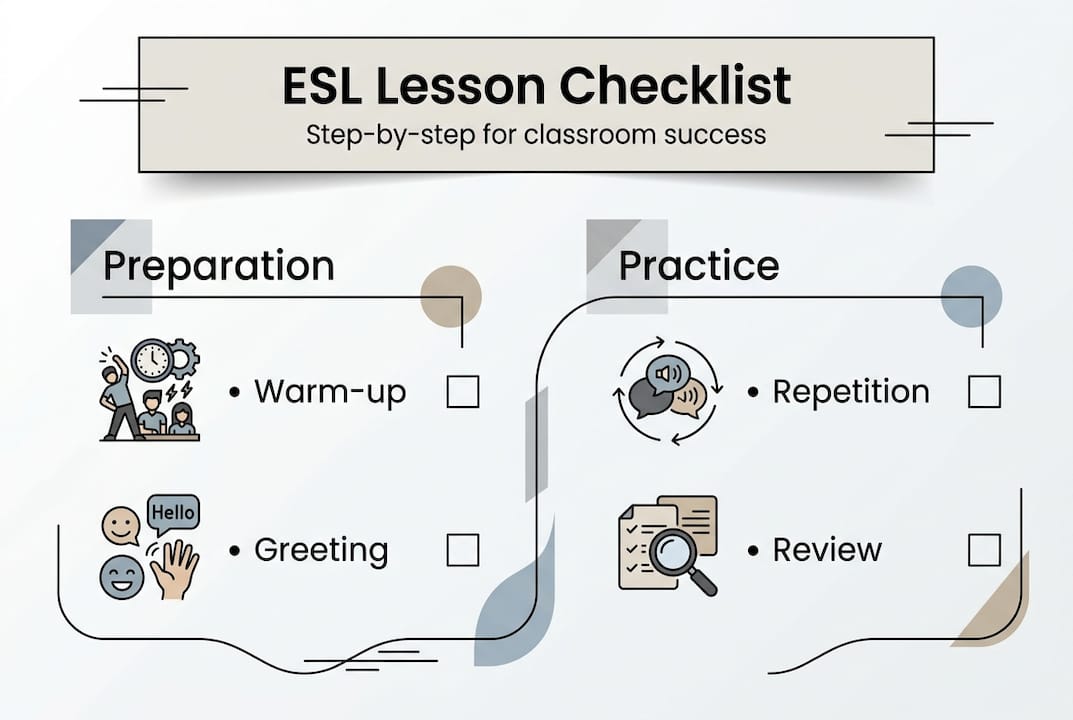
Here is a practical beginner lesson structure:
| Time | Activity | Materials Needed |
|---|---|---|
| 5 min | Greetings and connection | None |
| 10 min | Vocabulary introduction with visuals | Flashcards or real objects |
| 10 min | TPR practice with action verbs | Open space for movement |
| 10 min | Yes/no question practice | Picture prompts |
| 5 min | Review and goodbye routine | None |
Pro Tip: Keep a digital folder of copyright-free images organized by topic. When you need a visual for “apple” or “car,” you can pull it up instantly instead of scrambling during lesson prep. This small organizational step saves hours over time and ensures you always have engaging materials ready.
Integrating ESL teaching tips that boost oral proficiency into your checklist ensures students develop speaking confidence alongside vocabulary knowledge. Pair work activities, even at the beginner level, give learners more speaking time than teacher-led drills. When students practice greetings or simple questions with a partner, they get multiple repetitions in a low-stakes environment.
Effective ESL classroom management checklist
Classroom management makes or breaks your teaching effectiveness. A detailed ESL classroom management checklist guides you through five essential steps that create structure without rigidity. These practices work across age groups and proficiency levels, adapting to your specific context while maintaining core principles.
-
Set clear expectations and routines from day one. Students need to know what happens when they enter your classroom, how to ask for help, and what behaviors you expect during different activities. Create visual cues for common transitions like “pair work time” or “quiet reading.” Consistency matters more than complexity. A simple routine repeated daily becomes automatic, freeing students to focus on language learning instead of figuring out what comes next.
-
Build positive teacher-student relationships deliberately. Learn names quickly and use them often. Show genuine interest in students’ lives, hobbies, and progress. When learners feel valued as individuals, they take more risks with language and recover faster from mistakes. This relationship foundation pays dividends when you need to redirect behavior or push students beyond their comfort zones.
-
Plan engaging, varied activities that match energy levels. No single activity type works for an entire lesson. Alternate between high-energy games and focused written work. If students just completed a listening exercise requiring concentration, follow it with a movement activity or partner discussion. This rhythm prevents fatigue and behavior problems that emerge from boredom or overstimulation.
-
Address disruptive behavior consistently and fairly. When a student acts out, respond calmly using your established system. Avoid public confrontations that embarrass learners or derail lessons. A quiet word during independent work or a predetermined signal often resolves issues without drama. Document patterns of disruption so you can identify triggers and adjust your approach.
-
Regularly evaluate your management effectiveness and refine strategies. After each lesson, spend two minutes noting what worked and what needs adjustment. Did the transition between activities take too long? Did one group finish early and get restless? These quick reflections help you iterate toward smoother classroom operations. Teaching improves through deliberate practice, not just accumulated experience.
Pro Tip: Create a “first five minutes” routine that never changes. Students enter, put away belongings, complete a simple warm-up task visible on the board, and wait quietly for instruction. This predictable start eliminates confusion and sets a focused tone before you even begin teaching.
The essential classroom management strategies you implement early become habits that support learning all year. Positive reinforcement outperforms punishment for building desired behaviors. Catch students following directions, using English, or helping classmates, then acknowledge these actions specifically. “I noticed you used the new vocabulary word correctly” works better than generic praise like “good job.”
Choosing and applying ESL teaching methodologies
Effective ESL instruction blends multiple methodologies rather than rigidly following one approach. Understanding when to apply Presentation-Practice-Production, Engage-Study-Activate, Communicative Language Teaching, Content-Based Instruction, or Task-Based Language Teaching gives you flexibility to match activities with learning objectives. An integrated approach combining methodologies produces better engagement and skill development than any single method used exclusively.
Presentation-Practice-Production excels when introducing new grammar structures or vocabulary that requires accuracy. You present the language point explicitly, students practice it in controlled exercises, then produce it in freer communication. This linear progression works well for beginners who need clear models before attempting independent use. However, PPP can feel mechanical if overused, potentially reducing motivation.
Engage-Study-Activate offers more flexibility by starting with an engaging activity that creates interest in the language point. Students then study the target language, followed by activation tasks where they use it communicatively. ESA allows you to reorder stages based on student needs. You might activate first with a discussion, notice language gaps, then study specific forms before engaging again. This responsiveness to emerging needs makes ESA particularly effective with intermediate learners.
| Methodology | Best For | Pros | Cons | Decision Factor |
|---|---|---|---|---|
| PPP | New grammar, accuracy focus | Clear structure, measurable progress | Can feel rigid, less engaging | Choose when explicit teaching needed |
| ESA | Building motivation, flexibility | Student-centered, responsive | Requires more planning | Choose when engagement is priority |
Communicative Language Teaching prioritizes real-world communication over grammatical perfection. Students work on authentic tasks like ordering food, giving directions, or negotiating plans. CLT develops fluency and confidence but may leave gaps in accuracy if not balanced with explicit instruction. Content-Based Instruction teaches language through subject matter like science or history, making vocabulary acquisition purposeful and contextualized. This approach works brilliantly with motivated learners who have specific content interests.
Task-Based Language Teaching structures lessons around completing meaningful tasks rather than practicing isolated language points. Students might plan a class party, solve a problem collaboratively, or create a presentation. Language learning happens as a byproduct of task completion, mirroring how we acquire first languages. TBLT builds problem-solving skills alongside linguistic competence but requires careful task design to ensure appropriate language emerges.
Technology-enhanced learning tools expand your methodological toolkit significantly. Digital flashcard apps provide spaced repetition for vocabulary review. Video conferencing features enable authentic communication with speakers worldwide. Interactive whiteboards make grammar explanations more dynamic and memorable. The key is integrating technology purposefully rather than using it for novelty. Ask whether each tool genuinely enhances learning or just adds complexity.
Pro Tip: Balance explicit teaching with communicative activities in every lesson. Spend 40% of class time on focused language study and 60% on meaningful communication tasks. This ratio ensures students learn forms accurately while developing the fluency to use them naturally in conversation.
Exploring teaching aids that boost engagement helps you select materials that support your chosen methodology. Realia, authentic texts, and multimedia resources make abstract language concrete and memorable. When setting up your teaching environment, whether physical or digital, consider how your online class setup can facilitate different methodological approaches seamlessly.
Troubleshooting common ESL teaching challenges
Every ESL teacher encounters common challenges like silent students, persistent word mix-ups, and newcomer anxiety. These obstacles feel frustrating in the moment but become opportunities for building student confidence when you respond strategically. Silent students often stay quiet from fear of mistakes rather than lack of knowledge. Combat this by praising every attempt at communication, regardless of accuracy. When a student tries to answer and makes an error, acknowledge the effort first, then gently correct the language.
Word mix-ups reveal how students are processing language. If learners consistently confuse “he” and “she,” they likely come from a language without gendered pronouns. Instead of simply correcting each instance, create focused practice activities around the problematic distinction. Use photos of people with clear gender markers and have students describe them repeatedly until the pattern solidifies. Visual aids combined with repetition rewire these persistent errors more effectively than verbal corrections alone.
TPR activities rescue lessons when students seem disengaged or confused. If you notice glazed expressions during a vocabulary presentation, switch immediately to a movement-based game. Have students act out the words or follow commands using the target vocabulary. This kinesthetic engagement reactivates attention and provides a different learning pathway for students who struggle with auditory input alone.
Newcomers arriving mid-term need welcoming routines that help them catch up without feeling overwhelmed. Assign a buddy who speaks their first language if possible, or pair them with a patient, outgoing student who can model classroom procedures. Keep a folder of essential vocabulary and phrases with visuals that newcomers can review independently. Spend a few minutes before or after class orienting them to your routines so they know what to expect.
Here are specific challenge-solution pairs:
- Silent students: Praise attempts, use pair work for lower-stakes practice, ask yes/no questions before open-ended ones
- Persistent errors: Create targeted practice activities, use visual contrasts, provide immediate gentle correction
- Low energy: Incorporate movement breaks, switch activity types, use music or games
- Mixed proficiency levels: Prepare extension activities for fast finishers, use flexible grouping, offer choice in task complexity
- First-day anxiety: Establish predictable routines immediately, learn names fast, keep initial tasks simple and success-oriented
Pro Tip: Reframe every challenge as diagnostic information about your students’ needs. When multiple learners struggle with the same concept, your lesson needs adjustment, not just more repetition. This mindset shift transforms frustration into productive problem-solving.
Understanding the hiring essentials for ESL teachers can help you anticipate what skills employers value most. Many hiring managers prioritize candidates who demonstrate strong classroom management alongside content knowledge. Developing your troubleshooting abilities makes you more marketable and effective. Returning to proven classroom management tips when facing new challenges provides a reliable framework for maintaining learning environments even during difficult moments.
Grow your skills with TEFL Institute courses
Mastering the ESL teaching checklist takes practice, feedback, and ongoing professional development. TEFL Institute offers practical courses designed specifically for teachers who want to move beyond theory into confident classroom execution. Whether you are preparing for your first teaching position or refining techniques after initial experience, targeted training accelerates your growth significantly.

Our TEFL courses in Newcastle combine online learning with in-person practicum experiences, giving you real classroom hours with feedback from experienced mentors. This blended approach builds both knowledge and practical skills simultaneously. If you want to specialize further, explore our course extensions covering areas like young learners, business English, or exam preparation. These micro-credentials demonstrate expertise to employers while expanding your teaching toolkit. Ready to gain hands-on experience abroad? Check out our January TEFL internships that place you in supportive teaching environments where you can apply your checklist skills with mentorship and community support.
FAQ
What is the best way to start an ESL lesson for beginners?
Begin with a consistent greeting routine that includes simple phrases students can master quickly. Use visuals and Total Physical Response to engage multiple learning pathways from the first minute. Short connection time where you acknowledge individual students reduces anxiety and signals that your classroom values communication over perfection.
How do I manage disruptive behavior in an ESL classroom?
Set clear expectations on day one and address disruptions consistently using calm, private conversations rather than public confrontations. Build positive relationships proactively so students want to meet your expectations. Use engaging, varied activities to prevent the boredom that often triggers behavior problems, and document patterns to identify underlying causes.
Which teaching methodology suits large ESL classes best?
Communicative Language Teaching improves communicative competence but faces challenges in very large classes where monitoring individual student production becomes difficult. An integrated approach combining structured practice activities with carefully managed pair work often proves more practical. Focus on routines that maximize student talking time without requiring you to monitor every interaction simultaneously.
How often should I use Total Physical Response in lessons?
Incorporate TPR activities whenever introducing action verbs, commands, or concrete vocabulary that lends itself to movement. Use it as a energizer between sedentary activities or when you notice student attention flagging. TPR works best in short bursts rather than extended sessions, typically five to ten minutes at a time.
What should I include in a newcomer welcome packet?
Create a visual guide showing classroom routines, essential vocabulary with pictures, common phrases for asking questions or requesting help, and a simple map of your school. Include translated versions of key information if possible. Pair this written resource with a buddy system so newcomers have both reference materials and a peer mentor to navigate their first weeks.
Recommended
- ESL Classroom Management Tips for Confident Teaching Success | TEFL Institute
- Teaching ESL Resources: 7 Essential Tools for Global Success
- ESL Teaching Tips 2025: Boost Oral Proficiency by 40% | TEFL Institute
- Step by Step Classroom Management for ESL Success | TEFL Institute
- Educatieve Spellen Checklist: 45% Meer Betrokkenheid
