
 United Kingdom (UK)
 United States (US)
 Canada
 South Africa
 India
India Australia
 New Zealand
 China
China Russia
 Germany
 France
 Spain
Spain Netherlands
 Vietnam
 United Arab Emirates
 Italy
Italy Poland
 Thailand
 Türkiye








 Algeria


Master ESL curriculum development for learner success 2026

Most educators believe grammar mastery is the foundation of effective ESL curriculum, but this narrow focus often fails diverse learners. Research shows that communicative competence leads to better retention than grammar drills alone. Successful ESL programs balance language skills, cultural responsiveness, and evidence-based strategies. This guide walks you through systematic curriculum development that transforms language acquisition outcomes.
Table of Contents
- Understanding ESL Curriculum Development
- Frameworks For Systematic ESL Curriculum Design
- Balancing Language Skill Development
- Culturally Responsive Curriculum Development
- Evidence-Based Instructional Strategies
- Incorporating Technology And Digital Tools
- Assessment And Continuous Improvement In ESL Curriculum
- Common Misconceptions In ESL Curriculum Development
- Emerging Trends And Practical Applications
- Advance Your ESL Expertise With TEFL Institute
- Frequently Asked Questions
Key takeaways
| Point | Details |
|---|---|
| Systems approach enhances adaptability | 8-step iterative frameworks create responsive curricula through continuous feedback loops. |
| Balance all language domains | Effective programs equally develop reading, writing, speaking, and listening for complete communication skills. |
| Cultural responsiveness drives engagement | Inclusive curricula increase engagement by 20-30% and improve academic outcomes. |
| Evidence-based vocabulary instruction works | Explicit academic vocabulary teaching improves retention by 40% compared to incidental learning. |
| Continuous assessment ensures relevance | Iterative curriculum revision increases outcomes by 20% yearly through data-driven improvements. |
Understanding ESL curriculum development
ESL curriculum serves as a framework guiding language acquisition for learners with diverse backgrounds, proficiency levels, and goals. It encompasses content selection, instructional sequencing, and assessment strategies tailored to second language development.
Effective ESL curricula address three core goals. First, they develop functional communication skills for real-world contexts. Second, they build academic language proficiency for educational success. Third, they foster cultural competence alongside linguistic growth.
Diverse learner needs demand flexible curriculum design:
- Proficiency ranges from absolute beginners to advanced speakers needing refinement
- Cultural and linguistic backgrounds influence learning styles and prior knowledge
- Educational goals vary from survival English to professional certification
- Age groups require developmentally appropriate materials and approaches
- Learning contexts span traditional classrooms to online and hybrid environments
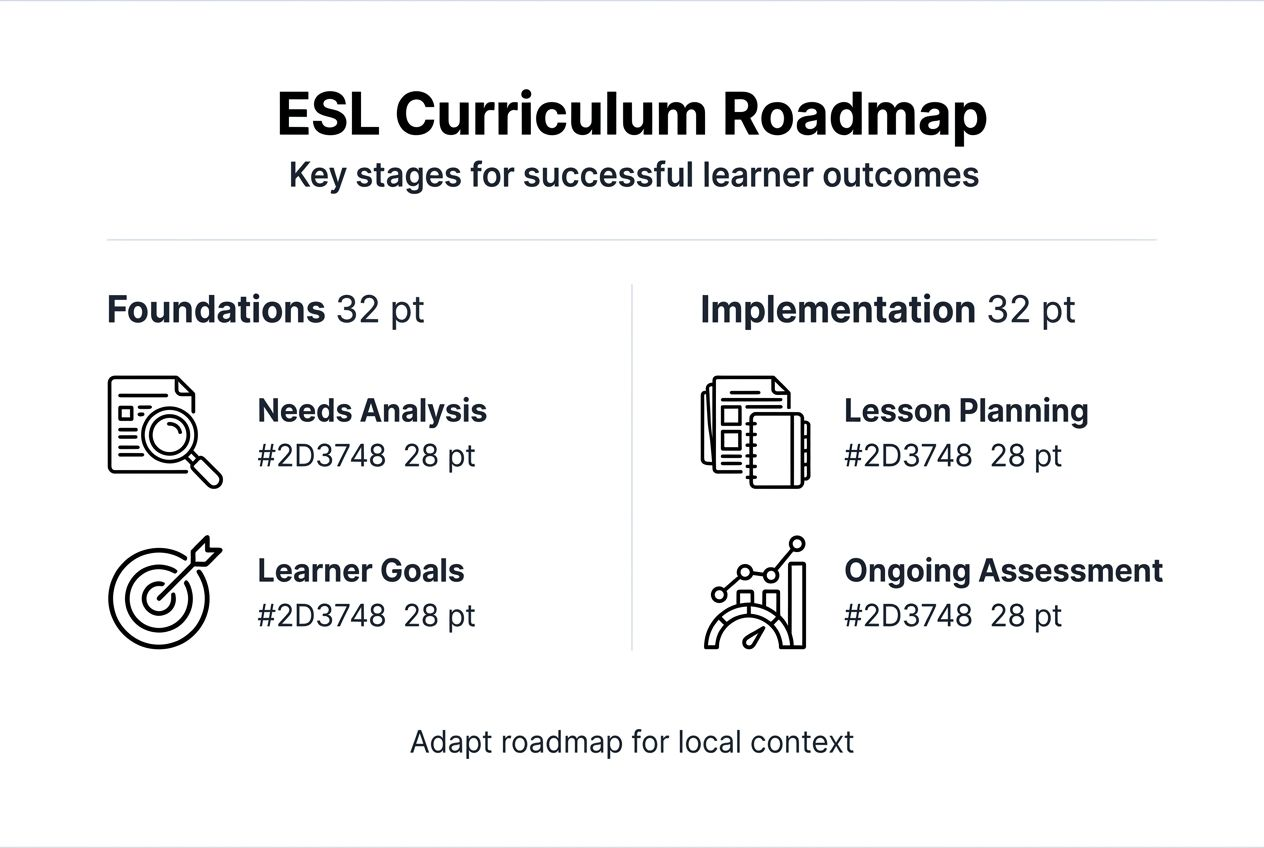
Your curriculum must function as a roadmap connecting learner needs with measurable outcomes. Without this foundation, programs drift toward unfocused activities that fail to build coherent language competence.
Pro Tip: Map your learner population demographics before designing curriculum to identify specific linguistic and cultural considerations that will shape your program.
Frameworks for systematic ESL curriculum design
Kathleen Graves developed an 8-step systems approach that creates adaptable, effective ESL curricula through iterative cycles. This framework aligns with second language acquisition theories while maintaining practical classroom application.
The eight steps create a continuous improvement cycle:
- Conduct comprehensive needs analysis examining learner backgrounds, goals, and contexts
- Define clear, measurable objectives tied to specific language competencies
- Develop conceptual frameworks connecting objectives to instructional sequences
- Design materials and activities supporting targeted outcomes
- Create assessment tools measuring progress toward objectives
- Implement curriculum with systematic observation and documentation
- Collect feedback from learners, instructors, and stakeholders
- Revise curriculum based on assessment data and feedback
This iterative process ensures your curriculum remains responsive to learner needs. Each cycle builds on previous implementations, refining materials and methods based on real classroom evidence.
| Design Phase | Key Actions | Success Indicators |
|---|---|---|
| Needs Analysis | Surveys, interviews, proficiency tests | Clear learner profiles with specific goals |
| Objective Setting | SMART goals aligned to standards | Measurable outcomes for each unit |
| Material Development | Authentic texts, scaffolded activities | Engagement and comprehension rates |
| Assessment Design | Formative and summative tools | Valid measures of language growth |
| Implementation | Systematic delivery with documentation | Consistent instructional quality |
| Revision | Data analysis and stakeholder input | Improved learner outcomes each cycle |
Incorporating this framework into your ESL lesson planning workflow creates coherence from program level to daily instruction. The systems approach prevents common pitfalls like activity-focused teaching without clear progression.
Pro Tip: Engage literacy specialists, cultural liaisons, and technology coordinators during initial planning to build richer, more inclusive curricula from the start.
Balancing language skill development
ESL learners need equal development across four language domains: reading, writing, speaking, and listening. Effective curricula balance instruction across these skills rather than prioritizing grammar in isolation.
The four domains work synergistically in communication:
- Reading builds vocabulary recognition and grammatical pattern awareness
- Writing reinforces grammar application and develops organizational skills
- Speaking practices real-time language production and pronunciation
- Listening develops comprehension and exposes learners to natural speech patterns
Overemphasizing grammar creates learners who pass tests but struggle with authentic communication. They know rules but can’t apply them fluently in conversation or writing.
| Grammar-Focused Curriculum | Communicative Curriculum |
|---|---|
| Isolated grammar drills and worksheets | Grammar taught through meaningful contexts |
| Vocabulary memorization from lists | Vocabulary acquired through authentic texts |
| Limited speaking practice | Regular interactive communication tasks |
| Focus on accuracy over fluency | Balance of accuracy and fluency development |
| Teacher-centered instruction | Learner-centered collaborative activities |
Integration techniques help develop skills simultaneously. Use reading passages as springboards for discussions and writing tasks. Have learners listen to podcasts, then summarize orally and in writing. Design projects requiring research, presentation, and written documentation.
Your effective ESL teaching methods should create natural connections between domains. Real-world communication always involves multiple skills working together, so your curriculum should mirror this reality.
Culturally responsive curriculum development
Culturally responsive teaching integrates students’ diverse backgrounds, experiences, and perspectives into curriculum design. This approach recognizes that language learning happens within cultural contexts and that honoring learner identities enhances engagement.

Inclusive curricula increase engagement by 20-30% because learners see themselves reflected in materials and activities. When content validates their experiences, motivation and participation rise significantly.
Key principles of culturally responsive ESL curriculum:
- Incorporate texts and media representing diverse cultures and perspectives
- Design activities that draw on learners’ home languages and cultural knowledge
- Create opportunities for learners to share their cultural expertise
- Address real-world issues relevant to learners’ communities
- Use assessment methods that accommodate diverse learning styles
Universal Design for Learning and scaffolding support inclusive, equitable ESL instruction. UDL provides multiple means of representation, expression, and engagement so all learners can access content. Scaffolding offers temporary support structures that gradually release as competence grows.
Scaffolding strategies include visual aids, sentence frames, peer collaboration, and strategic grouping. These supports help learners bridge the gap between current abilities and target performance without oversimplifying content.
Pro Tip: Build a library of culturally relevant materials representing your learners’ backgrounds, then rotate them regularly to maintain fresh connections between curriculum and lived experience.
Evidence-based instructional strategies
Research identifies specific teaching methods that significantly improve ESL learner outcomes. Explicit academic vocabulary instruction improves retention by 40% compared to hoping learners acquire words incidentally.
Explicit vocabulary teaching involves direct explanation of word meanings, multiple exposures in varying contexts, and practice using words in speaking and writing. This systematic approach accelerates acquisition of the academic vocabulary essential for content area success.
Proven instructional strategies for ESL contexts:
- Pre-teach critical vocabulary before reading or content instruction
- Use graphic organizers to visualize relationships between concepts
- Implement think-pair-share for structured peer interaction
- Provide sentence frames and language stems for productive practice
- Incorporate multimodal input through visual, auditory, and kinesthetic activities
- Design tasks requiring authentic language use for real purposes
Scaffolding and differentiation ensure all learners access challenging content. Provide leveled texts on the same topic, offer choice in assessment formats, and adjust task complexity based on proficiency. This maintains high expectations while supporting diverse entry points.
Interactive activities like role plays, debates, and collaborative projects create meaningful contexts for language practice. These tasks mirror real communication demands while providing structured opportunities to apply new skills.
Your ESL teaching aids should support these evidence-based strategies with materials designed for explicit instruction and scaffolded practice. Quality aids reduce preparation time while ensuring research-backed implementation.
Combining these effective ESL teaching methods creates a coherent instructional approach grounded in what actually works. Don’t rely on tradition or intuition when research shows clear paths to better outcomes.
Incorporating technology and digital tools
Technology transforms ESL instruction by enabling personalized learning, immersive practice, and instant feedback. Digital tools improve vocabulary acquisition by 25% and speaking fluency by 15% compared to traditional methods alone.
Types of technology enhancing ESL learning:
Every TEFL opening, salary and deadline that matters.
In your inbox every two weeks. Free, no spam, unsubscribe any time.
Teacher pay by country
New TEFL openings
Programme and visa dates
- AI-powered language apps providing adaptive practice and pronunciation feedback
- Virtual reality creating immersive cultural and conversational experiences
- Learning management systems organizing materials and tracking progress
- Interactive whiteboards supporting collaborative activities and multimedia presentation
- Video conferencing enabling authentic communication with global partners
- Digital storytelling tools building literacy through creative production
Technology supports differentiated instruction by allowing learners to work at individual paces on personalized content. Adaptive platforms adjust difficulty based on performance, ensuring appropriate challenge levels for each student.
Steps for effective technology integration:
- Identify specific learning objectives technology will support
- Select tools aligned with your curriculum goals and learner needs
- Provide explicit instruction on tool use before language tasks
- Design activities where technology enhances rather than replaces interaction
- Monitor engagement and learning outcomes to assess effectiveness
- Gather learner feedback on usability and value
Your ESL teaching tips 2025 should incorporate digital strategies that boost oral proficiency through apps providing conversation practice and pronunciation analysis. These innovative language teaching tools expand what’s possible in language instruction.
Balance is critical. Technology should complement face-to-face interaction, not replace it. The most effective programs blend digital tools with interpersonal communication that builds social language skills.
Assessment and continuous improvement in ESL curriculum
Systematic assessment drives curriculum refinement by revealing what works and what needs adjustment. Iterative revision increases learner outcomes by 20% yearly as programs respond to evidence rather than assumptions.
Formative assessment occurs during instruction to guide ongoing learning:
- Exit tickets capturing daily understanding
- Observation checklists tracking skill development
- Peer and self-assessments building metacognitive awareness
- Portfolio reviews documenting growth over time
Summative assessment measures achievement of major objectives through unit tests, performance tasks, and proficiency evaluations. These assessments validate whether curriculum objectives align with actual learning.
Curriculum evaluation tools help analyze program effectiveness. Self-check rubrics assess alignment between stated goals and implemented activities. Stakeholder surveys gather perspectives from learners, instructors, and administrators on strengths and gaps.
Collaborative curriculum planning enhances instructional alignment and student achievement by bringing diverse expertise to design and revision. When grade-level teams, specialists, and administrators work together, curricula benefit from multiple perspectives.
Collaborative practices include shared planning time, cross-classroom observations, data analysis meetings, and coordinated professional development. These structures ensure coherent instruction across classes and grade levels.
Continuous revision requires systematic data collection and analysis. Track proficiency growth, engagement indicators, and achievement gaps. Identify patterns suggesting needed adjustments in pacing, materials, or methods.
Schedule regular curriculum review cycles, not just end-of-year evaluations. Quarterly reviews allow mid-course corrections that benefit current learners rather than only future cohorts.
Common misconceptions in ESL curriculum development
Several persistent myths undermine ESL curriculum effectiveness. Grammar-centric methods produce weaker retention than communicative approaches that teach grammar within meaningful contexts.
Misconception one is that grammar mastery must precede communication. Reality shows learners develop grammar through meaningful use, not isolated drills. Communicative competence emerges from practicing language for real purposes.
Misconception two assumes all ESL learners need identical instruction. Diverse backgrounds, proficiency levels, and goals demand differentiated curriculum. One-size-fits-all approaches fail to meet specific needs and waste instructional time.
Misconception three treats cultural background as irrelevant to language learning. Culture and language intertwine inseparably. Ignoring cultural contexts creates disconnect between curriculum and learner identity, reducing engagement and relevance.
Common curriculum pitfalls and solutions:
- Pitfall: Activity-focused teaching without clear learning progression. Solution: Design backward from objectives to ensure activities serve specific goals.
- Pitfall: Overreliance on textbooks as complete curriculum. Solution: Supplement with authentic materials reflecting learner contexts.
- Pitfall: Neglecting oral language in favor of written work. Solution: Balance productive skills with regular speaking practice.
- Pitfall: Treating assessment as separate from instruction. Solution: Integrate formative assessment throughout daily teaching.
Understanding ESL teaching terminology helps avoid conceptual confusion that leads to flawed curriculum design. Clear definitions ensure your team shares understanding of key principles.
Emerging trends and practical applications
Current innovations are reshaping ESL curriculum design for 2026 and beyond. Social-emotional learning integration improves engagement and academic achievement by addressing whole-learner development.
SEL in ESL contexts helps learners build resilience, self-awareness, and relationship skills alongside language competence. Activities incorporate emotional vocabulary, conflict resolution practice, and collaborative problem-solving in the target language.
Collaborative curriculum frameworks bring together general education teachers, ESL specialists, and support staff to design integrated instruction. This coordination ensures language development happens across all content areas, not just in ESL classes.
Adaptive curriculum models use ongoing assessment data to modify pacing, materials, and methods for individual learners. Technology enables this personalization at scale, providing differentiated pathways through shared learning objectives.
Practical implementation steps:
- Start with pilot units testing new approaches before full adoption
- Build teacher capacity through targeted professional development
- Establish data systems tracking curriculum effectiveness metrics
- Create collaborative time for planning and revision
- Engage learners as partners providing feedback on curriculum relevance
Culturally sensitive, adaptive models recognize that effective ESL curriculum evolves continuously. Static programs quickly become outdated as learner populations, research findings, and educational contexts change.
Your curriculum development process should anticipate this evolution by building in regular review cycles and flexibility for mid-course adjustments. Future-ready programs embrace change as opportunity for improvement.
Advance your ESL expertise with TEFL Institute
Transforming ESL curriculum requires deep understanding of language acquisition, instructional design, and cultural responsiveness. TEFL Institute offers accredited TEFL courses equipping educators with evidence-based strategies for curriculum development and classroom instruction.
Our programs cover systematic curriculum design, differentiated instruction, assessment literacy, and technology integration. Whether you’re developing new curricula or refining existing programs, specialized training strengthens your capacity to create transformative learning experiences.
Explore TEFL courses in New York City combining theoretical foundations with practical application. Gain hands-on experience through our TEFL internships opportunities that connect learning to real classroom contexts. Advance your expertise and improve outcomes for diverse ESL learners.
Frequently asked questions
What is the most effective ESL curriculum development framework?
The 8-step systems approach by Kathleen Graves is widely recommended for its iterative, adaptable design. It includes learner analysis, objective setting, material development, assessment, and continuous revision based on feedback. This framework aligns with second language acquisition research while remaining practical for classroom implementation.
How can ESL curricula address diverse learner needs?
Incorporate culturally relevant materials and Universal Design for Learning principles to honor diverse backgrounds and learning styles. Use scaffolding, differentiated instruction, and formative assessments to tailor experiences. Provide multiple pathways to objectives while maintaining high expectations for all learners.
What role does technology play in ESL curriculum?
AI language apps and virtual reality provide immersive, interactive practice with instant feedback. Technology supports personalized learning by adapting to individual proficiency levels and pacing. Digital tools increase motivation, enable authentic communication with global partners, and expand access to diverse learning materials.
Why is continuous assessment important in ESL programs?
Continuous assessment identifies learner progress and curriculum gaps in real time, enabling immediate instructional adjustments. It provides data-driven evidence for curriculum revisions that improve outcomes. Regular assessment also builds learner metacognition and helps programs adapt to changing student needs and educational contexts.
Recommended
- ESL Teaching Tips 2025: Boost Oral Proficiency by 40% | TEFL Institute
- Online ESL teaching types: A guide for educators in 2026 | TEFL Institute
- 7 Essential Teaching ESL Resources for Global Success | TEFL Institute
- What Is an ESL Resource? 35% Higher Student Retention | TEFL Institute
- Defining brain training terms for vocabulary games
- The Categories Game for Kids and Classrooms | Lexiloot App
Tara and Jess talk through different TEFL and EFL topics, from finding work abroad to life in the classroom.