

 United Kingdom (UK)
 United States (US)
 Canada
 South Africa
 India
India Australia
 New Zealand
 China
China Russia
 Germany
 France
 Spain
Spain Netherlands
 Vietnam
 United Arab Emirates
 Italy
Italy Poland
 Thailand
 Türkiye





 Algeria


What Is a Teaching Assistant? Roles and Requirements
What Is a Teaching Assistant? Roles and Requirements

TL;DR:
- A teaching assistant supports licensed teachers by providing instructional, behavioral, and administrative support across various school settings.
- The role enhances student learning outcomes, especially through personalized attention and detailed documentation, with qualifications varying by district and role.
A teaching assistant is a classroom professional who works under a licensed teacher to support student learning, manage behavior, and handle administrative tasks across K-12, special education, and early childhood settings. Known formally as a paraprofessional or paraeducator in legal and federal education contexts, the role is far more structured and skill-dependent than most people assume. Whether you are considering a career in education or simply want to understand how classrooms function, the teaching assistant position is one of the most direct entry points into the profession.
What is a teaching assistant and what do they do?
A teaching assistant, also called a paraprofessional or paraeducator, is defined by the U.S. Bureau of Labor Statistics as a school employee who supports licensed teachers through instructional reinforcement, student supervision, and recordkeeping. The role exists across general education classrooms, special education programs, and early childhood centers. This breadth makes it one of the most versatile positions in any school building.
The core function of the role is to extend the reach of the lead teacher. When a teacher delivers a whole-class lesson, the teaching assistant works with students who need additional explanation, monitors off-task behavior, and prepares materials for the next activity. This division of labor allows the classroom to function at a higher instructional capacity than a single teacher could manage alone.
The terms “teaching assistant,” “teacher assistant,” and “paraprofessional” are often used interchangeably, but the distinctions matter for career planning. “Paraprofessional” is the formal legal designation tied to Title I and special education regulations, while “teaching assistant” is the operational title used in day-to-day school settings. Understanding which term a district uses tells you a great deal about the legal framework governing the position.
What are the primary responsibilities of a teaching assistant?
Teaching assistant responsibilities span three broad categories: instructional support, behavioral supervision, and administrative tasks. Each category carries real weight in the daily operation of a classroom, and most TAs move between all three within a single school day.

Instructional duties form the core of the job. A TA reinforces lessons through small group sessions, provides one-on-one support for students who are struggling, and adapts materials under the direction of the lead teacher. In special education settings, TAs also document student progress toward Individualized Education Program goals, a legally mandated task that requires precision and consistency.
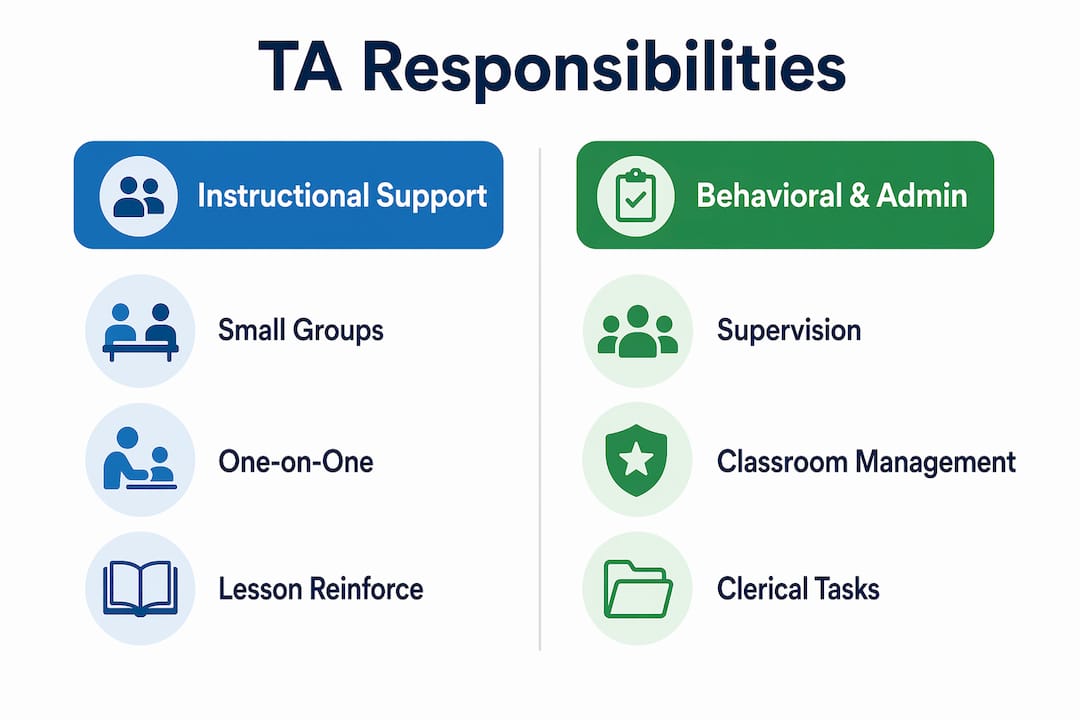
Behavioral supervision extends well beyond the classroom. Teaching assistants oversee students during recess, field trips, and lunch periods, maintaining safety and order in unstructured environments where incidents are most likely to occur. This aspect of the role demands situational awareness and calm decision-making under pressure.
Administrative responsibilities round out the teaching assistant job description. These include taking attendance, assisting with grading, organizing classroom materials, and maintaining behavioral logs. In special education, detailed and objective documentation of student behavior is not optional. It is a core legal requirement.
Common teaching assistant responsibilities include:
- Reinforcing lessons in small groups or one-on-one sessions
- Preparing instructional materials and classroom resources
- Supervising students during non-classroom periods
- Recording attendance and assisting with grading
- Documenting behavioral incidents and IEP goal progress
- Supporting students with physical, behavioral, or medical needs
- Communicating student observations to the lead teacher
Pro Tip: Ask during any job interview how the TA role is divided between direct instruction and behavioral supervision. The answer reveals the actual daily experience of the position far better than any job posting.
What qualifications are needed to become a teaching assistant?
Federal Title I guidelines set the baseline for how to become a teaching assistant in U.S. public schools. Candidates must meet one of three criteria: complete at least two years of post-secondary education, hold an associate degree, or pass a state-approved assessment of reading, writing, and math competency. These requirements apply specifically to Title I schools, but many districts adopt them as a universal standard.
State and district requirements add another layer of complexity. Some states require a specific teaching assistant license or certificate, while others mandate only a high school diploma plus on-the-job training. Special education roles frequently require additional certifications, and nearly all positions require a background check before employment begins.
The table below summarizes the most common qualification paths:
| Qualification path | Requirements | Typical setting |
|---|---|---|
| Associate degree | Two-year college degree in any field | General K-12 classrooms |
| Two years of college | Minimum 60 credit hours of post-secondary coursework | Title I public schools |
| State competency exam | Pass district or state-approved assessment | Title I public schools |
| Special education certification | Additional coursework or state credential | Special education programs |
| Background check | Required in virtually all U.S. states | All school settings |
The distinction between “teaching assistant” and “paraprofessional” also affects which legal requirements apply. Paraprofessionals working in Title I programs are subject to federal No Child Left Behind and IDEA compliance standards, while general classroom assistants in non-Title I schools may face fewer formal requirements. Clarifying this before applying saves significant time and prevents mismatched expectations.
How do teaching assistants impact student learning?
Research confirms that teaching assistants improve student outcomes by enabling more personalized instruction and creating greater psychological safety in the classroom. When a student who is confused about a math concept can receive immediate one-on-one attention from a TA rather than waiting for the teacher to finish with the whole class, learning gaps close faster. This is not a marginal effect. It is a structural advantage that well-deployed TAs provide consistently.
The impact is especially pronounced in special education. TAs serve as frontline observers who notice behavioral patterns, track IEP goal progress, and relay critical information to lead teachers and specialists. This function makes them indispensable to the legal and instructional compliance of special education programs, not simply helpful additions to the classroom.
A common misconception is that TAs are passive helpers who simply keep students occupied. Education research disputes this directly. Effective TAs align with lead teacher philosophies and adapt dynamically to student needs, functioning as active instructional partners rather than supervisory staff. The role of a TEFL teacher offers a parallel example of how structured instructional support drives measurable learning gains.
“Instructional aides act as critical contributors ensuring that no student is left behind, directly improving classroom instructional capacity and student learning outcomes.” — PMC Educational Research
Pro Tip: TAs who proactively communicate student observations to the lead teacher at the end of each day build stronger instructional partnerships and become far more effective over time. Treat that daily debrief as a professional obligation, not an informal chat.
What are the different types of teaching assistant roles?
The role of a teaching assistant is not uniform. Titles, responsibilities, and settings vary considerably depending on the student population and school context. Understanding these distinctions is critical for anyone evaluating a teaching assistant job description before applying.
| Role type | Primary focus | Typical setting |
|---|---|---|
| General instructional aide | Lesson reinforcement, material prep | General K-12 classrooms |
| Special education aide | IEP support, behavioral documentation | Special education programs |
| Behavioral support aide | De-escalation, behavioral intervention plans | Inclusion or self-contained classrooms |
| One-on-one aide | Direct support for a single student with disabilities | Any school setting |
| Medical support aide | Health monitoring, physical assistance | Schools with medically complex students |
General instructional aides work across subject areas and grade levels, supporting the lead teacher with lesson delivery and classroom management. Special education aides focus on students with Individualized Education Programs, managing both instructional and documentation responsibilities. Behavioral support aides specialize in de-escalation and the implementation of behavioral intervention plans, a role that requires specific training in applied behavior analysis or similar frameworks.
One-on-one aides are assigned to a single student with a significant disability, providing continuous direct support throughout the school day. This is among the most demanding TA configurations because the aide must balance the student’s needs against the broader classroom environment. Teaching assistant specializations often blur in practice, with many TAs performing duties across multiple categories depending on the day.
What does a typical day look like for a teaching assistant?
A teaching assistant’s day is rarely linear. The unpredictability of daily tasks is one of the defining features of the role, requiring emotional intelligence, behavior management skills, and the ability to reprioritize competing responsibilities without losing focus. A TA might begin the morning preparing reading materials, shift to supporting a small group during literacy instruction, respond to a behavioral incident before lunch, and spend the afternoon documenting IEP progress notes.
Emotional intelligence is not a soft skill in this context. It is a functional requirement. TAs who can read a student’s emotional state accurately and respond with appropriate support prevent minor disruptions from escalating into significant incidents. This capacity directly affects the instructional time available to the entire class.
The top skills that define effective teaching assistants are:
- Communication — Clear, consistent communication with lead teachers, students, and parents
- Flexibility — Ability to shift between instructional, behavioral, and administrative tasks without friction
- Organization — Managing documentation, materials, and schedules across multiple students or groups
- Emotional intelligence — Recognizing and responding to student emotional states accurately
- Collaborative mindset — Functioning as a genuine partner to the lead teacher rather than an independent operator
Cultural sensitivity also belongs on this list, particularly in diverse school environments where students come from varied linguistic and cultural backgrounds. TAs who understand how cultural context shapes student behavior and learning are better equipped to provide meaningful support.
Key takeaways
A teaching assistant is a trained classroom professional whose impact on student learning depends directly on the quality of their instructional partnership with the lead teacher.
| Point | Details |
|---|---|
| Core role definition | TAs work under licensed teachers to provide instructional, behavioral, and administrative support. |
| Federal qualifications | Title I schools require an associate degree, two years of college, or a passing state competency exam. |
| Specialization matters | Roles range from general instructional aide to one-on-one disability support, each with distinct duties. |
| Research-backed impact | TAs improve student outcomes by enabling personalized instruction and psychological safety. |
| Key career skill | Emotional intelligence and adaptability are the most critical functional skills for TA effectiveness. |
The value of adaptability in this role
From my perspective, the most underestimated quality in a successful teaching assistant is the willingness to treat unplanned situations as the actual job rather than interruptions to it. Most people entering this career expect a structured schedule with predictable tasks. The reality is that the most valuable TAs are the ones who respond to a student’s unexpected emotional breakdown, a sudden change in lesson plans, or a behavioral escalation with the same composure they bring to a planned small group session.
The partnership with the lead teacher is also more consequential than most job descriptions convey. TAs who take time to understand the lead teacher’s instructional philosophy, communication preferences, and classroom management approach become genuinely effective within weeks. Those who treat the role as a series of assigned tasks without that relational investment tend to plateau quickly.
The career also offers real growth potential that is frequently overlooked. Many lead teachers, school counselors, and special education coordinators began their careers as teaching assistants. The classroom exposure, student relationship experience, and institutional knowledge gained in this role are difficult to replicate through coursework alone. If you are serious about a career in education, starting as a TA is one of the most direct and practical paths available.
— Muller
Start building your education career with Teflinstitute
If you are considering a career in education, formal instructional training gives you a measurable advantage over candidates with no classroom preparation. Teflinstitute offers accredited online TEFL courses that build the instructional skills directly applicable to teaching assistant and broader education roles.

The 120 Hour Elective TEFL Course provides foundational training in lesson delivery, student engagement, and classroom management. For those aiming at more advanced qualifications, the 240 Hour Master TEFL Course offers externally accredited, comprehensive training that signals serious professional commitment to any hiring school. Both courses are completed online and designed for working adults who need flexibility without sacrificing rigor.
FAQ
What is a teaching assistant in simple terms?
A teaching assistant is a school employee who works under a licensed teacher to support student learning, manage classroom behavior, and handle administrative tasks. The role is also formally called a paraprofessional or paraeducator in federal education law.
What qualifications do you need to become a teaching assistant?
Federal Title I guidelines require at least two years of college, an associate degree, or a passing score on a state-approved competency exam. Additional state licensing, background checks, or special education certifications may also apply depending on the district and role type.
What is the difference between a teaching assistant and a paraprofessional?
“Paraprofessional” is the formal legal term used in Title I and special education regulations, while “teaching assistant” is the common operational title used in schools. Both refer to the same general role, but the legal designation affects which federal compliance standards apply.
How does a teaching assistant support students with disabilities?
In special education settings, TAs provide one-on-one instructional support, implement behavioral intervention plans, and document student progress toward IEP goals. This documentation is legally mandated and forms a critical part of a student’s educational record.
Can being a teaching assistant lead to a full teaching career?
Many licensed teachers, school counselors, and special education coordinators began as teaching assistants. The role provides direct classroom experience, student relationship skills, and institutional knowledge that accelerates professional development in education.
