

 United Kingdom (UK)
 United States (US)
 Canada
 South Africa
 India
India Australia
 New Zealand
 China
China Russia
 Germany
 France
 Spain
Spain Netherlands
 Vietnam
 United Arab Emirates
 Italy
Italy Poland
 Thailand
 Türkiye





 Algeria


What Is the Grammar Translation Method? A Teacher’s Guide
What Is the Grammar Translation Method? A Teacher’s Guide

TL;DR:
- The Grammar Translation Method emphasizes explicit grammar rules and translation exercises while neglecting speaking and listening skills. It originated from classical Latin and Greek instruction, focusing on reading and writing rather than conversational fluency. Although still used in some contexts, GTM is criticized for prioritizing declarative knowledge over practical language use.
The Grammar Translation Method (GTM) is a traditional language teaching technique that uses explicit grammar rules and translation exercises as the primary means of learning a foreign language. GTM prioritizes reading and writing over speaking and listening, treating formal accuracy as the central measure of language competence. Originating from classical instruction in Latin and Ancient Greek, it remains one of the most widely recognized approaches in language education history. For educators, student-teachers, and linguists, understanding GTM is foundational to grasping why modern methods like Communicative Language Teaching (CLT) and Total Physical Response (TPR) exist at all.
What is the grammar translation method and how does it work?
The Grammar Translation Method is defined by deductive grammar teaching, meaning rules are presented first and then applied through structured exercises. Students do not discover grammar through exposure. They receive explicit rule explanations, memorize them, and practice by translating sentences or passages between their native language (L1) and the target language (L2).
GTM classrooms follow a predictable structure. A typical lesson moves through these stages:
- Grammar rule presentation: The teacher explains a rule in the students’ native language, often with a formal definition and paradigm table.
- Vocabulary study: Students memorize bilingual word lists, usually drawn from literary or classical texts.
- Reading passage: Students read an excerpt from a formal or literary source in the target language.
- Translation exercises: Students translate the passage from L2 to L1, then construct new sentences translating from L1 to L2.
- Grammar analysis: Students identify grammatical structures within the text and label them according to the rules taught.
- Written assessment: Success is measured by formal accuracy in translation and grammar analysis, not by oral performance.
Oral communication receives almost no attention in a GTM classroom. Listening exercises are rare. Speaking practice is essentially absent. The teacher holds authority as the source of grammatical knowledge, and student interaction is limited to written responses.
Pro Tip: If you teach in a context where students must pass grammar-heavy standardized exams, GTM techniques like structured translation drills and explicit rule instruction can directly prepare students for those assessments. Pair them with at least one communicative activity per lesson to prevent skill gaps.

The method’s reliance on the native language as the medium of instruction is one of its most distinctive features. GTM permits native language use when explaining target language structures, which contrasts sharply with immersive approaches that prohibit L1 in the classroom entirely.
How did the grammar translation method develop historically?
GTM originated in the teaching of Ancient Greek and Latin, languages studied not for conversation but for access to classical literature and scholarly texts. The goal was never communicative fluency. It was reading comprehension and intellectual rigor.
Key developments in GTM’s historical arc include:
- Pre-18th century: Latin and Greek were taught through grammar memorization and translation of canonical texts like Virgil and Cicero. The method was purely functional for scholarly access.
- 18th–19th centuries: GTM became dominant in European education as modern languages like French and German entered school curricula. Educators applied the same classical framework to living languages, even though those languages were used for real communication.
- Late 19th century: Reform movements began challenging GTM’s dominance, arguing that living languages required oral instruction. The Direct Method emerged as an early alternative.
- 20th century onward: Despite the rise of CLT, Audio-Lingual Method, and immersive approaches, GTM persisted in many national curricula, particularly in Asia, Eastern Europe, and Latin America.
“GTM classes aim to develop reading ability and mental discipline rather than communicative skills. The mental discipline goal explains GTM’s longevity despite the loss of practical language use for Latin and Greek.” — Wikipedia on Grammar Translation Method
This framing of language learning as mental discipline, comparable to the rigor of mathematics, explains why GTM survived long after Latin ceased to be a spoken language. GTM historically aimed to train the mind through grammatical analysis, not just to teach a language. That rationale gave it institutional staying power in academic settings where intellectual rigor was valued above practical fluency.
Many modern language textbooks still reflect GTM’s influence. Grammar-centered chapter organization persists even in textbooks that claim a communicative approach, because GTM’s structural logic is deeply embedded in how publishers and curriculum designers organize language content.
What are the advantages and criticisms of GTM in modern education?
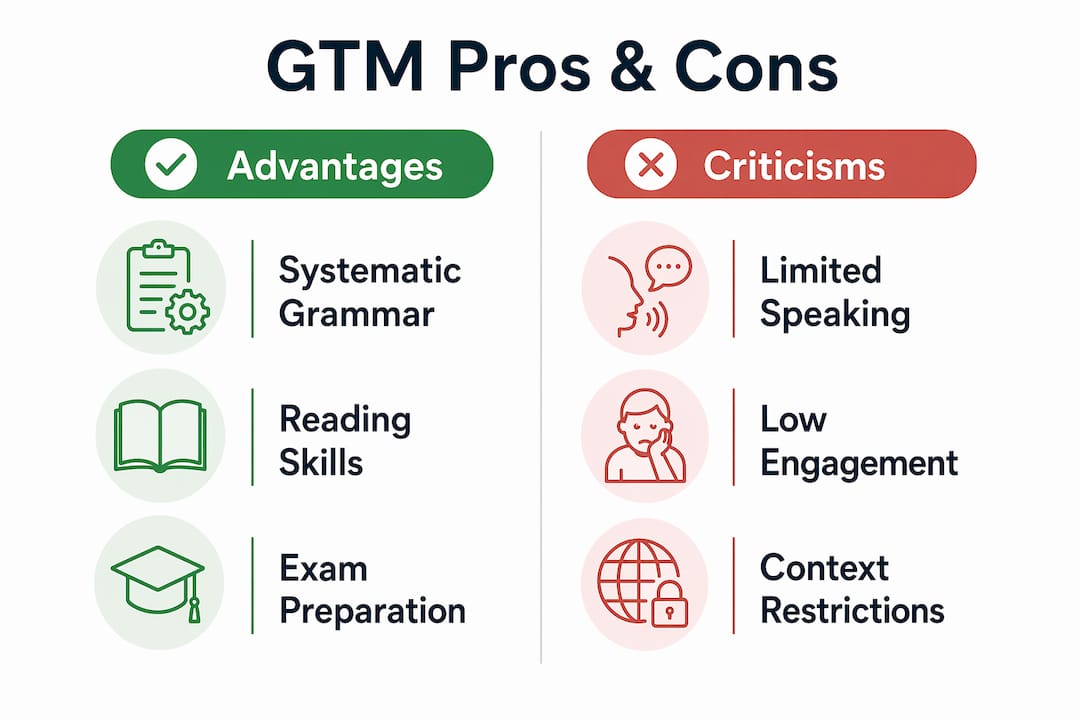
GTM offers genuine benefits in specific teaching contexts, but its limitations are well-documented. The table below presents a direct comparison.
| Dimension | Advantages | Criticisms |
|---|---|---|
| Grammar knowledge | Builds systematic, explicit understanding of rules | Overemphasizes prescriptive rules at the expense of natural use |
| Reading and writing | Develops strong formal literacy skills | Neglects listening and speaking entirely |
| Classroom management | Teacher-centered structure is predictable and orderly | Limits student interaction and engagement |
| Assessment | Easy to measure through written tests | Does not assess real communicative competence |
| Academic preparation | Prepares students for grammar-based exams | Poor preparation for real-world language use |
The most significant criticism of GTM is conceptual. GTM confuses “knowing about” language with “knowing” how to use it spontaneously. A student can correctly label every clause in a Latin sentence and still be unable to order a coffee in French. This distinction between declarative knowledge (facts about grammar) and procedural knowledge (ability to use language in real time) is central to modern applied linguistics.
Debate continues regarding GTM’s value in language teaching today, particularly in academic contexts where reading comprehension and formal writing are the primary goals. For a university student studying classical literature or a researcher accessing foreign-language academic papers, GTM’s emphasis on reading accuracy and translation precision is directly relevant.
Pro Tip: GTM works best as a supplementary tool rather than a sole method. Use it to teach complex grammatical structures explicitly, then follow up with CLT activities that require students to deploy those structures in conversation. This combination addresses both declarative and procedural knowledge.
The risk of disengagement is real. GTM lessons built entirely around grammar drills and translation passages can feel disconnected from authentic language use, particularly for younger learners or those motivated by travel and communication. Educators using GTM should supplement with engaging classroom activities that connect grammar knowledge to real-world contexts.
Grammar translation vs. communicative language teaching: key differences
Every modern pedagogical movement toward communicative teaching arose partly as a reaction to GTM’s perceived failures. Understanding what GTM does not do clarifies why CLT, TPR, and immersive methods were developed.
The core differences between GTM and the communicative approach include:
- Primary skill focus: GTM targets reading and writing. CLT targets speaking and listening as primary skills, treating grammar as a means to communication rather than an end in itself.
- Classroom language: GTM permits and often requires the native language. CLT minimizes L1 use, pushing students to think and respond in the target language.
- Error treatment: GTM treats errors as failures of rule application, corrected immediately and formally. CLT treats errors as natural parts of fluency development, often corrected indirectly.
- Assessment: GTM assesses grammar accuracy and translation quality. CLT assesses communicative competence through tasks, role plays, and real-world simulations.
- Teacher role: GTM positions the teacher as the authority who transmits knowledge. CLT positions the teacher as a facilitator who creates conditions for student interaction.
- Text type: GTM uses classical or literary texts. CLT uses authentic materials like news articles, podcasts, and everyday conversations.
A hybrid approach can be effective in specific contexts. Academic English programs, for example, often combine explicit grammar instruction drawn from GTM traditions with communicative writing tasks. Students learn the rule, then apply it in a paragraph or essay. This mirrors how many effective ESL teaching methods integrate multiple methodologies rather than committing to a single approach.
GTM’s influence on modern materials is also worth noting. Modern textbooks’ grammar-centered organization often derives from GTM traditions, even when the stated pedagogical approach is communicative. This structural legacy means that teachers using mainstream textbooks are often applying GTM principles without recognizing them as such.
Key takeaways
The Grammar Translation Method remains a foundational framework in language education, offering systematic grammar instruction while requiring deliberate supplementation to develop communicative competence.
| Point | Details |
|---|---|
| GTM definition | GTM teaches language through explicit grammar rules and L1-to-L2 translation exercises. |
| Historical origin | GTM developed from classical Latin and Greek instruction and dominated European education through the 19th century. |
| Core limitation | GTM builds declarative grammar knowledge but does not develop spontaneous communicative ability. |
| Enduring influence | Grammar-first textbook structures reflect GTM traditions even in communicative teaching contexts. |
| Practical application | GTM works best as a supplementary tool for grammar instruction, paired with communicative activities. |
Gtm’s place in the classroom: a practitioner’s view
I have spent years working with educators who either dismiss GTM outright or rely on it exclusively. Both positions miss the point. GTM is not a failed method. It is a method with a specific, narrow purpose that has been misapplied to broader goals it was never designed to achieve.
The honest assessment is this: GTM delivers exactly what it promises. Students who go through rigorous GTM instruction develop strong analytical grammar skills and solid reading comprehension in the target language. Those are real, measurable outcomes. The problem arises when those outcomes are treated as sufficient for language proficiency. They are not.
What I find most instructive about GTM is what it reveals about the assumptions behind language teaching. When you understand GTM’s logic, you understand why CLT was a necessary correction. You also understand why CLT alone is insufficient for learners who need to write formal academic prose or analyze complex texts. No single method covers every skill. GTM’s value in 2026 is not as a standalone approach. It is as a precise instrument for grammar instruction within a broader, more balanced pedagogical framework.
For student-teachers especially, studying GTM is not an exercise in learning what not to do. It is an exercise in understanding the full spectrum of language teaching tools available to you. The educators who teach most effectively are those who can draw from multiple traditions deliberately, not those who have committed to one camp.
— Muller
Deepen your teaching practice with Teflinstitute
Teflinstitute offers professional TEFL courses designed for educators who want to teach with both historical understanding and modern skill. Whether you are new to language teaching or an experienced instructor looking to formalize your knowledge, Teflinstitute’s programs cover grammar instruction, methodology, and practical classroom application.
The 120 Hour Advanced TEFL Course covers a broad range of teaching methodologies, including grammar-focused instruction and communicative approaches. For educators seeking the most thorough preparation, the 240 Hour Master TEFL Course provides externally accredited certification with in-depth coverage of language teaching theory and practice. Both programs are fully online and designed to fit around your existing schedule.
FAQ
What is the grammar translation method in simple terms?
The Grammar Translation Method is a language teaching approach that focuses on learning grammar rules explicitly and practicing through translation between the native and target languages. It prioritizes reading and writing over speaking and listening.
What are the main advantages of the grammar translation method?
GTM builds systematic grammar knowledge, develops formal reading and writing skills, and prepares students for grammar-based academic assessments. It provides a clear, structured framework for understanding complex grammatical structures.
How does GTM differ from communicative language teaching?
GTM focuses on formal accuracy, written translation, and grammar analysis, while CLT prioritizes oral fluency, real-world communication tasks, and target-language immersion. The two methods assess different skills and use different classroom activities.
Is the grammar translation method still used today?
GTM remains widely practiced globally, particularly in Asia, Eastern Europe, and Latin America. Many mainstream language textbooks still reflect GTM’s grammar-first organizational structure, even when the stated approach is communicative.
What is the biggest criticism of the grammar translation method?
The central criticism is that GTM confuses knowing about a language with knowing how to use it. Students may master grammar rules and translation exercises but remain unable to communicate spontaneously in the target language.
