

 United Kingdom (UK)
 United States (US)
 Canada
 South Africa
 India
India Australia
 New Zealand
 China
China Russia
 Germany
 France
 Spain
Spain Netherlands
 Vietnam
 United Arab Emirates
 Italy
Italy Poland
 Thailand
 Türkiye




 Algeria


How to prepare for IELTS tutoring: steps for exam success
How to prepare for IELTS tutoring: steps for exam success

TL;DR:
- Effective IELTS preparation requires understanding the exam structure and targeted practice.
- Organizing resources and structuring sessions around specific weaknesses increases success.
- Consistent analysis of errors and tutor feedback accelerates band score improvements.
Many students invest significant time and money into IELTS tutoring without first understanding how to make those sessions productive. The problem is rarely a lack of English ability. More often, it is a lack of direction: not knowing what the exam demands, what materials to bring, or how to structure learning around real weaknesses. Effective preparation before and during tutoring transforms each session from a general English lesson into a targeted, efficient path toward your band score goal. This guide walks through the essential steps to prepare for IELTS tutoring, organize your resources, structure your sessions, and overcome common obstacles along the way.
Table of Contents
- Understanding the IELTS exam structure and requirements
- Gathering resources and setting expectations
- Structuring your tutoring sessions for maximum impact
- Troubleshooting common challenges in IELTS tutoring
- A tutor’s advice: What makes IELTS preparation truly effective
- Take your IELTS preparation to the next level
- Frequently asked questions
Key Takeaways
| Point | Details |
|---|---|
| Know the exam | Understanding the IELTS format is essential for targeted tutoring sessions. |
| Choose the right resources | Select study materials that match your learning style and objectives for IELTS success. |
| Plan your sessions | Strategic session planning ensures you make steady progress and cover all language skills. |
| Address common challenges | Anticipate issues like anxiety and plateaus so you can stay motivated and improve faster. |
Understanding the IELTS exam structure and requirements
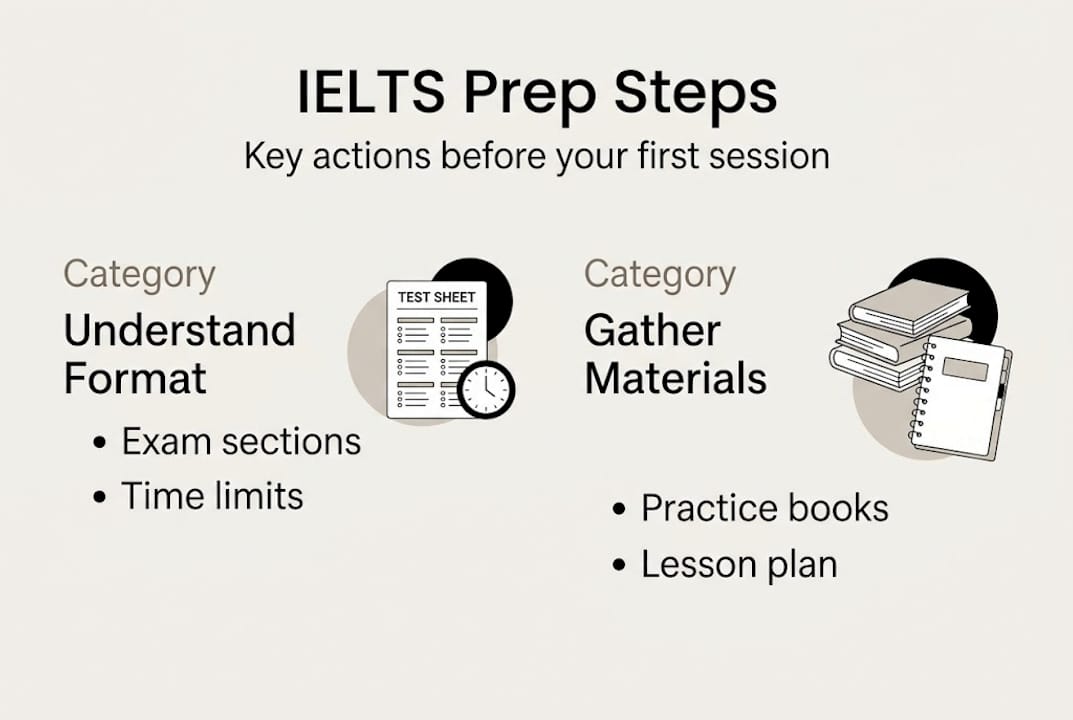
Before your first tutoring session, you need a clear picture of what IELTS exam sections actually involve. The exam is divided into four components: Listening, Reading, Writing, and Speaking. Each section tests a distinct set of skills under timed conditions, and your tutor will need to know where you stand in each area from the start.
The official IELTS format breaks down as follows:
| Section | Duration | Task types |
|---|---|---|
| Listening | 30 minutes | Multiple choice, matching, form completion |
| Reading | 60 minutes | True/False/Not Given, short answer, matching headings |
| Writing | 60 minutes | Task 1 (graph/letter) and Task 2 (essay) |
| Speaking | 11 to 14 minutes | Interview, long turn, discussion |
The exam also comes in two versions. The Academic version is required for university admission and professional registration. The General Training version is used for migration and workplace purposes. While Listening and Speaking are identical across both, Reading and Writing tasks differ significantly. Knowing which version you need determines the specific skills your tutor should prioritize.
Understanding what IELTS measures goes beyond memorizing the format. The exam evaluates how well you use English in real contexts, not just whether you know grammar rules. Scores are reported on a band scale from 1 to 9, with most universities and immigration bodies requiring a minimum of 6.0 to 7.5 depending on the program.
Core skills tested and approximate time allocation:
- Listening: Identifying key information, understanding context and speaker intent
- Reading: Skimming for gist, scanning for detail, inferring meaning
- Writing: Organizing ideas logically, using appropriate register and vocabulary
- Speaking: Fluency, coherence, lexical range, and pronunciation accuracy
As noted in guidance on IELTS assessment, IELTS assesses listening, reading, writing, and speaking as integrated competencies, not isolated grammar points.
Pro Tip: Download the official IELTS band descriptors before your first tutoring session. Review each criterion for Writing and Speaking and honestly rate yourself. This gives your tutor a starting point and saves valuable session time.
Gathering resources and setting expectations
With a clear picture of the exam, let’s focus on assembling everything you need and setting your goals for tutoring. As outlined in recommended IELTS resources, the right materials and resources make structured tutoring possible. Without them, even the most skilled tutor cannot build a consistent learning plan.

The core materials every student should gather before starting tutoring include official Cambridge IELTS practice books (series 1 through 18), the official IELTS website’s free sample tests, and a dedicated vocabulary notebook. Digital tools such as the British Council’s preparation platform and apps like IELTS Prep App supplement written practice with audio and interactive tasks.
Different learners absorb information differently. Use this comparison to match resources to your learning style:
| Resource type | Best for | Examples |
|---|---|---|
| Textbooks and workbooks | Visual learners | Cambridge IELTS series, Barron’s IELTS |
| Podcasts and audio tests | Auditory learners | IELTS Listening practice recordings |
| Flashcards and mind maps | Kinesthetic learners | Anki vocabulary decks, hand-drawn topic maps |
| Video lessons | Mixed learners | YouTube IELTS channels, online course modules |
The British Council preparation advice also recommends familiarizing yourself with task instructions before sitting any timed practice test, as misreading instructions is one of the most preventable sources of lost marks.
Setting realistic expectations matters just as much as gathering materials. Tutoring accelerates progress, but it does not replace independent study. Most candidates need between 150 and 300 hours of total preparation time, depending on their starting level. Your tutor can guide and correct, but consistent daily practice between sessions is what drives improvement.
Items to bring to your first IELTS tutoring session:
- A completed diagnostic or practice test (even if unofficial)
- Notes on your target band score and application deadline
- A list of specific problem areas you have already noticed
- A dedicated notebook for session notes and vocabulary
- Any previous English test results or school transcripts
Reviewing IELTS lesson plan examples can also help you understand how structured sessions are typically organized, so you arrive with realistic expectations about pacing and content.
Structuring your tutoring sessions for maximum impact
With your materials ready, it is time to strategically structure each tutoring session for the best results. Lesson planning is key to effective IELTS study, and students who arrive with a clear agenda consistently outperform those who rely on their tutor to decide everything.
A practical session blueprint follows this sequence:
- Pre-session review (10 minutes): Go over feedback and corrections from the previous session. Identify one specific goal for today.
- Skills focus (25 minutes): Target one IELTS section in depth. Rotate through Listening, Reading, Writing, and Speaking across sessions rather than covering everything at once.
- Timed practice task (15 minutes): Complete one authentic task under exam conditions. This builds both skill and time management.
- Feedback and analysis (10 minutes): Your tutor reviews your responses in detail. Note patterns in your errors, not just individual mistakes.
Dividing time across all four skills requires a strategic approach. Writing and Speaking tend to demand the most individualized feedback, so weight those sections more heavily in early sessions. As you improve, shift focus toward the sections where your band score still falls short of your target.
“The most effective IELTS preparation happens when students treat tutor feedback as data, not just correction. Each piece of feedback reveals a pattern that, once addressed, raises performance across multiple tasks.”
IELTS tutoring tips consistently emphasize the value of reviewing past errors systematically rather than moving on to new content before old issues are resolved.
The Cambridge IELTS preparation guide also recommends practicing under timed conditions regularly, as many candidates who perform well in relaxed practice underperform on test day due to time pressure.
Pro Tip: Before each session, write down two or three specific questions based on recent practice. For example: “Why did I lose marks on Task 2 coherence?” or “How do I improve my score on matching headings?” Specific questions lead to specific answers and faster improvement.
Troubleshooting common challenges in IELTS tutoring
Even with solid structure, challenges can arise. Knowing how to identify and address them early prevents wasted sessions and frustration.
Test anxiety is one of the most frequently reported obstacles. It affects performance in Speaking and Writing especially, where candidates must produce language under pressure. Practical strategies include timed simulation exercises, breathing techniques practiced before mock tests, and reframing the Speaking section as a structured conversation rather than a performance.
Common problems faced by IELTS candidates include anxiety and inconsistent progress, both of which are manageable with the right approach and tutor support. Inconsistency in session attendance is another major barrier. Missing even two sessions in a row disrupts the feedback loop and forces tutors to re-cover ground already addressed.
Warning signs that you are not making progress:
- Your practice test scores have not moved in three or more weeks
- You are repeating the same types of errors across multiple sessions
- You feel unclear about what to study between sessions
- Your tutor is spending most of each session re-explaining basics
- You are avoiding the section you find most difficult
Writing is the section where most candidates lose marks. Research consistently identifies Task 2 essay writing as the area with the widest gap between candidate expectations and actual band scores. Common issues include weak task response, underdeveloped arguments, and over-reliance on memorized phrases that examiners are trained to identify.
For motivation and scheduling, treat your tutoring appointments with the same commitment as a work meeting. Use a shared calendar with your tutor, set weekly study targets, and track your band score progress on a simple chart. Reviewing last-minute IELTS prep tricks can also provide practical strategies for maintaining momentum in the final weeks before your test date.
For test day itself, proven test day strategies include arriving early, bringing required identification, and using the reading time in the Listening section to preview questions before audio begins.
A tutor’s advice: What makes IELTS preparation truly effective
Students frequently assume that completing more practice tests is the fastest route to a higher band score. This assumption is understandable but often counterproductive. Practice tests measure your current level. They do not fix the underlying issues causing errors. Without analyzing why answers are wrong and adjusting the approach, repeating tests simply reinforces existing habits.
The most significant gains come from focused, targeted work on specific weaknesses combined with consistent application of tutor feedback. A student who completes five practice tests and reviews every error in detail will outperform a student who completes twenty tests without structured analysis.
Another common myth is that a high band score requires near-perfect grammar. In reality, IELTS Writing and Speaking reward range and flexibility. A candidate who uses a variety of structures, even with occasional minor errors, scores higher than one who uses simple structures flawlessly.
Trusting the feedback loop with your tutor is the single most effective accelerator. Reviewing lesson planning insights reinforces how structured, iterative feedback cycles drive measurable improvement in language learning outcomes.
Take your IELTS preparation to the next level
Knowing how to prepare is the first step. Accessing the right support structure is what turns preparation into results.

The TEFL Institute offers specialized resources and courses designed to support both IELTS candidates and the educators who guide them. Whether you are looking for structured lesson frameworks, expert-led instruction, or flexible scheduling options, the platform provides tools aligned with real exam requirements. Explore TEFL courses in Newcastle for in-person learning opportunities, or review available course extensions to continue building your skills at a pace that fits your schedule. Expert guidance, organized content, and a clear progression path make a measurable difference in exam outcomes.
Frequently asked questions
How much preparation do I need before starting IELTS tutoring?
You should have a basic understanding of the IELTS exam format and gather key study materials before your first session. As noted in guidance on IELTS materials, the right resources allow your tutor to build a structured plan from session one.
What materials should I bring to my first IELTS tutoring session?
Bring a notebook, any recent English test results, a list of your target scores, and at least one completed practice task. Organized IELTS preparation materials allow your tutor to assess your level accurately and plan accordingly.
How many tutoring sessions are usually needed for significant progress?
Most students see meaningful improvement after 8 to 12 focused sessions, though starting level and consistency between sessions affect this timeline. Lesson structure and regular review are the primary factors that determine how quickly progress occurs.
What is the most common mistake IELTS students make in tutoring?
Focusing only on completing practice tests rather than analyzing errors and applying tutor feedback is the most frequent mistake. Individualized feedback, not test volume, is what drives band score improvement.
Recommended
- How to Teach IELTS Preparation: Step-by-Step Guide for Teachers | TEFL Institute
- 7 Essential IELTS Preparation Tips for English Teachers | TEFL Institute
- Preparing for TEFL practicum: practical tips for success | TEFL Institute
- How to Succeed in TEFL Courses: Achieve Certification Goals | TEFL Institute
- ENS im DLR-Test: Englisch-Skills für den Test gezielt vorbereiten
