

 United Kingdom (UK)
 United States (US)
 Canada
 South Africa
 India
India Australia
 New Zealand
 China
China Russia
 Germany
 France
 Spain
Spain Netherlands
 Vietnam
 United Arab Emirates
 Italy
Italy Poland
 Thailand
 Türkiye





 Algeria


How to Design ESL Materials That Actually Work
How to Design ESL Materials That Actually Work

TL;DR:
- Effective ESL material design creates learner-centered resources aligned with educational goals and specific proficiency levels. It involves identifying learner needs, mapping content to CEFR levels, and systematically evaluating materials through pilot testing and feedback. Consistent refinement based on objective data and observed learner engagement ensures continuous improvement in teaching effectiveness.
Effective ESL material design is the process of creating focused, learner-centered resources that align with defined educational goals and specific learner profiles. Unlike generic classroom handouts, well-designed ESL materials follow a deliberate structure: they map to CEFR proficiency levels, reflect real-world language use, and build toward measurable outcomes. Knowing how to design ESL materials separates teachers who fill class time from those who produce genuine language gains. Teflinstitute trains educators to apply these principles from day one, grounding material development in sound pedagogy and practical classroom experience.
What do educators need before designing ESL materials?
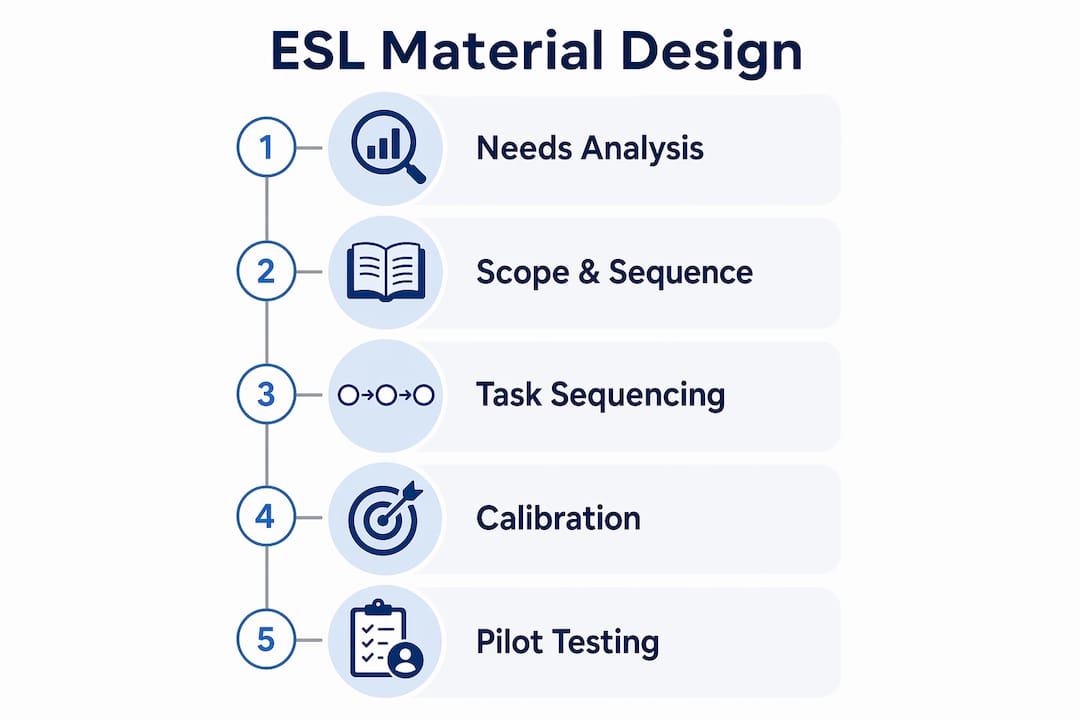
Strong ESL materials start with strong preparation. Before writing a single activity, educators need a clear picture of who their learners are, what those learners can already do, and where the instruction needs to take them.

Assessing learner needs and proficiency
A learner needs analysis identifies gaps between current ability and target performance. The Common European Framework of Reference (CEFR) provides a shared standard for this assessment, with levels from A1 through C2 that define what learners can do at each stage. Anchoring your materials to a specific CEFR level prevents the most common design error: writing content that is either too easy to challenge learners or too difficult to be useful.
Cultural context matters just as much as proficiency level. Real-world examples and culturally relevant contexts increase student motivation and make language feel purposeful rather than abstract. A business English worksheet built around American workplace scenarios will land differently with adult learners in Seoul than one built around local professional contexts.
Tools and resources for material creation
AI-assisted generators have changed the speed of material production. AI tools can generate a complete five-document lesson pack, including a lesson plan, worksheet, quiz, and reading passage, in under 60 seconds. That speed does not replace pedagogical judgment, but it does free educators to spend more time on adaptation and evaluation than on initial drafting.
| Prerequisite | Resource type | Purpose |
|---|---|---|
| Learner needs analysis | Survey, placement test | Identify proficiency gaps and goals |
| CEFR level mapping | CEFR descriptors, level guides | Anchor content to appropriate difficulty |
| Learning objectives | Curriculum documents, scope and sequence | Define measurable outcomes |
| Content sources | Authentic texts, corpus databases | Supply level-appropriate input |
| Design tools | AI generators, layout software | Produce and format materials efficiently |
Pro Tip: Run a short diagnostic task in the first class session. A five-minute writing or speaking prompt tells you more about actual proficiency than a placement score alone.
How should educators plan and structure ESL materials?
Planning is where most material design fails. Educators who skip the planning stage produce materials that feel disconnected, run long, or leave learners unclear about what they are supposed to learn.
Mapping scope and sequence
Experienced ELT authors emphasize planning scope and sequence fully before writing any content. A scope and sequence document maps which language points appear in which order, ensuring logical progression across lessons and units. Without it, educators risk repeating the same vocabulary in consecutive lessons while leaving critical grammar points uncovered.
The destination must be clear before the content is written. Defining learning objectives before drafting activities ensures every task serves a purpose and that coverage is complete. A well-written objective names the skill, the context, and the performance standard: “Learners will write a formal email requesting information using appropriate salutations and closing phrases.”
Designing task sequences
Effective task sequences move from input to output. Learners first encounter new language through reading or listening, then practice it in controlled exercises, and finally produce it independently in a communicative task. This progression, common in Task-Based Language Teaching (TBLT), reduces cognitive load and builds confidence before demanding fluency.
ESL materials must fulfill specific functional learning goals rather than include filler content. Irrelevant activities reduce motivation and waste limited class time. Every task on a worksheet should connect directly to the stated objective.
Visual clarity also affects how learners engage with materials. Clean visual design with clearly stated lesson objectives improves usability and learner motivation. Use white space generously, keep font sizes readable, and place the lesson goal at the top of every student handout.
Common structural components in well-designed ESL materials include:
- A stated learning objective visible to learners
- A warm-up or activation task linking to prior knowledge
- A controlled practice exercise targeting the core language point
- A communicative or productive task requiring independent use
- A reflection or self-assessment prompt at the close
Pro Tip: Write the student version of every activity before drafting the teacher’s guide. Drafting both versions in sequence prevents timing mismatches and ensures your instructions actually match what learners see on the page.
What methodologies ensure materials match learner levels?
Calibrating difficulty is one of the most technically demanding parts of creating ESL resources. Subjective judgment alone is unreliable. Objective linguistic data produces far more accurate results.
Using readability formulas
Readability scores and corpus frequency analysis ensure vocabulary density is appropriate for target CEFR levels. The Flesch-Kincaid Grade Level formula and the Gunning Fog Index both measure text complexity using sentence length and syllable count. A text scoring at grade 8 on the Flesch-Kincaid scale is generally appropriate for B1 learners. Running your materials through either formula takes under two minutes and removes guesswork from level decisions.
Lexical density, the ratio of content words to total words, is a separate but equally useful measure. High lexical density signals a text that demands significant processing effort. For lower-level learners, target a lexical density below 50 percent. For advanced learners, authentic texts with higher density provide appropriate challenge.
Adapting authentic materials
Authentic texts, such as news articles, product instructions, or podcast transcripts, motivate learners because they reflect real language use. When those texts exceed a learner’s proficiency level, the solution is not to replace them. Simplifying task demands rather than replacing texts preserves authenticity and learner interest. Guided notes, glossaries, and pre-reading vocabulary tasks reduce cognitive load without removing the challenge of the original text.
| Evaluation method | What it measures | Best used for |
|---|---|---|
| Flesch-Kincaid Grade Level | Sentence length and syllable count | General text complexity |
| Gunning Fog Index | Complex word frequency | Academic and professional texts |
| Lexical density analysis | Content word ratio | Vocabulary load assessment |
| Corpus frequency comparison | Word frequency against learner corpora | Vocabulary appropriateness by CEFR level |
| Native speaker review | Cultural and idiomatic accuracy | Authentic material adaptation |
How do you evaluate and improve ESL materials over time?
Designing effective ESL worksheets and activities is an iterative process. First-draft materials rarely perform exactly as planned. Systematic evaluation turns good materials into reliable ones.
Pilot testing and observation
Pilot testing with a small group of learners before full deployment reveals problems that desk review misses. Watch for moments when learners stop engaging, ask for clarification repeatedly, or finish tasks far faster or slower than planned. These signals indicate a structural or difficulty issue, not a learner failure.
Tracking speaking versus study time aids material effectiveness evaluation. The “heads up, heads down” principle holds that a healthy balance between learner speaking time and written practice time indicates well-paced materials. If learners spend most of the lesson looking down at a worksheet, the material needs more communicative tasks.
Collecting and applying feedback
Qualitative feedback from learners and colleagues provides context that observation alone cannot. A short exit ticket asking learners to rate task clarity and relevance takes two minutes to complete and generates data you can act on immediately.
Shared peer-evaluation rubrics increase accountability and critical engagement among learners. Rubrics also give you structured feedback on whether tasks are producing the language behavior you intended. When learners can articulate what good performance looks like, they engage more deeply with the task.
Evaluation and iteration steps for ESL materials:
- Set a clear success criterion before piloting, such as task completion rate or speaking time ratio.
- Observe one full lesson cycle and note where engagement drops or confusion arises.
- Collect written feedback from learners using a brief, structured exit ticket.
- Review timing against your lesson plan and identify tasks that ran long or short.
- Revise one element at a time to isolate what changed between versions.
- Re-pilot the revised material with a comparable group before finalizing.
Pro Tip: Ask a colleague to observe one pilot session and track how often learners look up from the page. That single metric tells you more about engagement than any post-lesson survey.
Key takeaways
Effective ESL material design requires aligning learning objectives with learner profiles, calibrating difficulty with objective data, and refining materials through systematic evaluation.
| Point | Details |
|---|---|
| Start with learner needs | Conduct a needs analysis and map materials to specific CEFR levels before writing. |
| Define objectives first | Write clear, measurable learning objectives before drafting any activity or task. |
| Use objective data for level | Apply Flesch-Kincaid or corpus analysis to verify vocabulary and text difficulty. |
| Write student version first | Draft the learner handout before the teacher’s guide to align timing and instructions. |
| Evaluate and iterate | Pilot test materials, track engagement ratios, and revise one element at a time. |
What I have learned from years of designing ESL materials
The single biggest mistake I see educators make is writing materials from the teacher’s perspective rather than the learner’s. It is easy to design a worksheet that covers the grammar point neatly on paper. It is much harder to design one that a B1 learner can actually navigate without asking three clarifying questions before the task even begins.
The practice of writing the student version first changed how I approach every new material. When you sit with a blank page and try to complete your own task as a learner would, problems surface immediately. Instructions that seemed clear become ambiguous. Tasks that seemed brief turn out to run twelve minutes. That friction is useful information.
I have also learned to trust objective data over instinct when it comes to text difficulty. I spent years assuming I could judge whether a text was appropriate for a B2 class by reading it once. Corpus analysis proved me wrong more often than I expected. Running a readability check takes two minutes and has saved me from distributing materials that were either frustrating or boring.
On the question of AI tools: they are genuinely useful for generating first drafts, but they require the same critical evaluation as any other source. An AI-generated lesson pack is a starting point, not a finished product. The pedagogical decisions, the cultural calibration, and the task sequencing still require a trained educator’s judgment. That is why ESL lesson planning skills remain non-negotiable even as the tools evolve.
The educators who produce the best materials are not the ones who spend the most time writing. They are the ones who spend the most time observing, collecting feedback, and revising. A material that has been through three pilot cycles will outperform a first-draft material every time, regardless of how carefully the first draft was written.
— Muller
Teflinstitute courses for ESL material design
Knowing the principles of material design is one thing. Applying them confidently in a real classroom is another.

Teflinstitute offers accredited online TEFL courses that cover curriculum development, lesson planning, and material creation in depth. The 120 Hour Elective TEFL Course is built for educators who want to move beyond generic lesson templates and develop materials that are genuinely responsive to learner needs. For those seeking a more comprehensive program, the 240 Hour Master TEFL Course covers advanced pedagogy alongside practical material design strategies. Both courses are completed online with flexible scheduling, making them accessible for working teachers at any stage of their career.
FAQ
What is the first step in designing ESL materials?
The first step is conducting a learner needs analysis and mapping your materials to a specific CEFR level. Defining clear learning objectives before writing any content ensures every task serves a measurable purpose.
How do I know if my ESL materials are the right difficulty level?
Apply the Flesch-Kincaid Grade Level formula or a corpus frequency analysis to check vocabulary and text complexity against your target CEFR level. Objective linguistic data is more reliable than subjective judgment for calibrating difficulty.
Should I use authentic texts in ESL materials?
Authentic texts are effective because they reflect real language use and increase learner motivation. When a text exceeds learner proficiency, simplify the task demands with guided notes or glossaries rather than replacing the text entirely.
How often should I revise ESL materials?
Revise materials after every pilot cycle, targeting one element at a time. Tracking speaking versus writing time ratios and collecting exit ticket feedback gives you specific data to guide each revision.
What makes ESL worksheets engaging for learners?
Worksheets that include culturally relevant contexts, clear visual design, and communicative tasks produce higher engagement. Materials with specific functional goals avoid the disengagement caused by filler activities that have no clear connection to learner needs.
