
 United Kingdom (UK)
 United States (US)
 Canada
 South Africa
 India
India Australia
 New Zealand
 China
China Russia
 Germany
 France
 Spain
Spain Netherlands
 Vietnam
 United Arab Emirates
 Italy
Italy Poland
 Thailand
 Türkiye








 Algeria


Benefits of Peer Assessment for Educators: 2026 Guide
Benefits of Peer Assessment for Educators: 2026 Guide
TL;DR:
- Peer assessment helps students develop critical thinking, communication, and collaborative skills while reducing teachers’ grading workload. Structuring assessments with clear rubrics and training improves feedback quality and student engagement. Proper implementation transforms classroom dynamics into a community where students share standards and responsibility for learning progression.
Peer assessment is defined as a structured educational practice in which students evaluate each other’s work to develop critical thinking, metacognitive awareness, and collaborative skills. The benefits of peer assessment extend well beyond simple grading convenience. Research from 2020–2025 confirms that peer review improves writing performance, sharpens self-assessment habits, and increases student motivation. For educators working in ESL and EFL contexts, peer evaluation also builds the kind of classroom community that sustains long-term learning. This guide synthesizes current empirical evidence and practical strategies to help you implement peer assessment with confidence.
What are the key benefits of peer assessment for students and teachers?
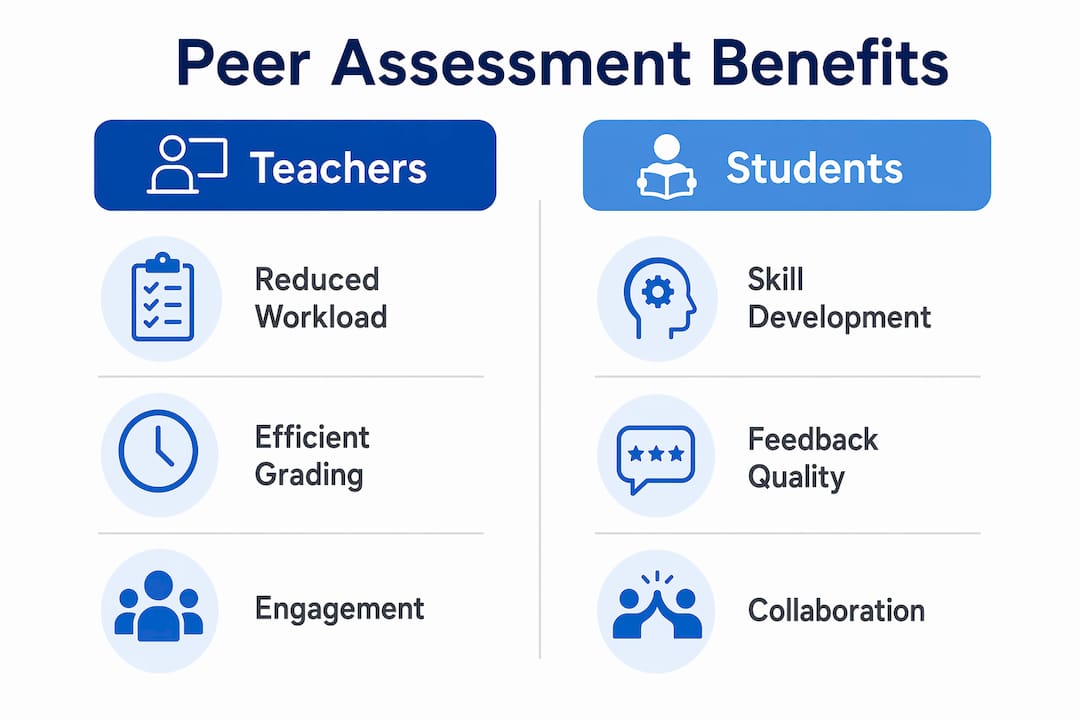
Peer assessment delivers measurable gains for both sides of the classroom. Students develop skills that go far beyond the subject being assessed, and teachers gain more time for instruction.
Benefits for students
The peer evaluation advantages for students fall into three broad categories: cognitive, social, and motivational.
- Critical thinking and metacognition. When students assess a peer’s work, they must apply criteria, weigh evidence, and justify judgments. Studies from 2020–2025 show that peer feedback builds metacognitive skills including self-assessment and reflective learning. Students who regularly evaluate others become more aware of their own strengths and gaps.
- Writing and communication quality. Structured peer review consistently improves higher-order writing skills such as content development, argument organization, and coherence. Students who give feedback on structure learn to apply those same standards to their own drafts.
- Motivation and accountability. Knowing that a classmate will read and evaluate your work raises the stakes in a productive way. Research confirms that peer assessment increases engagement and motivates students to produce better work before submission.
- Collaborative skills. Peer assessment builds the ability to negotiate viewpoints and synthesize ideas, skills that transfer directly to group projects and professional environments.
Benefits for teachers
Teachers report that peer assessment reduces grading load by distributing quality checks across the classroom. That shift creates more productive instructional periods because teachers spend less time marking routine drafts and more time addressing complex learning needs. The classroom also becomes more self-regulating, which reduces the constant demand on teacher attention.

Pro Tip: Start using peer assessment for low-stakes tasks like first drafts or reading responses. This gives you immediate feedback on whether students understand the criteria before you apply the same process to graded work.
How does structured peer assessment improve learning outcomes?
Structure is the single most important factor in whether peer assessment works. Without it, feedback tends to be vague, overly positive, or unhelpful.
Rubrics and explicit training significantly improve the quality of peer feedback. That finding holds across subject areas and age groups. When students know exactly what to look for, they give more specific, useful comments. The quality of feedback then rises for everyone in the class.
Educators can build structure into peer assessment through the following steps:
- Define the criteria explicitly. Create a rubric that breaks the task into specific, observable components. Avoid vague descriptors like “good writing.” Use concrete language such as “the introduction states a clear argument in one or two sentences.”
- Model feedback language before students practice. Teaching constructive feedback language is non-negotiable. Show students the difference between “this is confusing” and “the second paragraph would be clearer if the main idea came first.”
- Run a calibration exercise. Have the whole class assess one anonymous sample together. Discuss where scores differ and why. This builds a shared understanding of quality standards before students assess each other independently.
- Address social and cultural reluctance directly. Normalizing peer feedback as a supportive practice reduces the discomfort students feel about criticizing classmates. Frame feedback as a service, not a judgment.
- Monitor early rounds closely. Read a sample of peer comments after the first session. Identify patterns in weak feedback and address them with the class before the next round.
Understanding peer teaching principles alongside peer assessment helps educators design both practices in ways that reinforce each other.
Pro Tip: Give students sentence starters for feedback, such as “One strength of this section is…” and “One area to develop is…” These frames reduce anxiety and produce more consistent, useful comments.
What are practical strategies to implement peer assessment in the classroom?
Implementation quality determines whether peer assessment produces the results research promises. These strategies reduce friction and build student competence over time.
- Begin with low-stakes assignments. Starting with low-stakes tasks builds student confidence before peer assessment is applied to graded work. A short paragraph or a reading summary is a practical starting point.
- Use anonymous submissions where possible. Removing names from work reduces the social pressure students feel when giving critical feedback. It also reduces the risk that friendships influence scores.
- Pair rubric use with peer training sessions. Do not hand students a rubric and assume they know how to use it. Run a short training session where students practice applying the rubric to sample work before assessing a peer.
- Create a classroom culture that normalizes critique. Discuss why feedback is valuable. Use examples from professional fields, such as how academic publishing relies on peer review as a quality check, to show students that critique is a standard part of producing good work.
- Calibrate peer scores against teacher scores. After an early round, compare a sample of peer scores to your own. If there is a consistent gap, use it as a teaching moment. Show students where their assessments diverged from yours and explain your reasoning.
- Rotate partners regularly. Students who always assess the same classmate develop blind spots. Rotating pairs exposes students to a wider range of work and broadens their understanding of quality.
- Integrate peer assessment with formative assessment practices. Peer feedback works best when it feeds into revision cycles rather than standing alone as a one-time event.
How does peer assessment transform classroom dynamics?
Peer assessment shifts the classroom from a teacher-centric model to a community of learners. That shift has concrete effects on how students relate to each other and to the work itself.
Traditional classrooms concentrate authority in the teacher. Students produce work for one audience: the instructor. Peer assessment breaks down that hierarchy by making students responsible for evaluating quality. They become active participants in defining what good work looks like, not passive recipients of grades.
This shift produces a shared vocabulary around quality. When students regularly discuss criteria together, they internalize standards more deeply than they would from reading a rubric once. That shared language also makes classroom discussions richer, because students can articulate what makes an argument strong or a paragraph unclear.
The table below summarizes how peer assessment changes key classroom dynamics compared to traditional teacher-only assessment.
| Classroom element | Traditional assessment | Peer assessment |
|---|---|---|
| Authority over quality | Teacher only | Shared between teacher and students |
| Feedback sources | One perspective | Multiple peer perspectives |
| Student accountability | To the teacher | To peers and the class community |
| Skill development | Subject knowledge | Subject knowledge plus critical evaluation |
| Classroom relationships | Hierarchical | Collaborative and reciprocal |
Peer assessment also prepares students for real-world collaboration. Workplaces require the ability to give and receive feedback, negotiate disagreements, and hold shared standards. Developing collaborative skills through peer assessment gives students practice in exactly those competencies. The classroom becomes a rehearsal space for professional life.
Key Takeaways
Peer assessment improves student learning outcomes, reduces teacher grading load, and builds collaborative classroom communities when implemented with clear rubrics, explicit training, and a culture that normalizes constructive feedback.
| Point | Details |
|---|---|
| Structure drives quality | Rubrics and training sessions produce significantly better peer feedback than unguided assessment. |
| Start low-stakes | Begin with drafts or short responses to build student confidence before applying peer assessment to graded work. |
| Model feedback language | Teach specific sentence frames before students assess peers to reduce anxiety and improve comment quality. |
| Shift classroom power | Peer assessment moves authority over quality from teacher to students, building shared standards and accountability. |
| Teacher workload decreases | Distributing quality checks across students frees instructional time for higher-value teaching activities. |
What I have learned from watching peer assessment work and fail
Peer assessment is one of the most misunderstood tools in a teacher’s kit. Educators often introduce it as a time-saving measure and then wonder why students produce shallow, unhelpful feedback. The problem is almost never the students. It is the setup.
The research is clear: scaffolding with rubrics and training is what separates peer assessment that works from peer assessment that wastes everyone’s time. I have seen classrooms where students gave genuinely insightful feedback to each other because the teacher spent three sessions building that skill before the first real assessment. I have also seen classrooms where students wrote “good job” on every paper because no one taught them what useful feedback looks like.
The cultural dimension also matters more than most training programs acknowledge. Students from backgrounds where criticizing a peer feels disrespectful need explicit permission and framing before they will engage honestly. Treating that as a minor barrier is a mistake. Address it directly, early, and repeatedly.
The payoff is real. When peer assessment is done well, students stop writing for the teacher and start writing for an audience. That shift in purpose produces better work, more revision, and deeper engagement with the subject. The teacher’s role does not disappear. It changes. You become the person who designs the conditions for learning rather than the sole judge of its quality. That is a better use of your expertise.
— Muller
Teflinstitute courses that sharpen your assessment skills
Effective peer assessment requires more than good intentions. It requires training in how to design feedback structures, manage classroom dynamics, and support diverse learners. Teflinstitute offers programs built for educators who want to teach with greater precision and confidence.

The 120 Hour Elective TEFL Course covers assessment design, student engagement strategies, and classroom management techniques that apply directly to peer evaluation contexts. For educators ready to go deeper, the 240 Hour Master TEFL Course provides externally accredited training in advanced teaching and assessment methods. Both programs are available online and designed for working educators who need flexibility without sacrificing rigor.
FAQ
What is peer assessment in education?
Peer assessment is a structured practice in which students evaluate each other’s work using defined criteria. It develops critical thinking, metacognitive skills, and collaborative habits alongside subject knowledge.
How does peer assessment improve learning outcomes?
Peer assessment improves outcomes by requiring students to apply quality criteria actively, which deepens their understanding of the subject and sharpens their own work. Research from 2020–2025 links structured peer review to measurable gains in writing performance and student engagement.
What makes peer feedback effective?
Effective peer feedback depends on explicit rubrics, modeled feedback language, and calibration exercises that align student and teacher standards. Without structured scaffolding, peer comments tend to be vague and unhelpful.
How do you overcome student reluctance to give critical feedback?
Frame feedback as a professional skill rather than personal criticism, use anonymous submissions where possible, and provide sentence starters that guide students toward specific, constructive comments. Addressing cultural and social factors directly reduces conflict and increases honest engagement.
Does peer assessment reduce teacher workload?
Peer assessment distributes quality checks across the classroom, which reduces the volume of detailed grading teachers must complete. That reduction creates more time for targeted instruction and higher-value feedback on complex student needs.
Recommended
TEFL Institute guides

South Korea
EPIK, hagwons and pay
Czech Republic
Pay, visas and cities
Italy
Jobs, pay and visa routes
Portugal
Jobs, pay and visa routes
Cambodia
Pay, requirements and visas