

 United Kingdom (UK)
 United States (US)
 Canada
 South Africa
 India
India Australia
 New Zealand
 China
China Russia
 Germany
 France
 Spain
Spain Netherlands
 Vietnam
 United Arab Emirates
 Italy
Italy Poland
 Thailand
 Türkiye





 Algeria


What Is Peer Teaching? A Guide for Educators in 2026
What Is Peer Teaching? A Guide for Educators in 2026

TL;DR:
- Peer teaching involves students instructing peers to promote deeper learning through active explanation and social interaction. Research indicates it leads to significant academic gains, including up to six months of additional progress annually, and enhances communication and confidence skills. Effective implementation requires deliberate pairing, active facilitation, and varied models like jigsaw or reciprocal tutoring to maximize learning outcomes.
Peer teaching is defined as a structured educational practice in which students take on the role of instructor to teach concepts, skills, or content to their classmates under teacher guidance. The Education Endowment Foundation and Springer Nature research both confirm that this method produces measurable academic gains beyond what traditional instruction alone achieves. Grounded in the social constructivist theories of Lev Vygotsky and Jean Piaget, peer teaching works because explaining ideas to others forces deeper cognitive processing than passive listening. The result is a learning environment where both the student-teacher and the student-learner benefit simultaneously.
What is peer teaching and why does it work?
Peer teaching is the process by which one student explains, demonstrates, or guides another student through material, with the teacher acting as facilitator rather than sole knowledge source. This approach activates what researchers call the protégé effect: the act of preparing to teach forces the explainer to organize information, identify gaps in their own understanding, and articulate reasoning clearly. That cognitive effort produces retention levels that passive study methods cannot replicate.
The psychological dimension matters as much as the cognitive one. Peer teaching creates a low-stakes environment where students feel safer admitting confusion, asking questions, and self-correcting without fear of judgment from an authority figure. This psychological safety accelerates metacognitive development, which is the ability to monitor and regulate one’s own learning. Students who might hesitate to ask a teacher a “basic” question will ask a peer without hesitation.
Peer teaching is also grounded in social constructivism, the theoretical framework developed by Vygotsky that positions knowledge as co-constructed through social interaction. When students operate within each other’s zone of proximal development, learning becomes more efficient. Piaget’s concept of cognitive conflict, where encountering a different perspective forces mental reorganization, explains why peer dialogue produces conceptual change that lectures often cannot.
What are the proven benefits of peer teaching?
The academic evidence supporting peer teaching is substantial and consistent across education levels. According to the Education Endowment Foundation, peer tutoring produces an average positive impact equivalent to approximately six additional months of learning progress within a single academic year. That figure represents one of the strongest effect sizes in the EEF’s Teaching and Learning Toolkit.
A meta-analysis published through Springer Nature found that peer tutoring programs in higher education carry a moderate positive effect size of g = 0.480 on student academic performance. An effect size above 0.4 is considered educationally significant, meaning the gains are not marginal. They represent a meaningful shift in student outcomes across diverse subject areas and institutional contexts.
“Peer-led learning methods significantly increase student engagement and conceptual understanding, with outcomes statistically superior to traditional teacher-led tutorials.”
— Springer Nature, 2024
The benefits extend beyond test scores. Students who teach their peers develop communication skills, build confidence, and practice the kind of reasoning that prepares them for professional environments. For ESL learners specifically, peer interaction in the classroom provides additional speaking practice that teacher-fronted lessons structurally cannot offer at scale.
Pro Tip: Assign the student-teacher role to learners who have recently mastered a concept rather than the highest achievers. Recent mastery means they still remember the confusion points, making their explanations more accessible to struggling peers.
Low-attaining students gain the most from well-structured peer tutoring. The EEF notes that proper student matching is critical: the tutor must be advanced enough to explain accurately but close enough in experience to maintain empathy and relatability.
What models and strategies of peer teaching exist?
Peer teaching is not a single method. It encompasses several distinct models, each suited to different classroom contexts and learning objectives.
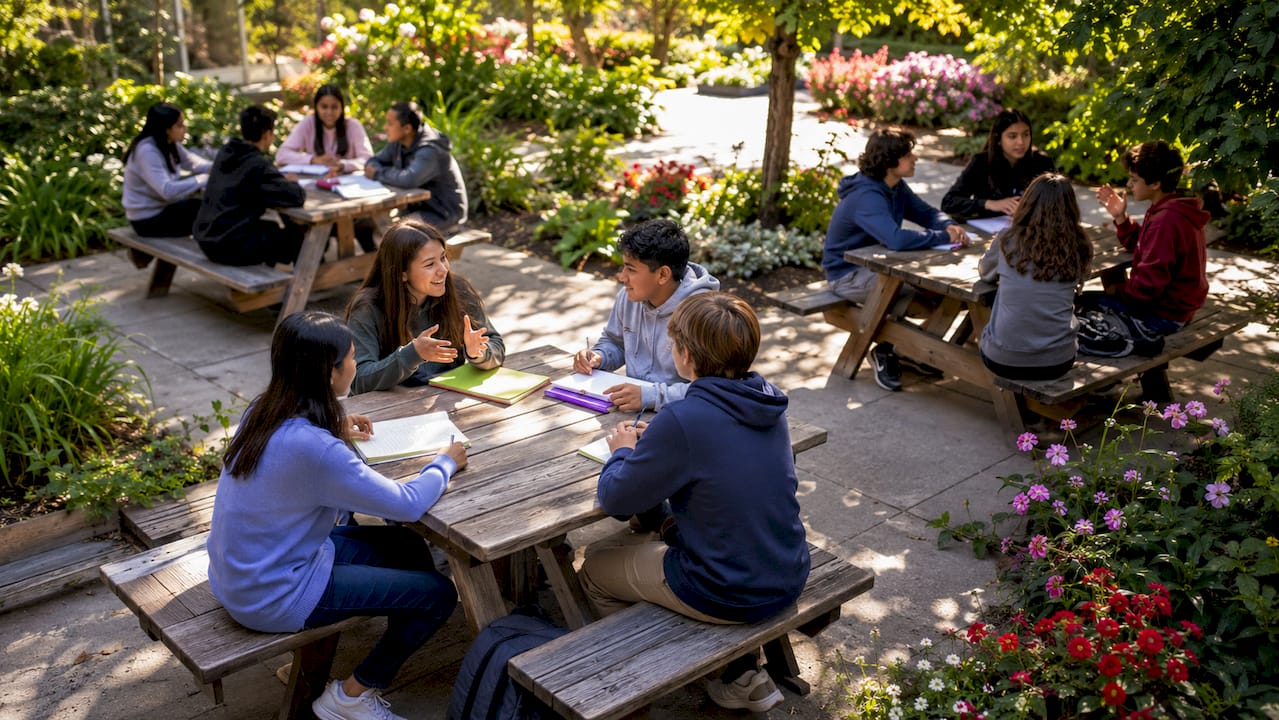
Cross-age tutoring pairs older students with younger ones. The age gap provides a natural authority dynamic while keeping the interaction less formal than teacher-student exchanges. Same-age tutoring pairs students at similar levels, often with one slightly more advanced. Reciprocal tutoring alternates the tutor and tutee roles between sessions, so both students experience the cognitive demands of explaining.
The jigsaw technique divides content into segments and assigns each segment to a small group of “experts.” Those experts then teach their segment to the rest of the class. This model promotes accountability because each student is responsible for content that no one else in the class has studied in depth. It also builds critical thinking as students must synthesize information rather than simply repeat it.
Peer instruction, developed by Harvard physicist Eric Mazur, uses conceptual questions to prompt student discussion before a class vote. Students first commit to an individual answer, then discuss with neighbors, then revote. The shift in correct responses after discussion demonstrates the power of peer explanation.
It is worth distinguishing peer teaching from micro teaching. Micro teaching is a teacher training method focused on developing pedagogical skills through short practice lessons, typically among trainee teachers. Peer teaching, by contrast, is a student-centered strategy focused on content mastery. The two serve different purposes and should not be used interchangeably.
| Model | Primary purpose | Best used when |
|---|---|---|
| Cross-age tutoring | Build confidence and consolidate knowledge | Reviewing material across year groups |
| Reciprocal tutoring | Develop explanation and listening skills | Consolidating recently taught content |
| Jigsaw technique | Promote accountability and collaboration | Covering multi-part topics efficiently |
| Peer instruction (Mazur) | Correct misconceptions through discussion | Introducing conceptual material in lectures |
| Same-age tutoring | Targeted academic support | Addressing specific skill gaps |
Pro Tip: Assign structured accountability roles such as explainer, scribe, and questioner within each peer group. Role assignment prevents passive observation and distributes cognitive load across all participants.
How does peer teaching work in practice?
Effective implementation requires deliberate teacher design, not simply pairing students and stepping back. The teacher’s role shifts from knowledge transmitter to facilitator, but that shift demands more preparation, not less. Active teacher facilitation is the single most critical factor in preventing misconceptions from taking hold and ensuring equitable participation across the group.
A practical implementation sequence looks like this:
- Select the content carefully. Peer teaching works best when reviewing or consolidating knowledge rather than introducing brand-new material. Use it after initial instruction, not as a replacement for it.
- Pair students with intention. Match tutors who have recently mastered content with tutees who are working toward that same understanding. Avoid pairing the highest achiever with the lowest attainer; the gap is often too wide for productive dialogue.
- Brief the student-teachers. Provide explainers with guiding questions, not just answers. Effective peer explanations involve justification and reasoning steps, not simply restating facts.
- Assign roles within groups. Use explainer, questioner, and checker roles to distribute responsibility and prevent any single student from dominating or disengaging.
- Monitor and intervene selectively. Circulate during peer sessions. Correct factual errors immediately but resist the urge to take over. Targeted questions from the teacher (“How did you reach that conclusion?”) redirect thinking without removing student ownership.
- Debrief as a class. Close every peer teaching session with a whole-class discussion. This surfaces misconceptions, reinforces correct understanding, and gives the teacher a formative assessment snapshot.
Bench-partner teaching, where two students work side by side rather than in larger groups, minimizes social risk and makes it easier for students to ask questions. This format is particularly effective in large classrooms where managing multiple groups simultaneously is logistically demanding.
Medical education offers a well-documented case study. Programs at institutions including Stanford University School of Medicine have used near-peer teaching, where senior medical students teach junior ones, to reinforce clinical reasoning. The evidence shows that near-peer teachers retain content longer and junior students report higher satisfaction than in faculty-only instruction.
How does peer teaching compare to traditional instruction?
Peer teaching and teacher-led instruction are not competing approaches. They address different aspects of the learning process and produce different outcomes. Understanding where each method excels allows educators to combine them strategically.
Traditional teacher-led instruction is more efficient for introducing new material, ensuring accuracy, and covering curriculum at pace. A trained teacher brings subject expertise, pedagogical skill, and the authority to correct errors definitively. For new methods of teaching English or any subject requiring precise foundational knowledge, teacher-led delivery remains the appropriate starting point.
Peer teaching outperforms traditional instruction on specific metrics. Research shows statistically superior engagement and conceptual understanding in peer-led conditions compared to teacher-led tutorials (p < 0.05). Students in peer teaching sessions ask more questions, make more connections between concepts, and demonstrate higher retention on delayed assessments.
| Dimension | Peer teaching | Traditional instruction |
|---|---|---|
| Engagement level | High: active participation required | Variable: depends on delivery style |
| Accuracy of content | Risk of misconceptions without facilitation | High: teacher controls accuracy |
| Retention outcomes | Strong for reviewed material | Moderate for passively received content |
| Speaking and reasoning practice | Extensive for both roles | Limited to teacher-student exchanges |
| Scalability | Scales well with proper structure | Limited by teacher-to-student ratio |
| Best phase of learning | Review, consolidation, application | Introduction of new concepts |
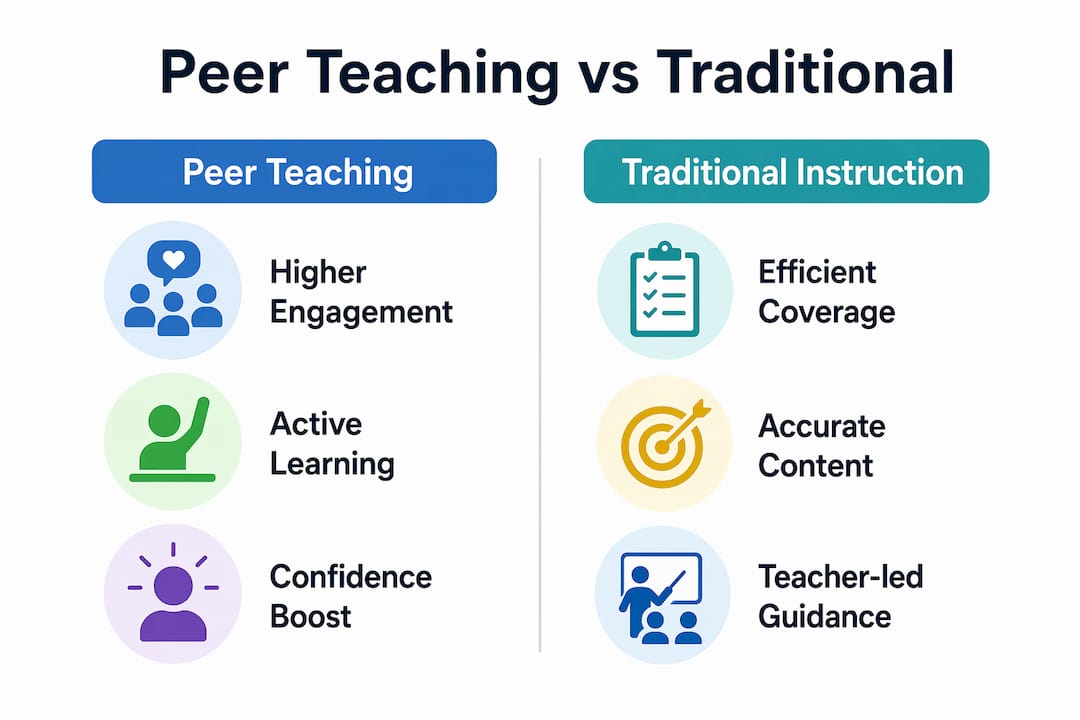
The most effective classrooms use both. Teacher-led instruction introduces and explains; peer teaching consolidates and deepens. This sequence aligns with cognitive load theory, which holds that new information requires expert guidance before learners can productively manipulate it independently.
Key takeaways
Peer teaching produces measurable academic gains, deeper cognitive processing, and stronger engagement when structured with clear roles, careful student pairing, and active teacher facilitation.
| Point | Details |
|---|---|
| Definition and mechanism | Peer teaching has students instruct peers, activating the protégé effect for deeper retention. |
| Evidence-based impact | EEF research shows peer tutoring delivers the equivalent of six additional months of learning progress per year. |
| Model selection matters | Jigsaw, reciprocal tutoring, and peer instruction each serve distinct learning phases and objectives. |
| Teacher facilitation is non-negotiable | Active monitoring prevents misconceptions and ensures equitable participation across all student groups. |
| Complement, not replace | Peer teaching consolidates knowledge most effectively after teacher-led introduction of new material. |
Peer teaching: what the research misses
I have observed peer teaching implemented across a range of educational settings, and the research captures the outcomes well but rarely addresses the preparation gap. Most studies measure what happens when peer teaching works. They are less informative about why it fails, and it does fail when teachers treat it as a low-effort alternative to direct instruction.
The most common mistake is deploying peer teaching with students who have not yet reached sufficient mastery of the content. When the student-teacher is uncertain, the session produces confident misinformation rather than learning. The EEF’s guidance on careful pairing is correct, but it understates how much pre-session preparation the student-teacher needs. Briefing explainers with structured prompts, not just the answer, is the difference between a productive session and a wasted one.
There is also a social dynamics dimension that research tends to flatten. In practice, peer teaching surfaces existing classroom hierarchies. The student who is academically strong but socially marginalized may struggle to hold authority in a peer session. Bench-partner formats reduce this risk considerably compared to group setups, and I would recommend starting there before scaling to larger configurations.
The cognitive gains are real and well-documented. The social benefits are real too, but they require more deliberate management than most implementation guides acknowledge. Educators who approach peer teaching as a structured pedagogical tool rather than a classroom activity will see the results the research promises.
— Muller
Deepen your teaching skills with Teflinstitute
Peer teaching is one of many student-centered strategies that separates effective language educators from average ones. Teflinstitute’s 120 Hour Elective TEFL Course covers collaborative learning methods, classroom facilitation techniques, and evidence-based instructional strategies in depth. The course is designed for educators who want to move beyond surface-level methodology and build a genuine toolkit for diverse learner needs.

For educators working with younger learners, the Teaching English to Young Learners course addresses how to implement peer interaction and structured group work with age-appropriate scaffolding. Both courses are fully online, externally accredited, and built for educators who take professional development seriously.
FAQ
What is the peer teaching definition in education?
Peer teaching is a structured method in which students take on the role of instructor to teach content or skills to their classmates, under teacher supervision. It is grounded in social constructivist theory and produces measurable gains in both the student-teacher and the student-learner.
What are the main benefits of peer teaching?
The Education Endowment Foundation identifies peer tutoring as equivalent to six additional months of learning progress per year. Benefits include deeper content retention through the protégé effect, increased engagement, and improved metacognitive skills.
How does peer teaching work in a classroom?
The teacher introduces content through direct instruction, then structures peer sessions where students explain, question, and consolidate that material in assigned roles. The teacher facilitates, monitors for misconceptions, and debriefs the class after each session.
What is the difference between peer teaching and micro teaching?
Peer teaching is a student-centered strategy focused on content mastery among learners. Micro teaching is a teacher training technique in which trainee teachers practice pedagogical skills through short, observed lessons, typically with other trainees as the audience.
What peer teaching strategies work best for ESL classrooms?
Reciprocal tutoring and the jigsaw technique are particularly effective in ESL settings because both require extended speaking, listening, and reasoning in the target language. Bench-partner formats reduce social risk and increase the frequency of student-to-student interaction during lessons.
