
 United Kingdom (UK)
 United States (US)
 Canada
 South Africa
 India
India Australia
 New Zealand
 China
China Russia
 Germany
 France
 Spain
Spain Netherlands
 Vietnam
 United Arab Emirates
 Italy
Italy Poland
 Thailand
 Türkiye







 Algeria


What is a TEFL resource guide: Your 2026 teaching tool
What is a TEFL resource guide: Your 2026 teaching tool

Think TEFL resource guides are just for beginners? Research reveals 38% of teachers misunderstand guide utilization, limiting their certification success. These comprehensive collections benefit everyone from first-time applicants to experienced educators, centralizing materials that streamline certification preparation, classroom teaching, and career advancement. This article unpacks what makes resource guides essential, corrects common myths, and shows you how to use them strategically for maximum teaching impact.
Table of Contents
- Introduction To TEFL Resource Guides
- Core Components Of TEFL Resource Guides
- Common Misconceptions About TEFL Resource Guides
- Comparing TEFL Resource Guides With Other ESL Teaching Resources
- Organizing And Using TEFL Resource Guides Effectively
- Global Variability And Practical Applications Of TEFL Resource Guides
- Conclusion: How TEFL Resource Guides Enhance TEFL Preparation And Teaching Careers
- Explore Top TEFL Courses And Resources At TEFL Institute
- Frequently Asked Questions
Key takeaways
| Point | Details |
|---|---|
| TEFL resource guides compile certification-aligned materials, lesson plans, and career tools in one structured package | They serve all experience levels, not just beginners, supporting exam preparation and global teaching readiness |
| Common misconceptions prevent optimal guide usage and limit learning outcomes | Evidence shows structured guides improve retention by 42% compared to scattered resources |
| Guides differ from free online materials by offering vetted, organized content with job market integration | They complement formal courses by adding practical teaching strategies and cultural competency training |
| Effective organization methods include thematic sorting and career-stage frameworks | Strategic guide selection aligns with personal goals, course formats, and target teaching regions |
| Global variability in certification standards makes guides crucial for international mobility | They enhance credential recognition and cultural adaptability across diverse teaching markets |
Introduction to TEFL resource guides
A TEFL resource guide is a curated collection of educational materials, teaching tools, and career preparation resources designed to support English language teaching certification and professional development. TEFL resource guides centralize essential materials that might otherwise require hours of searching across disconnected platforms. These guides consolidate everything from grammar references and lesson templates to job market insights and cultural competency training.
Their primary function is streamlining the path from certification study to classroom confidence. Rather than piecing together random blog posts or outdated worksheets, you access a structured system that aligns with recognized certification standards. This approach saves time while ensuring you’re working with vetted, current information that meets industry expectations.
Typical resource types include:
- Lesson plan frameworks and activity templates
- Grammar explanations and teaching methodology guides
- Classroom management strategies and student engagement techniques
- Cultural awareness materials and adaptation resources
- Job search tools including resume templates and interview preparation
- Certification exam practice materials and study schedules
These guides address three core needs simultaneously: passing certification exams, developing practical teaching skills, and preparing for the international job market. By organizing resources around these goals, guides eliminate the guesswork that often derails new teachers. Whether you’re pursuing a 120-hour certificate or an advanced diploma, a well-constructed guide provides the roadmap you need.
Explore free TEFL & TESOL teaching resources to see how organized materials accelerate your preparation.
Core components of TEFL resource guides
Comprehensive TEFL guides include lesson plans, grammar references, classroom management strategies, and cultural competency materials that form the foundation of effective teaching preparation. Understanding these components helps you evaluate guide quality and identify gaps in your current resource collection.
Lesson planning tools typically include customizable templates for different class types, timing guides for activity pacing, and sample plans demonstrating best practices. These templates save hours of preparation time while teaching you professional formatting standards employers expect. Grammar references break down complex concepts into teachable chunks, often including error correction strategies and common student challenges by language background.
Classroom management guidance covers:
- Behavior management techniques for different age groups
- Seating arrangements and classroom setup optimization
- Technology integration strategies for hybrid learning
- Assessment methods and progress tracking systems
Cultural awareness materials prepare you for teaching across diverse contexts. These resources address communication styles, classroom etiquette variations, and culturally responsive teaching methods. They’re particularly valuable when transitioning between teaching regions or working with multicultural student groups.

Job market components include credential recognition databases, salary expectation guides by region, and employment contract review checklists. Some guides link to practicum opportunities or volunteer teaching programs that build your resume before applying for paid positions.
Pro Tip: Cross-reference guide components with your course syllabus to identify supplementary materials that reinforce weak areas. Combine guide resources with TEFL classroom resources for complete preparation coverage.
Common misconceptions about TEFL resource guides
Several persistent myths prevent teachers from maximizing guide effectiveness. Recognizing these misconceptions helps you approach resources strategically rather than limiting their application.
The most damaging myth suggests guides only serve beginners with no teaching experience. This belief ignores that experienced educators use guides to expand into new teaching contexts, update methodologies, or pursue additional certifications. Advanced materials within comprehensive guides address classroom research, curriculum development, and specialized teaching niches that benefit seasoned professionals.
Another misconception claims formal TEFL course enrollees don’t need supplementary guides. Course materials focus primarily on certification requirements, often omitting practical job search strategies or regional teaching variations. Guides fill these gaps by providing real-world application resources that courses can’t cover within limited contact hours.
Many teachers overrely on free scattered materials instead of investing in structured guides. While free resources exist, their inconsistent quality and lack of organization create inefficiency. You spend more time evaluating reliability and filling knowledge gaps than actually learning.
“Structured resource guides improve learning retention by 42% compared to self-assembled free materials, primarily through coherent sequencing and integrated practice opportunities.”
Key corrections to widespread beliefs:
- Guides serve all career stages, from pre-certification through advanced specialization
- Course materials and guides complement rather than replace each other
- Time invested in quality guides reduces overall preparation time significantly
- Guide frameworks prevent knowledge gaps that emerge from random resource selection
Pro Tip: Use guides alongside your course to reinforce concepts immediately after instruction. This layered approach embeds knowledge more effectively than course materials alone. Check effective TEFL resource use for integration strategies.
Comparing TEFL resource guides with other ESL teaching resources
Understanding how resource guides differ from alternatives clarifies their unique value proposition and appropriate use cases. Each resource type serves specific purposes within your overall preparation strategy.
Structured TEFL guides offer curated, vetted content organized around certification pathways and career progression. They integrate teaching methodology, practical application, and employment preparation in a coherent sequence. This integration distinguishes guides from isolated materials that address single topics without context.
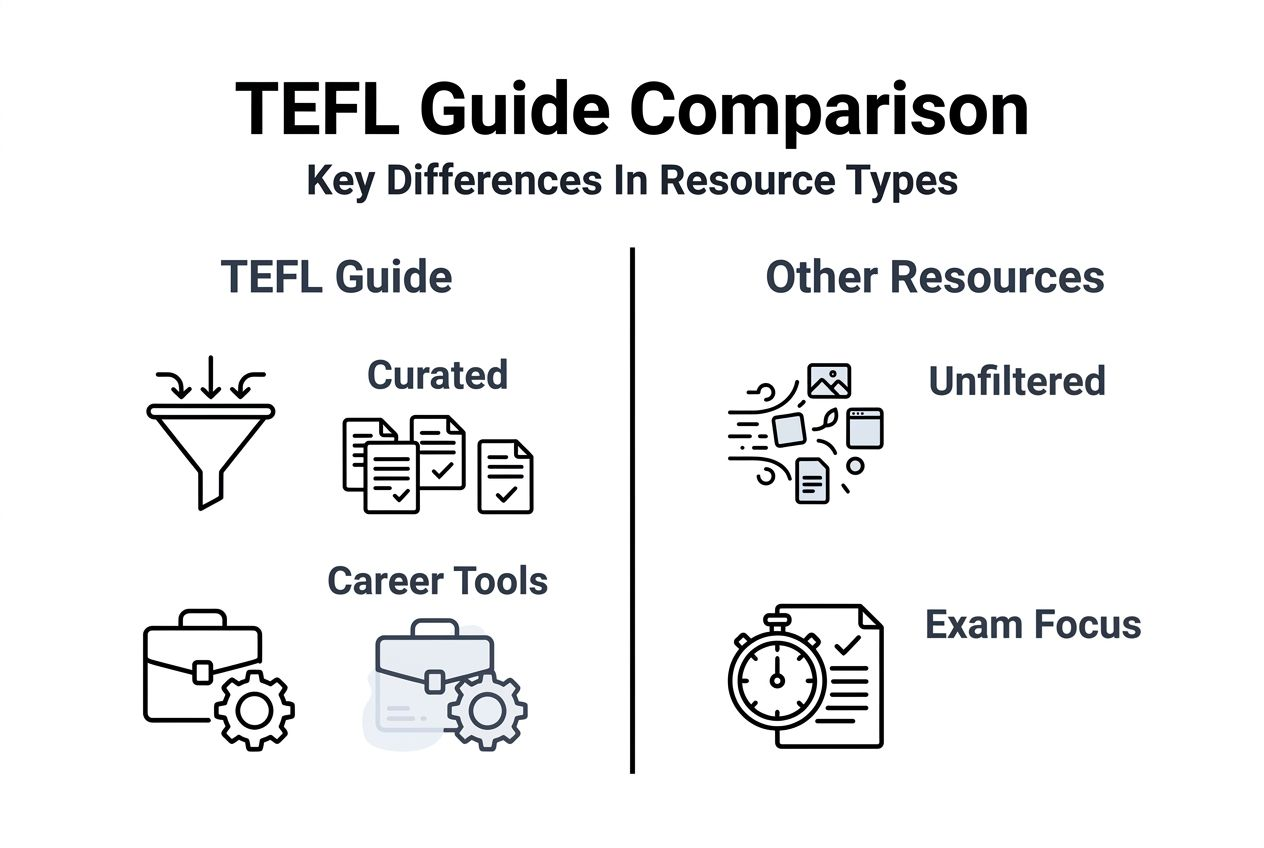
Free online resources provide accessibility but lack quality control and systematic organization. You’ll find excellent individual lessons alongside outdated or pedagogically questionable materials, with no clear way to distinguish quality. The time spent evaluating and organizing free resources often exceeds the cost of a comprehensive guide.
Official course materials focus exclusively on certification exam requirements. While thorough for passing tests, they typically omit cultural teaching considerations, job market navigation, and practical classroom management beyond theoretical frameworks. Courses assume you’ll acquire these skills through separate research or trial and error.
| Resource Type | Content Quality | Organization | Career Integration | Best Use Case |
|---|---|---|---|---|
| TEFL Resource Guides | Vetted, comprehensive | Structured pathways | Strong job market focus | Primary preparation tool |
| Free Online Materials | Highly variable | Self-organized | Minimal | Supplementary activities |
| Official Course Content | Standardized, exam-focused | Curriculum-based | Limited | Certification requirements |
| AI-Generated Resources | Customizable, emerging | User-dependent | Activity-specific | Targeted lesson creation |
Guides provide unique value through practicum connections, credential comparison tools, and regional teaching insights. These elements rarely appear in course materials or free resources. When selecting resources, compare TEFL certifications to ensure guide alignment with your target credential.
The most effective approach combines all three types: course materials for certification structure, guides for comprehensive preparation and career planning, and selective free resources for activity variety.
Organizing and using TEFL resource guides effectively
Systematic organization transforms resource guides from reference materials into active learning tools. The right framework matches your learning style and certification timeline.
Three primary organization methods work for most teachers:
- Chronological sequencing follows your certification program timeline, organizing materials by study week or module progression
- Thematic clustering groups resources by teaching skill: grammar instruction, classroom management, cultural competency, assessment methods
- Career-stage sorting separates pre-certification preparation, active teaching resources, and professional development materials
Choose chronological organization if you’re enrolled in a structured course and want guide resources to reinforce weekly topics. This approach creates natural study rhythms and prevents overwhelming yourself with unrelated materials. Mark guide sections corresponding to each course module, then review them immediately after instruction when concepts remain fresh.
Thematic organization suits self-directed learners or those preparing for specific teaching contexts. If you’re strong in grammar but need classroom management support, thematic sorting lets you concentrate effort where it matters most. This method also simplifies resource location when planning lessons or troubleshooting teaching challenges.
Career-stage frameworks work best for teachers with non-linear paths or those returning to teaching after breaks. Separate materials into certification prep, first-year teaching, and ongoing development categories. This prevents beginner resources from cluttering your workspace once you’ve advanced.
Pro Tip: Create a hybrid system by organizing primarily around your certification timeline but tagging resources with secondary themes. This dual-layer approach supports both sequential learning and quick reference access. Digital guides allow folder structures and search tags that physical materials can’t match.
Select guides aligned with your course format and career goals. Online certification seekers need different resources than in-person program students. Similarly, guides emphasizing Asian teaching markets won’t serve European job seekers equally well. Review the TEFL certification guide 2026 before choosing materials to ensure compatibility.
Consult the TEFL program and career guide for detailed selection criteria matching your specific situation.
Global variability and practical applications of TEFL resource guides
International teaching markets impose different certification standards, cultural expectations, and employment requirements that resource guides help you navigate successfully. Understanding these variations prevents costly credential mismatches and cultural missteps.
Regional certification preferences vary significantly:
- Asian markets typically require 120-hour minimum certifications with grammar-focused teaching experience
- European schools increasingly prefer CELTA or Trinity CertTESOL credentials with communicative methodology training
- Middle Eastern positions often mandate bachelor’s degrees plus teaching licenses in addition to TEFL certification
- Latin American schools accept diverse certifications but value cultural competency and Spanish language skills
Resource guides addressing these regional differences help you target appropriate certifications and develop market-specific teaching approaches. A guide oriented toward Japanese teaching contexts will emphasize different classroom management techniques than one focused on Brazilian schools.
Cultural competency materials within guides prepare you for communication style variations, classroom hierarchy expectations, and student engagement preferences across cultures. These resources prevent the common mistake of applying Western teaching methods universally without adaptation. Understanding that direct error correction offends students in some cultures while others expect it prevents classroom friction.
Job preparation components address credential recognition and documentation requirements that vary internationally. Some countries require embassy authentication of teaching certificates, while others accept digital verification. Guides with employment checklists ensure you complete all steps for your target region, avoiding visa complications or contract delays.
Practical benefits include:
- Faster job placement through targeted credential selection
- Reduced cultural adaptation stress and classroom management issues
- Improved student outcomes through culturally responsive teaching
- Enhanced career mobility as you understand credential transferability between regions
Guides supporting international mobility typically include credential comparison charts, visa requirement summaries, and cost of living data for major teaching destinations. This information informs realistic career planning and prevents relocating to markets where your credentials won’t meet employer standards.
Conclusion: how TEFL resource guides enhance TEFL preparation and teaching careers
Comprehensive TEFL resource guides transform certification preparation from overwhelming information searches into structured, efficient learning pathways. By centralizing vetted materials, practical teaching tools, and career preparation resources, guides address the complete spectrum of needs from exam preparation through international employment.
Research demonstrates structured guides improve exam pass rates and teaching readiness compared to scattered resource approaches. The 42% retention improvement stems from coherent material sequencing and integrated practice opportunities that reinforce learning. Teachers using quality guides report greater confidence entering classrooms and faster adaptation to diverse teaching contexts.
Correcting misconceptions about guide utility unlocks their full potential. Recognizing that guides serve all experience levels, complement rather than replace course materials, and provide unique career planning value changes how you approach TEFL preparation. Strategic guide selection and organization aligned with your certification timeline and career goals maximizes return on your study investment.
The practical advantages extend beyond certification into your teaching career. Cultural competency training, regional job market insights, and credential recognition guidance facilitate international mobility and employment success. Whether you’re pursuing your first certification or expanding into specialized teaching niches, resource guides provide the structured support that accelerates professional growth.
Explore top TEFL courses and resources at TEFL Institute
Ready to transform your TEFL preparation with expertly curated resources and certification programs? TEFL Institute combines comprehensive resource guides with industry-recognized courses designed for aspiring teachers at every career stage.
Our platform helps you navigate the complete certification journey, from selecting the right program to securing your ideal teaching position abroad. Whether you’re wondering which TEFL course to take or researching the best online TEFL courses for your schedule, we provide detailed comparisons and expert guidance. Gap year adventurers can explore TEFL certification for gap year adventures combining travel with professional development. Visit TEFL Institute today to access resources that complement your certification goals and launch your international teaching career.
Frequently asked questions
What is a TEFL resource guide?
A TEFL resource guide is a structured collection of teaching materials, certification preparation tools, and career development resources organized to support English language teachers from initial training through professional practice. These guides consolidate lesson templates, grammar references, classroom management strategies, cultural competency materials, and job market insights into coherent learning pathways. Unlike scattered free resources, guides provide vetted content aligned with recognized certification standards and practical teaching needs.
How do TEFL resource guides improve certification success?
Structured resource guides improve learning retention by 42% through coherent material sequencing and integrated practice opportunities that reinforce concepts. They provide targeted exam preparation materials, teaching methodology explanations, and practical application exercises aligned with certification requirements. Guides also offer job market preparation and cultural competency training that courses often omit, creating more confident, employable teachers.
Can I rely only on free TEFL resources instead of a guide?
Free resources offer accessibility but lack quality control, systematic organization, and comprehensive coverage of certification and career preparation needs. You’ll spend significant time evaluating material reliability and filling knowledge gaps rather than focused learning. Free materials also rarely integrate teaching methodology with practical application and employment preparation the way structured guides do, resulting in fragmented knowledge.
Are TEFL resource guides helpful for experienced teachers?
Experienced teachers benefit from guides through advanced teaching materials, specialized certification pathways, and updated methodologies addressing evolving classroom technologies. Guides support credential expansion into new teaching contexts, provide regional job market data for international moves, and offer cultural competency resources for diverse student populations. They facilitate professional development beyond initial certification requirements.
How do I choose the right TEFL resource guide for my needs?
Select guides aligned with your certification program format, target teaching region, and career goals. Online certification seekers need different resources than in-person students, while guides emphasizing Asian markets won’t serve European job seekers equally well. Evaluate guide components against your course syllabus to identify complementary rather than redundant materials. Consider whether you need general teaching preparation or specialized resources for specific student age groups or teaching contexts.
Recommended
- The Complete Guide to TEFL Certification in 2026: Everything You Need to Know Before You Start | TEFL Institute
- How to Use TEFL Resources for Effective Teaching Success | TEFL Institute
- Complete Guide to TEFL Certification Process 2025 | TEFL Institute
- Free TEFL & TESOL Teaching Resources & Material
- Fiches pédagogiques gratuites – CP à 3ème | EduLeo
TEFL Institute guides

Czech Republic
Pay, visas and cities
Spain
Jobs, pay and visa routes
Dubai
Pay, requirements and visas
Taiwan
Buxibans, pay and visas
Cambodia
Pay, requirements and visas