

 United Kingdom (UK)
 United States (US)
 Canada
 South Africa
 India
India Australia
 New Zealand
 China
China Russia
 Germany
 France
 Spain
Spain Netherlands
 Vietnam
 United Arab Emirates
 Italy
Italy Poland
 Thailand
 Türkiye








 Algeria


What Is Phonics? A Guide for Parents and Educators
What Is Phonics? A Guide for Parents and Educators

TL;DR:
- Phonics links spoken sounds to written letters to teach reading and spelling. It produces about five months of extra early reading progress and improves decoding, spelling, and confidence. Effective teaching involves structured, skill-based instruction, ongoing assessment, and contextual application.
Phonics is defined as the method of teaching reading and writing by connecting spoken sounds, called phonemes, to their written letter representations, called graphemes. This system forms the foundation of early literacy instruction and is grounded in the alphabetic principle: the idea that letters and letter combinations represent the sounds of spoken language. Research from the Education Endowment Foundation confirms that phonics instruction produces approximately 5 months of additional academic progress in early reading compared to other methods. That finding alone explains why phonics sits at the center of reading instruction in schools worldwide.
What is phonics and why does it matter for reading?
Phonics is the bridge between spoken language and written text. When a child learns that the letter “b” makes the /b/ sound, or that “sh” together makes the /ʃ/ sound in “ship,” they are applying phonics knowledge. This process gives children a reliable system for decoding unfamiliar words rather than memorizing each word by sight.

The alphabetic principle is the strongest predictor of later reading fluency, surpassing phonemic awareness alone. A large study involving 810,328 first-grade students confirmed this finding. Phonemic awareness, which is the ability to hear and manipulate individual sounds in words, is necessary but not sufficient on its own. Children also need explicit knowledge of how those sounds map to letters.
Phonics instruction builds reading fluency, spelling accuracy, and writing confidence simultaneously. When children can decode words reliably, they free up mental energy for comprehension. That shift from decoding to understanding is the central goal of early literacy instruction.
Why is phonics important for early learners?
The importance of phonics in early education is well established by decades of research. Children who receive structured phonics instruction consistently outperform peers who do not. The Education Endowment Foundation’s evidence base draws on extensive studies showing measurable gains in reading speed, accuracy, and comprehension.
Phonics also supports children who struggle with reading. Learners with dyslexia or other language processing differences benefit significantly from explicit, structured phonics programs. The systematic nature of phonics instruction gives these learners a clear framework rather than leaving them to guess at words.
Three core benefits stand out in the research:
- Reading fluency: Children decode words faster, which improves overall reading speed.
- Spelling accuracy: Understanding sound-letter relationships helps children spell words they have never written before.
- Academic confidence: Early reading success builds motivation and reduces anxiety around literacy tasks.
Phonics is one of six foundational literacy elements, and its effectiveness depends heavily on context, teacher learning, and implementation fidelity. A 45-year systematic review of phonics research confirmed this. That means the quality of instruction matters as much as the content itself.
How does phonics work? Core principles and types
Phonics works by teaching children to associate specific sounds with specific letters or letter groups. English has approximately 44 phonemes but only 26 letters, so many sounds are represented by combinations of letters, such as “ch,” “th,” and “igh.” Phonics instruction teaches these correspondences in a structured sequence.
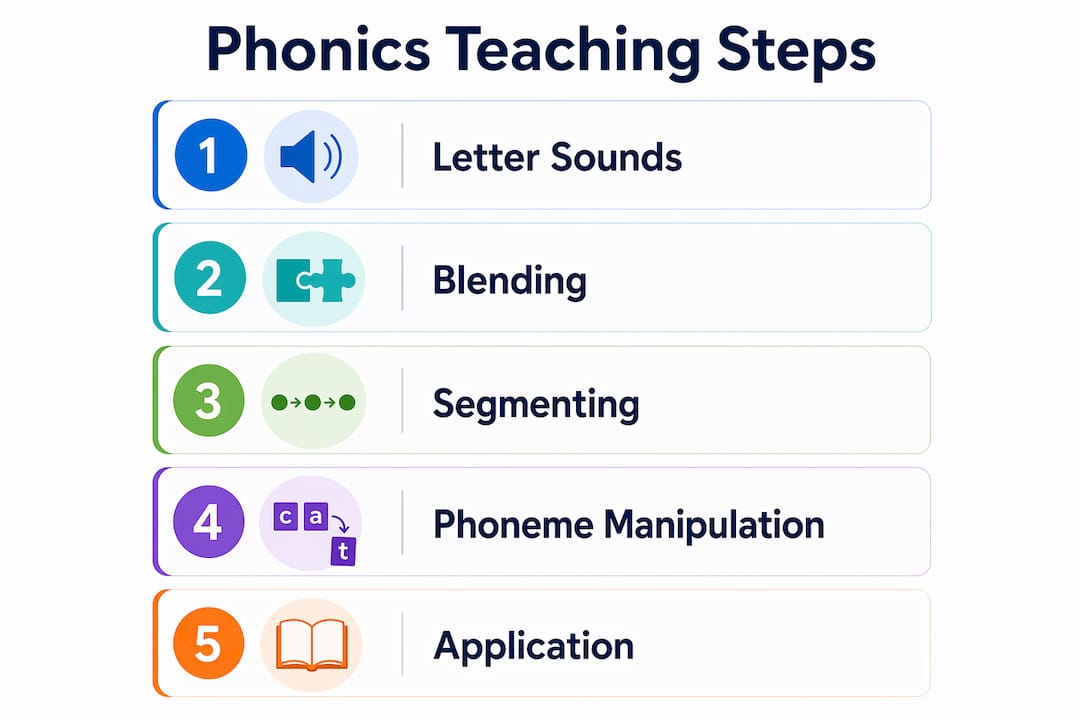
The five core phonics skills
Effective phonics instruction builds five skills in sequence:
- Letter-sound correspondence: Knowing that each letter or letter group represents a specific sound.
- Blending: Combining individual sounds to read a whole word, such as /k/ /æ/ /t/ = “cat.”
- Segmenting: Breaking a spoken word into its individual sounds for spelling.
- Phoneme manipulation: Adding, removing, or substituting sounds within words.
- Reading in context: Applying decoding skills within real sentences and texts.
Synthetic phonics vs. analytic phonics
Two main approaches dominate classroom instruction. Synthetic phonics teaches children to convert letters into sounds and then blend those sounds together to form words. This is the most widely used method in structured literacy programs. Analytic phonics, by contrast, starts with whole words and asks children to identify patterns within them.
Synthetic phonics has the highest impact when embedded in a rich literacy environment rather than taught in isolation. That means pairing phonics lessons with read-alouds, storytelling, and vocabulary work produces better outcomes than phonics drills alone. Educators who teach young learners can apply these principles directly in both ESL and first-language reading contexts.
Pro Tip: Introduce phonics through decodable books, which contain only the letter-sound patterns children have already learned. This builds confidence and reinforces skills without overwhelming learners with irregular words too early.
What are the most effective phonics teaching methods?
Effective phonics teaching combines structured instruction with responsive, individualized support. No single method works equally well for every learner. The most successful educators use a core framework and then adapt based on ongoing assessment.
Systematic synthetic phonics
Systematic synthetic phonics programs introduce sounds in a deliberate sequence, from simple to complex. Teachers follow a scope and sequence that ensures no sound-letter relationship is skipped. Programs typically begin with single consonants and short vowels, then progress to consonant blends, digraphs, and long vowel patterns.
Multi-sensory approaches
Multi-sensory phonics instruction engages sight, sound, and touch simultaneously. Children might trace letters in sand while saying the sound aloud, or clap syllables while reading. This approach is particularly effective for learners who struggle with traditional print-based instruction, including those with dyslexia.
Small-group interventions
Small-group phonics interventions often provide more targeted help for struggling readers compared to whole-class delivery. A teacher working with three or four students can monitor each child’s responses and adjust instruction in real time. This format is especially valuable for learners who fall behind the class pace.
A practical sequence for introducing phonics in any setting:
- Assess each learner’s current phonics knowledge before starting instruction.
- Introduce sounds in a logical sequence, beginning with the most common phonemes.
- Practice blending and segmenting daily using short, focused activities.
- Use decodable texts that match the sounds already taught.
- Assess progress regularly and adjust the sequence based on individual results.
Instructional strategies and teacher decision-making influence phonics outcomes as much as the content itself. That finding reinforces the value of professional development for anyone teaching reading. Educators who build their own knowledge of phonics structure become more effective at spotting gaps in student understanding. Teflinstitute’s training resources support this kind of professional growth for English language teachers working with young learners.
Pro Tip: Use ESL reading games to reinforce phonics skills in a low-pressure context. Word-building activities and sound-sorting games keep learners engaged while practicing the same decoding skills covered in formal lessons.
Common misconceptions about phonics instruction
Several persistent myths reduce the effectiveness of phonics programs in schools and homes. Addressing them directly leads to better outcomes.
Myth 1: Phonemic awareness is enough on its own.
Phonemic awareness combined with explicit alphabetic principle instruction produces stronger readers than phonemic awareness alone. Children who can hear sounds but cannot connect them to letters cannot decode written text. Both skills are necessary, and neither replaces the other.
Myth 2: Phonics is a complete reading program.
Phonics is one component of literacy, not the whole picture. Vocabulary development, reading comprehension, oral language skills, and fluency practice all contribute to a child’s reading ability. Treating phonics as the only tool produces narrow readers who can decode words but struggle to understand what they read.
Myth 3: All children learn phonics at the same pace.
Learner differences in language background, prior exposure to print, and cognitive processing speed all affect how quickly children acquire phonics skills. Instruction that ignores these differences produces uneven results. Teacher professional learning and ongoing assessment are the key factors that determine whether instruction keeps pace with individual learners.
Myth 4: Phonics only applies to native English speakers.
Phonics instruction benefits English language learners significantly. ESL learners who understand sound-letter relationships in English gain a systematic tool for decoding unfamiliar words. Effective ESL teaching methodologies incorporate phonics alongside oral language development for this reason.
Overcoming these misconceptions requires educators and parents to view phonics as one part of a broader literacy plan, not a standalone fix.
Key Takeaways
Phonics is the most evidence-backed method for teaching early reading, and its effectiveness depends on structured instruction, a language-rich environment, and continuous assessment of individual learner progress.
| Point | Details |
|---|---|
| Phonics definition | Phonics connects spoken sounds (phonemes) to written letters (graphemes) to teach reading and spelling. |
| Research-backed impact | Structured phonics instruction produces approximately 5 months of additional reading progress in early learners. |
| Alphabetic principle | Knowledge of the alphabetic principle predicts reading fluency more reliably than phonemic awareness alone. |
| Synthetic phonics | Synthetic phonics has the highest impact when embedded in a language-rich environment, not taught in isolation. |
| Teacher quality matters | Instructional decisions and ongoing assessment influence phonics outcomes as much as the program content itself. |
What I have learned from watching phonics instruction succeed and fail
After years of working within English language education and observing phonics instruction across multiple settings, one pattern stands out clearly: the method matters far less than the teacher’s ability to read the room.
I have seen highly structured synthetic phonics programs produce strong readers in one classroom and mediocre results in the classroom next door. The difference was never the program. It was whether the teacher assessed frequently, adjusted quickly, and kept instruction connected to real reading experiences. A child who can blend sounds in isolation but never applies that skill to a book has not truly learned to read.
The other mistake I see repeatedly is treating phonics as a phase to complete rather than a skill to embed. Phonics is not a six-week unit. It is a lens that should inform how teachers respond to every reading error a child makes. When a child misreads “ship” as “sip,” that is a phonics signal, not just a mistake. Responding to it with a quick, targeted correction is what adaptive teaching looks like in practice.
Parents often ask me whether they can teach phonics at home. The answer is yes, but only if they understand the sequence. Starting with irregular words or high-frequency sight words before establishing basic sound-letter correspondences creates confusion. Start with the sounds, build the patterns, and always connect the skill to books the child actually wants to read.
— Muller
Teaching phonics with confidence through Teflinstitute
Knowing what phonics is and knowing how to teach it are two different things. Teflinstitute offers TEFL certification courses that equip educators with practical strategies for teaching reading and phonics to young learners in both classroom and online settings.

The 120-hour advanced TEFL course covers specialized instruction methods including phonics-based approaches for ESL learners. For educators who want deeper preparation, the 240-hour Master TEFL course is externally accredited and covers literacy instruction in full. Both programs are designed for educators who want to teach English with real skill, not just enthusiasm.
FAQ
What is the phonics definition in simple terms?
Phonics is a method of teaching reading by connecting the sounds of spoken language to the letters that represent them. It gives learners a system for decoding written words rather than memorizing each word by sight.
What are the main benefits of phonics instruction?
Phonics instruction improves reading fluency, spelling accuracy, and decoding speed. Research from the Education Endowment Foundation shows it produces approximately 5 months of additional academic progress in early readers.
How does phonics differ from phonemic awareness?
Phonemic awareness is the ability to hear and manipulate sounds in spoken words, while phonics connects those sounds to written letters. Both skills are necessary, and research confirms that combining them produces stronger readers than either skill alone.
What phonics skills do children need to develop?
Children need five core phonics skills: letter-sound correspondence, blending, segmenting, phoneme manipulation, and applying decoding in real reading contexts. These skills build on each other in sequence.
Can phonics be used to teach English as a second language?
Phonics is effective for ESL learners because it gives them a systematic tool for decoding English words. Embedding phonics within oral language development and reading comprehension practice produces the strongest results for second-language learners.
Recommended
TEFL Institute guides

Germany
Freelance work and pay
Spain
Jobs, pay and visa routes
China
Z visa, pay and cities
Japan
JET, ALT and eikaiwa pay
Estonia
Jobs, pay and work routes