

 United Kingdom (UK)
 United States (US)
 Canada
 South Africa
 India
India Australia
 New Zealand
 China
China Russia
 Germany
 France
 Spain
Spain Netherlands
 Vietnam
 United Arab Emirates
 Italy
Italy Poland
 Thailand
 Türkiye








 Algeria


What Is Delta? Meanings Across Math, Finance, and Geography
What Is Delta? Meanings Across Math, Finance, and Geography

TL;DR:
- Delta is a symbol representing change or difference across diverse fields such as mathematics, science, finance, and geography. Its meaning varies from finite and infinitesimal differences to landforms and advanced mathematical functions, depending on the context. Recognizing the field-specific application of delta is essential for accurate understanding and interpretation.
Delta is defined as the fourth letter of the Greek alphabet (Δ or δ), used universally to represent change or difference across mathematics, finance, geography, and science. The symbol appears in algebra, calculus, options trading, and physical geography, each time carrying a precise meaning tied to its context. Understanding what delta means in each field removes confusion and builds a foundation for stronger analytical thinking. Whether you are a student working through calculus or a curious reader who spotted the term in a financial report, the concept is more accessible than it first appears.
What does delta mean in mathematics and science?
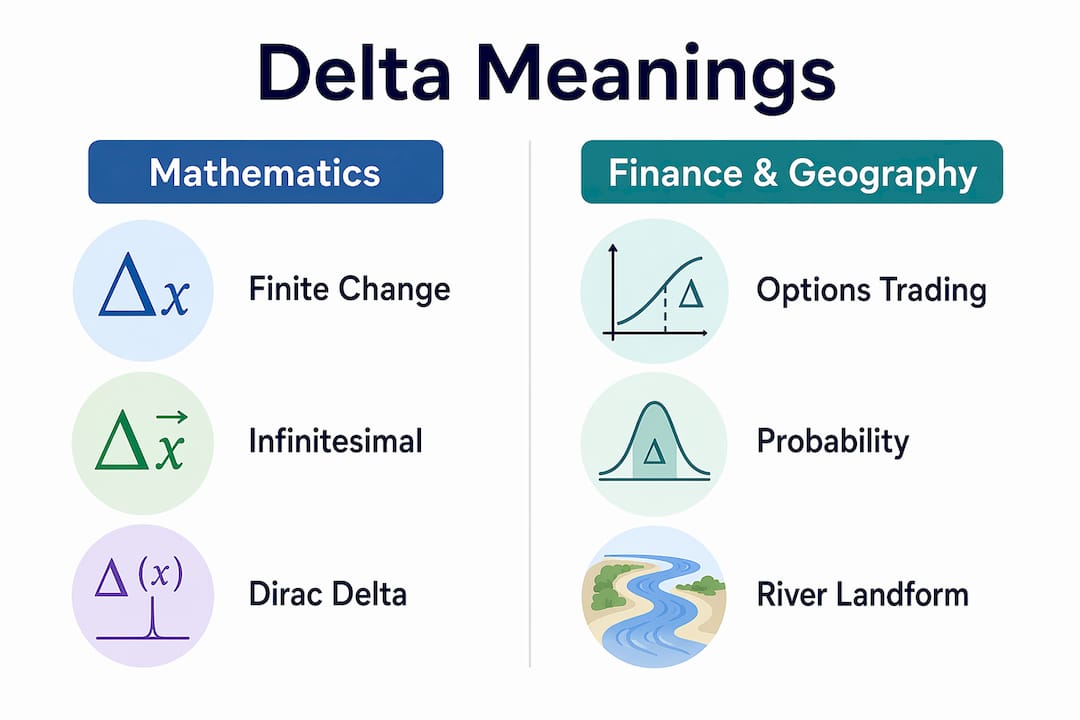
Delta represents change in its most fundamental mathematical sense. Uppercase Δ denotes a finite, measurable difference between two values. The standard expression is Δx = x₂ − x₁, which simply means “the change in x from one point to another.” This notation appears in physics, engineering, and algebra wherever a before-and-after comparison is needed.
Lowercase δ carries a related but distinct role. In calculus and limit proofs, δ refers to an infinitesimally small quantity. The classic epsilon-delta definition of a limit uses δ to describe how close an input must be to a target value for the output to stay within a defined range. This distinction between Δ and δ is one of the first things students must internalize when moving from algebra to calculus.
Δ also functions as the discriminant in quadratic algebra, expressed as Δ = b² − 4ac. The discriminant determines whether a quadratic equation has two real roots, one real root, or no real roots. A positive Δ means two distinct solutions; a zero Δ means one repeated solution; a negative Δ means no real solutions exist.
In physics and engineering, delta quantifies changes in specific variables. Common examples include:
- Δt (delta t): change in time, used in velocity and acceleration calculations
- ΔE (delta E): change in energy, central to thermodynamics and quantum mechanics
- Δv (delta v): change in velocity, critical in aerospace and orbital mechanics
- ΔP (delta P): change in pressure, used in fluid dynamics
Delta aids clear communication across STEM fields by giving scientists and engineers a shared shorthand for difference. Without it, equations would require lengthy verbal descriptions of what changed and by how much.
One symbol that students frequently confuse with delta is nabla (∇). Nabla is a vector differential operator used for gradient, divergence, and curl in multivariable calculus and physics. It looks like an inverted triangle and shares visual similarity with Δ, but it performs a fundamentally different mathematical operation. Nabla acts on a function to produce a vector; delta measures a scalar difference.
Pro Tip: Always identify whether you are reading uppercase Δ or lowercase δ before interpreting any equation. The case changes the meaning entirely, and mixing them up is one of the most common errors in early calculus coursework.
How is delta used in finance and options trading?
Delta in finance measures how much an option’s price changes when the underlying asset moves by $1. A delta of 0.5 means the option price shifts by $0.50 for every $1 move in the asset. This makes delta the primary sensitivity metric that options traders monitor when assessing position risk.
The delta range differs by option type:
- Call options carry a delta between 0 and 1. A call option with a delta of 0.8 moves $0.80 for each $1 increase in the underlying stock.
- Put options carry a delta between -1 and 0. A put option with a delta of -0.4 gains $0.40 in value for each $1 drop in the stock price.
- Deep in-the-money options approach a delta of 1 (calls) or -1 (puts), behaving almost identically to the underlying asset.
- At-the-money options typically carry a delta near 0.5, reflecting balanced sensitivity.
- Deep out-of-the-money options approach a delta of 0, meaning the price barely reacts to asset movement.
Options traders also interpret delta as a probability indicator. A delta of 0.3 implies roughly a 30% chance the option will finish in the money at expiration. This probabilistic reading gives traders a quick way to assess whether an option is worth holding or selling before expiration.
Delta also drives hedging strategy. A delta-neutral position is one where the combined delta of all holdings sums to zero, meaning the portfolio neither gains nor loses value from small price movements in the underlying asset. Traders build delta-neutral positions to isolate other variables, such as time decay or volatility, without exposure to directional price risk.
Delta changes dynamically as the underlying asset price moves. The rate at which delta itself changes is called gamma. A high gamma means delta shifts rapidly, requiring frequent position adjustments. Traders managing large options books monitor gamma closely to avoid sudden exposure spikes.
Pro Tip: Never treat delta as a fixed number. Recalculate it whenever the underlying asset price moves significantly, especially in volatile markets where gamma is high.
What is a delta in geography and environmental science?
A delta is defined as a triangular or fan-shaped landform that develops at the mouth of a river where it meets a larger body of water. River deltas form when sediment deposits accumulate faster than water currents can carry them away. Over time, the deposited material builds outward, splitting the river into multiple smaller channels called distributaries.

The name comes directly from the Greek letter Δ. The Nile River delta, viewed from above, resembles the triangular shape of the uppercase letter, which is how ancient Greek scholars first described it.
Well-known river deltas include:
- The Nile Delta (Egypt): one of the oldest inhabited deltas, supporting agriculture for thousands of years
- The Mississippi River Delta (United States): a major ecological zone and critical habitat for migratory birds
- The Ganges-Brahmaputra Delta (Bangladesh and India): the largest delta in the world by area, home to the Sundarbans mangrove forest
- The Mekong Delta (Vietnam): one of Southeast Asia’s most productive agricultural regions
Deltas serve as vital ecosystems. They filter water, store carbon, buffer coastlines against storm surges, and support extraordinary biodiversity. Wetland plants, fish nurseries, and migratory bird populations all depend on delta environments.
| Delta type | Shape | Formation driver |
|---|---|---|
| Arcuate (fan-shaped) | Curved, broad front | Strong wave action reshaping deposits |
| Bird’s foot | Narrow, finger-like channels | Low wave energy, high sediment load |
| Cuspate | Pointed, tooth-like | Opposing wave directions meeting at a point |
| Estuarine | Funnel-shaped | Tidal forces dominating over river flow |
Human settlements cluster around deltas because of fertile soil and access to water. Cities like Cairo, Dhaka, and Ho Chi Minh City sit on or near major deltas. This concentration of population makes delta degradation, driven by sea level rise and upstream damming, a significant concern for millions of people.
What are the different types of delta in advanced mathematics?
Advanced mathematics uses several specialized forms of delta that go well beyond the standard change notation. Dirac delta and Kronecker delta are the two most commonly encountered, and both differ significantly from the everyday Δ and δ.
The Dirac delta function (δ(x)) is not a function in the traditional sense. It represents an idealized spike: zero everywhere except at a single point, where it is infinitely tall, yet integrates to exactly 1. Physicists use it to model point masses, point charges, and instantaneous impulses. Engineers apply it in signal processing to represent a perfect impulse signal.
The Kronecker delta (δᵢⱼ) is a discrete tool used in linear algebra and tensor mathematics. It equals 1 when two indices are equal (i = j) and 0 when they differ. Matrix identity operations and orthogonality proofs rely on Kronecker delta notation to express conditions cleanly.
Distinguishing between Δ, δ, and ∇ is essential in higher-level math and physics. Mixing them up produces conceptual errors that are difficult to trace. The table below summarizes the key distinctions:
| Symbol | Name | Primary use |
|---|---|---|
| Δ | Uppercase delta | Finite change between two values |
| δ | Lowercase delta | Infinitesimal change; also Dirac delta function |
| δᵢⱼ | Kronecker delta | Index equality in linear algebra |
| ∇ | Nabla | Vector differential operator (gradient, divergence, curl) |
Misapplying specialized deltas outside their defined contexts is a common error among advanced students. The Dirac delta function, for example, cannot be treated like a standard function with a defined value at a point. Recognizing which delta applies in a given context is the skill that separates competent from advanced mathematical reasoning.
Key takeaways
Delta is a single symbol with distinct, precise meanings in mathematics, finance, and geography, and using it correctly requires identifying the context first.
| Point | Details |
|---|---|
| Delta means change | Uppercase Δ measures finite differences; lowercase δ handles infinitesimal quantities in calculus. |
| Finance delta measures sensitivity | A delta of 0.5 means an option price moves $0.50 for every $1 shift in the underlying asset. |
| Geographic deltas are landforms | River deltas form at river mouths through sediment deposits, creating fertile, ecologically vital zones. |
| Specialized deltas exist | Dirac delta and Kronecker delta serve advanced physics and linear algebra, not general change notation. |
| Context determines meaning | Nabla (∇) is not delta; confusing the two symbols produces errors in multivariable calculus and physics. |
Why context is the only rule that matters with delta
I have spent years explaining complex concepts to learners at every level, and delta is one of the symbols that trips people up most consistently. The confusion is understandable. The same letter appears in a high school algebra problem, a derivatives trading terminal, and a geography textbook, each time meaning something different.
The mistake most learners make is trying to memorize a single definition. That approach fails immediately when they move between disciplines. The better habit is to read the context before reading the symbol. Is this a physics equation? Delta means a measurable change in a variable. Is this an options chain? Delta measures price sensitivity. Is this a geography article? Delta is a landform. The symbol is the same; the application is entirely different.
I have also seen experienced students stumble when they first encounter Dirac delta or Kronecker delta. These are not harder versions of the same concept. They are separate tools that happen to share a name. Treating them as extensions of basic delta notation creates errors that are genuinely hard to unravel. The fix is simple: learn each delta form in its own context before trying to connect them.
Mastering delta is really about mastering the habit of asking “what does change mean here?” That question applies equally to a calculus proof, an options trade, and a river system. Once you frame delta as a universal shorthand for difference rather than a fixed formula, the symbol stops being intimidating and starts being useful. That shift in perspective is the actual lesson.
For educators, teaching delta well means teaching context first. The symbol is secondary. If you are building ESL teaching methodologies that include STEM vocabulary, this principle applies directly: anchor every technical term in a concrete situation before introducing the notation.
— Muller
Expand your teaching expertise with Teflinstitute
Understanding complex concepts like delta across multiple disciplines reflects the kind of analytical depth that strong educators bring to the classroom. Teflinstitute supports that depth through flexible, accredited courses designed for learners who want more than surface-level knowledge.

The 120 Hour Elective TEFL Course at Teflinstitute gives educators the tools to teach challenging material clearly and confidently. The course is fully online, self-paced, and built for professionals who want to advance their teaching credentials without pausing their careers. Whether you are new to TEFL or expanding an existing qualification, Teflinstitute offers structured, high-quality training that fits your schedule and goals.
FAQ
What is delta in simple terms?
Delta is the fourth letter of the Greek alphabet (Δ or δ) and universally represents change or difference. The specific meaning depends on the field: mathematics, finance, or geography.
What does delta mean in math?
Uppercase Δ denotes a finite change between two values, such as Δx = x₂ − x₁. Lowercase δ refers to infinitesimally small quantities used in calculus and limit definitions.
How does delta work in options trading?
Delta measures how much an option’s price changes when the underlying asset moves by $1. A delta of 0.5 means the option gains or loses $0.50 per $1 move in the asset.
What is a river delta in geography?
A river delta is a triangular landform that forms at a river’s mouth where sediment deposits accumulate as the river meets a larger body of water. The Nile and Mississippi River deltas are well-known examples.
What is the difference between Dirac delta and regular delta?
Regular delta (Δ or δ) measures change or difference in standard math and science. The Dirac delta function is a specialized physics and engineering tool representing an idealized spike that equals zero everywhere except at one point, yet integrates to 1.
Recommended
TEFL Institute guides

China
Z visa, pay and cities
Vietnam
Work permits and requirements
Germany
Freelance work and pay
Portugal
Jobs, pay and visa routes
Taiwan
Buxibans, pay and visas