
 United Kingdom (UK)
 United States (US)
 Canada
 South Africa
 India
India Australia
 New Zealand
 China
China Russia
 Germany
 France
 Spain
Spain Netherlands
 Vietnam
 United Arab Emirates
 Italy
Italy Poland
 Thailand
 Türkiye




 Algeria


TESOL Certification: Unlocking Global Teaching Careers
TESOL Certification: Unlocking Global Teaching Careers

Most American and European schools now require accredited TESOL certification for international teaching jobs, yet myths about the field still confuse many aspiring educators. If you are eager to teach abroad in Asia or Europe, understanding the realities of TESOL is key to securing top opportunities and avoiding costly missteps. This guide breaks down certification types, curriculum essentials, and the facts behind common misconceptions, so you can approach your TESOL journey confidently and make well-informed choices.
Table of Contents
- TESOL Defined And Common Myths
- Major Types Of TESOL Certifications
- Key Skills And Curriculum Components
- Eligibility, Accreditation, And Course Formats
- Costs, Career Impact, And Common Pitfalls
Key Takeaways
| Point | Details |
|---|---|
| TESOL’s Scope | TESOL involves teaching language and developing bilingual, bicultural competencies essential for educators in international environments. |
| Certification Importance | Research specific TESOL certifications that meet regional requirements to enhance job prospects and align with local standards. |
| Core Skills in TESOL | A TESOL curriculum must include linguistic competency, pedagogical skills, and intercultural communication to effectively teach across diverse contexts. |
| Cost Awareness | Understand the financial investment of certification programs and potential earning outcomes in targeted teaching markets to align with career goals. |
TESOL Defined and Common Myths
TESOL, an acronym for Teaching English to Speakers of Other Languages, represents a sophisticated professional field that extends far beyond simple language instruction. Professional development in global language education requires deep understanding of linguistic complexities and cross-cultural communication strategies.
At its core, TESOL encompasses more than just teaching English. It involves developing bilingual and bicultural competencies that enable educators to navigate complex international learning environments. Contrary to popular misconceptions, being a native English speaker does not automatically qualify someone to teach. The profession demands specialized training, understanding of linguistic structures, and advanced pedagogical techniques.
Several persistent myths continue to challenge the TESOL profession. One widespread misconception is that anyone who speaks English fluently can effectively teach it. In reality, successful TESOL practitioners require extensive training in methodology, language acquisition theories, and cultural sensitivity. Another common myth suggests that English teaching opportunities are uniform worldwide, when in fact regional educational contexts vary dramatically, requiring nuanced approaches to language instruction.
Pro tip: Research specific regional TESOL certification requirements before pursuing international teaching opportunities to maximize your chances of successful placement.
Major Types of TESOL Certifications
TESOL certifications come in various formats, each designed to meet specific professional and regional teaching requirements. Different certification pathways offer educators unique opportunities to develop specialized skills and enhance their international teaching credentials.
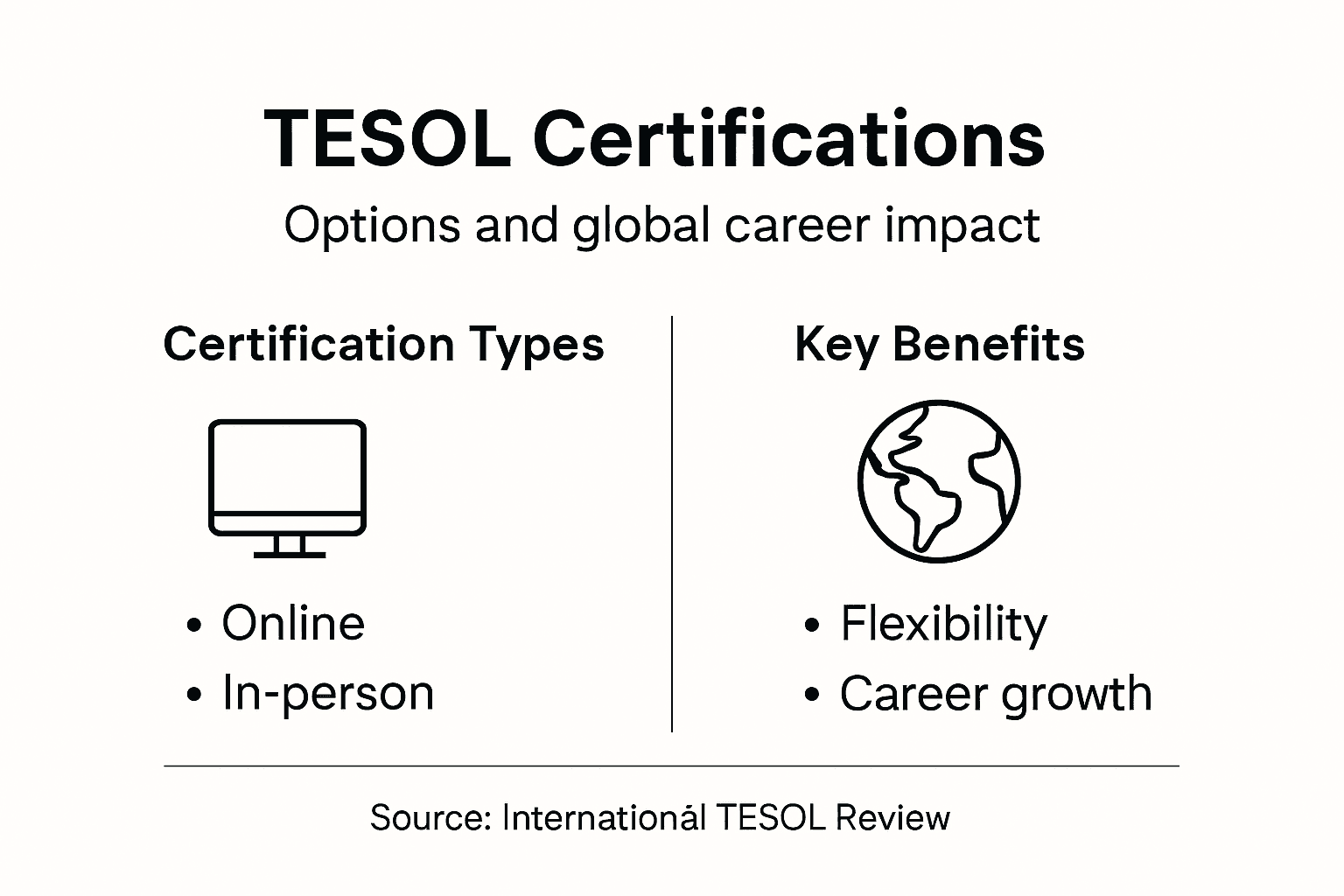
The primary types of TESOL certifications include online programs, in-person intensive courses, and hybrid learning formats. Online TESOL Certificates typically provide flexibility for working professionals, allowing completion of coursework through digital platforms. These programs often cover essential topics like language teaching methodology, classroom management, and second language acquisition theories. In-Person Intensive Certificates, such as CELTA (Certificate in English Language Teaching to Adults), involve hands-on training with direct classroom practice and immediate instructor feedback.
Regional variations significantly impact certification requirements. For instance, some Asian countries require specific endorsements, while European institutions might prioritize academic-focused TESOL credentials. Specialized certifications also exist for niche teaching contexts, including business English instruction, young learner programs, and academic English preparation. Advanced options like Graduate TESOL Diplomas and Level 5 TEFL Certificates provide deeper theoretical understanding and potential pathways to higher education teaching roles.
Pro tip: Research destination-specific teaching requirements before selecting a TESOL certification to ensure maximum employability and alignment with local educational standards.
Here’s a comparison of the main TESOL certification formats to help you choose the best approach:
| Certification Type | Flexibility | Practical Training | Typical Cost Range |
|---|---|---|---|
| Online Certificate | High (fully online) | Limited; theoretical focus | $500 – $1,200 |
| In-Person Intensive | Low (on-site only) | Extensive classroom practice | $1,500 – $2,500 |
| Hybrid Learning | Moderate flexibility | Balanced theory and practicum | $1,000 – $2,000 |
| Graduate Diploma | Low (academic setting) | Deep theoretical insight | $2,000+ |
Key Skills and Curriculum Components
A comprehensive TESOL certification curriculum encompasses a diverse range of skills essential for effective international language instruction. Platforms for online English teaching demonstrate the evolving complexity of language education in the digital age.

The core curriculum typically includes several critical skill domains. Linguistic Competency forms the foundation, requiring deep understanding of English grammar, phonetics, and language structure. Educators must develop advanced Pedagogical Skills that enable them to design engaging lesson plans, implement diverse teaching methodologies, and adapt instruction to various learning styles. This includes mastering techniques for classroom management, student assessment, and curriculum development.
Additional crucial components include Intercultural Communication Skills, which prepare teachers to navigate complex cultural contexts. This involves understanding cultural nuances, communication barriers, and developing strategies for effective cross-cultural interaction. Advanced TESOL programs also integrate technological proficiency, teaching candidates how to leverage digital tools, online learning platforms, and interactive teaching technologies to create dynamic learning experiences.
Pro tip: Develop a comprehensive digital portfolio showcasing your teaching methodologies, lesson plans, and cross-cultural communication skills to stand out in the competitive international teaching market.
The table below summarizes core TESOL skill areas and their importance for international educators:
| Skill Domain | Relevance | Example Application |
|---|---|---|
| Linguistic Competency | Foundation for all teaching tasks | Grammar analysis, pronunciation |
| Pedagogical Techniques | Drives lesson effectiveness | Lesson design, assessment |
| Intercultural Communication | Enables global classroom success | Navigating cultural differences |
| Digital Literacy | Essential in modern e-learning | Using online teaching platforms |
Eligibility, Accreditation, and Course Formats
Navigating the landscape of TESOL certification requires understanding complex eligibility requirements and academic staff qualifications that vary across different programs and regions. Potential candidates must carefully evaluate their educational background, language proficiency, and professional goals before selecting a certification pathway.
Eligibility Criteria typically include a minimum educational requirement of a bachelor’s degree, though specific programs may have varying standards. Native or near-native English proficiency is almost universally required, with many programs demanding formal language assessments or proven teaching experience. Accreditation Standards play a crucial role in determining the credibility and global recognition of a TESOL certification. Reputable programs are typically validated by international education bodies, ensuring that curriculum meets rigorous professional teaching standards.
Course formats have diversified significantly in recent years, offering flexible options for aspiring educators. Online Certification Programs provide maximum flexibility, allowing students to complete coursework while maintaining existing professional or personal commitments. Hybrid Courses combine digital learning with in-person practicum experiences, offering a balanced approach to theoretical knowledge and practical teaching skills. Intensive In-Person Certifications, such as CELTA, provide immersive training with immediate feedback and direct classroom observation, often preferred by employers seeking comprehensive preparation.
Pro tip: Verify the international recognition and accreditation of your chosen TESOL program before enrollment to ensure maximum career mobility and global teaching opportunities.
Costs, Career Impact, and Common Pitfalls
Pursuing a TESOL certification represents a significant investment in professional development, with costs and potential career trajectories varying widely across different programs and global markets. Teaching opportunities worldwide demonstrate the complex economic landscape of international language education.
The financial investment for TESOL certification ranges from approximately $500 to $2,500, depending on program complexity, delivery format, and additional practicum components. Online Certifications typically represent the most affordable option, while Intensive In-Person Programs like CELTA often demand higher tuition. Career impact can be substantial, with certified professionals potentially earning between $1,500 to $4,000 monthly in international teaching roles, particularly in high-demand markets like South Korea, China, and the United Arab Emirates.
Common pitfalls include selecting non-accredited programs, underestimating cultural adaptation requirements, and failing to research specific regional teaching regulations. Aspiring TESOL professionals must carefully evaluate certification programs, considering factors like international recognition, practical training components, and alignment with specific geographic teaching markets. Some educators mistakenly assume certification guarantees immediate employment, overlooking the importance of supplementary skills like digital literacy, cross-cultural communication, and specialized language teaching expertise.
Pro tip: Research salary ranges and job market conditions for your target teaching destinations before investing in a TESOL certification to ensure alignment with your career expectations and financial goals.
Take the Next Step Toward Your TESOL Career
If you are ready to transform your passion for teaching English into a global career you need the right certification that matches your goals and the diverse challenges of international language education. Understanding key concepts like linguistic competency and intercultural communication is essential but so is choosing a TESOL certification that offers practical training and recognized accreditation. At TEFL Institute, you can explore a full range of flexible online and hybrid courses designed to equip you with advanced skills and real-world teaching practice.
Start now to access comprehensive study prospectuses, salary calculators, and career guides that prepare you for teaching opportunities worldwide. Visit TEFL Institute to find the right program for your ambitions and secure your place in the growing field of English language education. Don’t wait to unlock your potential and make a difference in classrooms across the globe with trusted TESOL certification from a leader in online TEFL training.
Frequently Asked Questions
What is TESOL certification?
TESOL certification stands for Teaching English to Speakers of Other Languages certification, which prepares individuals to teach English effectively in international contexts. It covers essential skills such as language acquisition theories, pedagogical techniques, and intercultural communication.
What are the types of TESOL certifications available?
There are several types of TESOL certifications, including online certificates, in-person intensive courses, hybrid programs, and advanced graduate diplomas. Each offers different training formats and focuses on unique teaching needs.
How much does TESOL certification typically cost?
The cost of TESOL certification can range from approximately $500 to $2,500, depending on the program type and its inclusivity of practical training components. Online certifications tend to be the most affordable.
What skills are essential for a successful TESOL educator?
Essential skills for a successful TESOL educator include linguistic competency, advanced pedagogical techniques, intercultural communication skills, and digital literacy. These competencies help educators deliver effective instruction in diverse learning environments.
Recommended
- Best TEFL Certifications for Teaching English in Asia 2026: Japan, Korea, China, Thailand, Vietnam & Cambodia | TEFL Institute
- 180 Hour Level 5 TEFL Diploma | Ofqual Regulated | USA
- Best TEFL Certification for Online Teaching in 2026
- The Expert Guide to Teaching English Online in 2026 | Complete TEFL Roadmap | TEFL Institute
- Retraite Reizen In Het Buitenland Met Ervaren Coaches | Mi Cuento Reizen
