

 United Kingdom (UK)
 United States (US)
 Canada
 South Africa
 India
India Australia
 New Zealand
 China
China Russia
 Germany
 France
 Spain
Spain Netherlands
 Vietnam
 United Arab Emirates
 Italy
Italy Poland
 Thailand
 Türkiye





 Algeria


TEFL Teaching Jobs: Impact on Global Careers
TEFL Teaching Jobs: Impact on Global Careers

More than two million jobs for English teachers open worldwide every year, drawing recent American and European graduates hungry for adventure and professional growth. The demand for TEFL certification rises as online teaching and international placements spread through Asia and Europe, making language skills a ticket to global opportunities. This guide breaks down how new graduates can meet evolving requirements, compare positions, and land roles that fit their goals in thriving overseas markets.
Table of Contents
- Defining TEFL Teaching Jobs Worldwide
- Types of TEFL Positions and Key Differences
- Essential Qualifications and Certification Standards
- Global Markets and Where Teachers Are Needed Most
- Understanding Legalities, Contracts, and Safety Abroad
- Risks, Common Mistakes, and Real Salary Insights
Key Takeaways
| Point | Details |
|---|---|
| Global Demand for TEFL Teachers | There is high demand for TEFL instructors in regions such as East Asia, the Middle East, and parts of Latin America due to globalization and the need for English proficiency. |
| Diverse Employment Options | TEFL job positions range from full-time roles in schools to online platforms, offering flexibility and various working conditions for educators. |
| Essential Qualifications | A bachelor’s degree and specialized TEFL certification are typically required, with different regions having specific certification standards that candidates must meet. |
| Understanding Legalities | Teachers must carefully review employment contracts and local laws related to work permits and visas to ensure compliance and safety while teaching abroad. |
Defining TEFL Teaching Jobs Worldwide
Teaching English as a Foreign Language (TEFL) represents a dynamic global profession that enables language educators to bridge communication gaps across international settings. Emerging as a professional field over the past half century, TEFL jobs have become increasingly significant in response to globalization and the growing importance of English as a worldwide communication tool.
TEFL teaching positions are unique roles where educators teach English in countries where it is not the primary language, typically at language schools, universities, private institutions, or through online platforms. Unlike traditional teaching roles, TEFL instructors work with students who are learning English as an additional language for professional, academic, or personal development purposes. These positions require specialized training, cultural adaptability, and strong communication skills to effectively guide students through language acquisition.
The landscape of TEFL jobs is remarkably diverse, spanning multiple geographic regions and professional contexts. Teachers might find opportunities in East Asian countries like Japan and South Korea, Middle Eastern nations such as the United Arab Emirates, European countries including Spain and Poland, and emerging markets across Latin America. The specific requirements for TEFL teaching positions can vary significantly, with some roles demanding native English speaker status, while others prioritize advanced language certifications and teaching credentials.
Pro tip: Research the specific visa and work permit requirements for your target country before committing to a TEFL teaching position to ensure smooth professional transition and legal compliance.
Types of TEFL Positions and Key Differences
TEFL teaching positions represent a diverse and dynamic professional landscape, encompassing multiple educational contexts and employment models. Global TEFL job opportunities span various teaching environments, ranging from structured classroom settings to online platforms, private tutoring, and international volunteer programs. These roles require educators to demonstrate remarkable adaptability across different student populations and institutional requirements.
The primary categories of TEFL positions include full-time institutional roles, part-time language center positions, private tutoring, online teaching platforms, and international volunteer programs. Full-time positions typically offer the most stability, often found in public and private schools, universities, and language institutes across countries like South Korea, Japan, China, and Middle Eastern nations. These roles usually demand a bachelor’s degree, TEFL certification, and sometimes require a minimum contract period of one academic year.
Part-time and freelance TEFL positions provide greater flexibility for educators seeking diverse teaching experiences. These roles might involve working with language centers, conducting corporate English training, providing conversational practice, or teaching specialized English courses such as business English or academic writing preparation. Online teaching platforms have dramatically expanded in recent years, allowing instructors to connect with students globally without geographical constraints, offering unprecedented opportunities for remote teaching and international professional engagement.
Here’s a side-by-side look at key types of TEFL positions and their main attributes:
| Position Type | Typical Employer | Job Stability | Flexibility Level |
|---|---|---|---|
| Full-time Institutional | Public/Private Schools, Universities | High; annual contracts | Low; set schedule |
| Part-time/Language Center | Language Schools, Corporate Clients | Moderate; term-based | Moderate; variable hours |
| Private Tutoring | Individual Students | Low; informal | High; schedule control |
| Online Teaching | Online Platforms | Varies by platform | Very high; work from anywhere |
| Volunteer Programs | NGOs, Charities | Low; short-term | High; project-based |
Pro tip: Research the specific visa regulations and work permit requirements for your target country to ensure legal compliance and smooth professional transition in your chosen TEFL teaching context.
Essential Qualifications and Certification Standards
Navigating the world of TEFL certification requires understanding the foundational qualifications that employers worldwide seek in English language instructors. Regulatory requirements and professional standards vary significantly across different countries and institutions, creating a complex landscape of certification expectations for aspiring TEFL teachers.
Most TEFL positions mandate a minimum of a bachelor’s degree as a fundamental requirement, with many employers preferring degrees in English, Education, Linguistics, or related fields. Beyond academic credentials, specialized TEFL certification has become increasingly critical. Internationally recognized certifications like the Cambridge CELTA, Trinity CertTESOL, and standard 120-hour TEFL certificates demonstrate professional competence and provide crucial training in teaching methodologies, classroom management, and language instruction techniques.

Certification standards typically encompass comprehensive training modules that cover critical areas such as language teaching pedagogy, lesson planning, student assessment, and cross-cultural communication strategies. Advanced certifications often include practical teaching components, such as observed teaching practice or practicum sessions, which provide real-world experience and enhance employability. Some specialized TEFL certifications focus on niche areas like Business English, Young Learners, or Online Teaching, allowing educators to differentiate themselves in a competitive global job market.
Pro tip: Research the specific certification requirements for your target countries and institutions, as some regions have more stringent professional standards that can significantly impact your teaching opportunities.
Global Markets and Where Teachers Are Needed Most
The global landscape for TEFL teachers reveals dynamic opportunities across multiple international markets, with certain regions demonstrating particularly high demand for English language educators. Asia stands out as the most prominent market, with countries like South Korea, China, Japan, and Vietnam offering substantial teaching positions, competitive salaries, and comprehensive support packages for international instructors.
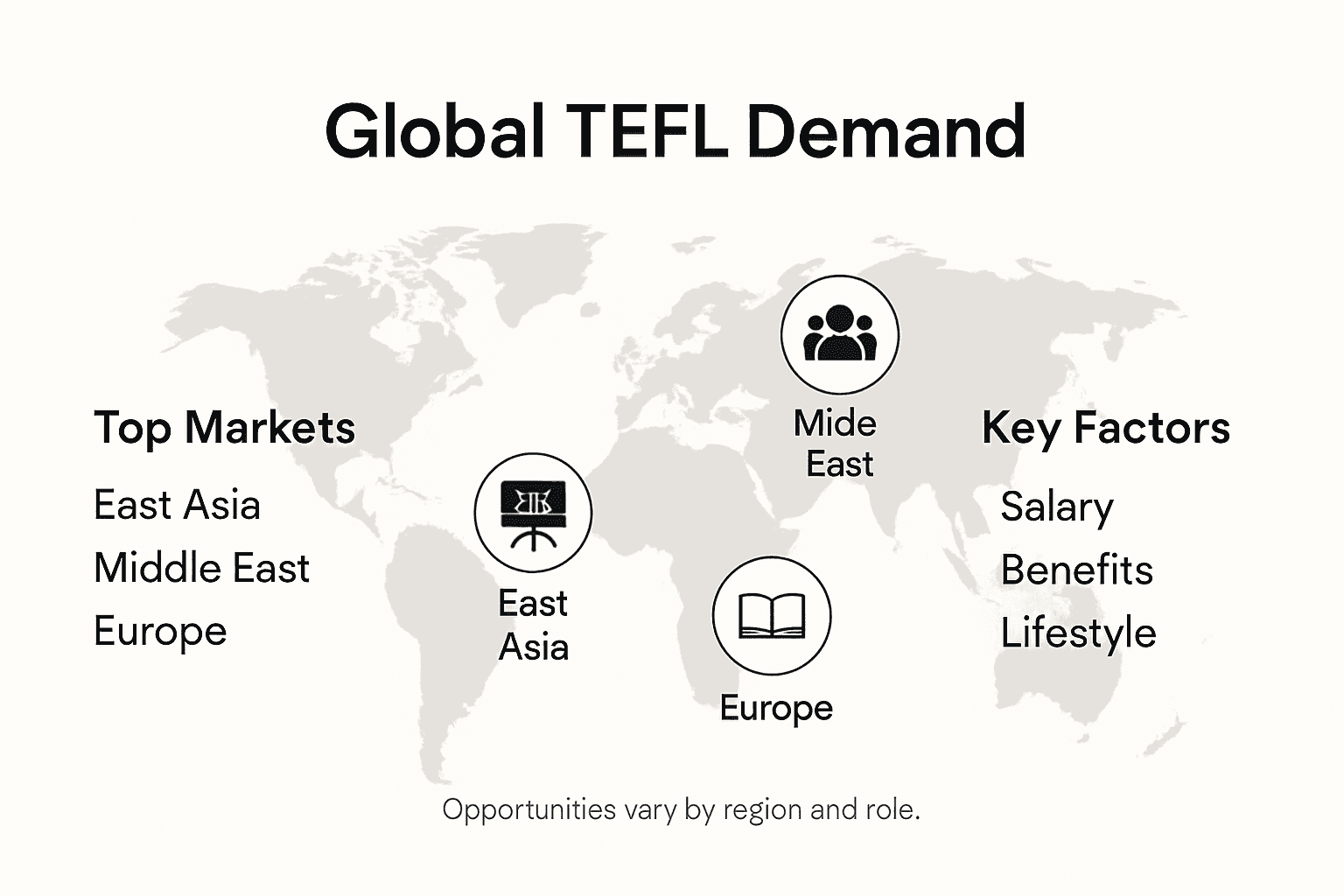
Emerging markets in the Middle East, particularly the United Arab Emirates, Saudi Arabia, and Qatar, have become increasingly attractive for TEFL professionals. These nations offer lucrative compensation packages, including tax-free salaries, housing allowances, and comprehensive benefits that make them particularly appealing to experienced educators. Latin American countries such as Brazil, Mexico, and Chile also present significant opportunities, with growing economic sectors requiring robust English language skills for international business and technological collaboration.
European countries continue to maintain steady demand for English teachers, with nations like Spain, Italy, Czech Republic, and Poland offering numerous positions for TEFL certified professionals. Smaller markets in Southeast Asian countries like Cambodia, Thailand, and Indonesia are also experiencing increased demand, driven by rapid economic development and a strategic focus on English language education as a pathway to global economic integration. Each region presents unique challenges and opportunities, requiring teachers to adapt their skills and expectations to local educational contexts and cultural nuances.
Pro tip: Research visa regulations, local job markets, and cost of living in potential teaching destinations to develop a comprehensive and realistic strategy for international TEFL employment.
Understanding Legalities, Contracts, and Safety Abroad
International employment frameworks for TEFL teachers require comprehensive legal understanding of complex visa, work permit, and contractual requirements that vary dramatically across different countries and educational institutions. Each destination presents unique legal challenges that demand careful navigation and thorough preparation from prospective international educators.
Employment contracts for TEFL teachers typically outline critical details including salary structure, working hours, housing provisions, health insurance coverage, and termination conditions. These agreements often include specific clauses related to professional responsibilities, performance expectations, and potential penalties for contract breaches. Potential teachers must scrutinize contract language carefully, understanding nuanced differences in labor protections, benefits, and institutional obligations that can significantly impact their professional and personal experience abroad.
Safety considerations extend beyond contractual terms, requiring teachers to develop cultural awareness, understand local legal systems, and maintain proactive personal security strategies. This involves researching local emergency protocols, understanding basic legal rights as a foreign worker, maintaining proper documentation, and developing networks with local and international support systems. Some regions may require additional certifications, background checks, or specific health screenings that must be completed before employment can be confirmed.
Pro tip: Consult with experienced TEFL professionals and thoroughly research government resources to understand the complete legal and cultural landscape before accepting an international teaching position.
Risks, Common Mistakes, and Real Salary Insights
International TEFL careers involve complex financial and professional challenges that require careful strategic planning, with potential teachers needing to navigate a landscape of variable job markets and unpredictable compensation structures. Understanding these nuanced dynamics is crucial for successfully managing expectations and developing sustainable international teaching careers.
Salary expectations in TEFL teaching vary dramatically across different global regions, influenced by factors such as local economic conditions, institutional budgets, teacher qualifications, and specific contractual arrangements. While developed countries like South Korea, Japan, and United Arab Emirates offer competitive compensation packages potentially ranging from $2,000 to $4,500 monthly, emerging markets in Southeast Asia and Latin America might provide lower base salaries but include additional benefits like housing allowances, airfare reimbursement, and significantly lower living costs.
Below is a comparison of TEFL salary ranges and benefits across major global regions:
| Region | Typical Salary (USD/month) | Key Benefits | Cost of Living |
|---|---|---|---|
| East Asia | $2,000 – $3,500 | Housing, airfare, bonuses | Moderate to high |
| Middle East | $2,500 – $4,500 | Tax-free pay, housing, insurance | High |
| Europe | $1,200 – $2,200 | Housing rarely included | Moderate to high |
| Latin America | $700 – $1,500 | Airfare, low living costs | Low to moderate |
| Southeast Asia | $1,000 – $2,000 | Housing, low taxes | Low |
Common mistakes that can derail TEFL career prospects include inadequate preparation, insufficient research about potential employers, and unrealistic salary expectations. Prospective teachers must carefully evaluate total compensation packages, considering not just monthly salary but also benefits, living expenses, potential savings opportunities, and long-term professional development potential. Additional risks include cultural adjustment challenges, unexpected contract restrictions, and potential workplace communication barriers that can impact job satisfaction and career progression.
Pro tip: Create a comprehensive spreadsheet comparing potential job offers, tracking not just salary but also total compensation, living expenses, and professional growth opportunities before making a final decision.
Build a Thriving Global TEFL Career with Confidence
Navigating the challenges of international TEFL teaching jobs requires more than just passion. The article highlights issues like understanding visa regulations, choosing the right certification, and managing realistic salary expectations. These pain points can feel overwhelming when trying to secure a fulfilling position abroad or online. With terms like “TEFL certification,” “visa requirements,” and “contractual legalities” shaping your journey, having a trusted support system and quality training is essential.
Take control of your teaching career today by enrolling in one of the specialized TEFL courses at TEFL Institute. Whether you want a 120-hour foundational certificate, an advanced diploma, or niche training like IELTS preparation, our comprehensive programs equip you to meet global market demands and overcome employment hurdles. Visit our course catalog to start preparing with confidence for the international opportunities that await. Don’t let uncertainty hold you back. Your global classroom is waiting.
Frequently Asked Questions
What qualifications are necessary for TEFL teaching positions?
Most TEFL positions require a minimum of a bachelor’s degree, with preferred fields including English, Education, or Linguistics. Additionally, specialized TEFL certifications like the Cambridge CELTA or Trinity CertTESOL enhance employability.
How do compensation packages for TEFL teachers vary across regions?
Compensation packages differ significantly based on factors like local economic conditions and institutional budgets. Developed regions typically offer higher salaries along with additional benefits, while emerging markets may provide lower salaries but compensate with lower living costs or other perks.
What are the different types of TEFL teaching positions available?
TEFL teaching positions include full-time institutional roles, part-time language center positions, private tutoring, online teaching, and international volunteer programs. Each type offers varying levels of job stability and flexibility.
What should I consider when evaluating a TEFL job contract?
When evaluating a TEFL job contract, scrutinize essential details such as salary structure, working hours, housing provisions, health insurance, and clauses related to professional responsibilities. Understanding these elements is crucial for a successful teaching experience abroad.
