

 United Kingdom (UK)
 United States (US)
 Canada
 South Africa
 India
India Australia
 New Zealand
 China
China Russia
 Germany
 France
 Spain
Spain Netherlands
 Vietnam
 United Arab Emirates
 Italy
Italy Poland
 Thailand
 Türkiye





 Algeria


Tefl Levels: Complete Guide to Differences
Tefl Levels: Complete Guide to Differences
Did you know a 120-hour TEFL course is the global minimum required to teach English abroad or online? Choosing the right TEFL certification level can make a big difference in your teaching journey and career growth. Different TEFL levels open doors to a range of teaching roles and salaries. Understanding how each level shapes your qualifications will help you find a path that matches your ambitions and skills.
Table of Contents
- What Are Tefl Levels?
- Comparing 120‑Hour Vs Level 3 Vs Level 5
- Celta Vs Standard Tefl Qualifications
- Who Should Choose Which Level
- Costs, Accreditation And Employer Recognition
- How Tefl Levels Affect Career Path
Key Takeaways
| Point | Details |
|---|---|
| TEFL Levels and Certifications | TEFL certifications are categorized from Level 1-2 (introductory) to Level 5 (advanced), impacting employability and training depth. |
| Standard TEFL Course | A 120-hour TEFL course is the industry standard for entry-level teaching positions globally. |
| Comparing TEFL and CELTA | CELTA involves intensive in-person training while TEFL courses offer flexible online options, impacting the choice based on personal preferences. |
| Career Impact of Certification Level | Higher TEFL certification levels lead to advanced roles and better opportunities in competitive international teaching markets. |
What Are TEFL Levels?
TEFL levels are structured certification categories that define the depth and complexity of training for individuals preparing to teach English as a foreign language. These levels help standardize the quality and comprehensiveness of teacher preparation programs. According to research from TEFL institutes, the minimum standard for teaching English abroad or online is typically a 120-hour TEFL course, which serves as an entry-level certification.
The primary TEFL levels range from basic introductory courses to advanced, professionally regulated certifications. A guide on understanding TEFL certificates reveals that most programs are categorized into the following tiers:
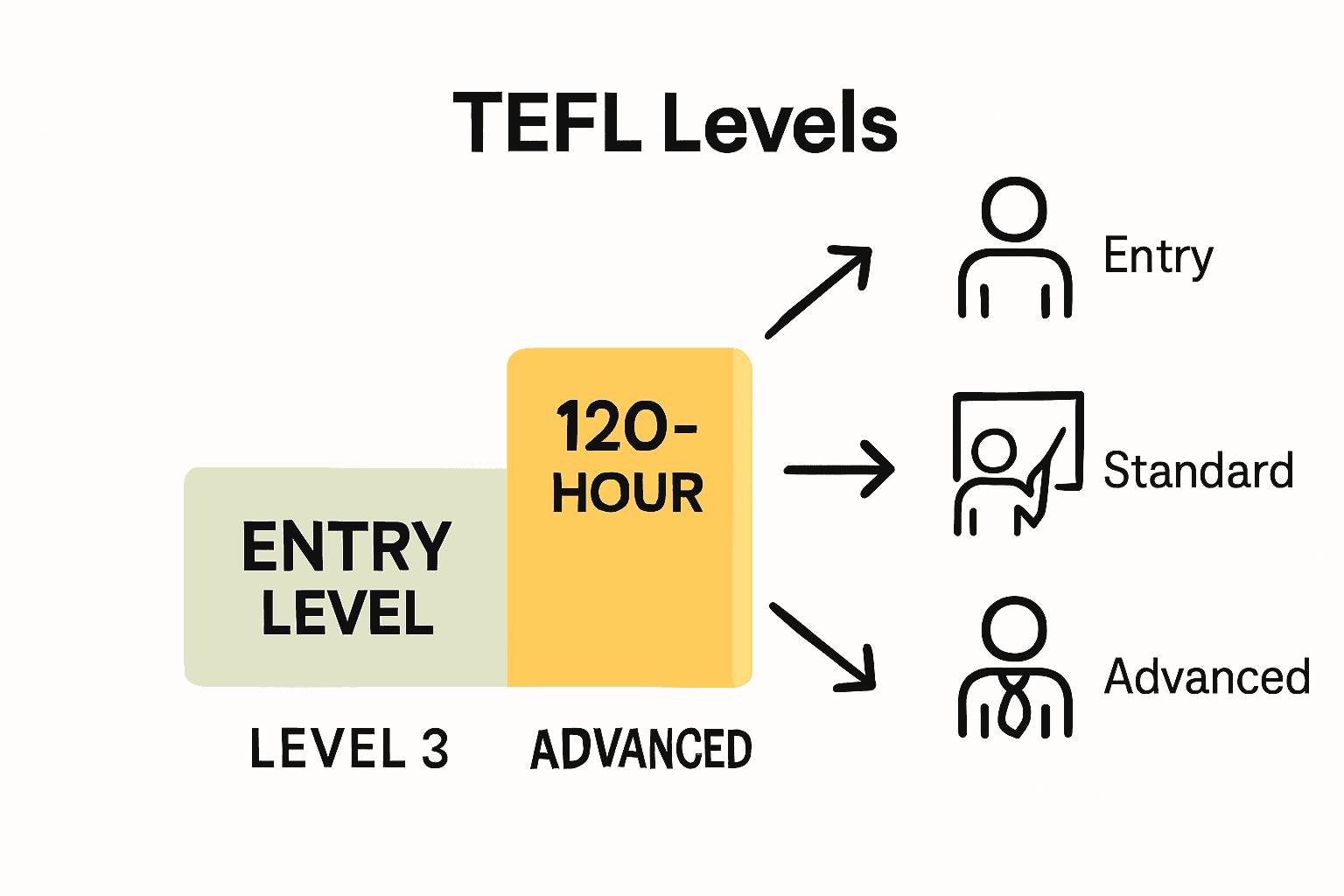
- Level 1-2: Basic introductory courses (60-120 hours)
- Level 3-4: Intermediate training programs (120-168 hours)
- Level 5: Advanced, professionally regulated certification (180-240 hours)
At the higher end of TEFL certification, Level 5 courses offer more comprehensive training. These advanced programs are particularly beneficial for individuals without previous teaching experience or an academic degree. Level 5 TEFL certificates are regulated by Ofqual, providing a rigorous and internationally recognized qualification that can significantly enhance teaching opportunities worldwide.
Comparing 120‑Hour vs Level 3 vs Level 5
Understanding the differences between TEFL certification levels is crucial for aspiring English language teachers. A 120-hour TEFL course represents the industry standard entry-level certification, providing foundational knowledge suitable for many basic teaching positions worldwide. According to research, these courses offer essential training for those beginning their international teaching journey.
Level 3 and Level 5 certifications represent increasingly sophisticated training options. Research from TEFL institutes reveals key distinctions:
- 120-Hour Course: Basic certification, meets minimum international requirements
- Level 3 Courses: Introductory programs (60-120 hours), aligned with high school diploma standards
- Level 5 Courses: Advanced certification equivalent to a foundation degree
For those seeking competitive teaching opportunities, understanding the details of Level 5 TEFL courses becomes essential. Level 5 certifications offer more comprehensive training, particularly advantageous for individuals without a traditional academic degree. These advanced programs provide deeper pedagogical insights, more extensive practical training, and significantly enhanced employability in international language education markets.
CELTA vs Standard TEFL Qualifications
TEFL certification comes in various forms, with CELTA and standard TEFL qualifications representing two prominent pathways for aspiring English language teachers. Both certifications aim to prepare educators for international teaching opportunities, but they differ significantly in structure, delivery, and practical components.
Key differences between these qualifications include:
- Training Format: CELTA typically involves intensive in-person training, while standard TEFL courses offer more flexible online learning
- Accreditation: Both are RQF Level 5 qualifications, indicating similar academic rigor
- Practical Components: CELTA usually requires assessed teaching practice, whereas online TEFL courses may offer optional practical elements
For teachers weighing their options, comparing CELTA and Level 5 TEFL certification becomes crucial. While CELTA is often considered more prestigious in some academic circles, modern Level 5 TEFL courses provide comprehensive training that can be equally competitive in the international job market. The choice ultimately depends on individual career goals, learning preferences, and specific teaching contexts.
Who Should Choose Which Level
Selecting the right TEFL certification level is a critical decision that depends on individual career goals, professional background, and personal circumstances. 120-hour TEFL courses are typically ideal for individuals who already possess a degree and have some teaching experience, providing a solid foundation for entry-level international teaching positions.
Different professional profiles align best with specific TEFL certification levels:
Here’s a comparison of TEFL certification levels and their key attributes:
| Certification Level | Typical Hours | Training Depth | Ideal Candidate |
|---|---|---|---|
| Level 3 | 60-120 | Introductory | Recent graduates Minimal experience |
| 120-Hour Course | 120 | Foundational | Degree holders Some teaching background |
| Level 5 | 180-240 | Advanced | Career changers No academic degree |
- Recent Graduates/Minimal Experience: Level 3 courses (60-120 hours)
- Degree Holders/Some Teaching Background: Standard 120-hour TEFL certification
- Career Changers/No Degree: Advanced Level 5 TEFL courses
According to research, understanding which TEFL course matches your professional profile is crucial. Level 5 courses are particularly recommended for non-native English speakers, individuals without a traditional academic degree, or those targeting competitive teaching markets. These advanced certifications provide more comprehensive training, enhanced pedagogical skills, and significantly improved employability in international education settings.
Costs, Accreditation and Employer Recognition
Choosing the right TEFL certification involves carefully evaluating costs, accreditation standards, and potential employer recognition. Accreditation plays a crucial role in determining the value of a TEFL qualification, with different levels offering varying degrees of professional credibility and international acceptance.
Key considerations for aspiring teachers include:
- 120-Hour Courses: Minimum standard, typically 4-6 weeks duration
- Level 5 Courses: More comprehensive training, 10-12 weeks long
- Cost Range: Varies from $200 to $1500 depending on course complexity
- Employer Recognition: Directly tied to accreditation and course depth
Understanding TEFL course accreditation is critical for maximizing employment opportunities. Level 5 TEFL courses, regulated by bodies like Ofqual, offer superior employer recognition and are particularly valuable for those targeting competitive international teaching markets. While these advanced certifications may cost more, they provide a significant return on investment through enhanced employability and more comprehensive pedagogical training.
How TEFL Levels Affect Career Path
Your chosen TEFL certification level dramatically influences potential teaching opportunities and career trajectory in the international education landscape. Different certification levels open varying professional doors, with each tier representing a significant step in career advancement and global teaching potential.
Career progression typically follows this strategic pathway:
- Level 3 Certification: Entry-level positions in language schools
- 120-Hour TEFL: Standard international teaching opportunities
- Level 5 Certification: Advanced roles, competitive international markets
- Specialized TEFL Diplomas: Academic and management positions
Exploring TEFL skills and their transferability reveals how certification levels impact professional growth. Higher-level certifications not only increase employability but also provide deeper pedagogical skills, enabling teachers to pursue more specialized roles such as curriculum development, teacher training, and educational consulting. Professional advancement becomes increasingly accessible as teachers invest in more comprehensive and recognized TEFL qualifications.
Take Charge of Your TEFL Journey Today
Confused about the differences between TEFL levels? It is normal to feel overwhelmed when every job ad wants a different certification and you are not sure which path best matches your teaching goals or background. Deciding between a 120-hour TEFL, a Level 3, or pursuing an advanced Level 5 can be stressful if you are anxious about employer recognition or making the most of your time and investment. At TEFL Institute, we understand the worries that come with kickstarting or advancing your ESL teaching career. Our resources and guidance help aspiring and experienced teachers like you navigate TEFL levels and select the ideal program for your dream job—without second-guessing your choices.
Why wait to transform your career? Compare our range of accredited TEFL certification options and access exclusive course prospectuses designed around the latest industry needs. For tailored advice on choosing the right TEFL level for your profile, explore helpful guides like What is TEFL: Get Certified Today or dive deeper into advanced options with What You Need to Know About the New Level 5 TEFL Course. Secure your place in an internationally recognized program by visiting TEFL Institute now. Your next teaching opportunity is closer than you think.
Frequently Asked Questions
What are the different levels of TEFL certification?
The primary TEFL levels include basic introductory courses (Level 1-2, 60-120 hours), intermediate training programs (Level 3-4, 120-168 hours), and advanced, professionally regulated certifications (Level 5, 180-240 hours).
How does a 120-hour TEFL course compare to Level 5 certification?
A 120-hour TEFL course serves as the industry standard entry-level certification, suitable for many basic teaching positions. In contrast, Level 5 certification offers more comprehensive training and is equivalent to a foundation degree, making it more advantageous for competitive teaching roles.
What are the key differences between CELTA and standard TEFL qualifications?
CELTA typically involves intensive in-person training and includes assessed teaching practice, while standard TEFL courses often offer flexible online learning and may not require assessed practice. Both are recognized as RQF Level 5 qualifications.
Who should consider enrolling in a Level 5 TEFL course?
Level 5 TEFL courses are recommended for career changers, individuals without a traditional academic degree, or those targeting competitive teaching markets. These advanced certifications provide enhanced pedagogical skills and significantly improve employability.
