

 United Kingdom (UK)
 United States (US)
 Canada
 South Africa
 India
India Australia
 New Zealand
 China
China Russia
 Germany
 France
 Spain
Spain Netherlands
 Vietnam
 United Arab Emirates
 Italy
Italy Poland
 Thailand
 Türkiye










 Algeria



ESL Job Markets Explained: Where and How You Can Teach English
ESL Job Markets Explained: Where and How You Can Teach English

The global ESL job market is booming, with more than 1.5 billion people worldwide studying English every year. For American teachers, this opens exciting doors to work in classrooms from Asia to Europe and even remotely online. Understanding market expectations gives you a clear advantage, whether you aim to teach abroad or secure flexible remote roles.
Table of Contents
- What ESL Job Markets Are
- Key ESL Market Types
- Top Countries Hiring ESL Teachers
- Certification And Qualification Requirements
- Online Vs. In‐Person Opportunities
- Risks, Competition And Market Trends
Key Takeaways
| Point | Details |
|---|---|
| Understanding ESL Job Markets | ESL job markets are dynamic platforms that offer diverse teaching opportunities worldwide, influenced by regional demands and educational contexts. |
| Types of ESL Jobs | There are several primary types of ESL markets, including public institutions, private language centers, corporate training, and online platforms, each catering to different teaching styles and goals. |
| Certification Requirements | TEFL certifications are essential for ESL educators, but additional qualifications may be required depending on the region, affecting employability and earning potential. |
| In-Person vs. Online Teaching | Both in-person and online teaching models offer unique benefits and challenges, encouraging educators to develop hybrid skills to maximize their career flexibility. |
What ESL Job Markets Are
ESL job markets are dynamic, global platforms where English language teachers can educate and communicate across cultures. Global markets include educational institutions, private language centres, corporate training programs, and internet teaching platforms that connect instructors and students.
At their core, ESL job markets are complex labor economic networks where supply and demand of English language instruction intersect. Geographically flexible ESL jobs allow professionals to work in numerous nations and educational contexts, unlike typical labour markets. Public school teaching in Asia and private tutoring in European language schools each have different standards and pay schemes.
The landscape of ESL job markets encompasses several key segments. Public school systems in countries like South Korea, China, and Middle Eastern nations consistently recruit foreign English teachers. Private language schools offer another robust employment channel, particularly in urban centers with high international population density. Online platforms have dramatically expanded these markets, enabling instructors to teach remotely and connect with students globally without geographical constraints.
Pro Teaching Tip: Research specific regional requirements and certification standards before applying to international ESL positions, as qualifications and expectations can vary significantly between different job markets and educational systems.
Key ESL Market Types
Overview of Global ESL Market Types
ESL job markets are diverse ecosystems with multiple specialized segments, each offering unique opportunities for language educators. These markets can be broadly categorized into several primary types that accommodate different teaching styles, professional goals, and personal preferences. Understanding these distinct market segments helps educators strategically navigate their career paths and identify the most suitable teaching environments.
Institutional ESL Teaching: Public and Academic Systems
The first major market type is institutional ESL teaching, which includes public and private educational systems. Academic job market networks significantly influence these opportunities, where teachers can find positions in K-12 schools, universities, and specialized language programs. Public school systems in countries like South Korea, China, and the United Arab Emirates consistently recruit foreign English instructors, offering structured environments with predictable schedules and comprehensive benefits packages.
Private Language Schools and Online ESL Platforms
Private language schools represent another critical ESL market segment, characterized by more flexible teaching structures and often higher compensation rates. These institutions range from small local centers to large international franchises, providing opportunities in urban centers across Asia, Europe, and South America. Online teaching platforms constitute a rapidly expanding market type, enabling instructors to connect with students globally without geographical restrictions. These digital platforms have revolutionized ESL instruction, offering unprecedented flexibility for teachers who prefer remote work or want to supplement their primary teaching income.
Corporate English Training and Professional ESL Roles
The corporate training market offers a specialized niche for ESL professionals, where educators teach English in professional contexts like multinational corporations, business workshops, and professional development programs. These positions typically require advanced language skills and industry-specific expertise, attracting educators with professional backgrounds and strong communication abilities.
Pro Teaching Tip: Diversify your teaching portfolio by exploring multiple ESL market types, as each segment offers unique professional development opportunities and can enhance your overall career trajectory in language education.
Here’s a comparison of key ESL job market types to help clarify their distinct characteristics:
| Market Type | Typical Environment | Key Benefits | Common Challenges |
|---|---|---|---|
| Public Institutions | K-12 schools, universities | Stable contracts, benefits | Strict requirements, bureaucracy |
| Private Language Centers | Urban language schools | Flexible hours, higher pay | Less job security, irregular demand |
| Corporate Training | Companies, businesses | High pay, professional networking | Specialized knowledge required |
| Online Platforms | Virtual classrooms | Global reach, remote work | Variable income, tech dependence |
Top Countries Hiring ESL Teachers
The global demand for English language instruction creates robust job markets in numerous countries, with some regions consistently standing out as prime destinations for ESL teachers. Labor economic networks have significantly influenced these hiring trends, creating dynamic opportunities for qualified educators across different international contexts.
In Asia, countries like South Korea, China, Japan, and Vietnam remain top recruiters for ESL professionals. South Korea offers some of the most attractive teaching packages, providing competitive salaries, housing allowances, and contract completion bonuses. China represents the largest job market, with thousands of positions available in public schools, universities, and private language centers. Japan continues to attract teachers through its renowned JET Program and numerous private language institutions, while Vietnam has emerged as an increasingly popular destination with growing demand and relatively low living costs.

Middle Eastern countries, particularly the United Arab Emirates, Saudi Arabia, and Oman, offer exceptionally lucrative ESL teaching opportunities. These markets typically provide tax-free salaries, comprehensive benefits packages, and professional development opportunities that far exceed compensation in other regions. Many positions in these countries require advanced qualifications, including master’s degrees and specialized TEFL certifications, making them highly competitive but equally rewarding for experienced educators.
European countries present more selective but equally compelling ESL job markets. Countries like Spain, Italy, Czech Republic, and Poland offer government-sponsored programs and private teaching opportunities, particularly for North American and European native English speakers. These markets often prioritize cultural exchange and language immersion, creating unique professional experiences for educators.
Pro Teaching Tip: Research specific visa requirements and contract details for each country, as teaching regulations and employment standards can vary dramatically between different international job markets.
Certification And Qualification Requirements
Why ESL Certifications Matter in Global Job Markets
ESL teaching certifications represent crucial professional credentials that significantly impact an educator’s employability and earning potential across international job markets. Academic job market networks consistently demonstrate that specialized qualifications play a critical role in securing competitive teaching positions worldwide.
TEFL Certification as the Global Standard
The TEFL (Teaching English as a Foreign Language) certification stands as the most widely recognized credential for ESL educators. Most international schools and language programs require a minimum 120-hour TEFL certification, with advanced positions often demanding more specialized credentials. Different regions have varying requirements: Asian countries typically prefer standard TEFL certifications, while Middle Eastern markets often require additional qualifications like CELTA or a master’s degree in education or linguistics.
Specialised Certifications That Boost Employability
Beyond basic TEFL certifications, educators can enhance their marketability through specialized endorsements. These may include advanced diplomas in online teaching methodologies, business English instruction, young learner certification, or subject-specific language training. Some countries mandate additional credentials such as state teaching licenses, university degrees, or native English speaker status. Increasingly, employers are looking for candidates with comprehensive backgrounds that extend beyond traditional language teaching qualifications.
Regional Differences in Certification Requirements
Regional certification requirements vary dramatically, making research and preparation essential for prospective ESL teachers. North American candidates might find different standards compared to European or Asian job markets, with some countries implementing strict credential verification processes. Online certification programs have expanded accessibility, allowing educators to gain qualifications while maintaining current employment and preparing for international teaching opportunities.
Pro Teaching Tip: Always verify specific certification requirements for your target country or institution, as qualification standards can change rapidly and differ significantly between regions.
The following table summarizes typical ESL certification requirements by region:
| Region | Minimum Certification | Additional Preferred Credentials |
|---|---|---|
| Asia | 120-hour TEFL | Bachelor’s degree, teaching license |
| Middle East | TEFL + CELTA | Master’s degree, native fluency |
| Europe | TEFL or equivalent | University degree, EU passport |
| Online Platforms | TEFL (varied providers) | Specialized online teaching diplomas |
Online Vs. In‐Person Opportunities
The ESL teaching landscape has dramatically transformed, offering educators two distinct pathways: traditional in-person instruction and emerging online teaching platforms. Labor economic networks have significantly reshaped these employment models, creating unprecedented flexibility for language professionals.
In-person teaching opportunities remain the traditional cornerstone of ESL instruction, offering immersive experiences in physical classrooms across international settings. These positions typically provide structured work environments, direct student interaction, and comprehensive cultural exchange. Countries like South Korea, China, and the United Arab Emirates continue to recruit heavily for on-site teachers, offering competitive salaries, housing allowances, and full-time contracts. In-person teaching allows for nuanced communication, immediate feedback, and deeper interpersonal connections that online platforms cannot fully replicate.
Online ESL teaching has exploded in popularity, particularly following global pandemic shifts in educational delivery. These digital platforms enable educators to teach students worldwide without geographical constraints, offering unprecedented scheduling flexibility and reduced overhead costs. Online teaching markets range from dedicated language learning platforms to corporate training programs, corporate tutoring services, and independent contractor opportunities. Compensation structures vary widely, with some platforms offering hourly rates and others providing monthly salary packages based on teaching hours and student ratings.
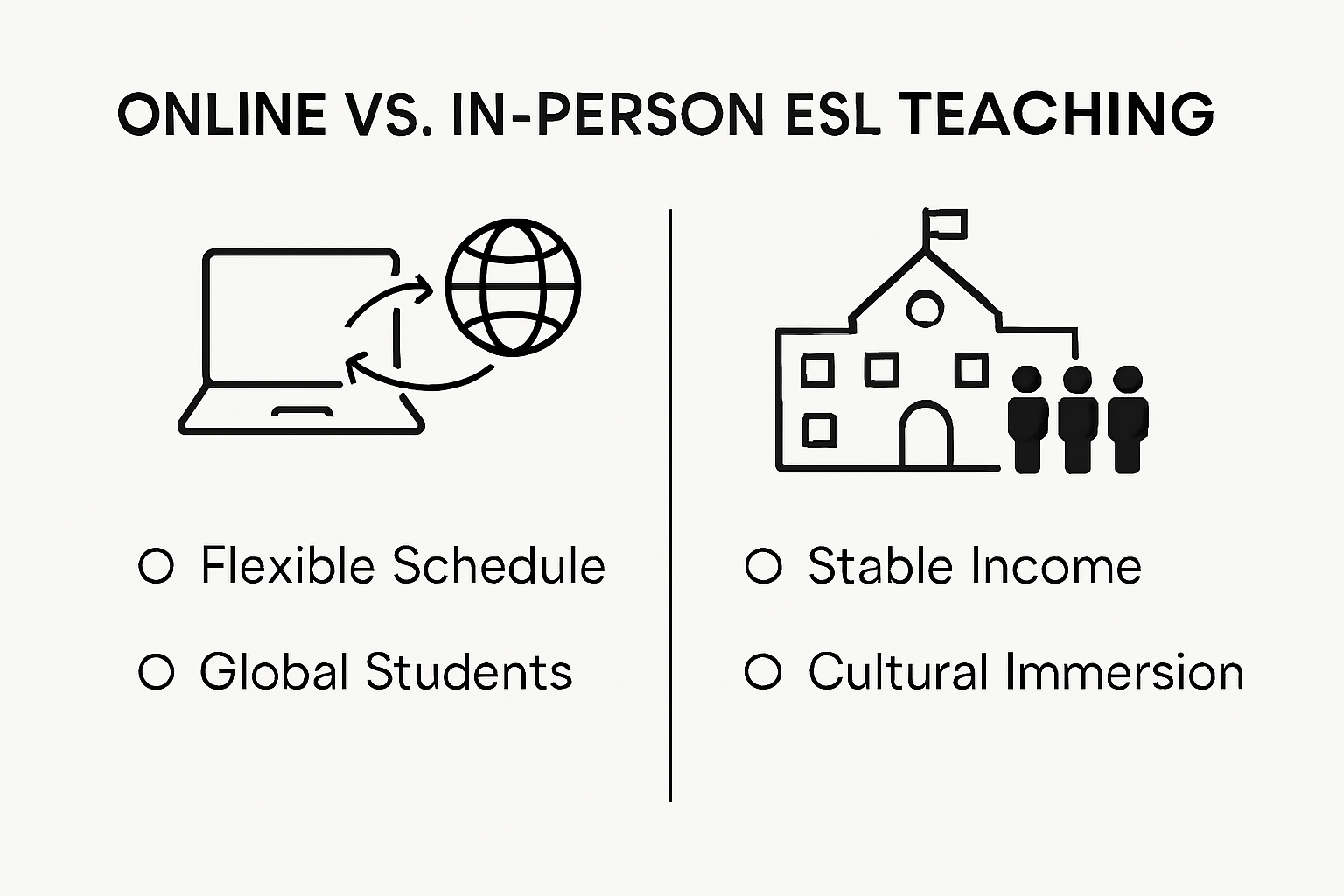
Both teaching models present unique advantages and challenges. In-person teaching provides more stable income, comprehensive benefits, and deeper cultural immersion, while online teaching offers greater personal flexibility, potential for multiple income streams, and reduced relocation expenses. Successful ESL educators increasingly develop skills that allow them to navigate both environments, creating more diverse and resilient career opportunities.
Pro Teaching Tip: Develop a hybrid skill set that allows you to teach effectively in both online and in-person environments, maximizing your employability and professional adaptability.
Risks, Competition And Market Trends
The ESL job market represents a complex ecosystem with evolving dynamics, characterized by significant competition and emerging challenges. Academic job market networks reveal increasingly sophisticated selection processes that demand more than traditional qualifications from prospective educators.
Competition in ESL teaching has intensified dramatically, driven by global economic shifts and technological advancements. Oversaturation is a major issue in traditional markets like East Asia, where many skilled individuals fight for a few posts. Many countries need advanced degrees, specialised certifications, and teaching experience above language proficiency. Which puts North American and European native English speakers under scrutiny.
Emerging market trends indicate a substantial transformation in ESL employment landscapes. Technological disruption has introduced significant risks, with artificial intelligence and automated language learning platforms challenging traditional teaching models. Online platforms have democratized access to language education, simultaneously creating opportunities and reducing job security for traditional educators. Geopolitical factors, including immigration policies and international relations, continue to reshape hiring practices, making adaptability a crucial skill for ESL professionals.
Risks in the ESL market extend beyond employment competition. Cultural adaptation challenges, potential contract uncertainties, and varying legal protections across different countries create complex professional environments. Some regions offer lucrative packages but demand significant personal and professional sacrifices, including strict work regulations, limited personal freedoms, and potential cultural misunderstandings. Successful ESL educators must navigate these intricate dynamics with cultural sensitivity, professional resilience, and strategic career planning.
Pro Teaching Tip: Continuously diversify your skill set and maintain flexible career expectations. The ESL job market rewards adaptable professionals who can quickly pivot between teaching modalities and geographic regions.
Unlock Your Global Teaching Career with TEFL Institute
ESL job markets are complicated due to certification requirements, regional disparities, and the choice between in-person and online teaching. TEFL Institute provides customised ways to overcome tight qualification standards, strong competition, and uncertain contract conditions to prepare you for success worldwide. Our comprehensive online TEFL training courses meet and surpass international standards. For Asian public schools, lucrative Middle Eastern markets, corporate training, and online platforms.

Take the next step toward your ESL teaching goals today by exploring our advanced diplomas, niche micro-credentials, and hybrid programs with practicum components that boost your marketability and confidence. Visit TEFL Institute to find detailed course guides and resources that match the exact demands of your target region or teaching environment. Don’t wait—equip yourself to thrive in any ESL job market by enrolling now at TEFL Institute Online TEFL Courses and start your journey with the tools to succeed globally.
Frequently Asked Questions
What are the different types of ESL job markets?
ESL job markets can be categorized into several types including institutional ESL teaching in public and private educational systems. Private language schools, corporate training programs, and online platforms. Each type offers unique opportunities and challenges for educators.
What qualifications do I need to teach ESL?
Most ESL teaching positions require at least a 120-hour TEFL certification. Some regions may also seek additional qualifications like CELTA or advanced degrees in education or linguistics, depending on the market and institution’s requirements.
What are the advantages of online ESL teaching compared to in-person teaching?
Online ESL teaching offers greater flexibility in scheduling, the ability to connect with students worldwide, and reduced overhead costs. In-person teaching provides structured environments and immersive cultural experiences, which can enhance student engagement.
How can I stay competitive in the ESL job market?
To remain competitive, consider diversifying your qualifications by obtaining specialized certifications, developing a hybrid teaching skill set for both online and in-person environments, and staying informed about industry trends and demands.