

 United Kingdom (UK)
 United States (US)
 Canada
 South Africa
 India
India Australia
 New Zealand
 China
China Russia
 Germany
 France
 Spain
Spain Netherlands
 Vietnam
 United Arab Emirates
 Italy
Italy Poland
 Thailand
 Türkiye









 Algeria


Global TEFL job market: trends and opportunities in 2026
Global TEFL job market: trends and opportunities in 2026

The global market for English language teaching is larger than most people realize. The English language learning market is projected to grow from $49.1 billion in 2025 to $127.7 billion by 2035, with the broader global English teaching market already valued at $289 billion in 2026. These figures challenge the common assumption that TEFL (Teaching English as a Foreign Language) jobs are scarce or that the market is oversaturated. In reality, demand is accelerating across multiple regions and teaching formats. This article breaks down what the TEFL job market includes, where growth is happening, what employers want, and how you can position yourself to succeed in it.
Table of Contents
- What is the TEFL job market?
- Current global demand for TEFL teachers
- Trends shaping the TEFL job market in 2026
- What skills, qualifications, and backgrounds are in demand?
- How TEFL compensation compares worldwide
- How to start or advance your career in TEFL
- Take the next step in your TEFL journey
- Frequently asked questions
Key Takeaways
| Point | Details |
|---|---|
| TEFL market growth | The TEFL job market is expanding fast worldwide, offering more jobs than ever. |
| Diverse opportunities | Jobs exist in schools, online platforms, and private institutions across many countries. |
| In-demand skills | Employers are seeking certified teachers with adaptability and strong communication skills. |
| Compensation varies | Salaries and benefits depend on a country’s demand, cost of living, and teaching context. |
| Start with certification | A reputable TEFL certificate is the quickest pathway to start or further your English teaching career. |
What is the TEFL job market?
The TEFL job market refers to the full range of employment opportunities available to certified English language teachers working with non-native speakers. It spans multiple sectors and operates across nearly every region of the world. The global English teaching market is valued at $289 billion in 2026, growing at 8% annually through 2030, which reflects just how broad this market has become.
The TEFL job market includes the following key sectors:
- Private language schools: Independent academies and language centers that hire TEFL teachers for group and individual instruction
- Public school systems: Government-funded K-12 programs that place native and non-native English speakers in classrooms abroad
- Online teaching platforms: Digital platforms connecting teachers with students globally, often on a freelance or contract basis
- Corporate and business English: Companies that hire TEFL teachers to train employees in professional English communication
- Private tutoring: One-on-one instruction arranged independently or through agencies
- Universities and higher education: Academic institutions offering English for Academic Purposes (EAP) programs
Understanding TEFL job trends across these sectors helps you identify where your qualifications and preferences align best with available roles.
Current global demand for TEFL teachers
Now that you understand what the TEFL job market includes, let’s look at the actual demand and where new jobs are emerging worldwide. The English language learning market is projected to grow significantly into 2030, driven by expanding economies, increased immigration, and the rapid adoption of remote learning technologies.
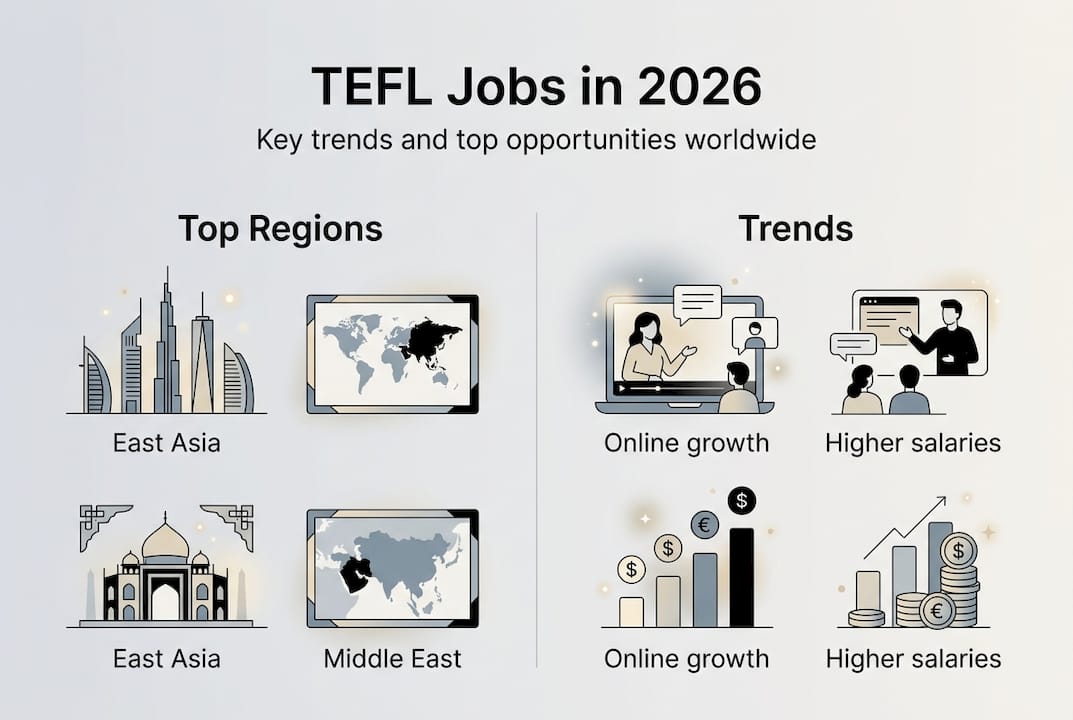
Several regions are generating particularly strong global TEFL demand right now:
| Region | Demand level | Key drivers |
|---|---|---|
| East Asia (China, Japan, South Korea) | Very high | Government English programs, private academies |
| Southeast Asia (Vietnam, Thailand, Indonesia) | High | Growing middle class, expanding education budgets |
| Middle East (UAE, Saudi Arabia, Qatar) | High | Economic diversification, international business |
| Latin America (Brazil, Colombia, Mexico) | Moderate to high | Remote learning growth, business English demand |
| Europe (Spain, Italy, Poland) | Moderate | Immigration, EU workforce mobility |
| Online (global) | Very high | Platform expansion, post-pandemic remote learning |
Key statistic: The global English teaching market is valued at $289 billion in 2026 and is growing at approximately 8% per year. This rate of expansion means tens of thousands of new teaching positions are created annually across both classroom and online formats.
Beyond traditional destinations, international job opportunities are also opening up in emerging markets across Africa and Central Asia, where English proficiency is increasingly tied to economic mobility. Reviewing top TEFL destinations can help you match your goals to the right region.
Trends shaping the TEFL job market in 2026
With demand established, let’s explore what trends are actively shaping how and where TEFL jobs are evolving. The market is not static. Several structural shifts are redefining what TEFL employment looks like and which candidates are most competitive.
- Online teaching has become a permanent fixture. Remote instruction is no longer a temporary alternative. Platforms offering live online lessons have expanded their teacher rosters significantly, and many teachers now build full-time careers without relocating abroad.
- Government-funded language programs are expanding. Countries across Asia, Latin America, and the Middle East are increasing public investment in English education at the K-12 level, creating stable, salaried positions for certified teachers.
- Specialized English instruction is growing. Business English, IELTS preparation, academic writing, and English for specific purposes (ESP) are all areas where demand is outpacing supply. Teachers with niche expertise command higher rates.
- Adult learner programs are increasing. Immigration-driven demand in countries like the United States is fueling growth in adult ESL programs. US language teacher demand is projected to grow by 5% through 2032, reflecting stable domestic opportunities alongside international ones.
- Hybrid roles are emerging. Some institutions now offer positions that combine in-person and online instruction, giving teachers more flexibility while maintaining institutional employment benefits.
Pro Tip: If you are considering navigating TEFL careers in specialized fields, adding a niche credential such as a business English or IELTS preparation certificate can significantly increase your earning potential and job options. Review important TEFL facts to understand what credentials matter most in different markets.
What skills, qualifications, and backgrounds are in demand?
Knowing the market trends, it is crucial to understand what backgrounds and credentials employers actually look for in TEFL hires. Requirements vary by region and role, but certain qualifications consistently appear across job listings worldwide.

| Qualification | Classroom roles abroad | Online teaching platforms |
|---|---|---|
| TEFL/TESOL certification (120+ hours) | Required in most markets | Required or strongly preferred |
| Bachelor’s degree | Required in East Asia and Middle East | Often required |
| Native or near-native English proficiency | Expected | Expected |
| Teaching experience | Preferred, sometimes required | Helpful but not always required |
| Specialized certification (business, IELTS) | Valued for advanced roles | Valued for premium platforms |
Beyond formal credentials, employers consistently look for the following soft skills:
- Clear and patient communication
- Adaptability to different learning styles and cultural contexts
- Classroom management and lesson planning ability
- Comfort with digital tools and learning management systems
- Reliability and professional conduct
US K-12 and adult English teacher demand is increasing due to immigration, which means domestic opportunities are also growing for teachers with the right credentials. Reviewing TEFL job requirements 2026 and teaching abroad qualifications will give you a precise picture of what each market expects.
Hiring windows close while you scroll.
Deadlines, salaries and visa notes for teaching jobs worldwide, checked against official sources and sent free every two weeks.
Get on the WirePro Tip: Online platforms often have faster hiring timelines than traditional schools. If you are newly certified, applying to online platforms first can help you build experience and references while you pursue classroom roles abroad.
How TEFL compensation compares worldwide
After understanding what makes a TEFL teacher competitive, let’s review how pay and benefits stack up across the globe. Compensation in TEFL varies widely depending on location, employer type, and your qualifications.
| Region | Monthly salary range (USD) | Common benefits |
|---|---|---|
| South Korea | $1,800 to $2,800 | Housing, airfare, health insurance |
| Japan | $2,000 to $3,500 | Housing allowance, transport |
| UAE / Saudi Arabia | $2,500 to $5,000 | Tax-free income, housing, flights |
| China | $1,500 to $3,000 | Housing, flight reimbursement |
| Spain / Italy | $900 to $1,800 | Varies by program |
| Online (global) | $10 to $40 per hour | Flexible schedule, no relocation |
“Compensation varies widely by country, role, and employer type. Teachers in the Middle East and East Asia typically receive the strongest overall packages, combining competitive salaries with housing and travel benefits.”
The global English teaching market continues to grow robustly, and compensation is generally keeping pace in high-demand regions. For a detailed breakdown, the TEFL salary guide and TEFL salary explained resources provide country-by-country figures to help you plan your finances before committing to a destination.
How to start or advance your career in TEFL
To help you take your next steps based on everything shared above, here is a clear roadmap for launching or advancing your TEFL journey. The TEFL market offers diverse opportunities for career progression at every experience level.
- Get certified. A 120-hour TEFL/TESOL certification is the standard entry point for most positions. Choose an accredited program that includes observed teaching practice for the strongest credential.
- Define your target market. Decide whether you want to teach abroad, online, or domestically. Each path has different requirements, timelines, and financial implications.
- Research regional requirements. Some countries require specific visa types, degree verification, or background checks. Confirm these before applying.
- Build your application materials. Prepare a professional resume tailored to TEFL roles, a cover letter, and references from any relevant teaching or tutoring experience.
- Apply through reputable channels. Use established job boards, government placement programs, and school networks. Avoid listings that request upfront fees or lack verifiable contact information.
- Advance through specialization. Once you have classroom experience, adding credentials in business English, IELTS preparation, or young learner instruction opens higher-paying and more competitive roles.
Pro Tip: Navigating the TEFL job market is easier when you understand the full scope of what teaching abroad involves, including the TEFL jobs global impact on communities and economies. This context helps you write stronger applications and perform better in interviews.
Take the next step in your TEFL journey
The data is clear: the global TEFL job market is growing, and certified teachers with the right credentials are in demand across multiple regions and formats. Whether you are planning to teach in a classroom abroad or build an online teaching career, the first step is obtaining a recognized TEFL certification.
TEFL Institute offers accredited certification programs designed to prepare you for real classroom and online teaching environments. From foundational courses to advanced diplomas and niche credentials, the programs are structured to match your career goals. If you are based in the United States, explore options such as the TEFL course New York or the TEFL course Salt Lake City to find a program that fits your schedule and location. Job placement support and graduate resources are available to help you move from certification to employment efficiently.
Frequently asked questions
Is the TEFL job market oversaturated in 2026?
No. The global English teaching market is valued at $289 billion in 2026 with 8% annual growth, meaning new positions are being created consistently across both online and in-person sectors.
What qualifications do I need for a TEFL job?
Most positions require a TEFL certification and a bachelor’s degree, though requirements vary by region and role. Reviewing common TEFL job requirements for 2026 will clarify what specific markets expect.
Where can I make the highest salary teaching English abroad?
The highest-paying positions are typically in the Middle East and East Asia, where tax-free salaries and housing benefits are common. The TEFL salary breakdown by country provides specific figures for each region.
Are there online TEFL job opportunities?
Yes. Online English teaching is one of the fastest-growing segments of the TEFL market, offering flexible, location-independent roles for certified teachers at all experience levels.
What trends should I watch in the TEFL job market?
Remote teaching growth, government-funded language programs, and rising demand for specialized English instruction are the key trends shaping TEFL opportunities in 2026 and beyond.
Recommended
TEFL Institute guides

Cambodia
Pay, requirements and visas
Thailand
Visas and teaching licences
Dubai
Pay, requirements and visas
South Korea
EPIK, hagwons and pay
Spain
Jobs, pay and visa routes