

 United Kingdom (UK)
 United States (US)
 Canada
 South Africa
 India
India Australia
 New Zealand
 China
China Russia
 Germany
 France
 Spain
Spain Netherlands
 Vietnam
 United Arab Emirates
 Italy
Italy Poland
 Thailand
 Türkiye








 Algeria


English as a Second Language: A Complete 2026 Guide
English as a Second Language: A Complete 2026 Guide

TL;DR:
- ESL programs teach English to non-native speakers through various models like pull-out, push-in, and bilingual instruction. Successful ESL learning focuses on practicing speaking, listening, reading, and writing regularly to build confidence for real-world situations. Effective teaching involves learner-centered, culturally responsive methods combined with consistent, low-stakes practice to foster both language skills and social integration.
English as a second language (ESL) is defined as the structured teaching and learning of English by individuals whose native language is not English, with the goal of developing communicative competence for daily life, academic settings, and professional environments. The field sits at the intersection of linguistics, immigration policy, and workforce development, meaning a learner’s program placement depends heavily on regional laws and local demographics. Federal frameworks like ESSA Title III and WIOA Title II govern how ESL programs are funded, structured, and delivered across the United States. Whether you are a non-native speaker building fluency or an educator seeking better tools, understanding how ESL programs work gives you a clear path forward.
What are common English as a second language instructional models?
ESL programs are not one-size-fits-all. Multiple instructional models exist across community colleges, adult education centers, and K-12 schools, each shaped by federal law and learner need.
The most widely used models in 2026 include:
- Pull-out ESL: Students leave the mainstream classroom for dedicated English instruction. This model works well for K-12 learners who need targeted language support without full separation from peers.
- Push-in ESL: An ESL specialist co-teaches inside the mainstream classroom. Learners stay with their grade-level peers while receiving language scaffolding in real time.
- Dual-Language Bilingual: Instruction is delivered in both English and the learners’ home language. Research consistently shows this model produces strong long-term academic outcomes.
- Structured English Immersion (SEI): All instruction is in English, but teachers use simplified language and visual supports. SEI is common in states with large immigrant populations.
- Adult ESL: Delivered through community colleges and adult education centers under WIOA Title II. Programs target workforce readiness, citizenship preparation, and basic literacy.
- Workplace ESL: Employers partner with education providers to deliver English instruction on-site. This model targets specific vocabulary and communication tasks tied to the job.
- Intensive English Programs (IEPs): Full-time programs, often at universities, that prepare international students for academic study. IEPs typically run 20–30 hours per week.
Federal law requires that ESL programs identify, assess, place, instruct, monitor, and reclassify learners. That legal structure means programs carry accountability obligations, not just instructional ones.
What are the core components of a comprehensive ESL curriculum?
A standard ESL curriculum integrates seven skill areas: speaking, listening, reading, writing, grammar, vocabulary, and pronunciation. Each skill reinforces the others. A learner who builds vocabulary through reading will write more clearly and speak with greater precision.
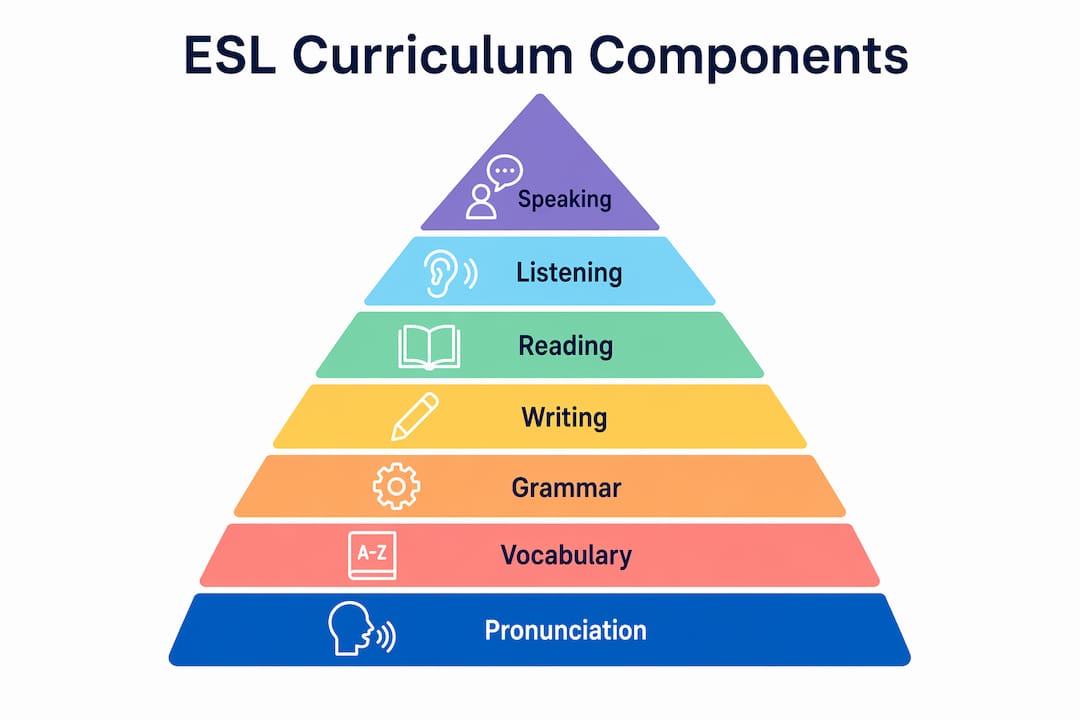
| Skill Area | Practical Application |
|---|---|
| Speaking | Job interviews, classroom discussions, social conversations |
| Listening | Following instructions, understanding lectures, media consumption |
| Reading | Graded texts, workplace documents, academic articles |
| Writing | Emails, reports, academic essays |
| Grammar | Sentence accuracy across all written and spoken tasks |
| Vocabulary | Domain-specific terms for academic and professional use |
| Pronunciation | Clarity in spoken communication, stress and intonation patterns |
Curricula are organized by proficiency levels, typically ranging from beginner to advanced. Learners move through levels based on periodic assessment results, not time spent in class. Mastery of academic English can take 4–7 years, even after a learner has been reclassified out of a formal ESL program. That timeline matters because it sets realistic expectations for both learners and teachers.
For ESL curriculum development, the most effective approach sequences skills deliberately, builds on prior knowledge, and includes regular formative checks.
Pro Tip: Track your progress by keeping a weekly writing journal. Compare entries from week one to week eight. Visible improvement in sentence length and vocabulary range is one of the strongest motivators for continued study.
How do learners effectively improve their English through ESL programs?
The primary goal of ESL learning is building confidence to use English in real-life, high-stakes situations, not achieving grammatical perfection. Learners who wait until they feel “ready” to speak often plateau. Consistent, low-stakes practice produces faster gains than occasional high-pressure performance.
Effective learners build a balanced daily routine:
- Listen actively: Podcasts, news broadcasts, and audiobooks expose you to natural speech patterns. Vary the source to hear different accents and registers.
- Read graded texts: Start at a level slightly below your comfort zone. Graded readers build fluency and vocabulary without the frustration of constant dictionary lookups.
- Write regularly: Short daily writing tasks, such as summarizing a news article or describing your day, build grammar and vocabulary simultaneously.
- Speak with native and non-native speakers: Both types of interaction build confidence. Non-native speakers often model the kind of clear, deliberate speech that is easiest to follow.
- Use technology strategically: Apps and AI-based tools support vocabulary, grammar, writing, and listening skills. They work best as a supplement to real-world practice, not a replacement.
Cultural adjustment is equally critical. Holistic programs that include cultural workshops and social support achieve higher learner retention than programs focused on language alone. Language acquisition is inseparable from learning social norms, humor, and context-specific communication.
Pro Tip: Set one specific speaking goal per week, such as ordering coffee in English without switching languages or asking a colleague a work-related question. Small, concrete targets build the habit of using English outside the classroom.

What distinguishes ESL from EFL, TESOL, and bilingual education?
These terms are often used interchangeably, but they describe different instructional contexts and learner experiences.
| Term | Definition | Context |
|---|---|---|
| ESL (English as a Second Language) | English taught to non-native speakers living in an English-speaking country | United States, UK, Australia |
| EFL (English as a Foreign Language) | English taught where it is not the dominant language | China, Brazil, Japan |
| TESOL (Teaching English to Speakers of Other Languages) | Umbrella term covering both ESL and EFL instruction | Global |
| ESOL (English for Speakers of Other Languages) | Equivalent to ESL, used more in UK and adult education contexts | UK, adult programs |
| Bilingual Education | Instruction delivered in two languages to support both language development and content learning | Multilingual communities |
The ESL/EFL distinction depends primarily on immersion context. ESL learners live and function in English daily, which creates urgency and constant practice opportunities. EFL learners study English in a classroom without that daily immersion, which changes both the teaching approach and the emotional experience of learning.
Modern pedagogy increasingly prefers the term English Learner (EL) over ESL. This terminology shift reflects a broader move toward recognizing learners’ multilingual strengths rather than framing English as a deficit to be corrected. TESOL, as an umbrella term, covers both ESL and EFL and is the standard credential category for professional teachers in the field.
What are effective teaching strategies for ESL educators?
ESL teaching produces the best outcomes when instruction is learner-centered and culturally responsive. Learner-centered activities build confidence and practical communication skills more reliably than grammar-focused drills alone.
Strong ESL instruction includes:
- Task-based learning: Learners complete real-world tasks, such as writing a complaint email or role-playing a job interview, using English as the tool, not the subject.
- Culturally responsive materials: Content that reflects learners’ backgrounds reduces anxiety and increases engagement. Avoid materials that assume a single cultural reference point.
- Interactive games and activities: Classroom games lower the affective filter, the psychological barrier that blocks language production when learners feel anxious or judged.
- Continuous formative assessment: Short, frequent checks, such as exit tickets or quick pair-share activities, give teachers real-time data on comprehension without the pressure of formal testing.
- Differentiated instruction: A single class often contains learners at multiple proficiency levels. Tiered tasks let every learner work at the right level of challenge.
Designing ESL materials that actually work requires aligning tasks to proficiency levels, using authentic language samples, and building in opportunities for learner choice. Teachers who adapt instruction based on ongoing assessment data consistently outperform those who follow a fixed syllabus without adjustment.
Language acquisition insights for TEFL teachers confirm that comprehensible input, the idea that learners acquire language best when they understand slightly more than their current level, remains the most evidence-supported principle in the field.
Key Takeaways
ESL programs are most effective when they combine structured skill instruction, cultural support, and consistent real-world practice across all seven core language skill areas.
| Point | Details |
|---|---|
| ESL is legally structured | ESSA Title III and WIOA Title II govern identification, placement, and monitoring of ESL learners. |
| Seven skills build proficiency | Speaking, listening, reading, writing, grammar, vocabulary, and pronunciation work together, not in isolation. |
| Academic English takes years | Mastery of academic English takes 4–7 years, even after formal program exit. |
| Cultural support reduces dropout | Programs that include cultural adjustment workshops achieve higher learner retention rates. |
| EL terminology reflects modern pedagogy | The shift from ESL to English Learner (EL) recognizes multilingual strengths rather than language deficits. |
The part of ESL most programs still get wrong
Most ESL programs measure success by test scores and reclassification rates. Those metrics matter, but they miss the most important outcome: whether a learner can walk into a job interview, a parent-teacher conference, or a doctor’s appointment and communicate with confidence.
I have seen learners with near-perfect grammar scores freeze completely in real conversations. The gap between knowing English and using English is real, and it is almost entirely a confidence problem, not a knowledge problem. Programs that build in regular, low-stakes speaking practice from day one close that gap faster than any grammar workbook.
The terminology debate, ESL versus EL, is worth taking seriously. Calling someone an “English Learner” rather than an “ESL student” is not just political correctness. It changes how teachers see the learner and, critically, how learners see themselves. A person who speaks Mandarin, Spanish, or Arabic fluently is not deficient. They are adding a language. That framing produces better outcomes.
The most underrated element in any ESL program is cultural adjustment support. Programs that omit cultural integration see higher dropout rates, not because the language instruction is poor, but because learners feel isolated. Language and culture are not separate tracks. They are the same track.
— Muller
TEFL certification and teaching ESL professionally
Learners who want to move from studying English to teaching it need a recognized credential. Teflinstitute offers a range of accredited TEFL courses designed for both new and experienced educators.

The 120-hour advanced TEFL course covers ESL methodology, lesson planning, and classroom management in a fully online format. For teachers who want deeper preparation, the 240-hour Master TEFL course provides extensive training for teaching ESL in any global context. Both programs are externally accredited and recognized by employers worldwide. Teflinstitute also offers a specialized IELTS teacher training course for educators focused on exam preparation instruction.
FAQ
What is an English as a second language program?
An ESL program is a structured course of instruction that teaches English to non-native speakers living in an English-speaking country. Programs are governed by federal laws like ESSA Title III for K-12 learners and WIOA Title II for adults.
How long does it take to become proficient in ESL?
Conversational fluency typically develops within 1–2 years of consistent study. Academic English proficiency takes 4–7 years, even after a learner exits a formal ESL program.
What is the difference between ESL and EFL?
ESL refers to learning English while living in an English-speaking country, while EFL refers to studying English in a country where English is not the dominant language. The immersion context changes both the teaching approach and the learner’s daily practice opportunities.
What does TESOL mean?
TESOL stands for Teaching English to Speakers of Other Languages. It is an umbrella term that covers both ESL and EFL instruction and is the standard professional credential category for English language teachers globally.
What are the best ESL teaching methods?
Task-based learning, culturally responsive instruction, and learner-centered activities consistently produce the strongest outcomes. Incorporating games, formative assessment, and differentiated tasks keeps learners engaged and supports measurable proficiency gains.
Recommended
TEFL Institute guides

China
Z visa, pay and cities
South Korea
EPIK, hagwons and pay
Italy
Jobs, pay and visa routes
Portugal
Jobs, pay and visa routes
Estonia
Jobs, pay and work routes