

 United Kingdom (UK)
 United States (US)
 Canada
 South Africa
 India
India Australia
 New Zealand
 China
China Russia
 Germany
 France
 Spain
Spain Netherlands
 Vietnam
 United Arab Emirates
 Italy
Italy Poland
 Thailand
 Türkiye









 Algeria


Designing Teacher Training Programs: A 2026 Guide
Designing Teacher Training Programs: A 2026 Guide

TL;DR:
- Effective teacher training programs are built on aligning conceptual, structural, and practice elements from the start. Modular microlearning of 5 to 15 minutes enhances retention, allows easy updates, and supports customization for different educators. Successful programs focus on practical classroom actions, decision-making, and contextual scenarios to influence real teaching practice.
Designing teacher training programs is the process of developing structured professional development initiatives that improve educators’ instructional skills and pedagogical competence. The field has a recognized industry term: teacher education program design, which covers everything from curriculum architecture to cohort structure and assessment strategy. For educational administrators and curriculum developers working in ESL or language education, getting this design right determines whether teachers actually change their classroom practice or simply complete a checklist. Frameworks like the CREATE model and principles from ISTE+ASCD show that the most effective programs align learning outcomes to real instructional needs from the very first planning stage.
What are the foundational principles of designing teacher training programs?
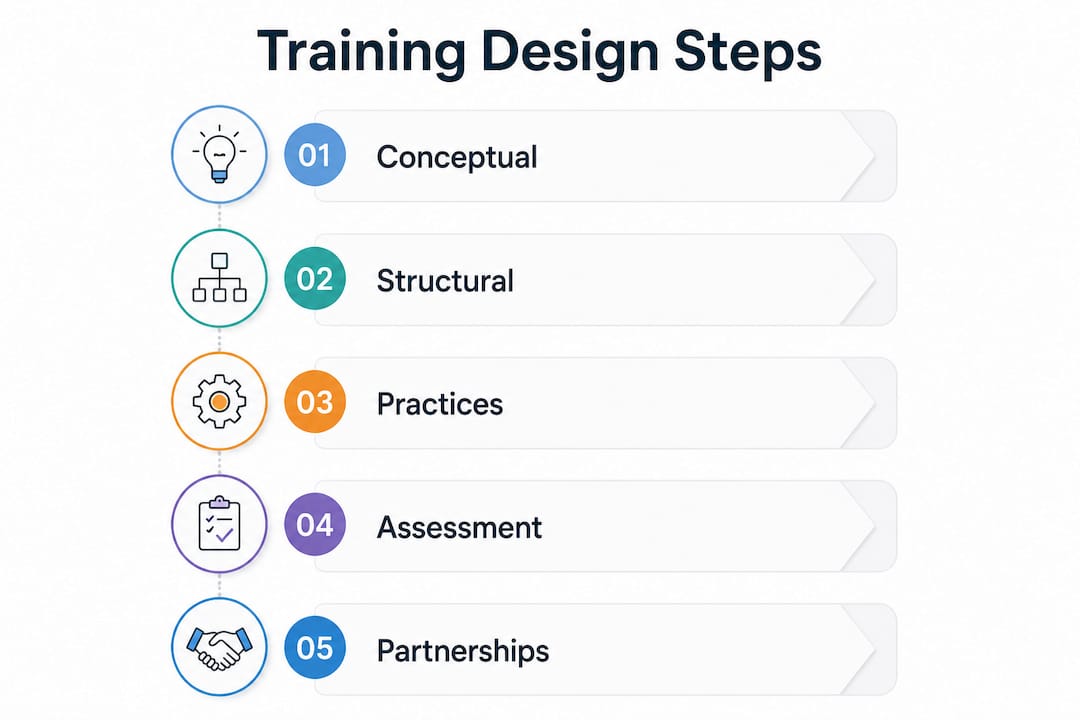
Effective teacher training program design rests on three interconnected pillars: conceptual elements, structural elements, and practices or protocols. Program integrity depends on strict alignment among all three. Neglecting any one pillar erodes participant trust and reduces the program’s credibility.

Conceptual elements define the program’s philosophy, purpose, and pedagogy. These answer the question: what does this program believe about how teachers learn? Without a clear answer, content decisions become arbitrary.
Structural elements cover admissions criteria, curriculum alignment, assessment design, and institutional partnerships. ISTE+ASCD’s instructional leader certification, for example, uses portfolio-based evidence rather than theoretical exams. Portfolios include coaching logs, student work analysis, and documentation of instructional improvements. This shift reflects a broader move toward validating actual practice over abstract knowledge.
Practices and protocols address how the program operates day to day: collaboration structures, clinical supervision, and communication norms. Etta R. Hollins’s framework for teacher education program design emphasizes that these three pillars must function as a system, not as separate components.
| Pillar | Core Focus | Key Feature |
|---|---|---|
| Conceptual elements | Philosophy and pedagogy | Defines the learning theory driving content |
| Structural elements | Curriculum and assessment | Aligns outcomes to institutional standards |
| Practices and protocols | Collaboration and supervision | Governs day-to-day program operations |
Pro Tip: Map each course module back to at least one structural element before finalizing content. This single check prevents the most common design flaw: modules that feel useful but don’t connect to measurable outcomes.
How can microlearning improve teacher training program effectiveness?
Microlearning is the practice of delivering content in short, focused segments rather than extended sessions. Eight 3-minute modules outperform a single continuous video for both knowledge retention and future content updates. That finding has direct implications for how administrators structure professional development courses.
The recommended structure for online teacher training is 3 to 7 modules per course, with each module running 5–15 minutes. This range keeps educators engaged without creating cognitive overload. It also makes updating content far easier: when curriculum standards change, you revise one module rather than rebuilding an entire course.
| Module number | Recommended length | Primary function |
|---|---|---|
| Module 1 | 5–8 minutes | Introduce core concept and context |
| Module 2 | 8–12 minutes | Demonstrate application with examples |
| Module 3 | 5–10 minutes | Practice activity or scenario |
| Module 4 | 5–8 minutes | Reflection and formative check |
| Module 5 | 5–15 minutes | Assessment or synthesis task |
Modular design also supports customization for different educator cohorts. A module on classroom management for young learners can be swapped out for one on business English contexts without touching the rest of the course structure. This flexibility is particularly valuable for ESL program administrators managing teachers across multiple grade levels or institutional settings.
Pro Tip: Build your module library before sequencing the course. When you treat each module as a standalone unit first, you create content that can be recombined for different audiences without starting from scratch.
What are the steps to create an effective teacher training module?
Building a training module without an instructional design team is achievable when you follow a clear process. The steps below reflect best practices from structured program development and apply directly to ESL and language education contexts.
-
Define one observable learning outcome. A single behavioral outcome per module improves focus and effectiveness. Write it as: “After completing this module, the teacher will be able to [specific action].” Vague outcomes like “understand grammar instruction” produce vague content.
-
Audit existing content before creating new material. Most institutions already have lesson recordings, policy documents, or workshop slides. Repurposing existing content cuts production time significantly and grounds new modules in real classroom experience.
-
Add scenario-based interactions. Replace passive reading with decision points. Present a classroom situation, ask the teacher to choose a response, and explain the consequences of each choice. This approach builds judgment, not just knowledge.
-
Export SCORM-compliant modules for LMS compatibility. SCORM (Sharable Content Object Reference Model) is the technical standard that allows modules built in one authoring tool to run inside any learning management system. Exporting in SCORM format protects your investment if the institution changes platforms.
-
Track completion and quiz performance. Data from learner analytics tells you which modules educators skip, where they drop off, and which quiz questions reveal persistent misconceptions. Use this data to revise content, not just to report completion rates.
-
Build in feedback loops. Resource-constrained training contexts require accessible tools, scaffolding for digital literacy, flexible pacing, and structured feedback. A short reflection prompt at the end of each module costs nothing to produce and generates qualitative data that completion rates cannot capture.
Pro Tip: Record a 60-second video introduction for each module using a smartphone. Seeing a real person frame the learning objective increases engagement more than a text slide, and it takes less time to produce than most administrators expect.
Creating effective TEFL curricula step by step follows the same logic: start with outcomes, build content around them, and assess what teachers can actually do rather than what they can recall.
How to tailor teacher training programs for ESL and language education
ESL teacher training programs require design choices that general professional development frameworks do not address. Language teaching involves specific pedagogical knowledge, such as phonics instruction, communicative language teaching, and task-based learning, that must be embedded in the training content itself.
The CREATE model demonstrates what targeted design can achieve. In pilot programs in Indonesia and Uzbekistan, participants’ scores rose from averages near 54 to above 80 after completing CREATE-based training. That improvement reflects what happens when a program is built around the specific pedagogical competencies teachers need, not around generic instructional theory.
Key design choices for ESL-specific programs include:
- Mixed-experience cohorts. Combining beginner, intermediate, and advanced teachers produces richer discussions and stronger peer learning. Experienced teachers articulate tacit knowledge they rarely examine. Newer teachers bring fresh questions that challenge assumptions.
- Digital literacy scaffolding. Many ESL teachers work in contexts where technology access is uneven. Build a module on the tools themselves before expecting teachers to use them for instruction. Teflinstitute’s guide on scaffolding in teaching offers practical frameworks for this kind of layered support.
- Classroom-realistic scenarios. Use examples drawn from actual ESL classrooms: mixed-proficiency groups, students with limited literacy in their first language, or online lessons with unreliable internet. Generic scenarios reduce transfer to real practice.
- Language-specific assessment design. Formative checks in ESL teacher training should assess pedagogical language knowledge, not just general teaching competency. Administrators can find practical models in Teflinstitute’s formative assessment guide for educators.
- Flexible pacing options. ESL teachers often work across multiple schools or time zones. Asynchronous modules with optional live discussion sessions accommodate this reality without sacrificing cohort interaction.
Designing ESL materials that work follows the same principle: specificity beats generality every time.
Key Takeaways
Effective teacher training program design requires aligning conceptual elements, structural components, and daily practices into a single coherent system from the outset.
| Point | Details |
|---|---|
| Align all three pillars | Conceptual, structural, and practice elements must connect or the program loses credibility. |
| Use microlearning modules | Structure courses as 3–7 modules of 5–15 minutes each to maximize retention and ease updates. |
| Write one outcome per module | A single observable behavioral outcome per module keeps content focused and measurable. |
| Tailor content to ESL realities | Use classroom-realistic scenarios, mixed cohorts, and language-specific pedagogy for language educators. |
| Build in feedback loops | Track quiz performance and collect reflection data to improve modules after each cohort. |
What I’ve learned from watching teacher training programs succeed and fail
The most common mistake I see in teacher development programs is confusing content volume with learning value. Administrators pack courses with readings, videos, and policy documents because it feels thorough. Teachers complete the course and change nothing in their classrooms. The problem is not effort. The problem is that the program measured coverage instead of competency.
The programs that actually shift classroom practice share one design feature: they force teachers to make decisions and then examine those decisions. Scenario-based modules, peer observation protocols, and portfolio tasks all require teachers to apply judgment, not just absorb information. Human subject matter expertise remains irreplaceable in this process. AI authoring tools can draft content quickly, but they cannot replicate the contextual knowledge an experienced ESL teacher brings to a scenario about a struggling intermediate learner.
Mixed-experience cohorts are underused and undervalued. Administrators often worry that beginners will slow down experienced teachers. The opposite tends to happen. Experienced teachers become more reflective when they have to explain their reasoning to someone who hasn’t yet developed automatic responses. That articulation is itself a form of professional growth.
The practical advice I give every administrator who asks: design for what teachers will do on Monday morning, not for what they will know by Friday afternoon. If you cannot draw a direct line from a module’s content to a specific classroom action, cut the module or rewrite it. Programs built on that standard tend to earn the one thing that matters most: teacher trust.
— Muller
Teflinstitute courses for professional development program design
Curriculum developers and educational administrators who want a concrete benchmark for high-quality teacher training can examine Teflinstitute’s course catalog directly.

Teflinstitute offers internationally recognized programs built on the same outcome-driven principles described in this article. The TEFL certification program provides a structured model of competency-based teacher education that administrators can use as a reference framework for their own program design. For institutions focused on specific learner populations, the 240-hour Master TEFL Course demonstrates how advanced content can be sequenced across modules with clear progression. Both programs are available online, externally accredited, and designed for educators working across diverse international contexts.
FAQ
What is teacher education program design?
Teacher education program design is the structured process of developing professional development initiatives that align learning outcomes, curriculum content, and assessment methods to improve educator effectiveness. It encompasses conceptual, structural, and practice-based elements that must work together as a system.
How long should each module in a teacher training course be?
Each module should run 5–15 minutes, with courses structured as 3–7 modules total. This range maximizes engagement and makes future content updates faster and less disruptive to the overall program.
What is the CREATE model in teacher training?
CREATE is a systematic six-stage training model designed to improve pedagogical competence. Pilot programs using CREATE in Indonesia and Uzbekistan raised participant scores from averages near 54 to above 80, demonstrating its effectiveness in ESL and language education contexts.
How do mixed-experience cohorts benefit teacher training programs?
Combining beginner, intermediate, and advanced teachers in one cohort produces richer peer discussions and stronger learning outcomes. Experienced teachers articulate tacit knowledge, while newer teachers ask questions that prompt deeper reflection across the group.
What does SCORM compliance mean for training modules?
SCORM (Sharable Content Object Reference Model) is the technical standard that allows training modules to run inside any learning management system. Exporting modules in SCORM format protects institutional investment if the platform changes and ensures consistent tracking of learner data.
Recommended
TEFL Institute guides

Mexico
Jobs, pay and cities
Estonia
Jobs, pay and work routes
Portugal
Jobs, pay and visa routes
China
Z visa, pay and cities
Thailand
Visas and teaching licences