
 United Kingdom (UK)
 United States (US)
 Canada
 South Africa
 India
India Australia
 New Zealand
 China
China Russia
 Germany
 France
 Spain
Spain Netherlands
 Vietnam
 United Arab Emirates
 Italy
Italy Poland
 Thailand
 Türkiye








 Algeria


What Is Reflective Practice for Educators: 2026 Guide
What Is Reflective Practice for Educators: 2026 Guide

TL;DR:
- Reflective practice involves educators critically examining their teaching experiences to improve outcomes through structured cycles of observation, evaluation, and action. It is essential for fostering professional growth, emotional resilience, and better classroom decision-making.
Reflective practice is defined as a systematic, self-directed process through which educators critically examine their teaching experiences to improve professional performance and student outcomes. Unlike casual self-assessment, it follows structured cycles of observation, evaluation, and deliberate action. Theorists Donald Schön and Chris Argyris established the foundational frameworks that shape how educators understand and apply reflection today. Schön introduced the concepts of reflection-in-action and reflection-on-action, while Argyris framed reflection as a continuous dialogue between thinking and doing. Education systems in 2026 increasingly treat reflective practice not as an optional skill but as a required professional disposition for effective teaching.
What is reflective practice? Core definition and theory
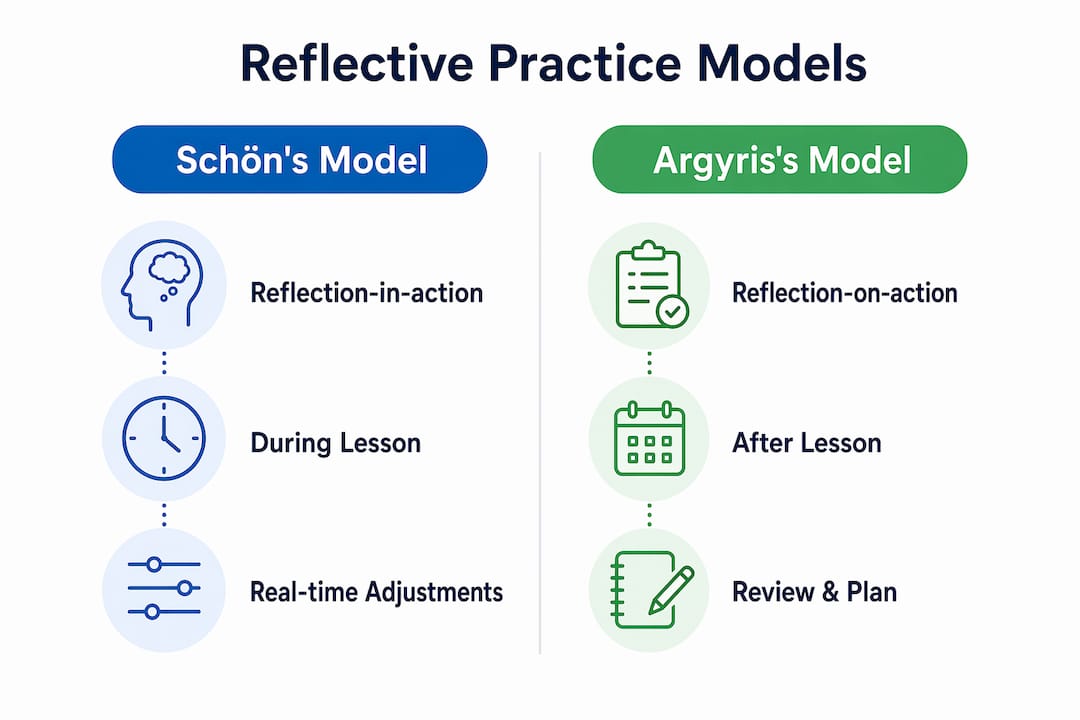
Reflective practice is grounded in two concepts developed by Donald Schön: reflection-in-action and reflection-on-action. Reflection-in-action happens during teaching. An educator notices a student’s confusion mid-lesson and adjusts the explanation in real time. Reflection-on-action happens after the fact. The educator reviews what occurred, identifies what worked, and plans a different approach for next time.
Chris Argyris extended this thinking by framing reflection as a dynamic dialogue between thinking and doing. His contribution emphasized that reflection must connect directly to behavior change, not just intellectual analysis. A teacher who reflects but never modifies their practice has completed only half the process.
The table below compares the two most widely applied models in professional education settings.
| Model | Core concept | When it occurs | Primary outcome |
|---|---|---|---|
| Schön’s reflection-in-action | Adapting during teaching | Real time, mid-lesson | Immediate instructional adjustment |
| Schön’s reflection-on-action | Evaluating after teaching | After the lesson or unit | Planned improvement for future sessions |
| Argyris’s double-loop learning | Questioning underlying assumptions | Ongoing, across practice | Systemic change in teaching beliefs and behavior |
Reflection as a skill means applying a technique when prompted. Reflection as a disposition means it becomes part of how an educator thinks at all times. The distinction matters because reflective learning in education produces lasting growth only when it operates as a mindset, not a checklist item.
Pro Tip: Read Schön’s “The Reflective Practitioner” alongside your teaching journal. Connecting his theory to your own classroom moments accelerates how quickly the concepts become practical habits.
How do educators effectively engage in reflective practice?
Effective reflection follows a repeatable cycle. Educators observe what happens in the classroom, evaluate the causes and effects of those events, and then plan specific actions to address gaps. Cyclic routines of observation, evaluation, and action planning support emotional resilience and reduce the risk of burnout. That cycle works because it prevents educators from ruminating without resolution.

Tools that support structured reflection
Three tools appear consistently in professional development literature for good reason.
- Reflective journals. Writing after each lesson forces clarity. The act of putting an experience into words reveals patterns that stay invisible in memory alone. Journals work best when educators write within 24 hours of the lesson, while details remain fresh.
- Peer feedback sessions. A colleague observing your class and sharing specific observations introduces an external perspective that self-reflection cannot replicate. Peer feedback reduces the blind spots that come from evaluating your own performance.
- Classroom observation logs. Structured logs with set categories, such as student engagement, pacing, and questioning technique, create consistent data across multiple lessons. That consistency makes it possible to track change over time.
Building a weekly and termly reflection cycle
Weekly reflection keeps the process manageable. A 15-minute journal entry at the end of each teaching day, combined with one peer feedback session per week, creates a steady rhythm without overwhelming workload. At the end of each term, educators review their journal entries to identify recurring themes. That termly review is where the most significant professional insights tend to surface.
Classroom observation data collected across a full term reveals patterns that weekly entries miss. An educator might notice that student engagement consistently drops during the final 10 minutes of class, a pattern invisible in any single lesson but clear across 12 weeks of logs.
Collaborative inquiry adds another layer. When a team of educators reflects together on shared data, the process becomes richer. Group discussion surfaces assumptions that individual reflection leaves unchallenged.
Pro Tip: Focus at least one reflection entry per week on a moment that surprised you. Unexpected teaching moments generate the most useful insights because they reveal the gap between what you expected and what actually happened.
What challenges and misconceptions surround reflective practice?
The most common misconception is that reflection alone produces growth. Reflection without actionable outcomes leads to reflection fatigue, a state where educators document their experiences thoroughly but change nothing about their teaching. The goal is behavior change, not journaling volume.
Several specific pitfalls undermine the process for educators at every experience level.
- The echo chamber effect. Reflecting only on your own perceptions reinforces existing beliefs. Without external input, self-appraisal becomes distorted over time.
- Documentation focus. Filling in reflection templates becomes the goal rather than the means. When the form matters more than the thinking, the process loses its value.
- Avoiding discomfort. Educators naturally gravitate toward reflecting on successes. Genuine growth comes from examining failures and uncomfortable moments with the same rigor.
- Reflection as a one-time event. Treating reflection as something done at the end of a course or appraisal cycle, rather than continuously, limits its impact to surface-level observations.
Cognitive biases distort self-appraisal in ways that educators rarely recognize without external input. Seeking diverse perspectives, through peer observation, student feedback, or mentoring, corrects for those biases. Reflection practiced in isolation is inherently limited.
The fix is not more reflection. The fix is better reflection connected to deliberate action. Peer teaching structures provide one of the most effective external checks on individual blind spots.
What are the key benefits of reflective practice for educators in 2026?
Meta-analysis confirms that iterative reflective practice improves cognitive flexibility, emotional resilience, and teaching problem-solving. These are not abstract qualities. They translate directly into better classroom decisions under pressure and more consistent student outcomes across diverse learning environments.
The documented benefits for educators include:
- Improved emotional resilience. Educators who reflect regularly process difficult classroom experiences more constructively. They recover from setbacks faster and maintain professional stability under stress.
- Greater cognitive flexibility. Reflective educators adapt their methods when a strategy stops working. They do not repeat ineffective approaches out of habit.
- Stronger professional decision-making. Reflection builds a personal evidence base. Over time, educators develop a refined instinct for what works with specific student populations.
- Reduced burnout risk. Structured reflection gives educators a framework for processing frustration rather than accumulating it. The cyclic nature of the process creates regular release points.
- Integration of theory and practice. Effective reflection merges pedagogical theory with classroom reality through what Schön called “knowledge-in-action.” Educators test hypotheses, observe results, and refine their approach continuously.
Reflective mindset development also strengthens professional identity. Educators who reflect consistently develop a clearer sense of their values, their teaching philosophy, and the ethical commitments that guide their decisions. That clarity sustains long-term career engagement in ways that external professional development programs alone cannot.
The teacher reflection process also improves how educators respond to unexpected classroom moments. Analyzing deviations from the lesson plan, rather than dismissing them, turns disruptions into rich learning data.
Key takeaways
Reflective practice is the most direct path from teaching experience to teaching expertise, requiring structured cycles, external feedback, and a commitment to behavior change over documentation.
| Point | Details |
|---|---|
| Definition of reflective practice | A systematic, self-directed process of examining teaching experiences to improve professional outcomes. |
| Core theoretical models | Schön’s reflection-in-action and reflection-on-action, plus Argyris’s double-loop learning, form the foundational framework. |
| Practical implementation tools | Reflective journals, peer feedback sessions, and classroom observation logs support consistent cyclical reflection. |
| Primary challenge to avoid | Reflection fatigue occurs when documentation replaces action; behavior change is the true measure of success. |
| Key professional benefits | Iterative reflection builds cognitive flexibility, emotional resilience, and stronger teaching decision-making over time. |
Reflective practice as a professional obligation, not a task
I have worked with educators at many stages of their careers, and the pattern is consistent. The teachers who grow fastest are not the ones who attend the most workshops. They are the ones who reflect most deliberately on what happens in their own classrooms.
The biggest mistake I see is treating reflection as something you do after teaching rather than during it. Schön’s concept of reflection-in-action is underused in practice. Most educators wait until the lesson is over to think critically. The ones who develop fastest learn to notice and adjust in real time, mid-sentence if necessary.
I have also seen reflection become a bureaucratic exercise. Teachers fill in journals because their institution requires it, not because they expect to learn anything. That version of reflection produces nothing. The journals sit in folders, unread and unchanged. The teaching stays exactly the same.
What actually works is combining structured personal reflection with honest peer feedback on a regular schedule. Not once a term. Every week. The discomfort of having a colleague observe your class and give you direct feedback is precisely what makes it effective. Comfort produces stagnation.
Reflection is also an ethical responsibility. Educators hold significant influence over their students’ development. Failing to examine and improve your practice is not a neutral choice. The educators I respect most treat reflection as a professional obligation, not a personal preference.
— Muller
Teflinstitute courses that build reflective teaching skills
Teflinstitute integrates reflective practice directly into its professional development programs, giving educators the frameworks and feedback structures to apply these skills in real classrooms.

The 120 Hour Elective TEFL Course covers core pedagogical skills including structured self-evaluation, lesson analysis, and the application of Schön’s reflective models to English language teaching contexts. For educators seeking deeper certification, the 240 Hour Master TEFL Course embeds reflective methodology throughout its curriculum, connecting theory to observed classroom practice. Both programs are designed for educators who want professional growth that goes beyond technique and builds a genuine reflective disposition.
FAQ
What is the definition of reflective practice in education?
Reflective practice in education is a systematic, self-directed process where educators critically examine their teaching experiences to improve professional performance and student outcomes. It is increasingly regarded as a required professional disposition rather than an optional skill.
What are the main reflective practice techniques for teachers?
The most widely used techniques are reflective journaling, peer observation and feedback, and structured classroom observation logs. These tools work best when used in combination within a regular weekly and termly cycle.
How does reflection-in-action differ from reflection-on-action?
Reflection-in-action occurs during a lesson, allowing real-time instructional adjustments. Reflection-on-action occurs after the lesson and focuses on critical evaluation and planning for future improvement.
What is reflection fatigue and how do educators avoid it?
Reflection fatigue occurs when educators over-document their experiences without applying any changes to their teaching. Avoiding it requires connecting every reflection cycle to at least one specific, concrete action.
Why is peer feedback important in reflective practice?
Cognitive biases distort self-appraisal when educators reflect in isolation. Peer feedback introduces an external perspective that corrects for those biases and enriches the professional learning process.
Recommended
TEFL Institute guides

Estonia
Jobs, pay and work routes
China
Z visa, pay and cities
Portugal
Jobs, pay and visa routes
Italy
Jobs, pay and visa routes
Taiwan
Buxibans, pay and visas