

 United Kingdom (UK)
 United States (US)
 Canada
 South Africa
 India
India Australia
 New Zealand
 China
China Russia
 Germany
 France
 Spain
Spain Netherlands
 Vietnam
 United Arab Emirates
 Italy
Italy Poland
 Thailand
 Türkiye









 Algeria


What Is Learner Motivation? A Guide for Educators
What Is Learner Motivation? A Guide for Educators

TL;DR:
- Learner motivation is a fluctuating internal and external drive that influences effort and persistence in learning. Educators can enhance motivation by applying frameworks like the MUSIC Model and teaching students self-regulation skills. Building supportive relationships and connecting learning to real-world goals sustain engagement over time.
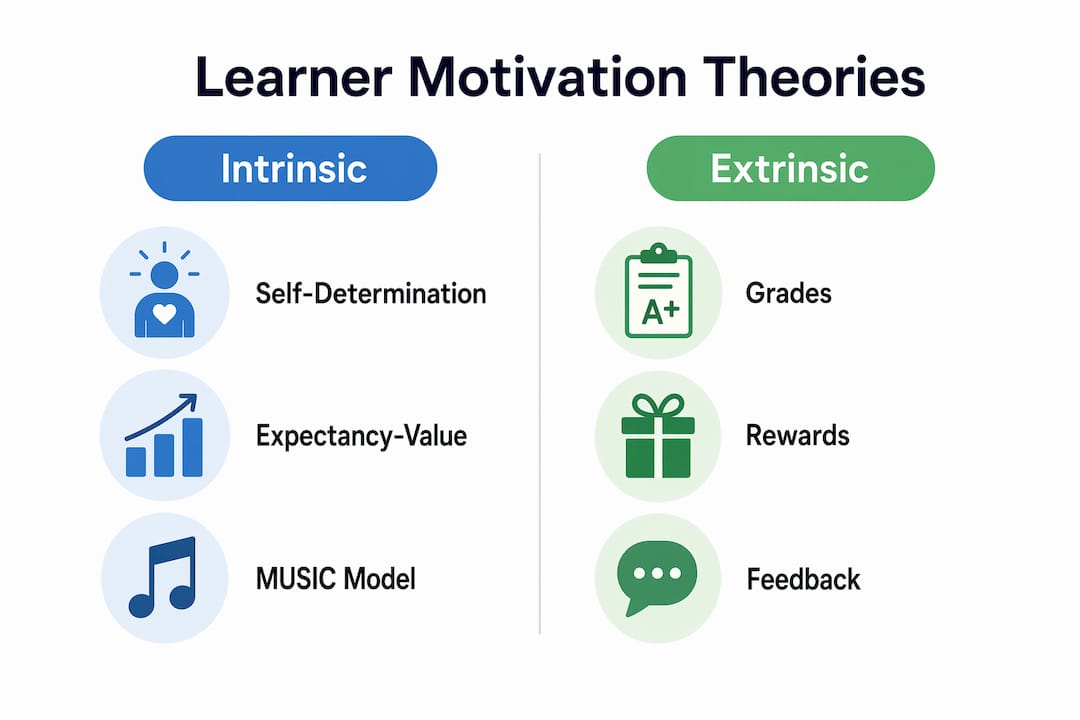
Learner motivation is defined as the internal and external forces that drive individuals to engage with, persist in, and succeed at learning tasks. It determines how much energy, focus, and effort a learner invests in any given educational experience. Understanding what is learner motivation matters because motivation is not a fixed trait. Research confirms it fluctuates moment to moment within a single learning session, shaped by task design, classroom environment, and learner beliefs. Frameworks like Self-Determination Theory, Expectancy-Value Theory, and the MUSIC Model give educators concrete tools to understand and act on these fluctuations.

What is learner motivation, and why does it matter?
Learner motivation is the psychological drive that energizes and sustains learning behavior. It operates across cognitive, emotional, and behavioral dimensions simultaneously. A learner who is motivated thinks harder, persists longer, and recovers faster from setbacks than one who is not.
The importance of learner motivation extends beyond individual performance. Motivated learners are more likely to complete courses, retain knowledge, and apply skills in real contexts. For educators and administrators, this translates directly into better program outcomes, higher completion rates, and stronger institutional credibility.
Motivation is also context-dependent. A learner who is highly engaged in one subject may disengage entirely in another. This means educators cannot rely on a learner’s general attitude as a reliable predictor of performance in any specific task. Motivation must be actively cultivated within each learning context.
Intrinsic motivation is superior for sustaining deep, long-term learning. Extrinsic motivation, such as grades or certificates, effectively promotes initial interest and short-term goal achievement. Both types serve a purpose, and skilled educators use them together rather than treating them as opposites.
What are the main theories explaining learner motivation?
Several well-established theories explain how and why learner motivation works. Each offers a different lens, and together they give educators a fuller picture.
Self-Determination Theory
Self-Determination Theory, developed by Edward Deci and Richard Ryan, holds that learners have three core psychological needs: autonomy, competence, and relatedness. When all three are met, intrinsic motivation rises. When any one is blocked, motivation drops. A classroom that gives learners no choice over how they complete a task directly undermines autonomy and, by extension, engagement.
Expectancy-Value Theory
Expectancy-Value Theory frames motivation as a product of two questions every learner asks: “Can I succeed at this?” and “Is this worth my time?” If a learner answers no to either question, motivation collapses regardless of how well the lesson is designed. Educators who address both questions explicitly, by building learner confidence and connecting content to real-world value, see stronger engagement.
Situational motivation
Situational motivation is a dynamic, temporal state that fluctuates within individuals in response to specific environmental triggers. It is shaped by task-specific beliefs and perceived costs throughout a learning session. This finding matters because it means motivation is not something learners bring to class. It is something that happens in class, and educators directly influence it through every instructional decision they make.
The MUSIC Model
The MUSIC Model of Motivation integrates five components that educators can apply directly: eMpowerment, Usefulness, Success, Interest, and Caring. Introduced in 2018 and still widely applied in 2026, the model translates abstract motivation theory into practical classroom actions. Each component maps to a specific learner need, making it one of the most usable frameworks available to practicing educators.
Pro Tip: Apply the MUSIC Model as a self-audit. After each lesson, rate your instruction on all five components. If “Caring” scores low, add a brief personal check-in at the start of the next session.
Short-term extrinsic motivation and long-term intrinsic motivation work together rather than in opposition. Educators who balance both types optimize academic success more effectively than those who rely on either alone.
Which factors most influence learner motivation in educational settings?
The factors affecting learner motivation fall into three broad categories: personal beliefs, social relationships, and environmental conditions. All three interact, and changing one often shifts the others.
Personal beliefs are the most powerful internal factor. A learner who believes they are capable of succeeding at a task, what researchers call self-efficacy, will invest more effort than one who doubts their ability. Educators build self-efficacy by designing tasks at the right difficulty level and giving specific, constructive feedback after each attempt.
Social relationships shape motivation in ways that many educators underestimate. Teacher-student relationships characterized by proximity, influence, and genuine caring are the second most important influence on student motivation, after overall supportive teaching style. This finding from a 2025 systematic review is significant. It means that how a teacher relates to learners matters nearly as much as what they teach.
Environmental conditions include task design, feedback structure, and classroom norms. Poorly designed tasks that feel arbitrary or disconnected from learners’ lives kill motivation quickly. Tasks that connect to real goals sustain it.
Purpose is a particularly underused motivational lever. Adolescents and adult learners have a strong need to connect learning to a greater purpose. Educators who help learners build that personal narrative sustain motivation even when tasks are difficult or tedious. Practical methods like connecting classroom engagement activities to learners’ stated goals make this concrete rather than abstract.
Key factors affecting learner motivation at a glance:
- Self-efficacy beliefs: Learners who believe they can succeed invest more effort.
- Teacher-student relationships: Caring, proximate relationships directly raise motivation.
- Task relevance: Tasks connected to real-world goals sustain engagement longer.
- Feedback quality: Specific, supportive feedback builds confidence and persistence.
- Classroom norms: Environments that normalize struggle reduce fear of failure.
How can educators effectively enhance and sustain learner motivation?
Strategies for motivating learners work best when they are systematic rather than reactive. The following approaches are grounded in current educational psychology research.
- Apply the MUSIC Model as a planning framework. Before designing a lesson, check each of the five components: eMpowerment, Usefulness, Success, Interest, and Caring. A lesson that scores low on “Usefulness” needs a real-world application added. One that scores low on “Success” needs a scaffolded entry point.
- Frame critical feedback with explicit care. Students perceive critical feedback more positively when it is framed with visible support. Handwritten notes clarifying a teacher’s intent increase motivation, particularly for learners from marginalized groups. The content of feedback matters, but so does its tone and delivery.
- Build learner autonomy through structured choice. Give learners options in how they demonstrate understanding, which topics they explore in depth, or how they organize their study time. Autonomy does not mean absence of structure. It means learners have a genuine role in shaping their experience.
- Teach learners to recognize and manage motivational dips. Motivation fluctuates within every learning session. Educators who name this openly, and teach learners to expect and work through low-motivation moments, produce more resilient students. This is a metacognitive skill, and it can be explicitly taught.
- Use ESL classroom ideas that connect content to learner goals. Whether teaching language, vocational skills, or academic content, grounding tasks in learners’ actual purposes raises both engagement and retention.
Pro Tip: Use guided reflection prompts at the end of each unit. Ask learners to write one sentence connecting what they learned to a personal goal. This simple practice builds the purpose narrative that sustains long-term motivation.
What is the role of learner self-regulation in long-term motivation?
Most motivation interventions focus entirely on what teachers do. Focusing solely on teachers’ actions limits the effectiveness of motivation programs. Teaching learners to self-regulate their own motivation, a concept called motivational apprenticeship, produces lasting engagement that does not depend on any single teacher or classroom.
Motivational apprenticeship treats motivation as a teachable skill. Educators model how they manage their own motivation, articulate the strategies they use, and then coach learners to apply those same strategies independently. This mirrors how master craftspeople teach apprentices: not just by demonstrating the product, but by making the process visible.
“Motivation is best approached as a teachable skillset rather than a static trait; frameworks encouraging learners’ metacognitive and motivational regulation skills are most effective.” Motivational Apprenticeship
Peer-driven feedback methods also play a significant role. Peer feedback methods like “Glows and Grows” help learners self-monitor progress and normalize learning struggles. This predictability reduces anxiety and sustains motivation across longer learning periods.
Practical elements of a motivational apprenticeship approach include:
- Modeling: Teachers narrate their own motivational strategies aloud during instruction.
- Articulation: Learners are asked to name the strategies they use when they feel unmotivated.
- Reflection: Regular structured reflection helps learners track their motivational patterns over time.
- Peer coaching: Learners practice motivational strategies with each other, reinforcing the skills socially.
The long-term benefit is a learner who does not need external motivation to persist. That kind of autonomy is the goal of every effective educator, and classroom behavior management frameworks that build self-regulation support this directly.
Key Takeaways
Learner motivation is a dynamic, teachable force shaped by personal beliefs, social relationships, and instructional design, and educators who apply frameworks like the MUSIC Model and motivational apprenticeship produce measurably stronger learner outcomes.
| Point | Details |
|---|---|
| Motivation is dynamic, not fixed | It fluctuates within single learning sessions and responds directly to instructional decisions. |
| Teacher relationships are critical | Caring, proximate teacher-student relationships are the second most important motivational influence. |
| The MUSIC Model guides practice | Applying eMpowerment, Usefulness, Success, Interest, and Caring gives educators a concrete planning tool. |
| Feedback framing changes outcomes | Critical feedback delivered with explicit care is accepted and used more effectively by learners. |
| Motivation is a teachable skill | Motivational apprenticeship frameworks build learner self-regulation that outlasts any single course. |
What I have learned about motivation after years in the classroom
Most educators enter the profession believing motivation is something learners either have or do not have. That belief is the single most limiting assumption in teaching. Once I stopped treating motivation as a fixed trait and started treating it as a skill I could develop in my learners, everything changed.
The shift is not just theoretical. When you explicitly teach a learner how to recognize a motivational dip and work through it, you give them something no grade or certificate can provide. You give them a process. I have seen this work with adult language learners who had failed multiple times before, and with adolescents who had been written off as disengaged. The difference was not the content. It was whether anyone had ever taught them how to stay in the game when it got hard.
The MUSIC Model is the most practical framework I have encountered for planning with motivation in mind. Most educators already do some version of it intuitively. Making it explicit turns intuition into a repeatable system. The “Caring” component is the one most often underweighted. Learners who do not feel seen by their teacher will not stay motivated, regardless of how well the lesson is designed.
My advice to educators: audit your own motivational assumptions before auditing your learners’. The question is not “Why are my students unmotivated?” The question is “What in my design is failing to meet their motivational needs?”
How Teflinstitute prepares educators to build motivated learners
Educators who understand motivation theory need training that translates that knowledge into classroom practice. Teflinstitute offers internationally recognized TEFL certification programs that include practical instruction on learner engagement, feedback design, and motivational strategies for diverse learner groups.

Teflinstitute’s course catalog covers both foundational certification and specialized programs, including courses designed for teaching young learners and business English contexts where motivation dynamics differ significantly from standard academic settings. All programs are available online, making professional development accessible regardless of where you teach. Educators who complete Teflinstitute certification gain credentials recognized internationally and skills they can apply from the first day of their next class.
FAQ
What is learner motivation in simple terms?
Learner motivation is the internal and external drive that compels a person to engage with and persist in learning. It determines how much effort and focus a learner brings to any educational task.
What are the main types of learner motivation?
The two primary types are intrinsic motivation, which comes from personal interest and satisfaction, and extrinsic motivation, which comes from external rewards like grades or certificates. Both types serve different purposes and work best when used together.
Which theories best explain learner motivation?
Self-Determination Theory, Expectancy-Value Theory, and the MUSIC Model are the most widely applied frameworks. Each explains a different dimension of why learners engage or disengage from learning tasks.
How can educators improve learner motivation practically?
Educators can apply the MUSIC Model during lesson planning, frame feedback with explicit care, build learner autonomy through structured choice, and teach learners to self-regulate their motivation using motivational apprenticeship methods.
Why does learner motivation fluctuate during a lesson?
Motivation is a situational state that responds to task design, perceived difficulty, and environmental cues in real time. A single lesson can move a learner from high engagement to disengagement and back, depending on how each phase is structured.
Recommended
TEFL Institute guides

Mexico
Jobs, pay and cities
Vietnam
Work permits and requirements
Czech Republic
Pay, visas and cities
China
Z visa, pay and cities
South Korea
EPIK, hagwons and pay