
 United Kingdom (UK)
 United States (US)
 Canada
 South Africa
 India
India Australia
 New Zealand
 China
China Russia
 Germany
 France
 Spain
Spain Netherlands
 Vietnam
 United Arab Emirates
 Italy
Italy Poland
 Thailand
 Türkiye








 Algeria


What Is Certificate Verification? A Practical Guide
What Is Certificate Verification? A Practical Guide

TL;DR:
- Credential fraud is more widespread than many professionals realize, with fake degrees and certificates often going unchecked. Proper certificate verification involves confirming the issuing authority, cross-referencing metadata, and using official verification channels to ensure authenticity. Implementing automated systems and layered validation processes reduces fraud risks and enhances organizational credibility.
Credential fraud is more common than most professionals expect. Résumés list degrees from institutions that never conferred them, TEFL certificates circulate without any traceable issuer, and organizations make hiring decisions based on documents they never actually checked. Understanding what is certificate verification, and more critically how to apply it, is a practical skill for both individuals protecting their professional standing and organizations managing risk in recruitment and compliance. This guide covers the process, the common failure points, and the tools that make verification reliable.
Table of Contents
- Key Takeaways
- What certificate verification means
- The certificate verification process for credentials
- Challenges in certificate verification
- Why certificate verification matters
- My perspective on common verification mistakes
- Verified TEFL certification from Teflinstitute
- FAQ
Key Takeaways
| Point | Details |
|---|---|
| Verification goes beyond appearance | Visual elements like signatures or QR codes alone cannot confirm a certificate’s authenticity without portal validation. |
| A structured process reduces fraud risk | Cross-referencing issuer records, metadata, and verification URLs provides a layered defense against credential fraud. |
| Technical and operational issues differ | A certificate can be cryptographically valid yet operationally broken due to missing intermediates or revocation problems. |
| Automated systems outperform manual checks | Integrating digital verification tools reduces delays and human error in high-volume credential screening. |
| Verified credentials strengthen trust | Organizations and individuals with verifiable certifications carry measurably more credibility in hiring and professional partnerships. |
What certificate verification means
At its core, certificate verification is the process of confirming that a credential is authentic, was issued by a legitimate authority, and accurately represents the qualifications of the person presenting it. The term is used across two distinct contexts: digital security certificates (such as SSL/TLS certificates that secure websites) and educational or professional credentials (such as degrees, TEFL certifications, or industry licenses). Both share the same underlying logic, though the mechanisms differ.
It helps to distinguish three related but separate concepts:
- Certification is the act of issuing a credential. It relies on documentation, completed coursework, or process compliance. Certification relies on documentation and process, while verification tests claims for authenticity beyond paperwork.
- Validation confirms that a certificate is authentic, was issued by a trusted authority, and has not been revoked. Certificate validation includes signature verification, chain of trust, revocation status, and validity period.
- Verification is the act of checking that a specific certificate presented by an individual actually matches what the issuing authority has on record.
In digital certificates, this verification depends on a chain of trust. A certificate is cryptographically linked through a chain from an end-entity back to trusted root certificates, with intermediate certificates protecting root keys along the way. In educational credentials, an equivalent structure exists: the issuing institution’s reputation, accreditation status, and database records form the chain that gives a certificate its weight.
A certificate without verifiable proof is just a visual. It carries no objective weight in professional settings without a confirmed link back to an issuing authority.
The certificate verification process for credentials
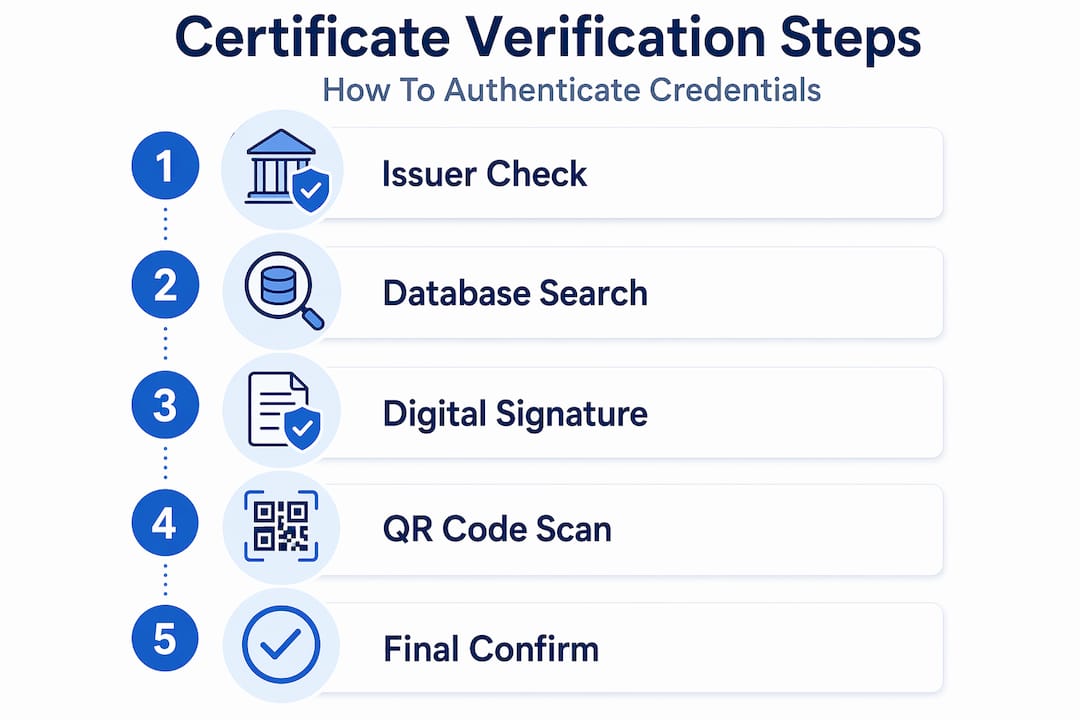
The certificate verification process for educational and professional credentials follows a consistent structure, regardless of the specific qualification being reviewed. The steps below apply whether you are an employer screening a TEFL certificate or an admissions officer reviewing a diploma.
- Confirm the issuing authority is legitimate. Look up the institution or certification body independently. Do not rely solely on the certificate itself for this information. Check whether the organization is accredited by a recognized body and whether it has a public record of issuing the credential in question.
- Locate the official verification channel. Most reputable issuers provide a dedicated verification URL, a QR code that links to a certificate-specific page, or a contact address for third-party verification requests. Confirming issuer legitimacy through a verification URL that leads to a certificate-specific page is a standard step in any credible process.
- Cross-reference the certificate metadata. Check that the name, date of issue, course title, and credential ID on the certificate match what the issuer’s records show. A mismatch between certificate contents and the issuer portal signals likely fraud or an invalid credential.
- Check the revocation status. Credentials can be revoked after issuance, for instance if a student was found to have cheated or if the issuing body lost its accreditation. A certificate that appears valid may no longer be recognized by the issuing authority.
- Contact the issuer directly when in doubt. For high-stakes decisions such as senior hiring or academic admissions, a direct inquiry to the institution adds a final layer of confirmation that no automated system alone can replicate.
Pro Tip: Do not use the verification link printed on the certificate itself as your only source. Navigate directly to the issuer’s official website and locate the verification portal from there. Fraudulent certificates routinely include functional-looking QR codes that redirect to convincing but fake verification pages.
Modern certificate verification services have reduced the time burden significantly. Digital systems using encrypted QR codes and blockchain provide forensic-grade validation and instant authentication, as demonstrated by Kenya National Examinations Council’s TrueCert system. These tools reduce reliance on manual document inspection and are increasingly adopted by international employers and academic institutions. Understanding how employers verify TEFL credibility provides useful context for teaching professionals navigating this space.
Challenges in certificate verification
Certificate verification is not always straightforward. Several technical and practical issues can complicate an otherwise routine check, and understanding them prevents costly mistakes.
| Challenge | Type | Impact |
|---|---|---|
| Expired certificates | Operational | Certificate no longer valid, may still appear authentic visually |
| Revoked credentials | Technical/Operational | Issuer has withdrawn recognition; verification portal reflects this |
| Missing intermediate certificates | Technical | Breaks the chain of trust; verification tools may fail silently |
| Fraudulent verification portals | Security | Fake pages mimic legitimate ones to produce false confirmations |
| Manual process errors | Operational | Human reviewers miss metadata mismatches or revocation flags |
Problems may arise from expired, revoked, or missing intermediate certificates, causing verification failures that security software may flag inconsistently. This is particularly relevant in digital certificate environments, but the same logic applies to credential databases where records are not maintained in real time.

A subtler problem is the difference between operational and technical validity. A certificate might be cryptographically valid but operationally broken due to missing intermediates or security flags that require expert analysis. In credential terms, a certificate may have been legitimately issued at one point but is no longer recognized because the issuing body lost its accreditation. The document looks correct, but the organization behind it no longer has standing.
Another significant risk comes from organizations cutting corners. Many organizations mistakenly disable important certificate validation checks for convenience, and threat actors exploit these misconfigurations to move laterally or harvest credentials using forged certificates. In educational settings, this translates to employers who accept credentials at face value without running even a basic issuer check.
Pro Tip: When verifying TEFL or other professional certificates at scale, build a standardized verification checklist into your recruitment or enrollment workflow. Treating verification as a repeatable process rather than a one-time judgment call significantly reduces the risk of oversight.
Why certificate verification matters
The importance of certificate verification extends well beyond individual hiring decisions. It affects organizational credibility, legal compliance, academic integrity, and the broader trust that professional credentials are designed to create.
Consider these concrete benefits:
- Fraud prevention. Certificate verification protects high standards and guards against credential fraud that can damage an organization’s reputation and expose it to legal liability. A single undetected fraudulent credential in a compliance-sensitive role carries significant consequences.
- Regulatory compliance. Many industries and jurisdictions require documented credential checks as part of licensing, employment, or program enrollment processes. Verification creates an auditable record of due diligence.
- Employer and institutional brand protection. Organizations that verify credentials signal a commitment to quality. This matters in recruiting, where verified credentials become a differentiator between candidates of similar apparent qualifications.
- Trust in academic admissions. Universities and professional programs rely on verified transcripts and certificates to maintain the integrity of their cohorts. A layered verification approach combining document signing, public verification pages, and direct issuer contact is more resilient than any single indicator alone.
- Protection for certificate holders. Individuals with verifiable credentials benefit directly. When an employer can confirm the credential quickly and confidently, it reduces friction in the hiring process and validates the time invested in obtaining the qualification.
For teaching professionals specifically, understanding TEFL verification importance is directly relevant to employment outcomes abroad and online. Employers in competitive markets increasingly require certificates from providers who offer a clear, accessible verification process.
My perspective on common verification mistakes
In my experience reviewing how organizations handle credential checks, the most persistent problem is not ignorance of the process. It is overconfidence in surface-level indicators. I have seen hiring managers treat a well-designed PDF certificate with a QR code as sufficient proof of qualification, without ever scanning the code or checking where it leads.
Visual elements like signatures or QR codes alone do not guarantee authenticity. The trustworthiness of the verification portal is what matters. That insight seems obvious once stated, but it runs counter to how most people intuitively assess documents.
What I have found genuinely works is cross-checking metadata. Cross-checking metadata consistency across issuer databases and recipient profiles is a proven method for detecting false or expired credentials. It requires a few extra minutes per check but catches fraud that visual inspection never would.
My recommendation for organizations: stop treating verification as a one-off task assigned to whoever receives the application. Build a documented workflow, assign clear responsibility, and integrate automated verification tools where volume justifies it. The cost of a missed fraudulent credential almost always exceeds the cost of a proper system.
— Muller
Verified TEFL certification from Teflinstitute
For teaching professionals who want their credentials to stand up to scrutiny, the choice of certification provider matters as much as the qualification itself.
Teflinstitute offers TEFL and TESOL certification courses designed with transparent, verifiable credentialing at every level. Whether you are pursuing the 120 Hour Advanced TEFL Course for a focused qualification or the 240 Hour Master TEFL Course for a credential recognized by employers worldwide, each course comes with certification that employers can verify directly. Teflinstitute’s approach to credentialing means that when an employer or institution runs a certificate authenticity check on your qualification, the process is clear, accessible, and returns a confirmed result. That transparency is exactly what serious teaching professionals and the organizations that hire them need.
FAQ
What is certificate verification, exactly?
Certificate verification is the process of confirming that a credential is authentic, was issued by a legitimate authority, and matches the issuing organization’s records. It applies to both digital security certificates and educational or professional credentials.
How do you verify a certificate’s authenticity?
Confirm the issuing authority independently, use the official verification URL or QR code from the issuer’s website, and cross-reference the certificate’s metadata against the issuer’s database. Contact the issuer directly for high-stakes decisions.
Why is certificate validation important for hiring?
Credential fraud costs organizations significant resources in rehiring, legal exposure, and reputational damage. Verification creates an auditable record of due diligence and confirms that a candidate’s qualifications are genuine before employment decisions are made.
What makes a certificate verifiable?
A verifiable certificate is linked to an issuer database that a third party can query independently. This typically includes a unique credential ID, a publicly accessible verification portal, and metadata that matches the issuer’s official records.
Can a certificate look valid but still be fraudulent?
Yes. Fraudulent certificates can include functional-looking QR codes that redirect to fake verification pages, or they may replicate visual elements of legitimate credentials precisely. Checking the issuer’s official portal directly, rather than relying on the certificate itself, is the only reliable defense.
Recommended
TEFL Institute guides