United Kingdom (UK)
 United States (US)
 Canada
 South Africa
 India
India Australia
 New Zealand
 China
China Russia
 Germany
 France
 Spain
Spain Netherlands
 Vietnam
 United Arab Emirates
 Italy
Italy Poland
 Thailand
 Türkiye









 Algeria


Advanced TEFL diploma guide: ESL pathways & career value
Advanced TEFL diploma guide: ESL pathways & career value

TL;DR:
- Advanced TEFL diplomas offer greater recognition, specialization, and leadership opportunities than entry-level certificates.
- Levels 5 and 7 differ in hours, depth, requirements, and career impacts, with Level 7 being more prestigious.
- Pursuing an advanced diploma improves job prospects, salary potential, and access to international school positions.
Many aspiring ESL teachers assume a TEFL diploma and a basic TEFL certificate are interchangeable. They are not. The gap between a 120-hour entry-level certificate and an advanced diploma represents a significant difference in depth, recognition, and career potential. Advanced diplomas are structured around higher-order teaching theory, observed practice, and academic specialization that simply does not exist in foundational courses. For teachers who want to move into international schools, leadership roles, or specialized instruction, understanding this distinction is essential. This guide breaks down what advanced diplomas are, how they are structured, and how to determine whether one fits your professional goals.
Table of Contents
- What qualifies as an advanced diploma in TEFL/TESOL?
- Levels of advanced diplomas: Level 5, Level 7, DELTA & DipTESOL
- Core skills, methodologies, and specializations covered
- Advanced diplomas vs entry-level TEFL certificates: What’s the difference?
- Why the ‘advanced diploma’ could be your best teaching move
- Explore advanced TEFL options with TEFL Institute
- Frequently asked questions
Key Takeaways
| Point | Details |
|---|---|
| Advanced diplomas stand out | An advanced diploma goes well beyond a basic TEFL certificate in both depth and employer recognition. |
| Levels matter | Level 5 diplomas suit entry to mid-level jobs, while Level 7 (DELTA/DipTESOL) enables academic leadership and top international school roles. |
| Skills and specialization | Advanced diplomas include research-driven teaching methods and options to specialize, making you more employable globally. |
| Practical experience counts | In-person modules and observed practice provide prestige and job market advantages over purely online options. |
What qualifies as an advanced diploma in TEFL/TESOL?
An advanced diploma in TEFL/TESOL is a professional qualification that goes beyond entry-level certificates such as the 120-hour TEFL or CELTA. These qualifications typically sit at UK Regulated Qualifications Framework (RQF) Level 5, requiring 180 to 300 or more hours of study, or at Level 7, which includes programs like DELTA and DipTESOL. The core distinction is not simply the number of hours. Advanced diplomas incorporate applied linguistics, second language acquisition (SLA) theory, assessment design, and often include an observed teaching component.
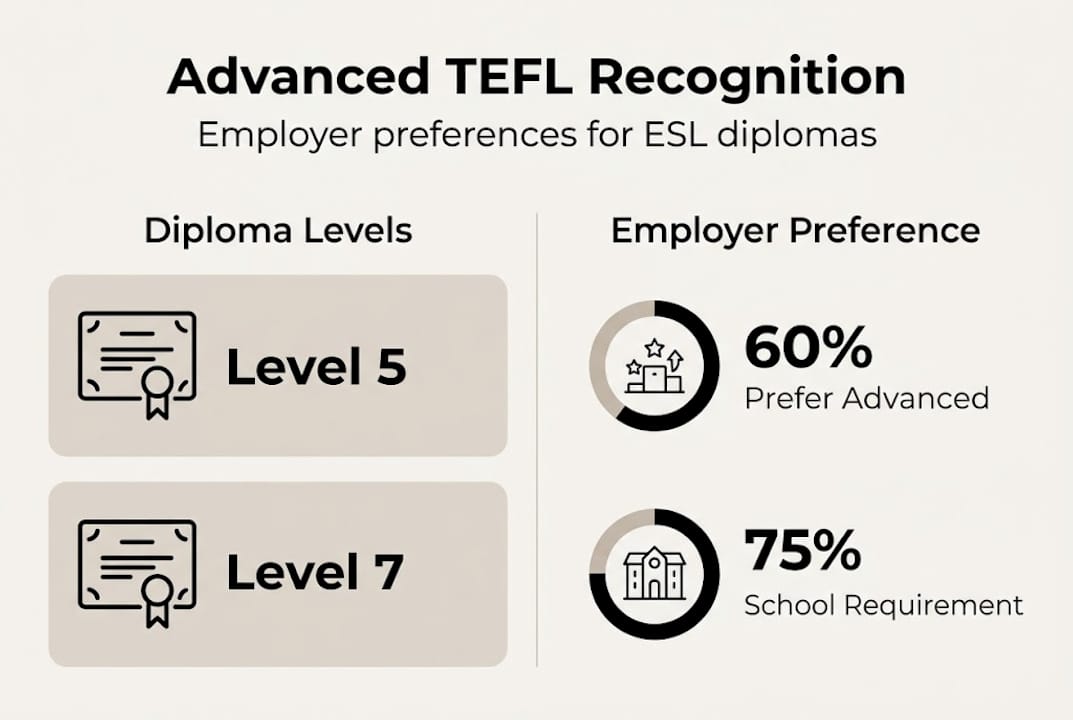
International employers recognize this distinction clearly. Over 60 to 75% of international schools prefer candidates with advanced qualifications when hiring for substantive roles. This is not a minor market preference. It reflects a structural demand for teachers who can manage diverse learners, apply research-backed methodology, and contribute to curriculum development.
| Feature | Entry-level certificate | Advanced diploma |
|---|---|---|
| Typical hours | 100 to 120 hours | 180 to 300+ hours |
| Academic level | RQF Level 3 to 4 | RQF Level 5 to 7 |
| Observed teaching | Rarely included | Often required |
| Content focus | Classroom basics | Theory, SLA, specialization |
| Global recognition | Moderate | High, especially Level 7 |
| Access to senior roles | Limited | Strong |
For teachers exploring understanding advanced diplomas, these qualifications offer concrete career advantages:
- Access to international schools and language academies with competitive pay
- Eligibility for academic leadership and curriculum coordinator positions
- Higher salary brackets in many ESL markets
- Stronger platform for pursuing further postgraduate study
If your goal is to boost your TEFL career beyond entry-level positions, an advanced diploma is not optional. It is the standard that serious employers expect.
Levels of advanced diplomas: Level 5, Level 7, DELTA & DipTESOL
Not all advanced diplomas are equivalent. The level you pursue determines the depth of study, entry requirements, and career outcomes. There are three primary tiers to understand.

| Diploma level | Hours | Entry requirements | Career outcomes |
|---|---|---|---|
| RQF Level 5 | 180 to 300 hours | Initial TEFL cert, some experience | Senior ESL teacher, curriculum support |
| DELTA (Level 7) | 300+ hours | CELTA or equivalent, 1 to 2 years experience, C1 English | Academic leadership, IELTS instruction, management |
| DipTESOL (Level 7) | 300+ hours | Similar to DELTA | Same senior and leadership roles |
Level 5 is roughly equivalent to a foundation degree, while DELTA at Level 7 is considered on par with a Master’s qualification in terms of academic standing. That comparison matters because it signals how employers and institutions perceive these credentials.
The DELTA and DipTESOL are structured around three distinct modules. Module 1 is a written theory exam covering linguistics and methodology. Module 2 involves observed and assessed classroom teaching. Module 3 is an extended specialism project on an area of your choice, such as young learners or English for academic purposes. This modular format allows candidates to complete sections over time, though all must be finished to receive the full award.
Entry requirements for Level 7 programs are specific. You typically need one to two years of active teaching experience, C1 English proficiency, and an initial qualification such as CELTA or Trinity CertTESOL.
For those weighing the practical side, this comparison of online vs offline diplomas is useful for understanding the tradeoffs between flexibility and practical components.
“Candidates who hold Level 7 qualifications consistently receive preference for academic leadership posts and higher salary offers in international school recruitment.”
The key takeaway is this: Level 5 provides a meaningful upgrade from entry-level training, but Level 7 programs like DELTA and DipTESOL carry the most weight with premium employers globally.
Core skills, methodologies, and specializations covered
Once you know which level of diploma you are targeting, it is equally important to understand what you will actually study and develop during the program.
Advanced diplomas focus on a set of competencies that go well beyond basic lesson planning. According to the advanced TEFL diploma curriculum, programs typically cover:
- Advanced Presentation-Practice-Production (PPP) methodology and task-based learning
- Differentiated instruction for mixed-ability and multilingual classrooms
- Second language acquisition theory and sociolinguistics
- Assessment design, error analysis, and learner feedback strategies
- Integration of educational technology into language instruction
- Research literacy and reflective teaching practice
Specialization is another defining feature of advanced diplomas. Depending on the program, you may be able to focus on:
- Young learners and primary education
- Business English and professional communication
- Exam preparation (IELTS, TOEFL, Cambridge)
- Academic English and higher education contexts
- Educational leadership and teacher training
The benefits of advanced TEFL courses are particularly visible when teachers align their specialization with regional job markets. For example, business English specialists are consistently in demand in East Asia and Europe, while young learner specialists find strong markets in Latin America and the Middle East.
Pro Tip: Before selecting a specialization, research the job boards for your target country or teaching context. Identify which niche is most in demand in that market, then match your diploma specialization accordingly. This single step can significantly improve your post-qualification employment prospects.
Tech integration is increasingly expected at the advanced level. Programs now incorporate tools for blended learning, digital assessment, and online classroom management, skills that have become standard requirements in many international institutions.
Advanced diplomas vs entry-level TEFL certificates: What’s the difference?
Most teachers start with a 120-hour TEFL certificate. That is a reasonable entry point. But it is useful to understand exactly where the gap opens up as you progress in your career.
| Factor | Entry-level certificate | Advanced diploma |
|---|---|---|
| Total study hours | 100 to 120 | 180 to 300+ |
| Modules | Single course | Multiple structured modules |
| Observed teaching | Optional or absent | Integrated in Level 7 programs |
| Academic recognition | Low to moderate | High, equivalent to degree-level |
| Job access | General ESL positions | Senior, specialist, and leadership roles |
| Typical cost | Lower | Higher, reflecting depth and accreditation |
This is not a straightforward “more is better” situation. The right qualification depends on where you are in your career and what you want to achieve. A TEFL course comparison shows that Level 5 online diplomas offer flexibility and affordability but often lack observed teaching practice, while DELTA and CELTA maintain their prestige precisely because of their practical, assessed components.
Three key decision factors to consider:
- Career goals. If you want to teach in international schools or move into academic management, an advanced diploma is the standard. If you are testing the waters in ESL, an entry-level certificate makes sense first.
- Flexibility vs. structure. Online diplomas offer study-at-your-own-pace formats. In-person or hybrid programs provide structured observed teaching that carries more weight with premium employers.
- Budget and timeline. Advanced diplomas cost more and take longer. Factor in whether the salary increase and job access justify the investment for your specific market.
For context on employer attitudes, the data on employer recognition of online TEFL is informative. Recognition has grown, but in-person practical experience remains the gold standard for senior roles.
Pro Tip: If you are mid-career and have two or more years of classroom experience, the Level 7 route offers the best return. If you are newer to teaching, a Level 5 diploma is a productive bridge qualification that positions you for Level 7 later.
The online vs in-class comparison is also worth reviewing when deciding on your study format.
Why the ‘advanced diploma’ could be your best teaching move
Conventional wisdom in the ESL community tends to suggest that any accredited TEFL certificate is sufficient to build a solid career. That view made sense a decade ago, when international ESL markets were less competitive and employer requirements were less defined. In 2026, market signals point in a different direction.
Teachers who invest in boosting their TEFL career through advanced qualifications consistently report access to positions that carry better pay, more stability, and genuine professional development pathways. The pattern is clear across international school recruitment data and employer surveys. Entry-level certificate holders compete for the same narrow band of roles. Advanced diploma holders access a different tier.
What surprises many experienced teachers is how quickly the online diploma landscape is closing the gap. Online Level 5 diplomas now carry meaningful recognition, provided they come from accredited providers. However, the observed teaching element found in Level 7 programs like DELTA still commands a premium in the most competitive markets. That in-person, assessed practice is genuinely difficult to replicate online, and employers know it. The bottom line is this: if you have the experience and the goal, a Level 7 diploma is still the single most effective credential upgrade available to working ESL teachers.
Explore advanced TEFL options with TEFL Institute
For teachers who are ready to move beyond foundational training, TEFL Institute offers a range of accredited programs designed to support that transition.
Whether you are based in the US and looking at an advanced diploma in Texas or exploring diploma course extensions to build on an existing qualification, the platform provides structured options with clear accreditation and support. Programs are designed for both aspiring and experienced teachers targeting international schools, specialist roles, and academic leadership. Browse course options, review prospectuses, and connect with the enrollment team to identify the qualification pathway that aligns with your career goals.
Frequently asked questions
What is the difference between a TEFL certificate and an advanced diploma?
A TEFL certificate covers foundational teaching skills in approximately 120 hours, while an advanced diploma in TEFL/TESOL sits at RQF Level 5 or Level 7, requiring 180 to 300 or more hours and offering deeper theory, specialization, and in many cases observed teaching practice.
Are advanced diplomas necessary to teach English abroad?
They are not always a mandatory requirement, but over 60 to 75% of international schools prefer advanced qualifications, and they are often essential for higher-paying positions, specialist roles, and academic leadership posts.
What are the entry requirements for DELTA or DipTESOL?
For Level 7 programs like DELTA and DipTESOL, you typically need one to two years of teaching experience, C1 English proficiency, and an initial qualification such as CELTA or Trinity CertTESOL.
Can I complete an advanced TEFL diploma online?
Yes. Online Level 5 diplomas are widely available and offer flexibility and affordability, though they typically do not include the observed teaching components that Level 7 in-person programs provide.
Recommended
TEFL Institute guides

Vietnam
Work permits and requirements
Czech Republic
Pay, visas and cities
Japan
JET, ALT and eikaiwa pay
Cambodia
Pay, requirements and visas
Mexico
Jobs, pay and cities