

 United Kingdom (UK)
 United States (US)
 Canada
 South Africa
 India
India Australia
 New Zealand
 China
China Russia
 Germany
 France
 Spain
Spain Netherlands
 Vietnam
 United Arab Emirates
 Italy
Italy Poland
 Thailand
 Türkiye










 Algeria



Why Teach English in Asia: Key Insights into the Asian TEFL landscape

English is changing the future across Asia and it is not just a classroom skill anymore. Studies show that nations with high English proficiency attract more foreign investment and enjoy stronger economic growth. Most people picture learning English as just memorizing words but in Asia it is now the key to getting better jobs, making global friends, and even transforming entire communities.
Table of Contents
- The Importance Of English In Asia’s Global Landscape
- Cultural Exchange And Personal Growth Through Teaching
- Economic Opportunities For English Teachers In Asia
- Educational Trends And Demand For English Proficiency
- Understanding The Teaching Environments Across Asian Countries
Quick Summary
| Takeaway | Explanation |
| English proficiency boosts economic competitiveness | Countries with high English skills attract foreign investments and strengthen their economies. |
| Teaching English offers transformative experiences | Educators gain personal growth and cultural understanding while teaching in diverse environments. |
| Adaptability is essential in varied teaching environments | Understanding cultural differences helps educators navigate diverse classrooms effectively. |
| Demand for English teachers is rapidly increasing | Asia presents lucrative job opportunities with competitive salaries in various sectors. |
| Nationwide English education reforms are underway | Countries are integrating English as a core skill to enhance global readiness and competitiveness. |
The Importance of English in Asia’s Global Landscape
English has transformed from a foreign language to a critical communication tool across Asia, driving significant economic, professional, and cultural opportunities. As globalization accelerates, the ability to speak English fluently has become an essential skill that opens doors to international collaboration and personal advancement.
Economic Opportunities Through Language Proficiency
In the contemporary global marketplace, English serves as the primary language of international business, technology, and academic exchange. Asian countries recognize that English proficiency directly correlates with enhanced economic competitiveness. Companies across sectors like technology, finance, and manufacturing prioritize employees who can communicate effectively in English, creating substantial career advantages for language-skilled professionals.
According to research from the Asian Development Bank, nations with higher English proficiency demonstrate stronger economic integration and attract more foreign investment. Countries like Singapore, Philippines, and India have leveraged English as a strategic asset, positioning themselves as global business hubs.
Bridging Cultural and Professional Networks
Beyond economic benefits, English functions as a powerful tool for cross-cultural communication and professional networking. In multinational corporations, academic institutions, and diplomatic circles, English enables professionals from diverse backgrounds to collaborate, share knowledge, and build meaningful relationships.
Key advantages of English proficiency in Asia include:
- Enhanced career mobility across international markets
- Access to global educational opportunities
- Improved communication in multicultural professional environments
The strategic importance of English extends far beyond simple language acquisition. It represents a gateway to global understanding, professional growth, and personal development in an increasingly interconnected world.
Cultural Exchange and Personal Growth through Teaching
Teaching English in Asia represents far more than a professional opportunity. It is a transformative journey of personal development, cultural immersion, and mutual understanding that transcends traditional career paths. Educators who embark on this experience discover profound personal and professional growth while contributing to meaningful cross-cultural dialogue.
Immersive Cultural Learning
Teaching English provides an unparalleled opportunity to deeply understand Asian cultures from an insider’s perspective. Unlike typical tourist experiences, educators live and work within local communities, developing genuine connections and insights that go beyond surface-level interactions. This immersion allows teachers to experience daily life, traditions, social dynamics, and cultural nuances in ways impossible through short-term travel.
According to anthropological research from the International Journal of Intercultural Relations, long-term cultural immersion significantly enhances individuals’ cross-cultural competence, empathy, and global perspective.
Professional and Personal Transformation
Beyond cultural understanding, teaching English in Asia catalyzes substantial personal and professional development. Educators develop critical skills that extend far beyond language instruction:
- Advanced communication and adaptability
- Cross-cultural problem-solving abilities
- Enhanced self-confidence and independence
- Multilingual and multicultural professional capabilities
The experience challenges teachers to step outside their comfort zones, navigate unfamiliar environments, and develop resilience. Many educators report that their time teaching in Asia fundamentally reshapes their worldview, career trajectory, and personal identity.
Ultimately, teaching English becomes a two-way street of learning and exchange. While teachers share language skills, they simultaneously receive profound insights into different cultural perspectives, social structures, and human connections. This reciprocal process of understanding represents the most significant value of international teaching experiences.
Economic Opportunities for English Teachers in Asia
Asia represents a dynamic and lucrative landscape for English language educators, offering diverse and compelling professional opportunities across multiple sectors. The region’s robust demand for English language skills has transformed teaching from a simple job into a strategic career path with significant economic potential and professional growth.
Varied Employment Landscapes
English teaching opportunities in Asia span multiple professional environments, providing educators with unprecedented flexibility and income potential. Public schools, private language academies, international corporations, and online platforms all seek qualified English instructors. Each sector offers unique compensation structures, allowing teachers to select roles that align with their career objectives and lifestyle preferences.
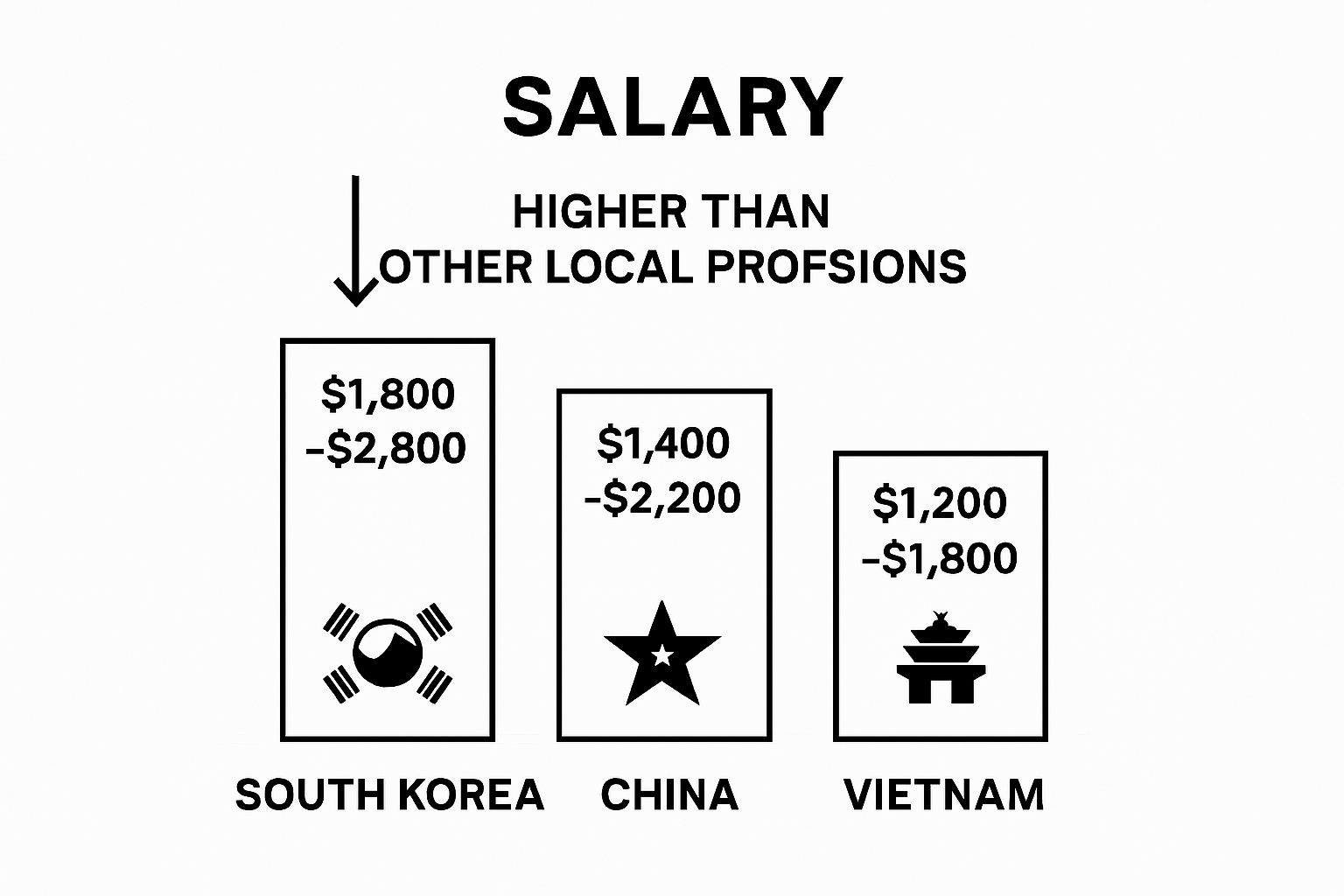
According to economic research from the Asia Development Bank, countries like South Korea, China, Japan, and Vietnam consistently demonstrate strong demand for English language educators, with competitive salary ranges significantly higher than local teaching wages.
Comprehensive Compensation Packages
Beyond competitive salaries, many Asian countries provide comprehensive compensation packages that enhance the overall economic attractiveness of teaching positions. These packages often include additional benefits that significantly increase the total compensation value:
- Fully covered housing accommodations
- Round-trip airfare reimbursement
- Health insurance coverage
- Contract completion bonuses
- Opportunities for private tutoring
Explore our guide on teaching opportunities to understand the diverse economic landscapes available for English teachers. These positions not only provide financial stability but also create pathways for long-term career development in international education and cross-cultural communication.
The economic opportunities for English teachers in Asia extend far beyond immediate financial rewards. They represent a strategic investment in personal and professional growth, offering a unique blend of cultural immersion, skill development, and global career advancement.
This table summarizes the most common components of English teaching compensation packages in Asia and the typical benefits reported in the article.
| Benefit Type | Description | Notes |
| Salary | Base monthly pay for teaching | Often higher than local educator salaries |
| Housing | Accommodation or housing allowance | Sometimes fully covered by employer |
| Airfare Reimbursement | Round-trip flights to/from home country | Provided at contract start/end or as a bonus |
| Health Insurance | Medical coverage for duration of contract | Covers basic health needs |
| Contract Completion Bonus | Additional lump sum at end of contract | Encourages teachers to fulfill contract terms |
| Private Tutoring Opportunities | Extra income through private lessons | Common in cities, subject to visa restrictions |
Educational Trends and Demand for English Proficiency
Asia is experiencing a remarkable transformation in educational strategies, with English language proficiency emerging as a critical competency for national development and individual advancement. The region’s educational landscape is rapidly evolving, driven by globalization, technological innovation, and economic integration.
Shifting Educational Paradigms
Traditional educational models across Asia are undergoing significant restructuring, with English becoming a fundamental skill rather than an optional subject. Governments and educational institutions are implementing comprehensive strategies to enhance English language capabilities across all academic levels. This shift reflects a strategic approach to preparing students for global academic and professional environments.
According to research from UNESCO, countries like South Korea, Singapore, and Vietnam are investing heavily in English language education infrastructure, recognizing language skills as a key driver of economic competitiveness.
Strategic National Priorities
Multiple Asian nations are developing ambitious national strategies to elevate English proficiency. These initiatives extend beyond traditional classroom learning and encompass broader societal transformation:
- Integration of English across academic disciplines
- Enhanced teacher training programs
- Technology-driven language learning platforms
- Curriculum reforms emphasizing practical language skills
Learn about navigating the TEFL job market to understand how these educational trends create unprecedented opportunities for English language educators.
The demand for English proficiency represents more than an educational trend. It signifies a fundamental reimagining of learning approaches, where language skills are viewed as essential tools for personal empowerment, economic mobility, and global engagement. As Asian countries continue to invest in English education, the landscape for language teachers becomes increasingly dynamic and promising.
Understanding the Teaching Environments Across Asian Countries
Teaching English in Asia is not a monolithic experience but a complex landscape with diverse educational environments, cultural nuances, and institutional expectations. Each country presents unique challenges and opportunities that require adaptability, cultural sensitivity, and specialized teaching strategies.
Institutional Diversity and Teaching Contexts
Asian countries offer a wide spectrum of teaching environments, ranging from structured public school systems to dynamic private language academies and corporate training programs. In Japan, teachers might encounter highly disciplined classroom settings with elaborate protocols, while in Vietnam, classrooms might be more interactive and spontaneous. These variations demand that English educators develop flexible pedagogical approaches and cultural intelligence.
According to comparative educational research from the Asian Pacific Journal of Education, teaching environments across Asia reflect profound cultural and systemic differences that significantly impact instructional methodologies and student interactions.
Cultural Considerations in Classroom Dynamics
Successful English teaching in Asia requires deep understanding of cultural communication patterns and educational philosophies. Different countries exhibit distinct classroom behaviors and learning expectations:
- Hierarchical respect structures in classroom interactions
- Varying student participation levels
- Different approaches to error correction
- Unique expectations regarding teacher authority
Explore our comprehensive TEFL certification guide to understand how professional training can prepare you for these diverse teaching environments. Successful educators recognize that effective teaching transcends language instruction and requires genuine cultural adaptation.
Understanding these nuanced teaching environments is crucial for English language professionals. Each country offers a rich, complex educational ecosystem that challenges teachers to be more than language instructors. They must become cultural ambassadors, facilitating not just linguistic knowledge but also cross-cultural understanding and global communication skills.
To help readers compare the teaching environments across several Asian countries mentioned in the article, the table below highlights key characteristics and variations teachers can expect.
| Country | Common Teaching Settings | Classroom Culture | Unique Features |
| Japan | Public schools, private academies | Highly disciplined, formal | Strict protocols, respect for hierarchy |
| South Korea | Hagwons (private academies), schools | Structured, high expectations | Competitive job market, strong demand |
| China | Public/private schools, corporate | Exam-focused, varying discipline | Large class sizes, urban/rural differences |
| Vietnam | Public schools, language centers | Interactive, less formal | Flexibility in methods, rapid reforms |
| Singapore | Public/private, bilingual schools | Globalized, English immersion | Advanced infrastructure, government support |
| Philippines | Private language centers, online | English used widely | English as official language in many contexts |
| India | Public/private schools, business | Diverse, English medium common | English as associate official language |

Ready to Step Into Asia’s Dynamic Classrooms as a Certified English Teacher?
The article uncovered real challenges many aspiring educators face, from navigating different teaching environments and cultural norms in Asia to figuring out which certification truly unlocks doors to international careers and economic opportunities. Maybe you feel inspired but overwhelmed by the idea of living and teaching abroad, or you wonder how to make sure your credentials will actually lead to lasting growth and professional respect in a competitive job market.
Let TEFL Institute’s trusted online TEFL certification courses help you turn your ambition into global impact. Our flexible programs are designed for anyone eager to thrive in Asia’s diverse classrooms, whether you want a standard TEFL diploma, advanced micro-credentials, or niche specializations. You’ll gain the essential skills mentioned in the article—cultural intelligence, practical classroom know-how, and verified qualifications—making you highly employable across Asia.
Take the next big step. Enroll today at TEFL Institute and explore our full range of accredited courses and support services. Start building a life-changing teaching journey that matches your goals—and seize the global opportunities waiting for you in Asia right now.
Frequently Asked Questions
What are the economic benefits of teaching English in Asia?
Teaching English in Asia offers significant economic benefits due to high demand for English language skills, competitive salaries, and comprehensive compensation packages that may include housing, flight reimbursements, and health insurance.
How does teaching English in Asia enhance personal and professional growth?
Teaching English in Asia promotes personal and professional growth by fostering cultural immersion and developing skills such as advanced communication, adaptability, and cross-cultural problem-solving, which are highly valued in global job markets.
What are some cultural considerations when teaching English in Asia?
Successful English teaching in Asia requires understanding cultural communication patterns, such as hierarchical respect structures, varying student participation levels, and unique classroom behaviors that influence teaching methodologies.
How is the demand for English teachers evolving in Asian countries?
The demand for English teachers in Asia is increasing as countries prioritize English proficiency to enhance national competitiveness, invest in language education infrastructure, and adopt innovative teaching strategies across academic disciplines.