

 United Kingdom (UK)
 United States (US)
 Canada
 South Africa
 India
India Australia
 New Zealand
 China
China Russia
 Germany
 France
 Spain
Spain Netherlands
 Vietnam
 United Arab Emirates
 Italy
Italy Poland
 Thailand
 Türkiye








 Algeria


What Is Authentic Assessment? A Guide for Educators
What Is Authentic Assessment? A Guide for Educators

TL;DR:
- Authentic assessment involves evaluating students through real-world tasks that demonstrate their skills and knowledge. It emphasizes meaningful application rather than rote memorization and aligns with professional and civic challenges.
Authentic assessment is defined as an evaluation method where students demonstrate knowledge and skills by completing real-world tasks rather than standardized tests. Unlike a multiple-choice exam, authentic assessment asks a student to write a business proposal, design an engineering prototype, or lead a community health campaign. The AAC&U employer survey shows over 80% of employers report that students who complete authentic assessments are better prepared for real-world problem-solving and communication. That figure signals a clear gap between what traditional tests measure and what workplaces actually need. For educators and administrators, understanding this method is the first step toward building evaluation systems that produce graduates who can perform, not just recall.
What is authentic assessment and how is it defined?
Authentic assessment is the practice of evaluating students through performance-based tasks that mirror real-world challenges rather than testing memorization. The term was popularized by education theorist Grant Wiggins, who argued that meaningful evaluation requires students to apply knowledge in context, not simply retrieve it on demand. The University of South Australia’s assessment policy reinforces this position, stating that authentic tasks must reflect practical complexity and carry value beyond the classroom.

The definition of authentic assessment rests on one core idea: the task must resemble something a professional or citizen would actually do. A chemistry student who writes a lab safety report for a fictional company is doing something authentic. A student who memorizes the periodic table for a fill-in-the-blank quiz is not. The difference is not difficulty. It is purpose and transfer.
Authentic assessment also goes by the term “performance-based assessment” in many educational standards frameworks. Both terms describe the same core approach. Educators benefit from knowing both labels, since policy documents and curriculum guides may use either one.
What are the main principles of authentic assessment?
Authentic assessment follows a set of design principles that separate it from disposable classroom tasks. Those principles are:
- Realism: The task reflects a genuine problem or scenario from a professional or civic context.
- Challenge: Students must synthesize information, not just recall it.
- Evaluative judgment: Students assess the quality of their own work against defined criteria.
- Iterative feedback: Students receive feedback during the task, not only after submission.
- Student involvement: Learners have a degree of choice in how they demonstrate their learning.
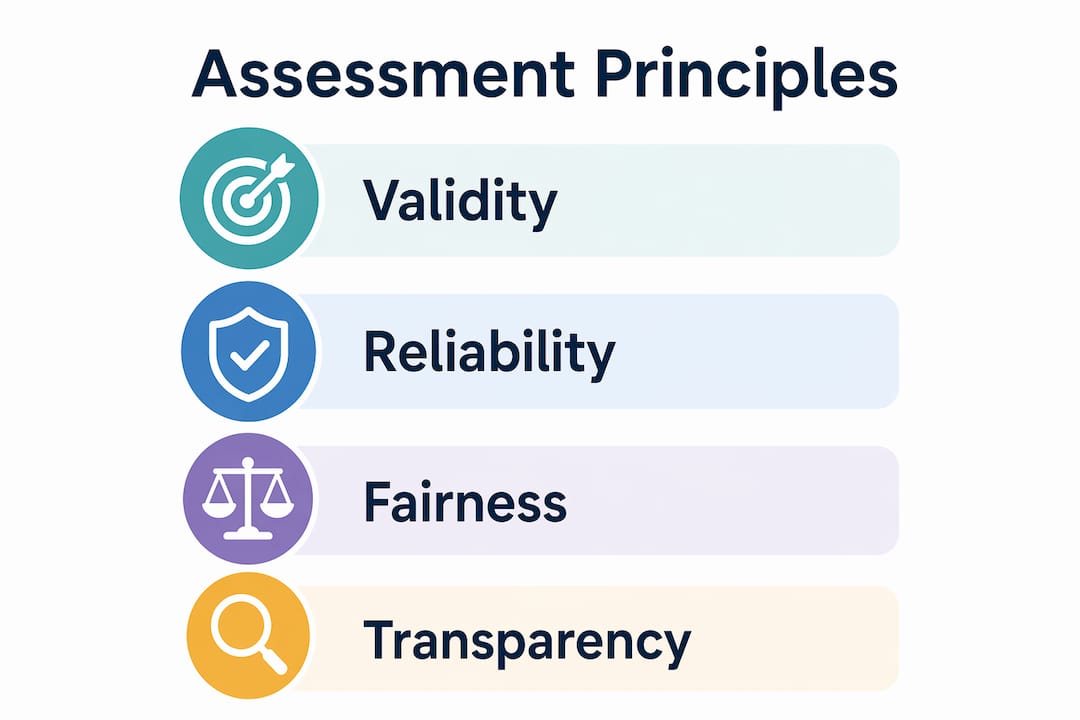
Quality in authentic assessment depends on four criteria: validity, reliability, fairness, and transparency. A task is valid when it actually measures the intended learning outcome. It is reliable when different graders reach consistent scores. It is fair when all students have equal access to the resources needed to complete it. It is transparent when students understand the criteria before they begin.
Rubrics are critical to meeting these criteria. They convert subjective judgment into explicit, defensible standards. Without a rubric, two teachers grading the same student portfolio may reach very different conclusions. With a well-designed rubric, those scores converge.
Pro Tip: Build your rubric before you finalize the task. If you cannot write clear criteria for what “excellent” looks like, the task itself may need redesigning.
What are practical examples of authentic assessment?
Authentic assessments appear across every subject area and education level. The format varies by context, but the underlying logic stays the same: the task must require real application.
| Assessment type | Example task | Complexity | Typical duration |
|---|---|---|---|
| Simulation | Students role-play a city council budget meeting | Moderate | 1–2 class periods |
| Case study | Analyze a real company’s marketing failure | Moderate | 3–5 class periods |
| Portfolio | Collect and reflect on writing samples over a semester | High | Several weeks |
| Project | Design a working prototype for an engineering brief | High | 3–6 weeks |
| Presentation | Pitch a public health campaign to a panel | Moderate | 1–2 class periods |
Authentic tasks range from quick performance activities to extended projects requiring multiple drafts and peer feedback cycles. A debate or a short pitch can be completed in one or two class periods. A portfolio or a community research project may span several weeks. This range matters because not every course has the time for a six-week project, but every course can include at least one meaningful performance task.
Concrete examples help educators visualize the method in practice:
- A business class creates a full marketing strategy for a local nonprofit.
- An engineering course produces a working prototype that solves a client-submitted problem.
- A public health course designs and presents a community vaccination awareness campaign.
- An English language class writes and records a podcast episode on a topic of their choice.
The last example is particularly relevant for ESL educators. A recorded podcast requires students to plan, draft, revise, and deliver language in a format they will encounter outside the classroom. That is authentic assessment in direct action. Educators building critical thinking in ESL contexts will find performance tasks like these far more diagnostic than a grammar fill-in exercise.
What are the key benefits of authentic assessment?
Authentic assessment produces measurable gains in the skills employers and institutions value most. The benefits fall into four categories: critical thinking, communication, student motivation, and metacognition.
- Critical thinking: Students must analyze, evaluate, and synthesize information to complete real-world tasks. This is a fundamentally different cognitive demand than recognizing a correct answer on a multiple-choice test.
- Communication: Presentations, reports, and proposals require students to organize and express ideas clearly. These formats mirror professional communication standards.
- Student motivation:** Student voice and choice in task design increases engagement and buy-in. When students select their topic or format, they invest more in the outcome.
- Metacognition: Requiring students to explain and justify their problem-solving process fosters deeper self-awareness about how they learn and where they struggle.
Authentic assessment prepares students for complexity and realistic employment environments rather than disposable tasks that do not transfer beyond the classroom. The University of South Australia’s assessment framework identifies this transfer of learning as the defining measure of an assessment’s educational value.
The employer data reinforces this point. Over 80% of employers report greater confidence in graduates who have completed performance-based assessments. That is not a marginal preference. It reflects a structural gap between what traditional tests develop and what professional environments demand.
Authentic assessment also connects directly to 21st-century skills frameworks, including communication, collaboration, creativity, and critical thinking. These are not abstract goals. They are the competencies that appear in job descriptions, graduate attribute statements, and national curriculum standards across the United States and internationally. Educators who want to understand how formative assessment fits into this picture will find that authentic tasks often serve both summative and formative purposes simultaneously.
Interactive learning approaches share significant overlap with authentic assessment, particularly in how both methods use active participation and reflection to deepen understanding.
How can educators design and implement authentic assessments?
Effective implementation follows a clear sequence. Skipping steps produces tasks that feel authentic but lack academic rigor.
- Start with backward design. Identify the learning outcome first. Then design a task that requires students to demonstrate that outcome. Then build the rubric. This sequence prevents the common mistake of creating an interesting activity that does not actually assess the intended skill.
- Align the task to a real context. The scenario must be plausible. A student writing a “letter to the editor” about climate policy is working in a real genre with real conventions. A student writing a “pretend newspaper article” with no audience or purpose is not.
- Build in iterative feedback. Authentic inquiry cycles include questioning, investigation, creation, discussion, and reflection. Each stage is an opportunity for feedback, not just the final submission. This structure prevents authentic assessment from becoming an unguided free-for-all.
- Apply Universal Design for Learning (UDL) principles. Offer multiple means of representation and expression. A student with a language processing difficulty may demonstrate the same competency through a recorded presentation rather than a written report. Equity requires flexibility in format, not in standards.
- Use a detailed rubric from the start. Share it with students before they begin. Rubrics prevent inconsistent grading by defining criteria explicitly. They also give students a self-assessment tool during the task.
Pro Tip: Avoid the “activity trap.” A task that is engaging but not academically rigorous is still a weak assessment. Ask yourself: does completing this task require the specific skill I am trying to measure? If not, redesign it.
A common implementation pitfall is confusing novelty with authenticity. A scavenger hunt or a creative collage may be engaging, but fit-for-purpose design requires that the task maintain validity and alignment to learning goals. Simply being “real-world” is not enough. The task must measure what it claims to measure.
Managing grading complexity is a practical concern. Authentic tasks take longer to grade than multiple-choice tests. Educators can address this by using peer assessment with structured rubrics, limiting the number of high-stakes authentic tasks per term, and building shorter performance tasks into regular class time rather than reserving them for end-of-semester projects.
Key Takeaways
Authentic assessment is the most direct method for evaluating whether students can apply their learning to real-world problems, and its effectiveness depends on rigorous task design, clear rubrics, and alignment to learning outcomes.
| Point | Details |
|---|---|
| Core definition | Authentic assessment evaluates students through real-world tasks, not memorization-based tests. |
| Rubrics are non-negotiable | Rubrics convert subjective judgment into consistent, transparent grading criteria. |
| Employer evidence is strong | Over 80% of employers report greater confidence in graduates from performance-based programs. |
| Design starts with outcomes | Use backward design: define the learning outcome before building the task or rubric. |
| Equity requires flexibility | UDL principles allow format variation without lowering academic standards. |
Why authentic assessment changed how I think about evaluation
I spent years watching students ace grammar tests and then freeze when asked to write a real email to a client. That gap is not a student failure. It is a design failure. Traditional tests measure what students know at a fixed moment. Authentic assessment measures what students can do with what they know, which is the only thing that matters once they leave the classroom.
The transition from traditional tests to performance-based tasks is not painless. Rubric design takes time. Grading open-ended work takes longer than scanning a Scantron sheet. And some students resist the ambiguity of tasks that do not have a single correct answer. Those are real costs. But the payoff is a classroom where students are actually practicing the skills they will need, not rehearsing for a test that ends when the bell rings.
My advice to educators making this shift: start small. Replace one traditional quiz with a short performance task this term. Use a simple rubric with three criteria. Collect student work and compare it to what the quiz would have told you. The difference in diagnostic depth will be immediately apparent. From there, scaling up is a matter of confidence and design practice, not a wholesale curriculum overhaul.
Research from Grant Wiggins and the University of South Australia’s assessment frameworks gives educators the theoretical grounding to defend this approach to administrators and accreditation bodies. Use that research. Authentic assessment is not a trend. It is a well-documented shift toward evaluation that actually serves learners.
— Muller
Deepen your assessment practice with Teflinstitute
Educators who want to build stronger assessment skills alongside their teaching practice will find structured support through Teflinstitute’s professional development courses.

The 120 Hour Elective TEFL Course covers advanced pedagogical methods, including performance-based evaluation strategies that align directly with authentic assessment principles. For educators seeking a more thorough grounding in teaching methodology, the 240 Hour Master TEFL Course provides externally accredited training across the full range of modern classroom techniques. Both programs are designed for working educators who need flexible, evidence-based professional development without stepping away from their current roles.
FAQ
What is the definition of authentic assessment?
Authentic assessment is an evaluation method where students demonstrate learning by completing real-world tasks such as projects, presentations, or portfolios. It measures applied skills rather than memorized content.
How does authentic assessment differ from traditional assessment?
Traditional assessment typically tests recall through standardized formats like multiple-choice or fill-in-the-blank exams. Authentic assessment requires students to apply knowledge to realistic scenarios, producing work that mirrors professional or civic contexts.
What are the most common examples of authentic assessment?
Common examples include case studies, simulations, portfolios, research projects, and oral presentations. Tasks range from short debates completed in one class period to multi-week projects with iterative drafts and peer feedback.
Why are rubrics important in authentic assessment?
Rubrics define grading criteria explicitly, making subjective judgments consistent and defensible across different graders. Without a rubric, open-ended authentic tasks are vulnerable to inconsistent or biased evaluation.
How do educators start implementing authentic assessment?
Start with backward design: identify the learning outcome, then build a task that requires students to demonstrate it, then write the rubric. Replace one traditional assessment with a short performance task and use the rubric as a student self-assessment tool throughout the process.
Recommended
TEFL Institute guides

Vietnam
Work permits and requirements
Spain
Jobs, pay and visa routes
Germany
Freelance work and pay
Dubai
Pay, requirements and visas
Cambodia
Pay, requirements and visas