

 United Kingdom (UK)
 United States (US)
 Canada
 South Africa
 India
India Australia
 New Zealand
 China
China Russia
 Germany
 France
 Spain
Spain Netherlands
 Vietnam
 United Arab Emirates
 Italy
Italy Poland
 Thailand
 Türkiye









 Algeria


What Is Teacher Autonomy? A Guide for Educators
What Is Teacher Autonomy? A Guide for Educators

TL;DR:
- Teacher autonomy refers to teachers’ professional freedom to make independent decisions about curriculum, instruction, assessment, and classroom management within ethical and institutional boundaries. It enhances teacher motivation, job satisfaction, and student learning outcomes, especially when supported by effective training and collaborative frameworks. Without proper preparation and capacity-building, autonomy alone can lead to frustration, disorientation, and reduced instructional quality.
Teacher autonomy is defined as the professional freedom educators hold to make independent decisions about curriculum, instruction, assessment, and classroom management based on their expertise and their students’ needs. This concept sits at the center of teacher motivation, job satisfaction, and instructional effectiveness. Research from OECD TALIS 2024, the University of Helsinki, and a 2026 post-pandemic qualitative study all confirm that autonomy shapes how teachers perform and how students learn. Understanding teacher autonomy meaning goes beyond simply knowing what the term means. It requires recognizing how professional freedom operates within ethical, institutional, and collaborative boundaries.
What is teacher autonomy in education?
Teacher autonomy in education refers to the degree of professional control a teacher exercises over their own practice. This includes decisions about what to teach, how to teach it, how to assess student progress, and how to manage the classroom environment. The concept does not imply unrestricted independence. As middle school teachers’ perspectives confirm, experienced educators understand autonomy as professional freedom that operates within ethical, scientific, and pedagogical constraints.

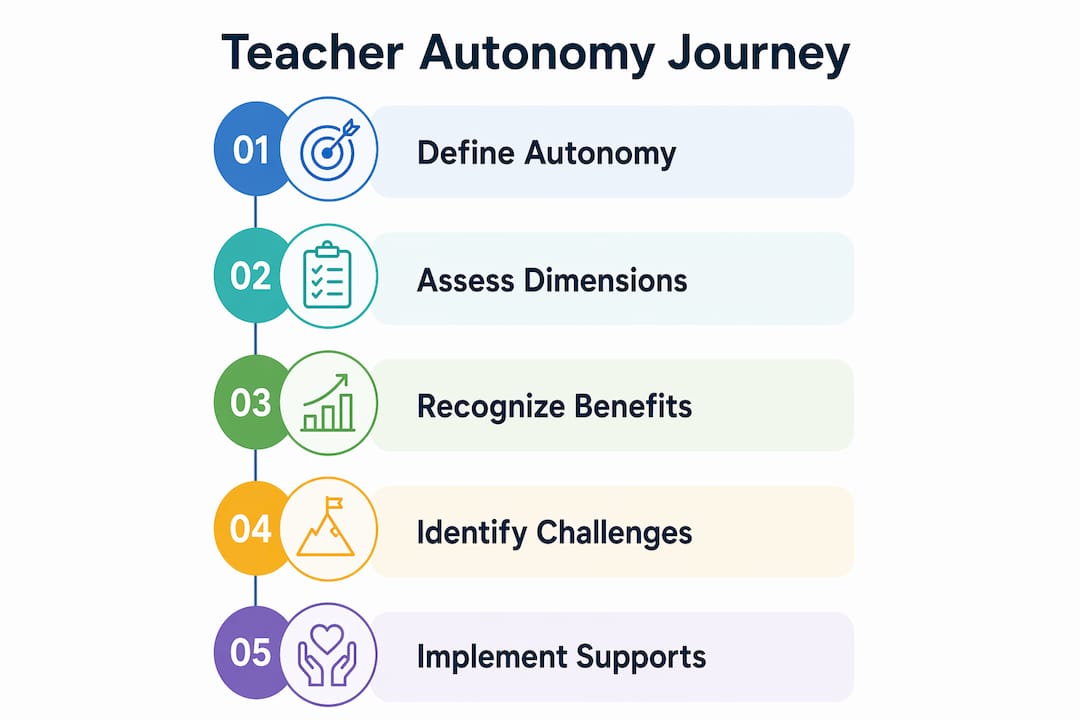
Autonomy exists across three distinct dimensions. The first is curricular autonomy, which covers decisions about content selection and sequencing. The second is instructional autonomy, which covers the choice of teaching methods, materials, and pacing. The third is evaluative autonomy, which covers how teachers design and interpret assessments. Each dimension carries different levels of institutional constraint depending on the school system, national curriculum, or accreditation requirements in place.
Pro Tip: When mapping your own autonomy as a teacher, assess each dimension separately. You may have high instructional freedom but low curricular freedom. Knowing the difference helps you identify where to advocate for more professional control.
Autonomy vs. isolation vs. agency
| Concept | Definition | Key Distinction |
|---|---|---|
| Teacher Autonomy | Freedom to make professional decisions | Operates within shared standards and ethics |
| Teacher Isolation | Working without collaboration or support | Absence of community, not a form of freedom |
| Teacher Agency | Capacity to act purposefully on decisions | Requires confidence and skill, not just permission |
Autonomy and isolation are frequently confused, but they describe opposite conditions. A teacher with genuine autonomy makes informed choices within a professional community. An isolated teacher simply works alone, often without support or feedback.
What benefits does teacher autonomy provide?
The benefits of teacher autonomy are well-documented across multiple research contexts. A study of 3,131 junior high teachers in China found that autonomy positively correlates with job satisfaction, self-efficacy, and intrinsic motivation, with self-efficacy acting as a significant mediator between autonomy and satisfaction. That finding matters because it shows autonomy does not directly produce satisfaction on its own. It works by building a teacher’s confidence in their own professional capacity first.
OECD TALIS 2024 data confirms that countries with higher teacher autonomy report stronger teacher confidence and better student intrinsic motivation, particularly during secondary school when student engagement typically declines. This is a critical insight for school leaders. Protecting teacher autonomy is not just a retention strategy. It is a student outcomes strategy.
The benefits extend to teacher well-being. High autonomy combined with administrative support leads to higher job satisfaction and reduced emotional exhaustion in post-COVID teaching environments. Burnout is a direct cost to schools in terms of turnover, recruitment, and instructional continuity. Autonomy functions as a structural buffer against that cost.
- Teachers with autonomy report greater confidence in adaptive classroom management and responsive instruction
- Autonomy supports classroom innovation, including personalized learning approaches that improve student engagement
- Reduced scripted teaching leads to more authentic student-teacher interaction
- Teachers who control assessment design report stronger alignment between instruction and evaluation
A 2026 qualitative study of post-pandemic teachers found that systemic restrictions on materials and assessment reduce motivation and enforce scripted teaching. That outcome directly harms instructional quality and teacher morale simultaneously.
How does teacher autonomy differ from teacher agency?
Teacher autonomy and teacher agency are related but not interchangeable. Autonomy is the freedom to choose; agency is the capacity to act purposefully on those choices. A teacher can have formal autonomy granted by their institution and still lack the confidence, skills, or support structures needed to exercise it effectively. That gap between permission and capacity is where many professional development programs fall short.
Consider the following distinction in practice:
- Autonomy without agency: A teacher is told they can design their own curriculum unit. They have no training in curriculum design, no access to mentorship, and no collaborative planning time. The freedom exists on paper but produces anxiety rather than innovation.
- Agency without autonomy: A teacher has strong pedagogical skills and clear professional vision but works in a system with a fully scripted curriculum. Their capacity to act is high, but the institutional space to act is absent.
- Autonomy with agency: A teacher with advanced training and peer collaboration uses their institutional freedom to design differentiated assessments that respond to student data. This is the target condition.
- Neither autonomy nor agency: A teacher in a highly controlled system with limited professional development. This condition correlates most strongly with burnout and attrition.
Pro Tip: Developing agency is a professional development goal, not just a personal trait. Structured mentorship, peer observation, and advanced certification all build the capacity teachers need to use their autonomy productively.
The distinction between autonomy and agency is critical because lack of confidence in agency limits the benefits a teacher can draw from autonomy. Schools that grant freedom without building capacity are not actually promoting professional growth.
What challenges limit teacher autonomy in classrooms?
The importance of teacher autonomy is widely acknowledged, but significant barriers prevent many educators from experiencing it in practice. Standardized curricula, high-stakes testing regimes, and punitive accountability systems are the most common structural constraints. Over-regulation harms teacher morale and instructional quality by reducing teachers to compliance roles rather than professional decision-makers.
The post-pandemic period introduced additional complexity. Remote and hybrid teaching required rapid instructional adaptation, which temporarily expanded some teachers’ practical autonomy. However, the return to standardized structures in many systems reversed those gains. The 2026 qualitative study found that teachers who experienced greater flexibility during the pandemic reported heightened frustration when rigid systems were reinstated.
Key challenges affecting teacher autonomy include:
- Standardized testing pressure: High-stakes exams narrow curriculum choices and push teachers toward test preparation over genuine instruction
- Administrative micromanagement: Frequent lesson plan reviews and prescriptive observation frameworks reduce professional trust
- Inconsistent policy application: Autonomy granted in one domain (instruction) but denied in another (assessment) creates professional fragmentation
- Isolation masquerading as autonomy: Teachers left without support or feedback may interpret neglect as freedom, which produces neither growth nor satisfaction
Too much unstructured autonomy also creates problems. Without shared standards and collaborative accountability, instructional coherence across classrooms breaks down. The OECD describes the target condition as anchored autonomy, which balances teacher freedom with coherence and shared goals across classrooms.
How can schools effectively promote teacher autonomy?
Promoting teacher autonomy requires deliberate structural design, not simply reducing oversight. The most effective approach combines clear decision-making frameworks with collaborative professional culture. Explicit frameworks for autonomy support experimentation and accountability within defined boundaries, creating the psychological safety teachers need to take instructional risks.
The following strategies reflect current research and practice:
- Define non-negotiables clearly. Schools should specify which elements are fixed (safety protocols, graduation requirements, core standards) and which are open to teacher discretion. Ambiguity about boundaries reduces rather than increases professional confidence.
- Differentiate autonomy by experience level. New teachers benefit from structured mentorship and guided decision-making before taking on full curricular or evaluative independence. Experienced teachers need fewer constraints and more collaborative leadership opportunities.
- Build professional learning communities. Autonomy works best when paired with collaboration and shared standards. Peer observation, co-planning, and structured reflection all support teachers in using their freedom productively.
- Invest in advanced training. Finland’s education system demonstrates that five-year master’s programs and institutional support create high teacher autonomy and professional stability. Advanced certification builds the agency teachers need to act on their freedom.
Autonomy-supportive practices by school role
| Role | Autonomy-Supportive Practice |
|---|---|
| School Principal | Define decision-rights frameworks; protect planning time |
| Department Head | Facilitate peer collaboration; reduce prescriptive observation |
| Curriculum Coordinator | Provide flexible curriculum frameworks with clear core standards |
| Classroom Teacher | Pursue advanced training; engage in curriculum design and peer reflection |
For ESL and TEFL educators specifically, autonomy in classroom behavior management and lesson design is particularly significant. Language classrooms require rapid adaptation to student proficiency levels, cultural contexts, and communicative goals. Institutional flexibility in these areas directly affects instructional quality.
Key takeaways
Teacher autonomy is the professional freedom to make instructional decisions, and it produces measurable gains in teacher satisfaction, student motivation, and classroom effectiveness only when paired with agency, collaboration, and clear institutional frameworks.
| Point | Details |
|---|---|
| Core definition | Teacher autonomy is professional freedom over curriculum, instruction, assessment, and classroom management. |
| Research-backed benefits | Autonomy correlates with higher job satisfaction, reduced burnout, and stronger student motivation across multiple studies. |
| Autonomy vs. agency | Autonomy is permission to choose; agency is the capacity to act. Both are required for effective teaching. |
| Key barriers | Standardized testing, administrative micromanagement, and punitive accountability systems all reduce professional autonomy. |
| Promotion strategies | Clear decision-rights frameworks, mentorship, professional learning communities, and advanced training all sustain autonomy. |
Why autonomy without investment is just neglect
The research on teacher autonomy is consistent, but the conversation often stops at the wrong place. Most discussions focus on whether teachers have freedom. Fewer ask whether teachers have the preparation to use that freedom well. That gap is where professional development becomes non-negotiable.
In my reading of the current evidence, the Finnish model is the most instructive example available. Five-year master’s programs do not just produce qualified teachers. They produce teachers who have the intellectual confidence to make complex professional decisions without constant external validation. That confidence is what transforms formal autonomy into genuine instructional impact.
The post-pandemic data reinforces this. Teachers who experienced expanded flexibility during remote instruction did not uniformly thrive. Those with stronger training backgrounds adapted and innovated. Those without adequate preparation found the freedom disorienting. The variable was not the autonomy itself. It was the professional foundation underneath it.
For TEFL educators working across diverse international contexts, this matters acutely. You are frequently operating in systems where curriculum expectations, student backgrounds, and institutional norms vary significantly. The ability to read that context and adapt your practice accordingly is not improvisation. It is a trained professional skill. Autonomy is the space to use it. Advanced certification is how you build it.
— Muller
Advance your teaching practice with Teflinstitute

Teflinstitute offers structured certification programs designed to build the professional skills and pedagogical confidence that make teacher autonomy meaningful in practice. The 120-hour Advanced TEFL course covers instructional design, classroom management, and adaptive teaching strategies that give you the tools to exercise genuine professional judgment. For educators seeking deeper expertise, the 240-hour Master TEFL course provides externally accredited training across curriculum development, assessment design, and specialized teaching contexts. Both programs are completed online, allowing you to develop professional capacity on your own schedule.
FAQ
What is teacher autonomy in simple terms?
Teacher autonomy is the professional freedom a teacher has to make decisions about what to teach, how to teach it, and how to assess student learning. It operates within ethical and institutional boundaries rather than as unrestricted independence.
What is the difference between teacher autonomy and teacher agency?
Autonomy is the institutional permission to make professional choices; agency is the personal capacity to act on those choices effectively. Both are necessary for strong teaching outcomes.
Why is teacher autonomy important for student outcomes?
OECD TALIS 2024 data shows that countries with higher teacher autonomy report stronger student intrinsic motivation, particularly during secondary school when engagement typically declines.
What reduces teacher autonomy in schools?
Standardized testing pressure, prescriptive curricula, punitive accountability systems, and administrative micromanagement are the primary structural barriers to teacher autonomy.
How can teachers develop greater professional autonomy?
Advanced training, participation in professional learning communities, and clear institutional frameworks that define decision-making boundaries all support the growth of meaningful teacher autonomy.
Recommended
TEFL Institute guides

Vietnam
Work permits and requirements
Taiwan
Buxibans, pay and visas
Portugal
Jobs, pay and visa routes
Japan
JET, ALT and eikaiwa pay
South Korea
EPIK, hagwons and pay