

 United Kingdom (UK)
 United States (US)
 Canada
 South Africa
 India
India Australia
 New Zealand
 China
China Russia
 Germany
 France
 Spain
Spain Netherlands
 Vietnam
 United Arab Emirates
 Italy
Italy Poland
 Thailand
 Türkiye









 Algeria


IELTS Teacher Online: Build Your Credentials in 2026
IELTS Teacher Online: Build Your Credentials in 2026

TL;DR:
- An online IELTS teacher is a certified professional who provides structured, exam-specific coaching with measurable results.
- They need qualifications like CELTA, DELTA, and examiner experience to ensure accuracy in rubric application and feedback.
An IELTS teacher online is a qualified professional who delivers structured, exam-specific coaching through diagnostic assessments, targeted skill sessions, and detailed rubric-based feedback to help students reach defined band score targets. The role demands more than general English proficiency. It requires formal certification, examiner-level knowledge of IELTS band descriptors, and a repeatable teaching framework that produces measurable results. Structured IELTS coaching programs consistently enable 85–90% of students to improve their band score by 0.5 to 1.0 within 4–8 weeks. That outcome depends entirely on the quality and preparation of the instructor delivering the course.
What certifications does an IELTS teacher online need?
Professional credibility in online IELTS instruction rests on formal qualifications. The two most recognized certifications in the field are CELTA (Certificate in English Language Teaching to Adults) and DELTA (Diploma in English Language Teaching to Adults), both awarded by Cambridge Assessment English. CELTA establishes foundational classroom competence, while DELTA signals advanced pedagogical expertise. Top-tier IELTS instructors typically hold DELTA certification alongside 15–20 years of teaching experience. That combination signals the depth of knowledge required to coach students from Band 5.5 to Band 7 and above.

Examiner experience is the qualification that separates good IELTS teachers from exceptional ones. A teacher who has worked as an official IELTS examiner understands exactly how band descriptors are applied in live marking conditions. That insider knowledge directly improves the accuracy of feedback on student writing and speaking tasks. Without it, teachers often give feedback based on general English quality rather than the specific criteria examiners use.
The minimum professional standard for an IELTS English teacher working online includes:
- CELTA or equivalent: Confirms foundational teaching methodology and classroom management skills
- DELTA or advanced diploma: Demonstrates specialist knowledge of language acquisition and assessment
- IELTS examiner experience: Provides direct insight into band descriptor application and marking accuracy
- Subject-matter familiarity: Includes deep knowledge of all four IELTS modules: Listening, Reading, Writing, and Speaking
Certification also shapes teaching methodology. A DELTA-qualified instructor approaches lesson planning with a diagnostic mindset, identifying specific linguistic gaps rather than delivering generic grammar instruction. That shift in approach is what drives the band score improvements students need for university admission or professional registration.
Pro Tip: If you hold CELTA but not DELTA, completing a specialist IELTS teacher training course fills the gap in exam-specific methodology and positions you credibly with prospective students.
How to structure effective online IELTS teaching sessions
A well-structured online IELTS session follows a three-part framework: diagnostic assessment, focused skill instruction, and task-based feedback. A structured 3-part tutoring process of assessment, tailored lessons, and detailed feedback produces measurable score gains. Students who complete 10 or more lessons within a personalized plan consistently show the strongest progress. The session structure below reflects what high-performing online IELTS tutors use in practice.
A repeatable session framework
- Diagnostic review (10 minutes): Open each session by reviewing errors from the previous lesson. Use a shared document to track recurring mistakes in grammar, coherence, or task response. This keeps feedback cumulative rather than isolated.
- Focused skill instruction (25 minutes): Target one module or sub-skill per session. For writing, this might mean analyzing Task 2 essay structure against the official band descriptors. For speaking, it could mean drilling Part 2 long-turn responses with timed practice.
- Timed practice task (15 minutes): Assign a task under exam conditions. Timed practice builds the pacing awareness students need to complete all sections within the official time limits.
- Feedback and rubric analysis (10 minutes): Review the completed task against the IELTS band descriptors for Coherence and Cohesion, Lexical Resource, Grammatical Range and Accuracy, and Task Achievement. Name the specific descriptor level the student reached and what is required to move up.
Session length of 60 minutes is the standard for productive online IELTS coaching. Shorter sessions rarely allow enough time to complete a full practice task and provide meaningful feedback. Frequency matters equally. Two sessions per week with asynchronous written feedback between sessions produces faster progress than one weekly lesson alone.
Pro Tip: For writing tasks, record a short audio note explaining your corrections rather than typing comments only. Transcript-based asynchronous feedback allows students to replay your reasoning and internalize it more effectively than written margin notes.
What teaching methodologies yield the highest student success rates?
Exam literacy is the core skill an IELTS coaching instructor must teach. General conversational fluency does not guarantee IELTS exam success. Students who speak English confidently in daily life frequently plateau at Band 6.5 because they do not understand how examiners apply band descriptors. The teacher’s job is to close that gap by making the marking criteria explicit and teachable.
The most effective methodologies share four characteristics:
- Rubric decoding: Teach students to read and apply the official IELTS band descriptors themselves. When students understand what “sufficient range of structures” means at Band 7, they can self-assess more accurately between lessons.
- Targeted diagnostic feedback: Focusing on one or two high-impact structural issues in the first lesson drives the fastest early improvement. Addressing ten problems at once produces confusion, not progress.
- Draft-feedback-rewrite cycles: Cycles of draft, feedback, and rewrite are more effective than isolated testing. For writing tasks, require students to rewrite corrected drafts before moving to the next topic. The rewrite step is where learning consolidates.
- Results-driven pacing: Results-driven coaching that targets the highest-impact changes first outperforms broad skill overhauls. Prioritize the changes that move the band score needle fastest, then build from there.
“Exam literacy is the essential skill to teach. The misconception that general fluency equals exam success limits many IELTS students. Experienced tutors prioritize training students to interpret official band descriptors to overcome common plateau points at Band 6.5.”
A common student misconception is that more vocabulary automatically raises the Lexical Resource score. In practice, examiners reward precise and appropriate word choice over volume. Teaching students to use a narrower range of vocabulary accurately scores higher than encouraging them to insert advanced words they cannot control. This is the kind of examiner-perspective insight that separates a certified IELTS instructor from a general English tutor.
What digital tools optimize the online IELTS teaching experience?
The right digital tools make online IELTS instruction more organized, more trackable, and more effective for students working remotely. The tools below are used consistently by experienced online IELTS tutors to manage feedback, track progress, and maintain student engagement across multiple lessons.
- Shared digital workspaces: Shared documents like Google Docs enable cumulative error logs and personalized progress monitoring. Create a dedicated document for each student and update it after every session with new errors, corrections, and improvement notes.
- Asynchronous audio feedback: Record short audio or video explanations of writing corrections and share them between sessions. Transcript-based asynchronous feedback allows precise correction of logical, coherence, and grammar deficits that are difficult to explain in real time.
- Official IELTS practice materials: Use Cambridge IELTS test books (volumes 1–18) as the primary source of authentic practice tasks. These materials reflect current exam format and difficulty, which generic ESL resources do not replicate.
- Lesson planning resources: Teflinstitute’s teaching resources for English educators provide structured lesson frameworks and supplementary materials that support IELTS-specific instruction.
- Video conferencing platforms: Zoom and Google Meet both support screen sharing, which is necessary for reviewing student writing in real time. Use the annotation feature to mark up text during the session.
Maintaining student motivation in a remote setting requires consistent progress visibility. Update the shared error log after every session and highlight improvements explicitly. Students who see their error count decreasing and their practice scores rising stay engaged through the full course. Motivation collapses when feedback feels repetitive or disconnected from measurable progress.
Pro Tip: Build a personal bank of annotated student writing samples (anonymized) that illustrate the difference between Band 6 and Band 7 responses. Showing students real examples of the gap they need to close is more persuasive than describing it abstractly.
Key Takeaways
An IELTS teacher online must combine formal certification, examiner-level rubric knowledge, and a structured diagnostic framework to produce consistent band score improvements for students.
| Point | Details |
|---|---|
| Certification is non-negotiable | CELTA and DELTA, combined with examiner experience, establish the credibility and methodology needed for effective IELTS instruction. |
| Structure drives results | A three-part session framework of diagnostic review, focused instruction, and timed practice produces the most consistent score gains. |
| Exam literacy over fluency | Teaching students to decode official band descriptors is more effective than improving general conversational English. |
| Digital tools extend feedback | Shared Google Docs and asynchronous audio feedback make progress tracking cumulative and corrections more precise between sessions. |
| Targeted changes first | Addressing one or two high-impact issues per lesson produces faster band score movement than broad, unfocused correction. |
The examiner advantage most teachers overlook
Most English teachers who move into IELTS preparation underestimate how different exam coaching is from general language instruction. I have seen teachers with strong classroom skills struggle to explain why a Band 6.5 essay does not reach Band 7, simply because they have never sat in an examiner’s chair. The band descriptors are not intuitive. They require deliberate study and, ideally, direct experience applying them under marking conditions.
The teachers who get the best results are not necessarily the most fluent English speakers. They are the ones who have internalized the IELTS marking criteria so completely that they can predict an examiner’s score before the student submits. That predictive accuracy is what makes feedback genuinely useful. When a teacher tells a student “this paragraph will score Band 6 for Coherence because the central idea shifts mid-paragraph,” the student has something concrete to fix.
Remote teaching also creates an opportunity that classroom instruction does not. Asynchronous feedback allows teachers to review student work carefully, without the time pressure of a live session. A teacher who records a five-minute audio walkthrough of a corrected Task 2 essay gives the student something they can replay three times. That repetition is where the learning happens. The IELTS exam tips that produce the fastest score gains are almost always the ones rooted in examiner-perspective thinking, not general writing advice.
My strongest recommendation for any English teacher building an IELTS specialization: invest in formal IELTS teacher training before taking on students. The gap between knowing the exam as a teacher and knowing how to teach it as a coach is wider than most people expect.
— Muller
Teflinstitute’s IELTS teacher training course
Teachers who want a structured path to IELTS specialization will find Teflinstitute’s 30 Hour IELTS Teacher Training Course a direct fit for that goal. The course covers exam-specific teaching methodology, band descriptor application, and lesson planning frameworks designed for online delivery.

For teachers seeking a broader qualification that includes IELTS preparation as part of a wider TEFL specialization, the 240 Hour Master TEFL Course provides advanced modules covering exam preparation methodology alongside core language teaching competencies. Both courses are externally accredited and recognized by employers and language schools internationally. Completing either course positions you with the credentials and practical frameworks needed to teach IELTS effectively online.
FAQ
What qualifications does an IELTS teacher online need?
The standard qualifications are CELTA or DELTA certification combined with direct knowledge of IELTS band descriptors. Examiner experience significantly improves a teacher’s ability to give accurate, rubric-based feedback.
How many lessons does a student need to improve their IELTS band score?
Students typically require 10 or more lessons within a structured, personalized plan to show measurable progress. Improvement of 0.5 to 1.0 band points is achievable within 4–8 weeks of intensive coaching.
What is exam literacy and why does it matter for IELTS coaching?
Exam literacy is the ability to understand and apply the official IELTS band descriptors to self-assess and improve performance. General English fluency does not guarantee exam success; students must learn how examiners mark each task.
How should an IELTS writing teacher structure feedback?
The most effective approach uses draft-feedback-rewrite cycles, where students submit a task, receive detailed rubric-based corrections, and then rewrite the task before moving on. Asynchronous audio feedback between sessions reinforces corrections more effectively than written comments alone.
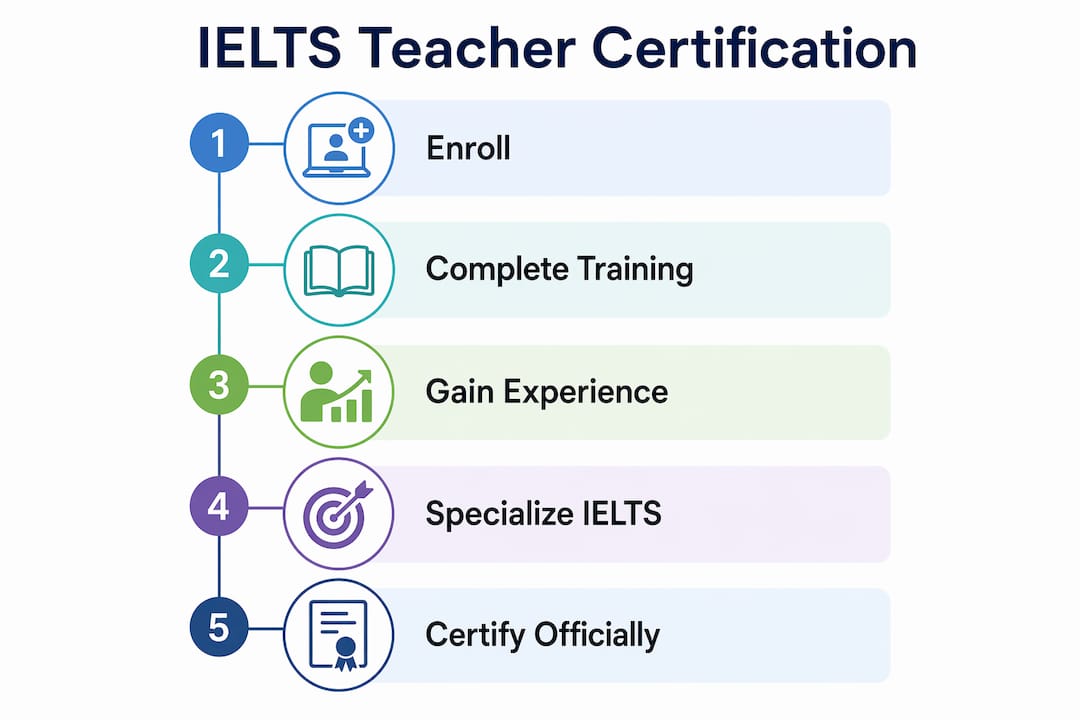
How can I become a certified IELTS instructor online?
Completing an accredited IELTS teacher training course, such as Teflinstitute’s 30 Hour IELTS Teacher Training Course, provides the methodology and certification needed to teach IELTS preparation professionally online.
Recommended
TEFL Institute guides

Czech Republic
Pay, visas and cities
Spain
Jobs, pay and visa routes
Thailand
Visas and teaching licences
Mexico
Jobs, pay and cities
Cambodia
Pay, requirements and visas