United Kingdom (UK)
 United States (US)
 Canada
 South Africa
 India
 Australia
 New Zealand
 China
 Russia
 Germany
 France
 Spain
 Netherlands
 Vietnam
 United Arab Emirates
 Italy
 Poland
 Thailand
 Türkiye






 Algeria


What Is Student Autonomy? A Guide for Educators
What Is Student Autonomy? A Guide for Educators

TL;DR:
- Student autonomy allows learners to control their own decisions within structured goals and boundaries. It is a key psychological need linked to motivation, engagement, and persistence in learning.
Student autonomy is defined as the capacity of learners to take meaningful control over decisions in their own learning process within structured goals and clear boundaries. Rooted in Self-Determination Theory by Edward Deci and Richard Ryan, this concept links directly to intrinsic motivation alongside competence and relatedness. Yet autonomy appears just once in every 5,000 prominent university teaching documents, nearly 50 times less frequently than belonging. That gap signals a significant missed opportunity for educators and parents who want to build genuine engagement in students.
What is student autonomy and why does it matter?
Student autonomy is the degree to which learners direct their own learning choices, including what to study, how to approach a task, and when to seek help. It is not the absence of teacher guidance. Autonomy is a basic psychological need that, alongside competence and relatedness, forms the motivational foundation described in Self-Determination Theory. When all three needs are met, students engage more deeply and persist longer on difficult tasks.
The practical implication is direct: classrooms that offer structured choice produce more motivated learners than those that rely entirely on teacher-directed instruction. Autonomy does not mean students do whatever they want. It means students have a genuine voice in decisions that affect their learning, within a framework the teacher has designed.
“Fostering autonomy is not about giving control but creating environments that enable student ownership.” — TeachThought
This distinction matters for parents as well. Supporting autonomy at home means allowing children to make decisions about their study schedule, project approach, or reading selection, rather than dictating every step. The goal is ownership, not chaos.
Why is student autonomy important for learning outcomes?
The importance of student autonomy shows up clearly in empirical research. A study involving 994 students and 516 secondary teachers found that autonomy significantly mediates the relationship between classroom participation and both intrinsic and extrinsic motivation. Students who perceived higher autonomy reported stronger self-determined participation. That finding confirms autonomy is not a soft concept. It is a measurable driver of engagement.
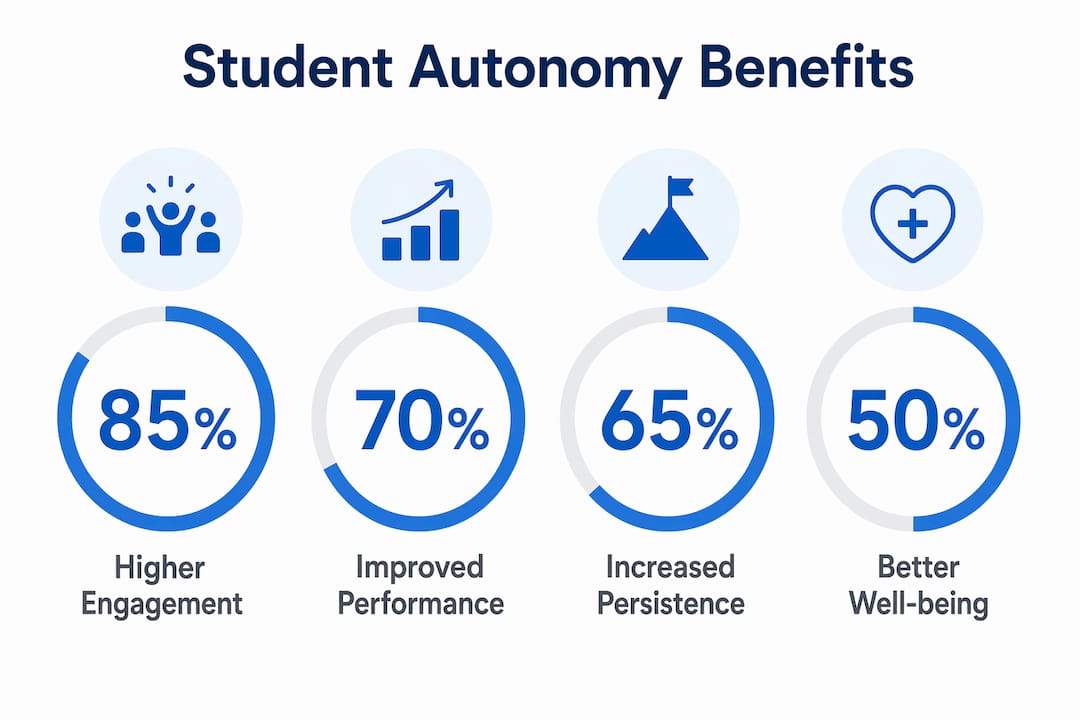
Beyond motivation, autonomy connects to persistence and academic performance. Students who exercise control over their learning decisions are more likely to continue working through challenging material rather than disengaging. They develop a sense of ownership that sustains effort even when tasks become difficult.
Psychological well-being also improves in autonomy-supportive environments. Students report lower anxiety and higher satisfaction when they feel their choices are respected. For educators managing diverse classrooms, this means that building in structured choice is not just a pedagogical preference. It is a strategy with documented effects on student health and performance.
The benefits of student independence extend beyond the classroom. Students who practice autonomous decision-making in school develop self-regulation skills that transfer to higher education, professional settings, and lifelong learning.
How does student autonomy differ from independence and free-choice learning?
Many educators confuse autonomy with independence or with unstructured free time. These are distinct concepts, and the difference has real consequences for classroom design.

| Concept | Definition | Teacher’s role |
|---|---|---|
| Student autonomy | Choosing how and why to learn within structured goals | Facilitator who scaffolds choices |
| Independence | Completing tasks without support | Minimal or absent during task |
| Teacher-directed learning | Teacher controls content, pace, and method | Central authority and decision-maker |
| Free-choice learning | No defined goals or structure | Observer or absent |
Autonomy means choosing how and why to learn with support, while independence means doing it alone. A student working autonomously still operates within teacher-established learning goals. A student working independently may simply be unsupported.
Choice architecture, also called nudging, is the most practical tool for maintaining this balance. Choice architecture scaffolds student decisions by offering a curated set of options rather than unlimited freedom. A teacher might offer three formats for a writing assignment rather than asking students to invent their own. Students experience genuine agency. The teacher maintains focus on the learning objective.
Initial student resistance to autonomy is common when teachers shift from directive to facilitative approaches. This resistance signals cognitive engagement, not failure. Students accustomed to being told exactly what to do need time to build the metacognitive skills required for self-directed learning. Abandoning autonomy scaffolding at the first sign of resistance is the most common mistake educators make.
Pro Tip: Start with micro-choices. Offer two options for how students submit an assignment before moving to open-ended project design. Small decisions build the decision-making muscle students need for larger autonomy.
How to promote student autonomy in educational settings
Promoting student autonomy requires deliberate design, not a single policy change. The following sequence gives educators and parents a practical framework.
-
Set clear learning goals first. Autonomy works within structure, not instead of it. Define what students must learn before offering choices about how they learn it. Clear goals prevent autonomy from becoming confusion.
-
Offer meaningful choices on task, timing, and collaboration. Choices on task, timing, and methods improve student ownership without losing focus on learning goals. Let students select project topics within a defined theme, choose whether to work alone or in pairs, or decide the order in which they complete assigned readings.
-
Teach metacognitive routines explicitly. Metacognitive routines like planning, self-monitoring, and help-seeking are prerequisites for effective autonomy. Students cannot direct their own learning if they lack the tools to assess their own understanding. Teach students to set daily learning goals, check their own progress, and identify when they need support.
-
Co-construct rubrics and success criteria. When students participate in defining what good work looks like, they internalize the standards. This is one of the most direct methods for building student decision-making in education. It also reduces the anxiety that comes with open-ended tasks.
-
Use classroom dialogue to support participatory decision-making. Regular structured discussions about how the class is working give students a voice in the learning environment. This practice aligns with classroom management strategies that build student ownership rather than compliance.
-
Align autonomy with competence and relatedness. Autonomy alone does not produce motivation. Students also need to feel capable and connected. Pair choice with skill-building activities and collaborative tasks to activate all three elements of Self-Determination Theory.
Pro Tip: Co-constructed rubrics work best when introduced at the start of a unit, not after students have already begun working. Early involvement shapes how students approach the entire task.
What are examples of student autonomy across different settings?
Examples of student autonomy vary by age group and educational context, but the core principle remains consistent: students make real decisions within a structured framework.
- Primary school: A teacher offers students a choice of three books for independent reading. Students select based on interest, then complete a response activity of their choosing from a short menu of options.
- Middle school: Students choose their own research topic within a teacher-defined subject area. They set a personal timeline for completing each stage of the project and self-assess their progress using a shared checklist.
- High school: Students select the format for a final project, such as a written report, a recorded presentation, or a visual display. They negotiate deadlines with the teacher based on their workload across subjects.
- Higher education: Learners in self-paced online modules choose the sequence in which they complete units. Tools like Grammarly support self-assessment of written work, reducing dependence on teacher feedback for every draft.
- ESL classrooms: Students choose discussion topics, select vocabulary they want to learn, or decide which grammar points to review. These ESL classroom engagement practices give language learners ownership over content that directly reflects their communication needs.
- At home: Parents support autonomy by allowing children to plan their own study sessions, choose the order of homework tasks, or select the method they use to review material before a test.
Each example reflects a different scale of choice, but all share the same structure: defined goals, real options, and student accountability for the decision made.
Key takeaways
Student autonomy is the most underused driver of intrinsic motivation in education, requiring structured choice, metacognitive skill-building, and teacher scaffolding to produce measurable gains in engagement and performance.
| Point | Details |
|---|---|
| Autonomy requires structure | Student choice works within clear learning goals, not instead of them. |
| SDT provides the framework | Deci and Ryan’s Self-Determination Theory links autonomy to intrinsic motivation alongside competence and relatedness. |
| Resistance is normal | Early pushback from students signals cognitive adjustment, not a reason to abandon autonomy scaffolding. |
| Metacognition is a prerequisite | Students must be taught planning, self-monitoring, and help-seeking before they can direct their own learning. |
| Choice architecture is the practical tool | Offering curated options, not unlimited freedom, delivers autonomy’s motivational benefits while maintaining focus. |
Autonomy is the skill schools are not teaching directly enough
The research on student autonomy has been available for decades, yet autonomy remains dramatically underrepresented in how institutions talk about motivation. That gap is not a coincidence. Autonomy is harder to measure than test scores and harder to design than a lecture. It requires teachers to relinquish some control, which is uncomfortable for educators trained in directive models.
What I find most striking is that the resistance educators face from students is often used as evidence that autonomy does not work. In practice, that resistance is the clearest sign that students are being asked to think differently. Learner agency is more critical than ever in an AI-augmented world where the ability to direct one’s own learning is a professional survival skill, not just a classroom preference.
The educators who succeed with autonomy-supportive practice share one trait: patience with the transition period. They understand that teacher autonomy and student autonomy are connected. Teachers who feel ownership over their own professional decisions model the same capacity they are trying to build in students.
For parents, the message is equally direct. Every time you allow a child to solve a problem independently before stepping in, you are building the metacognitive foundation that autonomy-supportive classrooms depend on. The two environments reinforce each other.
— Muller
How Teflinstitute supports autonomy-focused teaching
Educators who want to build autonomy-supportive classrooms need practical training in scaffolding, classroom management, and student engagement design. Teflinstitute offers certification programs that address exactly these skills.
The 120 Hour Elective TEFL Course covers advanced teaching strategies including student-centered methods and structured choice design. For educators seeking a more comprehensive qualification, the 240 Hour Master TEFL Course provides in-depth training in classroom engagement techniques grounded in current research. Both programs are delivered online and designed for working educators who need flexible, accredited professional development.
FAQ
What is the simplest definition of student autonomy?
Student autonomy is the capacity of learners to make meaningful decisions about their own learning within a structured framework set by the teacher. It is grounded in Self-Determination Theory by Deci and Ryan, which identifies autonomy as a basic psychological need for intrinsic motivation.
Is student autonomy the same as letting students do whatever they want?
No. Student autonomy operates within clear learning goals and teacher-designed boundaries. Choice architecture, or offering curated options, maintains structure while giving students genuine agency over how they learn.
Why do some students resist autonomous learning at first?
Initial resistance is a normal part of the transition from teacher-directed to facilitative learning. Students accustomed to being told exactly what to do need time to develop the metacognitive skills required for self-directed work. This resistance signals cognitive adjustment, not failure.
What is one practical way to start promoting student autonomy?
Offer micro-choices first, such as two options for how to submit an assignment or which of three topics to write about. Small, structured decisions build the decision-making capacity students need for larger autonomous tasks.
How does student autonomy connect to academic performance?
Research involving 994 students and 516 secondary teachers found that autonomy significantly mediates the relationship between classroom participation and intrinsic motivation. Higher perceived autonomy correlates with stronger self-determined engagement and greater persistence on challenging tasks.
Recommended
TEFL Institute guides

Portugal
Jobs, pay and visa routes
Italy
Jobs, pay and visa routes
Mexico
Jobs, pay and cities
South Korea
EPIK, hagwons and pay
Thailand
Visas and teaching licences