

 United Kingdom (UK)
 United States (US)
 Canada
 South Africa
 India
India Australia
 New Zealand
 China
China Russia
 Germany
 France
 Spain
Spain Netherlands
 Vietnam
 United Arab Emirates
 Italy
Italy Poland
 Thailand
 Türkiye








 Algeria


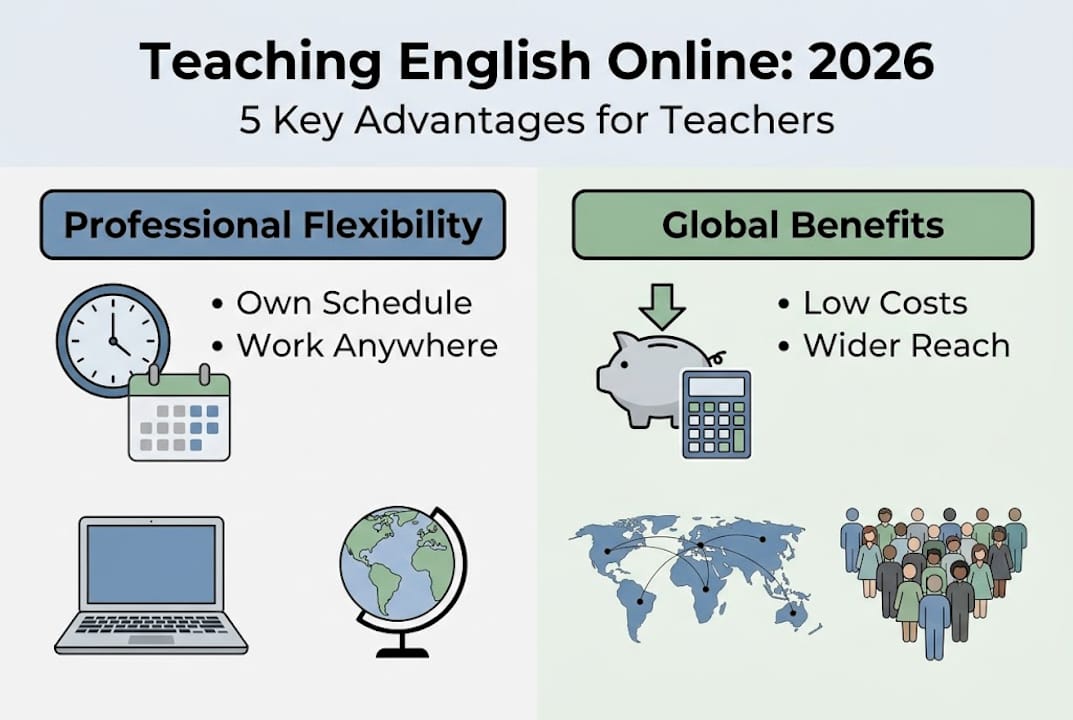
5 key advantages of teaching English online in 2026

TL;DR:
- Online TEFL offers flexible schedules, cost savings, and global teaching opportunities.
- Effective online English instruction produces learning outcomes comparable to traditional classrooms.
- Hybrid and blended models combine advantages of online and in-person teaching for broader career prospects.
Teaching English online has fundamentally changed what a TEFL career looks like. You no longer need to book a one-way flight or sign a year-long contract abroad to reach students in Tokyo, São Paulo, or Madrid. With a stable internet connection and the right certification, you can build a rewarding, internationally connected teaching career from your own home. This guide examines the evidence-backed advantages of online TEFL, addresses common concerns about effectiveness, and outlines practical strategies to help you maximize your career potential in 2026 and beyond.
Table of Contents
- The flexibility and freedom of online teaching
- Cost savings and opportunities to teach globally
- Educational impact: Student outcomes in online English classes
- Limitations and challenges: What to consider before teaching online
- Maximizing your advantage: Hybrid, blended, and future-ready TEFL strategies
- Our take: Why online TEFL is a game changer for modern teachers
- Take the next step: Start your online teaching journey
- Frequently asked questions
Key Takeaways
| Point | Details |
|---|---|
| Flexible career options | Teaching English online allows you to set your own hours and work from anywhere with internet. |
| Cost and time savings | No commuting and minimal overhead mean bigger savings compared to classroom teaching. |
| Proven student outcomes | Students in online English classes often see equal or greater gains in reading and speaking skills. |
| Hybrid models maximize benefits | Combining online and in-person teaching offers flexibility and valuable human connection. |
The flexibility and freedom of online teaching
For many aspiring TEFL teachers, the appeal of online teaching starts with one word: flexibility. Unlike traditional classroom roles that lock you into fixed timetables and physical locations, online teaching lets you design a schedule that fits your life. Whether you prefer early morning sessions or late-night lessons for students in different time zones, the choice is largely yours.
Teaching English online offers flexible schedules and the ability to work from anywhere with a reliable internet connection. This is not a minor perk. It represents a structural shift in how TEFL careers are built. Teachers who previously had to uproot their lives to work abroad can now access international students without relocating.
The practical benefits extend beyond scheduling. Consider what you eliminate from your daily routine:
- No daily commute, saving both time and transportation costs
- No mandatory dress code or institutional bureaucracy
- No fixed geographic requirement, meaning you can travel and teach simultaneously
- Lower overhead compared to maintaining a physical classroom presence
Understanding why teach English online goes beyond convenience. It is about building a sustainable career model that adapts to your personal and professional goals. Teachers who embrace this model often report lower daily stress levels and greater job satisfaction because they retain control over their working environment.
Pro Tip: Invest in a few ergonomic upgrades for your home workspace. A good chair, adequate lighting, and a quality microphone significantly improve your teaching performance and reduce fatigue during long sessions.
The freedom online teaching provides is not just about where you work. It is about how you work. You can take on more students when demand is high and scale back during personal commitments. That level of autonomy is rarely available in traditional school settings.
Cost savings and opportunities to teach globally
Beyond lifestyle flexibility, online TEFL delivers measurable financial advantages. Cost savings for teachers include no commuting expenses, reduced daily overheads, and the ability to teach students globally without the cost of international relocation.

For teachers who previously worked abroad, the expenses add up quickly: flights, visa fees, housing deposits, and the general cost of living in a foreign country. Online teaching removes most of these barriers entirely.
| Factor | Classroom teaching | Online teaching |
|---|---|---|
| Commuting costs | High | None |
| Housing/relocation | Often required | Not required |
| Geographic reach | Local or regional | Global |
| Schedule control | Limited | High |
| Startup costs | Moderate to high | Low to moderate |
The global reach of online teaching is particularly significant for career growth. Rather than being limited to students in one city or country, you can access learners across multiple markets simultaneously. This diversification protects your income and broadens your professional experience.
Exploring remote teaching platforms is one of the most effective ways to expand your reach. Many platforms connect teachers with students in Asia, Latin America, Europe, and the Middle East, giving you access to a truly global student base from day one.
Key financial advantages of online TEFL include:
- Elimination of daily commuting costs
- No relocation or visa expenses
- Ability to work across multiple platforms and income streams
- Reduced spending on work attire and meals outside the home
Pro Tip: Register on two or three reputable online teaching platforms simultaneously. This diversifies your student base and protects your income if one platform changes its policies or rates.
The combination of lower costs and broader market access makes online teaching a financially sound choice for both new and experienced TEFL educators.
Educational impact: Student outcomes in online English classes
A common concern among aspiring TEFL teachers is whether online instruction actually works. The data provides a clear answer. Empirical research across 200 students shows a mean advantages score of 32.12 out of 45, with a strong correlation of r=0.829 between perceived advantages and measurable learning impact. Students showed notable improvements in both reading and speaking skills.
These figures matter because they counter the assumption that online teaching is a lesser substitute for in-person instruction. In many cases, it is not. When structured effectively, teaching English online produces outcomes that are comparable to, and sometimes better than, traditional classroom results.
Understanding what is online language teaching at a structural level helps teachers design more effective lessons. The medium itself encourages certain skills, particularly written communication, self-paced review, and the use of multimedia resources that are harder to integrate in a physical classroom.
Three proven methods to improve student outcomes in online English classes:
- Use breakout rooms and pair activities to replicate small-group interaction and encourage speaking practice.
- Incorporate multimedia content such as short video clips, audio recordings, and interactive quizzes to maintain engagement.
- Provide consistent written feedback after each session so students can track their progress and revisit corrections independently.
Effective planning an online ESL lesson is the foundation of strong student outcomes. Teachers who invest time in structured lesson design see measurably better results than those who rely on improvisation. The data supports a deliberate, methodical approach to online instruction.
The evidence is clear: online English teaching, when done well, is educationally effective. The key variable is not the medium but the quality of instruction.
Every TEFL opening, salary and deadline that matters.
In your inbox every two weeks. Free, no spam, unsubscribe any time.
Teacher pay by country
New TEFL openings
Programme and visa dates
Limitations and challenges: What to consider before teaching online
A balanced assessment of online TEFL requires acknowledging its limitations. Research comparing emergency remote teaching to in-person instruction found a drop in some enjoyment aspects, particularly the personal and social dimensions of classroom learning. However, the same research found that convenience and autonomy increased, and that technical issues were less predictive of negative outcomes than many assume.
This is an important distinction. The challenges of online teaching are real but manageable. They rarely undermine the core educational experience when teachers take proactive steps to address them.
Common challenges and practical solutions:
- Reduced social interaction: Schedule regular group sessions and use collaborative tools like shared documents or discussion boards to build community.
- Technical disruptions: Keep a backup device ready, test your equipment before each session, and communicate a clear protocol to students if connectivity fails.
- Screen fatigue: Structure lessons with varied activity types and include short breaks to maintain focus for both you and your students.
- Motivation management: Use goal-setting frameworks and regular progress check-ins to keep students engaged over time.
“While some personal and social enjoyment aspects decline in online settings compared to in-person teaching, the gains in convenience and autonomy are consistent and significant. Technical disadvantages are less predictive of negative student impact than commonly assumed.” — International Review of Applied Linguistics in Language Teaching
Reviewing practical ESL class setup tips before you launch your online teaching practice can prevent many of the most common technical and organizational problems. A well-configured digital classroom minimizes disruptions and creates a more professional experience for students.
The limitations of online TEFL are worth knowing, but they should not discourage you. Most are addressable with preparation and the right tools.
Maximizing your advantage: Hybrid, blended, and future-ready TEFL strategies
For teachers who want the widest range of career options, hybrid and blended teaching models represent the most strategic path forward. Hybrid and blended models optimize the advantages of both online and in-person teaching, combining scheduling flexibility with the human interaction that supports deeper learning.
These models are increasingly in demand among language schools, corporate training programs, and international education providers. Teachers who can operate effectively in both environments are significantly more employable.
How to design your hybrid teaching path:
- Start with online-only teaching to build your digital classroom skills, develop lesson templates, and establish a student base.
- Add in-person components gradually, such as weekend workshops or intensive courses, to develop your face-to-face facilitation skills.
- Seek out institutions that offer blended programs, as these roles typically offer more stability and higher pay than purely online freelance work.
- Document your experience across both formats to build a portfolio that demonstrates versatility to future employers.
Exploring hybrid TEFL programs and reviewing a hybrid learning guide can help you understand what skills and certifications are most valued in this growing segment of the TEFL market.
Pro Tip: Start your TEFL career online to develop core digital teaching competencies, then layer in hybrid experience. This sequence builds the broadest skill set and opens the most career doors.
The future of TEFL is not purely online or purely in-person. It is adaptive. Teachers who can move fluidly between both environments will have the strongest long-term career prospects.
Our take: Why online TEFL is a game changer for modern teachers
Conventional wisdom in language education still favors the classroom. Many institutions default to in-person hiring, and some teacher training programs barely address digital instruction. This is increasingly out of step with where the industry is heading.
The data and the market both point in the same direction. Online and blended TEFL models are not temporary workarounds. They are established, effective, and expanding. Teachers who build digital competencies early position themselves for a wider range of opportunities, greater geographic mobility, and more resilient income streams.
From our perspective, the minor challenges of online teaching, such as reduced social spontaneity or occasional technical friction, are far outweighed by what you gain: access to global students, schedule control, and the ability to teach from virtually anywhere. Understanding the online TEFL course advantages is the first step toward making an informed decision about your career path. The teachers who thrive in the next decade will be those who treat digital fluency as a core professional skill, not an optional add-on.
Take the next step: Start your online teaching journey
If the evidence in this article has made one thing clear, it is that online TEFL is a credible, well-supported career path with measurable advantages for both teachers and students. The right certification is what turns that potential into a real career.
At TEFL Institute, our programs are designed to take you from your first lesson plan to expert-level educator, with options that fit your schedule and career goals. Whether you are exploring Newcastle TEFL courses, looking into TEFL course extensions to deepen your qualifications, or ready to explore TEFL Institute and find the right program for you, we have structured pathways that support every stage of your TEFL journey. Start today and open the door to global teaching opportunities.
Frequently asked questions
How do online TEFL jobs compare to traditional classroom jobs in terms of income?
Online TEFL roles reduce costs such as commuting and housing while giving you access to students worldwide, though actual pay rates vary depending on the platform and region you teach in.
Are online English classes as effective as in-person classes?
Research on 200 students shows strong correlations between online teaching advantages and measurable skill improvements, particularly in reading and speaking, suggesting effectiveness is comparable to in-person instruction.
What are the biggest drawbacks of teaching English online?
Some teachers and students miss the social and personal dimensions of classroom learning, but research indicates that convenience and autonomy gains consistently outweigh these drawbacks for most educators.
How can I prepare for technical issues in online teaching?
Keep a backup device available, test your internet connection and audio equipment before each session, and share a clear contingency plan with students in case of connectivity problems.
Is hybrid or blended TEFL teaching a better option?
Many educators find that hybrid models deliver the strongest outcomes by combining the scheduling flexibility of online teaching with the interpersonal depth of in-person instruction.
Recommended
- Best Platforms To Teach English Online
- How to Teach English Virtually (Work From Anywhere) | TEFL Institute
- How to Become an Online English Teacher in 2026 | Complete TEFL Roadmap
- Online ESL teaching types: A guide for educators in 2026 | TEFL Institute
- Formation en ligne pour coachs vocaux : 7 avantages clés

Tara and Jess talk through different TEFL and EFL topics, from finding work abroad to life in the classroom.