

 United Kingdom (UK)
 United States (US)
 Canada
 South Africa
 India
India Australia
 New Zealand
 China
China Russia
 Germany
 France
 Spain
Spain Netherlands
 Vietnam
 United Arab Emirates
 Italy
Italy Poland
 Thailand
 Türkiye









 Algeria


Types of English Exams: Choose the Right Test for TEFL
Types of English Exams: Choose the Right Test for TEFL

TL;DR:
- Choosing the correct English proficiency test is crucial for TEFL job eligibility and visa approval.
- IELTS, TOEFL, and OET serve different purposes with specific acceptance in various markets and roles.
- Proper research ensures your exam aligns with your target country, employer, and specialization, preventing application rejections.
Many aspiring TEFL teachers assume that any English proficiency test will satisfy employer and visa requirements. That assumption can cost you a job offer or delay your teaching career by months. The reality is that IELTS, TOEFL, OET, and other recognized exams serve distinct purposes, target different score benchmarks, and are accepted in very different contexts. Choosing the wrong test is not just inconvenient; it can make your application ineligible before it is even reviewed. This article breaks down the major types of English exams, compares their structures and scoring, and shows you how to select the right one based on your specific TEFL goals.
Table of Contents
- Understanding English exam types and their purpose
- IELTS: Structure, scoring, and relevance
- TOEFL: Features, format, and academic use
- OET and specialized tests: When are they necessary?
- How to choose the right English exam for your TEFL journey
- Why the right English exam can make or break your TEFL career
- Advance your TEFL career with expert guidance
- Frequently asked questions
Key Takeaways
| Point | Details |
|---|---|
| Not all exams are equal | Different English exams suit different teaching goals and regions. |
| Know your requirements | Align your exam choice with your targeted country and employer preferences. |
| IELTS and TOEFL dominate | These two tests cover most TEFL scenarios but specialized exams exist for niche roles. |
| Understand score equivalence | Score requirements can differ even if exams are CEFR-aligned, so check benchmarks closely. |
| Strategic choices pay off | Selecting the right exam early can open more TEFL career opportunities. |
Understanding English exam types and their purpose
English proficiency exams exist because employers, governments, and academic institutions need a standardized way to verify that a teacher or applicant can function effectively in an English-language environment. For TEFL roles specifically, these exams serve as evidence that a candidate can model correct, high-level English for students. Without a recognized score, many schools and language centers will not consider an application, regardless of experience.
All major exams align to the Common European Framework of Reference (CEFR), a six-level scale running from A1 (beginner) to C2 (mastery). Understanding proficiency levels for TEFL is essential because most teaching positions require at least a B2 or C1 level, which translates to different minimum scores depending on which exam you take.
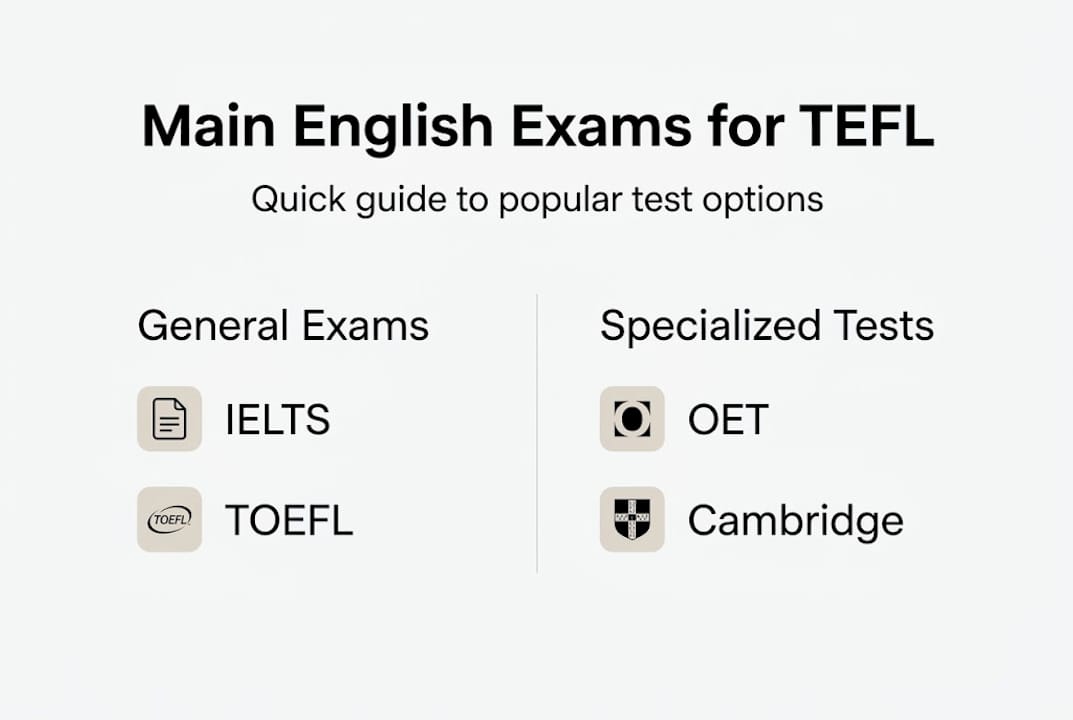
The landscape of English exams breaks down into three broad categories:
- Academic-focused exams: Designed for university admission and high-stakes professional contexts. IELTS Academic and TOEFL iBT fall here.
- General use exams: Cover everyday and professional English. IELTS General Training is a common example.
- Specialized exams: Tailored to specific professions or use cases, such as the Occupational English Test (OET) for healthcare workers.
Test choice directly affects job eligibility. Some employers in East Asia accept only IELTS. Certain U.S.-based online platforms prefer TOEFL. Specialized English teaching roles in medical or legal sectors may require OET. Reviewing the qualifications for teaching abroad before registering for any exam is a practical first step.
“Not all exams are accepted equally in all markets. Confirming which test an employer or visa authority recognizes before booking your test date can save significant time and registration fees.”
Each exam format also influences how you prepare. Academic writing tasks differ substantially from general writing prompts, and computer-delivered speaking tasks feel very different from face-to-face interviews. Knowing what you are preparing for shapes your study plan.
IELTS: Structure, scoring, and relevance
With a broad framework in mind, let’s look closer at the most recognized exam: IELTS.
IELTS is available in Academic, General Training, and UKVI versions, making it one of the most flexible and widely accepted options for TEFL teachers globally. The exam covers four skills: Listening, Reading, Writing, and Speaking. Each section receives a band score from 0 to 9, and the overall band is the average of the four.

| IELTS band | CEFR level | Typical TEFL relevance |
|---|---|---|
| 9.0 | C2 | Expert teacher or specialist roles |
| 8.0 to 8.5 | C2 | Senior positions, competitive markets |
| 7.0 to 7.5 | C1 | Standard TEFL requirement in most markets |
| 6.0 to 6.5 | B2 | Entry-level roles, some Asian markets |
| Below 6.0 | B1 or lower | Generally not accepted for teaching roles |
For most TEFL positions, a band of 7.0 or higher is the standard benchmark, which maps to C1 on the CEFR scale. Some important TEFL facts that candidates overlook: the Academic version is required for university-linked positions, while IELTS General Training is more appropriate for immigration and some corporate English programs.
The Speaking test is conducted face-to-face with a certified examiner, which many test takers find more natural than computer-based alternatives. Results are valid for two years, so timing your test relative to your job search matters.
Pro Tip: If you plan to teach in the UK, Europe, or Australia, check whether the UKVI version is required. Some visa categories only accept IELTS for UKVI, even if the exam content is identical to the standard version. For those exploring TEFL in English-speaking countries, this distinction is especially relevant.
TOEFL: Features, format, and academic use
After IELTS, another exam that stands out for TEFL candidates is TOEFL. Here’s what sets it apart.
The TOEFL iBT (Internet-Based Test) assesses academic English and is trusted by universities and visa authorities in the United States and Canada in particular. It covers four sections: Reading, Listening, Speaking, and Writing. Each section scores between 0 and 30, giving a total maximum score of 120.
Here is a step-by-step look at how the TOEFL iBT is structured:
- Reading (0-30): Two or three academic passages with multiple-choice and drag-and-drop questions.
- Listening (0-30): Lectures and conversations followed by comprehension questions.
- Speaking (0-30): Six tasks, all recorded via microphone, with no live examiner.
- Writing (0-30): One integrated task (reading plus listening) and one academic discussion task.
A total score of 95 to 100 on the TOEFL iBT is broadly equivalent to IELTS 7.0, both mapping to C1 on the CEFR scale. This matters when you are comparing acceptance thresholds across job markets.
The fully computer-based format suits candidates who are comfortable with academic writing under timed digital conditions. All speaking responses are recorded and scored by raters remotely, which some find less pressured than a live IELTS examiner. However, others find the lack of human interaction makes the speaking section feel less intuitive.
Pro Tip: TOEFL scores are preferred or sometimes required for positions at international schools in the United States, Canada, and some Latin American countries. Before registering, review TEFL interview expectations at your target schools to confirm which exam they request in the hiring process.
TOEFL results are also valid for two years and can be sent directly to institutions from your ETS account, which simplifies the application process for multiple employers.
OET and specialized tests: When are they necessary?
But English exams aren’t always one-size-fits-all. Some roles require specialized tests.
The Occupational English Test (OET) is graded on an A to E scale and uses profession-specific materials rather than general academic content. It is designed for healthcare professionals, including doctors, nurses, and pharmacists, who need to demonstrate English ability in clinical settings. For TEFL instructors who specialize in teaching medical English to healthcare students, an OET score can reinforce their credibility and qualifications.
| Feature | OET | IELTS | TOEFL iBT |
|---|---|---|---|
| Target audience | Healthcare professionals | General and academic | Academic and university |
| Scoring scale | A to E | Band 0 to 9 | 0 to 120 |
| CEFR alignment | B1 to C2 | A1 to C2 | B1 to C2 |
| Use in TEFL | Specialized medical English roles | Widely accepted | U.S. and Canada focused |
| Test format | Profession-specific tasks | Mixed paper and computer | Fully computer-based |
Beyond OET, other profession-specific exams exist. The Legal English Certificate (LEC) targets lawyers and legal professionals. Cambridge English for Specific Purposes covers business and academic contexts at various levels. These are relevant for TEFL teachers developing niche courses.
For most standard TEFL roles, OET is not required. However, if you are exploring other teaching qualifications that intersect with industry-specific English instruction, understanding OET’s scope gives you a competitive edge.
- OET is accepted for healthcare registration and migration in Australia, the UK, and Ireland.
- It is not a substitute for IELTS or TOEFL when applying for general teaching positions.
- Medical English teaching roles at hospitals or nursing schools may list OET as a preferred qualifier.
How to choose the right English exam for your TEFL journey
With popular and specialized exams explained, the next step is choosing the one that fits your career vision.
Selecting the right exam requires a structured approach rather than choosing based on familiarity or convenience. Misalignments in professional benchmarking create edge cases where a valid score is simply not accepted for a specific role or visa category.
Follow these steps to make the right choice:
- Identify your target country and employer. Research whether schools in your destination accept IELTS, TOEFL, or a specific version of either. This is the single most important filter.
- Check visa requirements separately. Work visa authorities often have their own exam preferences, which may differ from employer requirements. Both need to be satisfied.
- Determine if your role is specialized. Medical or legal English teaching roles may require OET or a similar credential in addition to a standard proficiency test.
- Compare score equivalencies carefully. An IELTS 7.0 is broadly equivalent to a TOEFL iBT score of 95 to 100 and PTE Academic 65, all at C1 CEFR. Verify the exact benchmark your employer uses.
- Factor in test format preference. If you perform better in face-to-face conversations, IELTS may suit you. If you are more comfortable typing responses in an academic format, TOEFL iBT may be a better fit.
Common pitfalls include taking the IELTS General Training version for a role that requires Academic, or assuming a TOEFL score is accepted in markets that specifically request IELTS. Exploring global TEFL careers and the requirements for teaching English abroad gives you a more complete picture of regional expectations.
For those focusing on structured preparation, resources on improving TEFL evaluation skills can also help you understand how proficiency benchmarks are applied during the hiring process.
Why the right English exam can make or break your TEFL career
Having mapped out your options and decision factors, here is an honest perspective on why your choice is more important than most guides admit.
Most articles treat exam selection as a minor administrative task. In practice, it is a strategic career decision. Teachers have been disqualified from highly competitive positions not because their English was insufficient, but because they submitted scores from a test the employer did not recognize. That distinction matters far more in tight hiring markets.
Institutional preferences are not always published openly. Some schools list IELTS in their official job posting but internally benchmark candidates using TOEFL scores because the hiring manager trained in a U.S. system. These hidden expectations are only uncovered through direct communication with hiring contacts before you apply.
The honest advice from TEFL veterans: treat teaching abroad requirements as research, not bureaucracy. Spending one week confirming the right exam before registration can protect months of preparation time. Your exam choice signals preparation and professionalism before you say a word in an interview.
Advance your TEFL career with expert guidance
Selecting the right English exam is only one part of building a strong TEFL profile. The courses you complete alongside your exam preparation shape your long-term career options.
The TEFL Institute offers accredited courses designed to align with international teaching standards, giving you credentials that complement your English proficiency scores. Whether you are exploring TEFL courses in Newcastle for a structured in-person experience or looking at TEFL course extensions to deepen a specific area of expertise, expert guidance is available at every stage. Having the right certification alongside a recognized exam score positions you as a qualified, credible candidate in any global market.
Frequently asked questions
Do I need a specific English exam for TEFL certification?
Most TEFL programs accept major proficiency tests like IELTS or TOEFL, but specific requirements vary by employer, country, and the type of teaching position you are applying for.
How do IELTS and TOEFL scores compare for TEFL?
IELTS 7.0 is equivalent to approximately TOEFL iBT 95 to 100 and PTE Academic 65, all corresponding to the C1 level on the CEFR scale.
Is OET required for general TEFL jobs?
OET is not required for standard TEFL positions. It is only relevant for specialized medical contexts where teaching English to healthcare professionals is part of the role.
Which exam should I take if I want to teach in an English-speaking country?
Most English-speaking countries accept IELTS or TOEFL, but you should verify both the visa authority’s requirements and the employer’s preferred test version before registering.
Recommended
TEFL Institute guides

South Korea
EPIK, hagwons and pay
Taiwan
Buxibans, pay and visas
Cambodia
Pay, requirements and visas
Mexico
Jobs, pay and cities
Vietnam
Work permits and requirements