
 United Kingdom (UK)
 United States (US)
 Canada
 South Africa
 India
India Australia
 New Zealand
 China
China Russia
 Germany
 France
 Spain
Spain Netherlands
 Vietnam
 United Arab Emirates
 Italy
Italy Poland
 Thailand
 Türkiye









 Algeria


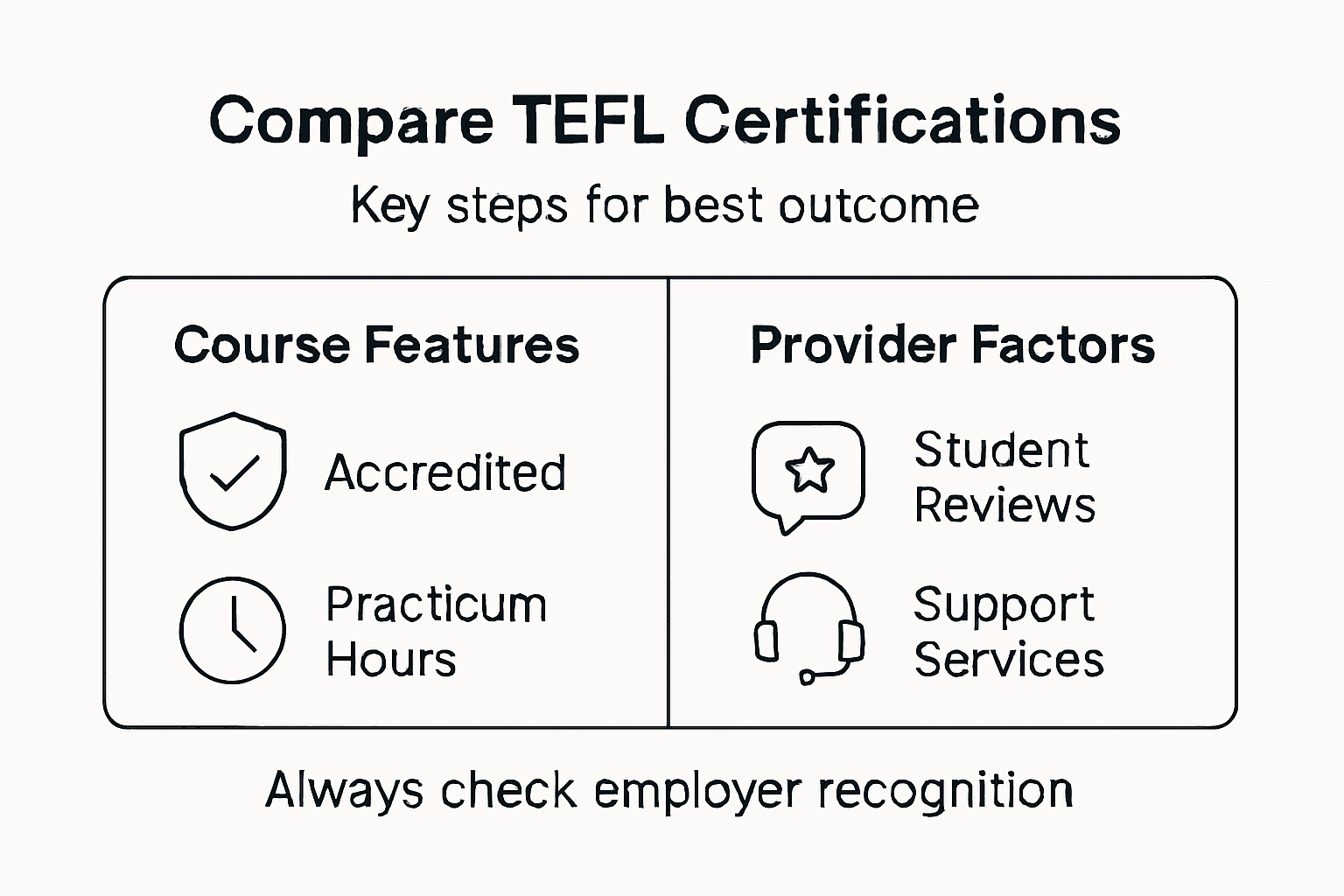
Compare five things in order: hours (at least 120), who accredits or regulates the course, the content and teaching practice, whether employers in your target country accept it, and the support you get. Leave price until last. A course that fails any of the first four checks is poor value however cheap it is.
How to Compare TEFL Certifications for the Best Outcome
Updated 8 October 2026: comparison checklist rewritten against current accreditation and hiring rules.
To compare TEFL certifications, check five things in order: whether the course is at least 120 hours, who accredits or regulates it, what the content and teaching practice cover, whether employers in your target country accept it, and what support you get. Price comes last. A course that fails any of the first four is poor value at any price.

Every TEFL provider promises a career changing qualification, and the brochures start to blur together after the third tab. The way through is to compare on evidence you can check rather than claims you have to trust. These five steps take an evening and will save you from the most common and expensive mistakes.
Key takeaways
- Start with your destination. The country’s visa and employer rules decide which TEFL you need.
- 120 hours is the hiring benchmark. Courses below it rarely get you through the first screen.
- Accredited and regulated are different. Only a regulated qualification has an Ofqual number you can look up.
- Real job adverts in your target country are the best test of employer acceptance.
- Judge support by testing it: send a question before you enrol and see how fast and how well they answer.
Step 1: What are your teaching goals?
Your teaching goals decide which TEFL features matter, so define them before comparing any courses. Write down where you want to teach, who you want to teach, and when you want to start. Those three answers narrow the field faster than any comparison table.
- Where: Asia and the Middle East usually need a degree for the visa; the Middle East often expects a Level 5 qualification for school posts. Europe depends on your passport. Online platforms set their own rules.
- Who: if you plan to teach children, look for young learner content. For adults or professionals, business English matters more.
- When: a self paced online course can fit around work; a fixed date course cannot.
Our guide to the qualifications you need to teach English abroad sets out the degree, visa and document rules by region.
Step 2: Is the course accredited or regulated?
Check who stands behind the certificate, and confirm it on that body’s own website. This is the single most important step, because it decides whether an employer can verify what you bought.
| Question | Accredited | Regulated (Ofqual) |
|---|---|---|
| Who grants it? | An independent accreditation body | A government regulator, through a recognised awarding organisation |
| How do you check it? | On the accreditor’s own provider list | By qualification number on the Ofqual register |
| Does it carry a level? | No | Yes, for example RQF Level 5 |
| Typical use | Most 120 hour certificates | Level 5 TEFL diplomas |
If a provider claims “Level 5”, ask for the qualification number and search it on the Ofqual register. Our Level 5 TEFL Diploma is listed under 610/1571/4, awarded by Highfield Qualifications. For more on the difference, see what Ofqual regulated actually means.
Step 3: What do the content, hours and teaching practice cover?
Compare the syllabus, the total hours and the teaching practice, because these decide whether you leave able to teach. A good course covers grammar for teachers, lesson planning, classroom management and the four skills before moving into specialist areas.

Look for at least 120 hours, stated on the certificate. A 120-hour TEFL certificate meets most employers’ screening line; regulated Level 5 diplomas go further, with 180 guided learning hours or more.
Then check how you practise. Options range from observed live teaching to recorded lessons and peer practice. If you want classroom confidence before your first job, our guide to finding a TEFL practicum covers the routes.
| Delivery model | Flexibility | Tutor contact | Teaching practice |
|---|---|---|---|
| Self paced online | High, study any time | Tutor marked assignments | Limited unless added |
| Online with live sessions | Medium, some fixed times | Live classes plus marking | Virtual practice |
| In person or hybrid | Low, fixed dates | Face to face | Observed classroom practice |
Academic
The TEFL Institute Group
How to Land Your First TEFL Job
teflinstitute.comWatch on YouTube · The TEFL Institute Group
Step 4: Will employers in your target country accept it?
Check real job adverts in the country you want, because they tell you exactly what employers ask for. Pick three current adverts and note the wording: “120 hour TEFL”, “CELTA or equivalent”, “Level 5”. That list is your requirement.
Our guide to how employers verify TEFL certificates explains what schools actually check. For pay and entry rules by country, the TEFL Salary Index is dated and sourced.
Step 5: What support do you get during and after the course?
Test a provider’s support before you pay, not after. Send a specific question by email or chat and note how quickly and how helpfully they answer. That one exchange predicts most of your experience as a student.
| Support feature | What good looks like | Red flag |
|---|---|---|
| Tutor access | Named tutors who give written feedback | Automated marking only |
| Student support | Replies within a working day | No reply, or a sales script |
| Career help | Job guidance, CV help, job boards | Nothing after the certificate |
| Reviews | Many independent reviews over time | Only testimonials on the provider’s own site |
Read independent reviews, such as Google reviews, and look for patterns rather than single complaints. Reviews that mention landing a job are worth more than reviews about the course videos.
Ready to compare our courses?
The TEFL Institute Group is Europe’s largest TEFL trainer by teachers certified, with 161,000 teachers certified since 2017 and graduates in 80 countries. We are a Highfield Approved Centre (number 21335), so our regulated diplomas carry a number you can check yourself.
Start with the 120 Hour Advanced TEFL Course for most first jobs, or the 180 Hour Level 5 TEFL Diploma for a regulated qualification employers can verify.

Jessica Jeffery, Recruitment and Partnerships Specialist
Holds a business degree plus TEFL and CELTA, and taught in Thailand and Italy; helps students find high quality jobs and internships.
We love taking your call.

TEFL Institute guides
Plan for 2027
Dubai
Pay, requirements and visas
Read the guide
Plan for 2027
South Korea
EPIK, hagwons and pay
Read the guide
Plan for 2027
Estonia
Jobs, pay and work routes
Read the guide
Plan for 2027
Portugal
Jobs, pay and visa routes
Read the guide
Plan for 2027
Thailand
Visas and teaching licences
Read the guide
An accredited TEFL has been reviewed by an independent body, which you check on that body’s provider list. A regulated TEFL sits on a government framework such as Ofqual’s RQF, with a qualification number and a level you can look up on the public register. Most 120 hour courses are accredited; Level 5 diplomas are regulated.
At least 120 hours, stated on the certificate. That is the line most language schools and online platforms screen for. Regulated Level 5 TEFL diplomas are larger, with 180 guided learning hours or more, and are often expected for Middle East school posts and competitive roles.
Look at three current job adverts in the country you want to teach in and note exactly what they ask for, such as 120 hour TEFL, CELTA or equivalent, or Level 5. Then check that the course you are considering meets that wording and can be verified by the employer.
It is not always required, but it helps. Many online courses rely on tutor marked assignments, while some add live or observed practice. If you are nervous about your first class, or your target employers ask for practicum hours, choose a course or add on that includes real teaching practice.
Look for independent reviews, such as Google reviews, rather than testimonials on the provider’s own website. Read across many reviews and look for patterns in tutor feedback, support response times and whether graduates found jobs. Then test support yourself by sending a question before you enrol.