United Kingdom (UK)
 United States (US)
 Canada
 South Africa
 India
India Australia
 New Zealand
 China
China Russia
 Germany
 France
 Spain
Spain Netherlands
 Vietnam
 United Arab Emirates
 Italy
Italy Poland
 Thailand
 Türkiye









 Algeria


ESL vs EFL: Teaching differences every educator should know
ESL vs EFL: Teaching differences every educator should know

TL;DR:
- ESL occurs in English-speaking environments; EFL takes place in non-English-speaking countries.
- Teaching strategies differ: ESL focuses on social integration, while EFL emphasizes grammar and vocabulary.
- Digital platforms are blending ESL and EFL experiences, requiring adaptable teaching skills.
Many educators use “ESL” and “EFL” as interchangeable labels, assuming they refer to the same practice under slightly different names. They do not. The context in which English is taught shapes everything from lesson design to assessment strategy, and treating these environments as identical leads to mismatched instruction and weaker student outcomes. Understanding what separates ESL from EFL is not a matter of academic terminology. It is a practical foundation for building an effective teaching career, whether you plan to work domestically or abroad.
Table of Contents
- What do ESL and EFL mean?
- Core classroom differences: Immersion, practice, and student needs
- Key teaching strategies for ESL and EFL success
- Learning outcomes and evidence: Academic impacts in both contexts
- Choosing your path: Career considerations and classroom realities
- Why the ESL/EFL divide matters and why it’s fading
- Get certified and shape your teaching future
- Frequently asked questions
Key Takeaways
| Point | Details |
|---|---|
| Definitions matter | Understanding ESL and EFL contexts is key to effective teaching strategy. |
| Context shapes practice | Immersion and student background determine instructional methods. |
| No one-size-fits-all | Success depends on adaptable, evidence-based strategies, not just terminology. |
| Career flexibility | Investing in accredited training opens doors to diverse teaching roles worldwide. |
What do ESL and EFL mean?
Before comparing methodologies or outcomes, educators need to be precise about what each term actually describes. The distinction is rooted in geography and exposure, not in the English language itself.
ESL, or English as a Second Language, describes the teaching and learning of English in a country where English is the dominant language of daily life. Think of a Spanish-speaking immigrant attending English classes in the United States, or a Mandarin-speaking student in an Australian university language program. In both cases, English surrounds the learner. It appears on street signs, in shops, in conversations overheard on public transit, and in every professional interaction outside the classroom.
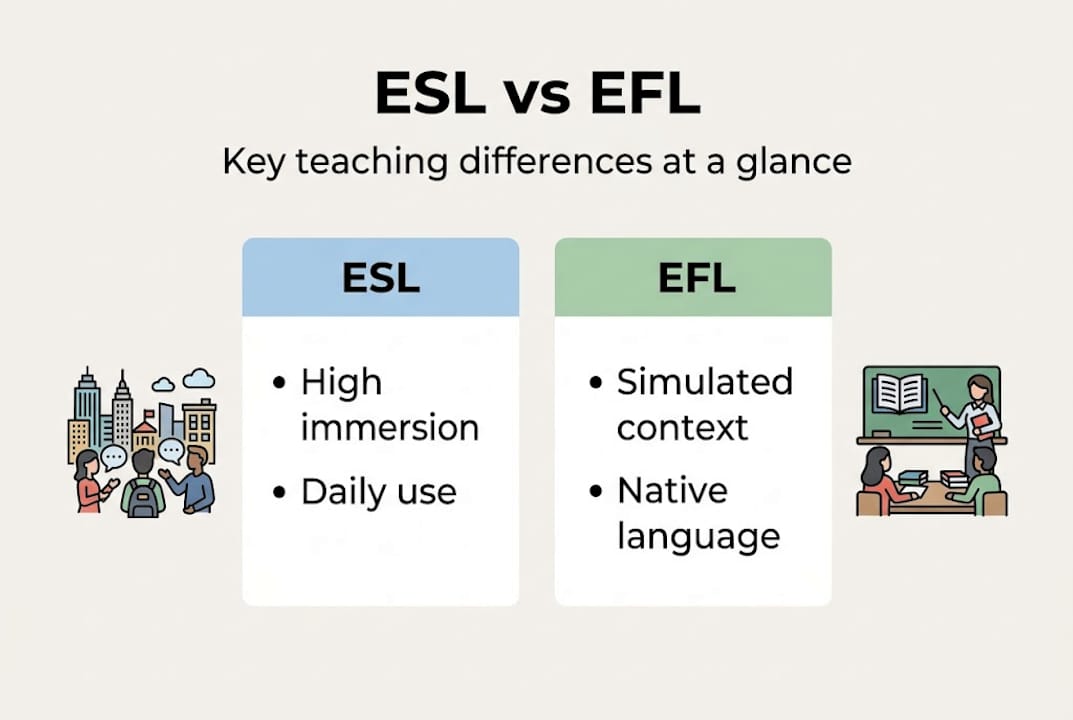
EFL, or English as a Foreign Language, describes the teaching and learning of English in a country where English is not used as the primary language of daily communication. A student in South Korea attending private English tutoring classes, or a business professional in Brazil enrolled in corporate English training, is learning EFL. Once the lesson ends, English essentially disappears from their daily environment.
As defined in the field, ESL refers to learning and teaching English in an English-speaking country where learners are immersed in the language daily, while EFL refers to learning and teaching English in a non-English-speaking country with limited exposure outside the classroom. That single environmental factor drives almost every difference in curriculum design, teaching approach, and learner progress.
Consider what this means practically:
- ESL learners receive continuous reinforcement outside class, making fluency development more organic and rapid.
- EFL learners depend almost entirely on structured classroom time, supplemented by whatever media or independent study they pursue.
- ESL classrooms tend to serve learners from many different language backgrounds, creating a genuinely multilingual environment.
- EFL classrooms often serve a group of learners who share the same first language, which changes how teachers explain concepts and handle errors.
“The difference between ESL and EFL is not about the quality of English being taught. It is about the conditions under which learning happens.”
This distinction also affects curriculum priorities. An ESL program in Canada may emphasize social English, workplace communication, and cultural orientation because learners need those skills immediately. An EFL program in Japan may place more weight on grammar accuracy, written proficiency, and test preparation because learners are building knowledge for future use rather than daily survival.
Knowing this from the outset shapes how you plan every lesson, choose every activity, and evaluate every learner.
Core classroom differences: Immersion, practice, and student needs
With definitions established, the practical classroom implications become much clearer. The two environments differ in immersion level, student composition, available practice opportunities, and instructional priorities.
| Feature | ESL classroom | EFL classroom |
|---|---|---|
| Immersion level | High (English used daily outside class) | Low (English confined to classroom) |
| Student backgrounds | Diverse first languages | Often a shared first language (L1) |
| Real-world practice | Constant, organic, unavoidable | Limited, dependent on deliberate effort |
| Instructional focus | Communication, integration, social skills | Grammar, vocabulary, structured output |
| Teacher role | Facilitator and cultural guide | Primary knowledge provider |
Research confirms these key mechanics differences: ESL features high immersion, real-life practice, and diverse student backgrounds, while EFL has low immersion, classroom-only practice, and often homogeneous groups sharing a first language. These are not minor variations. They represent fundamentally different learning ecosystems.
In an ESL setting, the teacher’s job is partly to harness what students already encounter outside class and connect it to formal instruction. A student might come to class having struggled to understand a medical appointment or a bank form. That real-world experience becomes teaching material. Lessons can be anchored in authentic, relevant challenges the learner is already facing.

In an EFL setting, no such organic material exists. The teacher must construct relevance and simulate contexts where English is useful. This requires greater creativity in lesson design and a much stronger emphasis on motivating students to engage with English beyond class time.
Student diversity also matters enormously. In a typical ESL classroom in the United Kingdom, you might have learners from Pakistan, Nigeria, Brazil, and Vietnam all sitting together, none of them sharing a first language. The only language they have in common is the one they are all learning. This forces authentic communication in English from day one and limits the temptation to revert to a shared native language.
In most EFL classrooms, students share a mother tongue. A teacher in Thailand is almost certainly working with learners who can all speak Thai. The risk of code-switching (falling back to the shared language) is constant. Managing this, and designing instruction that keeps students engaged in English throughout the lesson, is a specific skill EFL educators need to develop.
Pro Tip: If you are transitioning from an EFL environment to an ESL one, resist the urge to over-explain grammar rules. ESL learners often benefit more from exposure and guided practice than from formal analysis. A good ESL classroom setup guide can help you rethink the physical and instructional structure of your space for maximum engagement.
Key teaching strategies for ESL and EFL success
Understanding the mechanics of each context is only useful if it translates into concrete instructional decisions. Effective educators tailor their strategies to the realities of their environment.
Experienced educators acting as ESL facilitators and EFL knowledge providers represent two genuinely distinct professional identities. Both require skill, but the skills themselves differ in important ways.
For ESL educators, the priorities typically include:
- Cultural integration activities. Help students make sense of the society they are living in. Role-playing job interviews, navigating government services, or practicing small talk in a local context builds functional competence quickly.
- Leveraging diverse student backgrounds. Multicultural classrooms are rich resources. Encouraging students to share perspectives from their home cultures builds communication skills and mutual understanding simultaneously.
- Task-based learning. Give learners real-world tasks to complete in English, such as researching and presenting on a local issue, writing a formal complaint letter, or conducting a structured interview with a classmate.
- Error correction calibrated to fluency. In ESL settings, over-correcting can stall communication. Focus correction on errors that impede understanding rather than every grammatical imperfection.
For EFL educators, effective strategies look somewhat different:
- Explicit grammar instruction. Without constant real-world reinforcement, students need clear rules and structured practice. Teach grammar systematically and provide plenty of controlled exercises before moving to freer practice.
- Vocabulary building through repetition and context. EFL learners encounter far fewer opportunities to encounter new words naturally. Spaced repetition, word mapping, and contextual vocabulary activities compensate for limited outside exposure.
- Encouraging independent English use. Assign media consumption as homework. Students who watch English-language films, read English news, or follow English-language social media accounts are extending their learning time substantially.
- Creating communicative necessity in class. Design activities where students genuinely need English to participate, making reverting to the first language less convenient than simply using English.
Pro Tip: For online educators working across contexts, setting up your virtual classroom well before instruction begins is critical. A structured online ESL class setup and a clear plan for planning online ESL lessons give you tools that work in both ESL and EFL digital environments.
Online teaching, increasingly, is dissolving the traditional barriers between ESL and EFL. A learner in Vietnam working with a teacher in Canada via video call occupies a genuinely hybrid space. The learner is technically in an EFL environment geographically, but has access to immersive, native-speaker instruction. This blending of contexts is one of the most significant developments in language teaching today.
Learning outcomes and evidence: Academic impacts in both contexts
It is tempting to assume that ESL learners, surrounded by English constantly, will always outperform EFL learners. The research is more nuanced than that.
Studies show morphological interventions improve reading outcomes similarly regardless of learning context, and blended learning approaches boost EFL proficiency with post-test gains equivalent to a Cohen’s d of 0.74, which represents a large effect in educational research terms. Explicit grammar instruction in EFL writing contexts reduces errors by 30 to 40 percent. These are significant, measurable results achieved without immersion.
| Intervention | Context | Measured outcome |
|---|---|---|
| Blended learning | EFL | Cohen’s d = 0.74 proficiency gain |
| Explicit grammar teaching | EFL writing | 30 to 40% error reduction |
| Morphological instruction | Both ESL and EFL | Similar reading improvements |
| Immersion environment | ESL | Faster conversational fluency |
At the same time, immersion correlates with faster fluency gains, and the benefits of living in an English-speaking country are real. An ESL learner in a full-time English environment typically develops conversational confidence more quickly than a motivated EFL learner studying part-time. But “faster” does not mean “better” in any permanent sense.
Highly motivated EFL learners who actively supplement their classroom instruction with reading, media consumption, and conversation practice can achieve levels of fluency and accuracy that rival or exceed those of ESL learners who do not engage actively outside class. Motivation and instructional quality matter at least as much as environment.
This means educators working in either context should avoid fatalism. An EFL teacher is not at an automatic disadvantage. A thoughtfully designed EFL curriculum built around evidence-based ESL teaching methodologies and incorporating effective ESL teaching methods produces real, documented gains. The key is aligning instruction with the specific needs and constraints of the learning environment, rather than defaulting to generic approaches that ignore context.
Choosing your path: Career considerations and classroom realities
For educators in the early stages of their careers, or considering a shift in direction, understanding the ESL/EFL divide is also a career planning tool.
The best context for any given educator depends on individual professional goals, preferred teaching style, tolerance for cultural complexity, and personal circumstances. Consider these factors carefully:
- Multicultural interest. If you are drawn to working with diverse groups, navigating multiple cultural frames, and supporting learners through real social integration challenges, ESL environments will likely energize you.
- Language instruction focus. If you prefer structured curriculum design, explicit grammar teaching, and a more formal instructional relationship, EFL is often the better fit.
- Geographic preferences. EFL careers almost always involve travel or relocation abroad. Countries like South Korea, Japan, China, Spain, and many Middle Eastern nations have significant demand for qualified EFL teachers. ESL positions are concentrated in English-speaking countries.
- Job market factors. Both sectors have strong demand, but the nature of that demand differs. ESL positions in English-speaking countries often require local credentials and work authorization. EFL positions abroad may require a TEFL certification and a university degree, with fewer additional barriers.
- Student age and level. Both ESL and EFL contexts offer opportunities across age groups and proficiency levels. However, young learner EFL programs in Asia are among the most accessible entry points for new teachers without prior classroom experience.
It is also worth noting that the ESL/EFL distinction is based on location and linguistic context, not on the order in which a person learned their languages. A learner for whom English is technically a third or fourth language, living in the United States, is still an ESL learner by definition. The label describes the learning environment, not the learner’s personal language history.
Hybrid contexts are also increasingly common. Explore current ESL teaching trends to understand how global mobility, digital platforms, and shifting immigration patterns are changing both sectors in ways that create new opportunities for flexible educators.
Why the ESL/EFL divide matters and why it’s fading
The ESL/EFL distinction remains a genuinely useful framework for understanding teaching contexts and designing instruction. But it is worth acknowledging that the traditional boundaries are eroding. Digital platforms now allow an EFL learner in Indonesia to receive live tutoring from a teacher in Ireland, access Hollywood films with subtitles, join international English-speaking online communities, and consume news from English-language sources around the clock. The immersion gap that once clearly separated ESL and EFL environments is narrowing.
Educators who recognize this shift are better positioned than those who treat the categories as fixed and permanent. The types of online teaching that now dominate the industry require practitioners to be fluent in both ESL and EFL principles simultaneously, because a virtual classroom may contain learners from ten different countries with ten different immersion levels. The ability to adapt is no longer optional. It is the core professional skill that separates effective modern educators from technically qualified but inflexible ones. Career success in this field increasingly goes to those who understand both contexts deeply and can shift between them without losing instructional clarity.
Get certified and shape your teaching future
Whether your goal is to work in an ESL setting domestically or build an EFL career teaching abroad, the right certification makes you eligible for both. Accredited TEFL training equips you with methodologies, practical frameworks, and recognized credentials that employers in every English-teaching market expect.

TEFL courses from the TEFL Institute are designed to prepare educators for real classroom environments, covering both ESL and EFL contexts with current, evidence-based content. Whether you are starting your career or expanding your qualifications, the institute offers flexible programs including advanced diplomas, micro-credentials, and hybrid courses with practicum options. If you are ready to teach English with confidence in any context, accredited certification is the most direct path forward.
Frequently asked questions
Can EFL students reach the same fluency as ESL students?
Yes, EFL learners can achieve high fluency with consistent practice and deliberate exposure to English through supplemental media, conversation practice, and independent study.
Is ESL easier to teach than EFL?
Neither context is inherently easier; each demands a specific set of skills and approaches, and both require well-trained, adaptable educators to produce strong outcomes.
Do online lessons blur the lines between ESL and EFL?
Yes, online teaching blurs the traditional lines between ESL and EFL by enabling hybrid learning experiences where geography no longer dictates a learner’s level of English exposure.
Are there different certification requirements for ESL and EFL teachers?
Most internationally recognized certifications, including TEFL, qualify candidates for both ESL and EFL positions, though specific requirements vary by employer, institution, and the country where you intend to teach.
Recommended
TEFL Institute guides

Italy
Jobs, pay and visa routes
Taiwan
Buxibans, pay and visas
South Korea
EPIK, hagwons and pay
Portugal
Jobs, pay and visa routes
Czech Republic
Pay, visas and cities