

 United Kingdom (UK)
 United States (US)
 Canada
 South Africa
 India
India Australia
 New Zealand
 China
China Russia
 Germany
 France
 Spain
Spain Netherlands
 Vietnam
 United Arab Emirates
 Italy
Italy Poland
 Thailand
 Türkiye










 Algeria



TEFL Requirements by Country: What Varies Worldwide
TEFL Requirements by Country: What Varies Worldwide
Quick Answer: TEFL Requirements by Country 2026
Most countries require a minimum 120-hour TEFL certificate to teach English abroad in 2026, but requirements vary significantly by region — degree requirements, visa rules, and language proficiency standards all differ. Here’s a concise breakdown by region:
- Asia (South Korea, Japan, China): Bachelor’s degree mandatory + TEFL certificate + background check; Vietnam more flexible — TEFL certificate alone often sufficient
- Middle East (UAE, Saudi Arabia, Qatar, Kuwait): Bachelor’s degree required + Level 5 TEFL or CELTA preferred; salaries $2,000–$5,900/month tax-free
- Europe (Spain, Germany, Czech Republic): TEFL certificate essential; Germany and Spain prefer advanced qualifications; Czech Republic more flexible
- Latin America (Brazil, Mexico): TEFL certification highly recommended; requirements generally more flexible than Asia or Middle East
- Central Asia / Eurasia (Kyrgyzstan, Uzbekistan, Tajikistan): No degree required; 120-hour TEFL sufficient; Georgia & Armenia also degree-optional
- Level 5 TEFL Diploma: Ofqual-regulated, CELTA-equivalent — opens higher-paying positions in all regions; costs $300–$1,500 vs CELTA’s $1,500–$2,500
- Universal minimum: 120-hour TEFL + clean background check + native or near-native English proficiency
2026 Market Update (Last Reviewed: March 2026): Global TEFL hiring requirements are tightening in key markets. South Korea’s EPIK programme continues to require a bachelor’s degree plus TEFL certification, with 2026 intake applications now open. China has reinforced its Z-visa degree authentication requirements following 2024 policy updates, making degree apostille verification mandatory. Vietnam remains one of the most accessible markets — many positions still accept TEFL certificate holders without degrees, though demand for Level 5 Diploma holders is growing. The UAE’s ADEK programme now lists Ofqual Level 5 TEFL as an accepted qualification equivalent to CELTA for government school placements. Spain’s language assistant programmes are fully subscribed for the 2025–26 academic year. Turkey uniquely requires non-native English speakers to hold IELTS 7.0+ or TOEFL 100+. All requirement data reflects verified 2026 hiring standards.
m.supabase.co/storage/v1/object/public/blog-images/organization-5175/1770456860082_image.png” alt=”Teacher preparing lesson in classroom setting”>
Searching for budget-friendly ways to teach English abroad can feel overwhelming, especially when every country sets its own rules. Aspiring teachers in Europe often need to stretch limited resources while meeting professional standards across borders. This guide highlights TEFL certification options that combine affordability with the practical requirements demanded in countries like Germany, Spain, and the Czech Republic, helping you confidently chart your teaching path without overspending.
Table of Contents
- What TEFL Certification Means and Involves
- TEFL Requirements: Global Similarities and Differences
- Asia, Europe, and Americas: Country-Specific TEFL Rules
- Degree, Visa, and Language Criteria Explained
- Common Challenges and How to Meet Standards
Key Takeaways
| Point | Details |
|---|---|
| TEFL Certification Importance | A TEFL certification is essential for teaching English to non-native speakers and is often required by international employers. |
| Global Requirements Variation | Requirements for TEFL certification vary by region, with some countries demanding advanced degrees or specific language skills. |
| Documentation and Challenges | Aspiring teachers must navigate complex documentation, including visas, background checks, and proof of qualifications. |
| Cultural Adaptability | Employers increasingly prioritize candidates who demonstrate cultural sensitivity and adaptability in diverse educational environments. |
What TEFL Certification Means and Involves
A TEFL certification represents a specialized credential designed for teaching English to non-native speakers, typically in international settings. TEFL certification requirements demonstrate a professional’s foundational understanding of language instruction methodologies and classroom management techniques.
TEFL certifications generally involve comprehensive training across multiple critical areas:
- Language teaching theory and methodology
- Classroom management strategies
- Lesson planning techniques
- Grammar instruction principles
- Cultural awareness and communication skills
- Practice teaching components
Most professional TEFL programs require approximately 120 training hours, which has become the industry standard for international teaching positions. These programs typically blend theoretical coursework with practical teaching experiences, ensuring educators develop both knowledge and hands-on skills needed for effective language instruction.
The certification process prepares teachers to work in diverse educational environments, from private language schools to public institutions across different countries. Successful completion demonstrates a standardized level of professional competence that many international employers require when hiring English language instructors.
Pro tip: Research multiple TEFL certification programs to ensure they offer comprehensive training and are recognized by international educational institutions.
TEFL Requirements: Global Similarities and Differences
When exploring international English teaching opportunities, aspiring educators encounter a complex landscape of teaching requirements for overseas jobs. While specific regulations vary by country, several fundamental similarities exist in TEFL certification standards worldwide.
Global TEFL requirements typically share several key characteristics:
- Minimum 120-hour training certification
- Demonstrated English language proficiency
- Basic understanding of teaching methodologies
- Proof of educational credentials
- Background check clearance
- Native or near-native English speaking ability
However, significant differences emerge across different regions. Some countries maintain strict requirements, demanding advanced degrees or extensive teaching experience, while others have more flexible entry standards. Asian countries like South Korea and Japan often require bachelor’s degrees alongside TEFL certifications, whereas some Eastern European and Latin American countries might accept candidates with only language teaching credentials.

International schools and language institutes typically prioritize candidates who demonstrate not just technical certification, but also cultural adaptability and communication skills. This means that beyond formal qualifications, employers increasingly value candidates who can navigate cross-cultural environments and show genuine commitment to language education.
Pro tip: Research specific country requirements thoroughly, as immigration and teaching regulations can change rapidly and vary significantly between regions.
Asia, Europe, and Americas: Country-Specific TEFL Rules
Navigating the complex world of international English teaching requires a nuanced understanding of TEFL certification requirements across different regions. Each continent presents unique challenges and opportunities for aspiring English language instructors.
Country-specific TEFL regulations vary significantly across different regions:
Asian Countries:
- South Korea: Bachelor’s degree mandatory, TEFL certification required
- Japan: Native English speaker preference, degree and TEFL certification needed
- China: Bachelor’s degree, TEFL certification, and clean background check
- Vietnam: More flexible requirements, some positions accept only TEFL certification
European Countries:
- Germany: Strong preference for advanced qualifications
- Spain: TEFL certification crucial, additional language skills valued
- Czech Republic: Less strict requirements, more emphasis on practical teaching skills
North and South American Countries:
- United States: Domestic TEFL jobs often require state teaching licenses
- Brazil: Growing market with increasing professional certification standards
- Mexico: TEFL certification highly recommended for competitive positions
Employers in different regions prioritize various aspects of professional preparation. While some countries focus heavily on academic credentials, others emphasize practical teaching experience and cultural adaptability. This means that a one-size-fits-all approach to international teaching simply does not work.
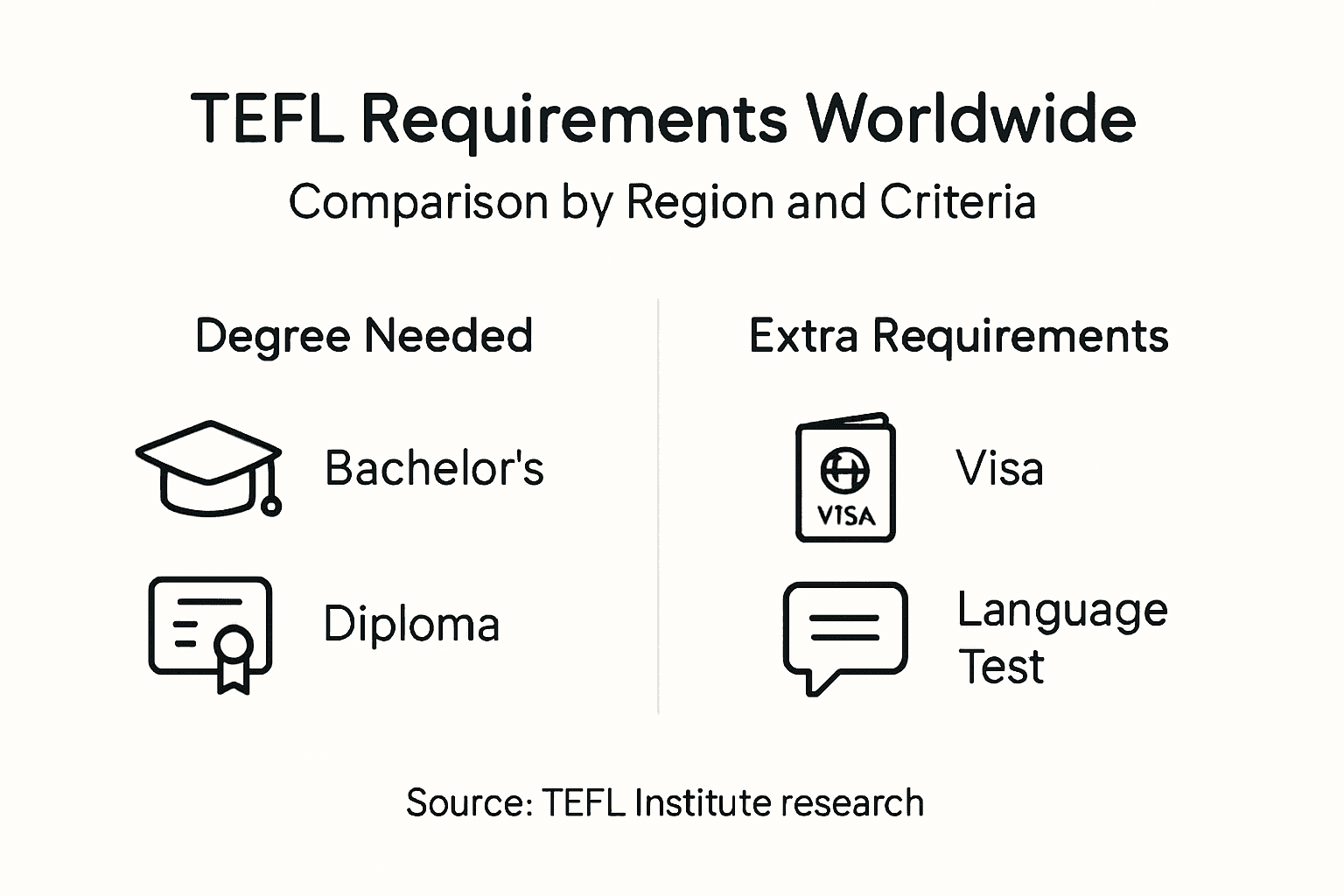
Here’s a summary of how TEFL requirements differ by region:
| Region | Typical Degree Needed | Extra Requirements | Employer Focus |
|---|---|---|---|
| Asia | Bachelor’s degree | Background check, TEFL cert | Credentials, native fluency |
| Europe | Often advanced degree | Language skills, TEFL cert | Practical skills, adaptability |
| Americas | Varies by country | State license (US), TEFL cert | Certification, local norms |
Pro tip: Always verify current immigration and work regulations directly with official government sources, as requirements can change rapidly.
Degree, Visa, and Language Criteria Explained
Understanding the intricate requirements for international English teaching involves navigating complex work visa processes for English teachers. These criteria encompass multiple dimensions beyond basic teaching qualifications.
Key criteria typically include:
Degree Requirements:
- Bachelor’s degree (preferred in most countries)
- Some regions accept associate degrees
- Specific fields like education or linguistics valued
- Degree from accredited institutions mandatory
Visa Considerations:
- Work authorization specific to teaching profession
- Passport validity requirements
- Background check documentation
- Proof of financial stability
- Health insurance documentation
Language Proficiency Criteria:
- Native or near-native English speaking ability
- Standardized test scores (TOEFL, IELTS)
- Additional language skills considered bonus
- Regional accent and pronunciation evaluations
Each country maintains unique immigration policies that intersect with educational employment regulations. This means aspiring teachers must meticulously research specific requirements for their target destination, understanding that blanket assumptions can lead to significant complications.
Pro tip: Always consult official embassy websites and maintain updated documentation to ensure smooth international teaching transitions.
Common Challenges and How to Meet Standards
Aspiring TEFL teachers often encounter significant obstacles when pursuing international teaching opportunities, particularly when navigating teaching options without traditional credentials. Understanding these challenges is crucial for successful career planning.
Common challenges in TEFL certification and employment include:
Documentation Hurdles:
- Complex visa application processes
- Extensive paperwork requirements
- Credential verification challenges
- International background check complications
- Language proficiency documentation
Professional Qualification Barriers:
- Inconsistent certification standards
- Regional credential recognition issues
- Limited teaching experience opportunities
- Financial investment in additional training
- Competitive job market expectations
Cultural and Linguistic Adaptation:
- Communication skill gaps
- Cultural sensitivity requirements
- Accent and pronunciation challenges
- Understanding local educational systems
- Navigating workplace cultural norms
Successful TEFL professionals develop strategic approaches to overcome these challenges. This involves continuous learning, flexibility, and proactive professional development. Candidates must remain adaptable and committed to meeting evolving international teaching standards.
Below is a quick reference for key documents needed for international teaching:
| Document Type | Purpose | Common Issues Encountered |
|---|---|---|
| Degree Transcript | Proof of educational history | Delays in verification |
| Background Check | Visa and employment clearance | Extra steps for international checks |
| English Test Score | Language proficiency proof | Test score expiration or mismatch |
| Health Insurance | Visa and workplace requirement | Coverage sometimes lacking abroad |
Pro tip: Build a comprehensive portfolio documenting your language skills, teaching experiences, and cultural adaptability to stand out in competitive international job markets.
Master TEFL Requirements and Unlock Global Teaching Opportunities
Navigating the varying TEFL requirements across countries can feel overwhelming with diverse degree standards, visa rules, and certification expectations affecting your teaching career plans. The key challenges like understanding which documents to prepare and meeting country-specific criteria are critical to overcome. At TEFL Institute, we provide tailored online TEFL courses designed to build your confidence and meet international teaching standards with comprehensive training and flexible study options.
Start your journey with TEFL Institute where you can explore our extensive course catalog, including diplomas and niche certifications that align perfectly with regional requirements. Don’t let uncertainty hold you back. Act now to gain recognized credentials and expert guidance, helping you meet global TEFL requirements and open doors to teaching around the world. Visit our site and find the course that fits your goals today.
Frequently Asked Questions
What are the common TEFL certification requirements worldwide?
Common TEFL certification requirements generally include a minimum of 120 hours of training, demonstrated English language proficiency, a basic understanding of teaching methodologies, proof of educational credentials, a background check clearance, and native or near-native English speaking ability.
How do TEFL requirements differ between countries?
TEFL requirements can vary significantly by country, with some nations requiring specific degrees or teaching experience while others may have more flexible standards. It’s essential to research the specific requirements for the country you’re interested in teaching in.
What is the typical duration of TEFL certification programs?
Most professional TEFL programs require approximately 120 training hours, which has become the industry standard for international teaching positions. This often combines theoretical coursework with practical teaching experiences.
Are there any additional criteria for teaching English abroad?
In addition to TEFL certification, candidates often need a bachelor’s degree, meet visa requirements, and maintain proof of English language proficiency. Some regions may also value cultural adaptability and communication skills alongside formal qualifications.
Recommended
- Can I Teach English Abroad Without a Degree? Complete Guide with Country Requirements | TEFL Institute
- 7 Essential Steps for Landing Teaching Overseas Jobs | TEFL Institute
- TEFL Teacher Salary Guide: Complete Earnings Breakdown by Country | TEFL Institute
- Top 10 Cities to Teach English in Germany, Salaries & Visas 2026 | TEFL Institute | TEFL Institute
