

 United Kingdom (UK)
 United States (US)
 Canada
 South Africa
 India
India Australia
 New Zealand
 China
China Russia
 Germany
 France
 Spain
Spain Netherlands
 Vietnam
 United Arab Emirates
 Italy
Italy Poland
 Thailand
 Türkiye









 Algeria


A TEFL practicum is supervised teaching practice with real English learners, usually observed by an experienced teacher who gives feedback. It can be classroom teaching, one to one tutoring or observed online lessons. It turns the theory in your TEFL course into practical classroom experience you can talk about in interviews.
How to Find TEFL Practicum for Global Teaching Success
Updated 8 October 2026: practicum routes and hiring requirements re-checked.
A TEFL practicum is supervised teaching practice with real English learners, and you can find one in four ways: through a hybrid TEFL course that includes classroom hours, a paid internship abroad, volunteering with a local ESL group, or supervised online tutoring. Most employers do not require a practicum, but a short one makes your first class far less daunting.

Plenty of new teachers worry that an online course leaves them unready for a real room. A practicum closes that gap. This guide explains what counts, where to find one, how to choose between options and how to record the hours so employers can see them.
Key takeaways
- A practicum means teaching real learners with feedback, not just watching videos.
- Most private language schools and online platforms hire on a 120-hour TEFL certificate alone; practicum is an advantage, not usually a requirement.
- The four main routes are hybrid courses, paid internships, local volunteering and supervised online tutoring.
- Choose a setting that matches the learners you want to teach later.
- Keep a signed log of hours and a supervisor’s reference. That is what makes the experience count on a CV.
What is a TEFL practicum?
A TEFL practicum is a block of real teaching practice, usually observed and given feedback by an experienced teacher. It sits alongside the theory in your course and turns lesson planning from a written exercise into something you have actually stood up and done.
Practicum can mean live classroom teaching, one to one tutoring, observed online lessons or a mix. Observation of other teachers often forms part of it too, but the hours that build confidence are the ones where you are the person teaching.
Do you need a practicum to get a TEFL job?
Usually not. Most private language academies and online platforms screen for a TEFL of at least 120 hours, a degree where the visa needs one, and a good interview. Teaching practice helps you pass that interview, especially the demo lesson, but it is rarely a written requirement.
Where practice does matter more is in competitive schools and programmes that compare candidates closely. If that is your target, a regulated Level 5 TEFL Diploma plus some documented teaching hours makes a strong pairing. Our guide to the qualifications you need to teach English abroad sets out what each region expects.
Where can you find a TEFL practicum?
You can find a TEFL practicum through your course, through an internship, through local volunteering or online. Each suits a different budget and timeline.
| Route | What it involves | Best for | Watch out for |
|---|---|---|---|
| Hybrid TEFL course | Online study plus scheduled classroom practice | People who want practice built into the course | Fixed dates and locations |
| Paid internship abroad | A placement in a school, usually with a monthly allowance | Gap years and first time teachers who want support | Placement fees; read what “paid” covers |
| Local volunteering | ESOL groups, refugee charities, libraries and community centres | Practice at home before you go | Safeguarding checks may be required |
| Supervised online tutoring | Teaching learners online with a mentor reviewing lessons | People who plan to teach online | Make sure someone actually gives feedback |
If an internship appeals, our guide to paid TEFL internships explains what they pay, what they charge and whether they are worth it.

For volunteering at home, local adult education services, refugee support charities and community ESOL classes often welcome trained volunteers. In the UK, expect a DBS check for roles involving children or vulnerable adults.
Whichever route you pick, ask who will observe you and how you will get feedback. Practice without feedback builds habits, good and bad, equally well.
Academic
The TEFL Institute Group
How to Land Your First TEFL Job
teflinstitute.comWatch on YouTube · The TEFL Institute Group
How do you choose the right practicum?
Choose the practicum that looks most like the job you want. If you plan to teach children in Asia, a young learner placement beats a business English one. If you plan to teach adults online, supervised online lessons are more useful than a primary classroom.
| What to check | Good sign | Red flag |
|---|---|---|
| Teaching hours | Most hours spent teaching, not observing | Mostly observation |
| Feedback | Observed lessons with written feedback | No observer, or a single generic comment |
| Learners | Similar to the learners you want to teach | Unrelated age group or level |
| Paperwork | Signed hours log and reference provided | Nothing in writing at the end |
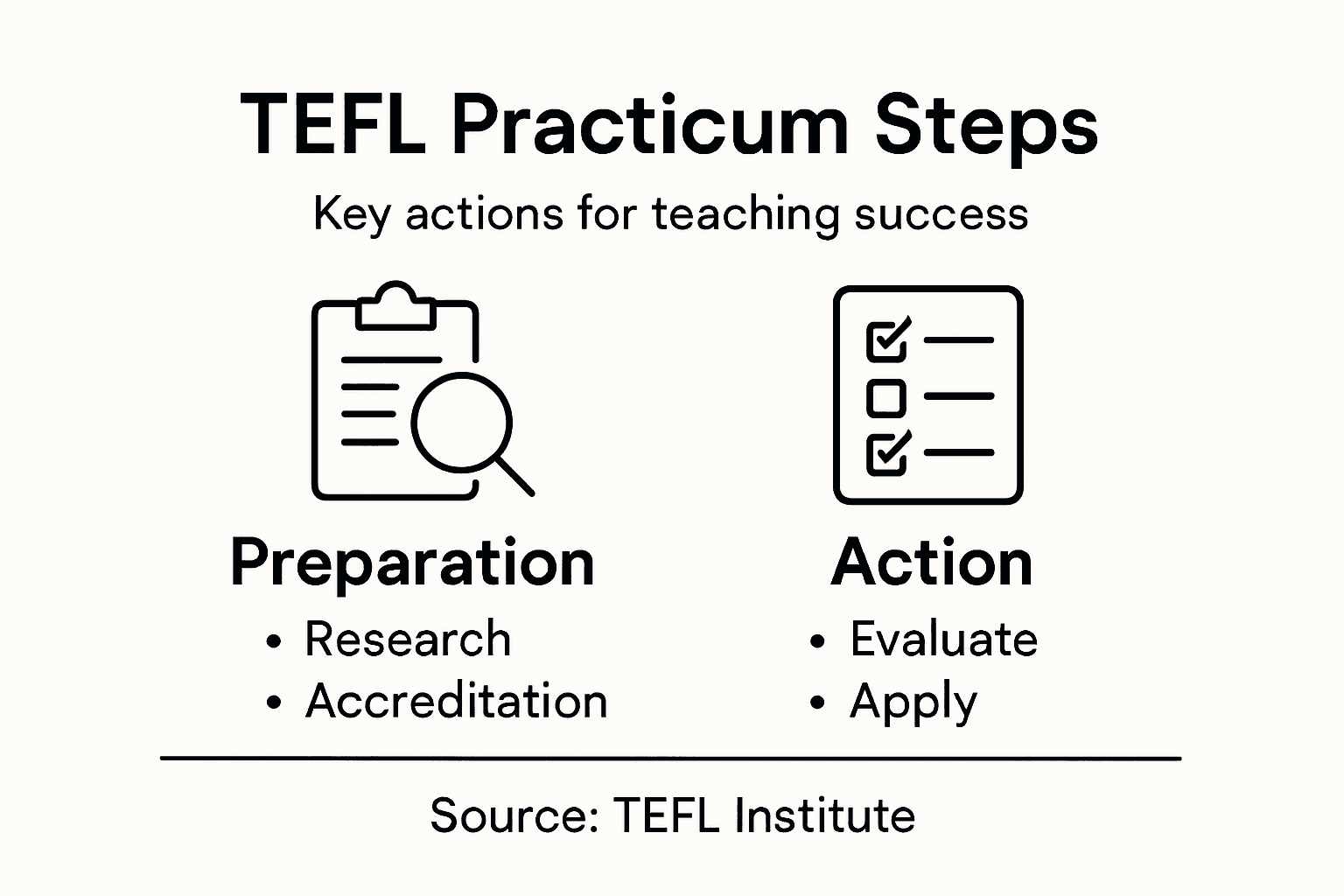
How do you record practicum hours so employers see them?
Keep a dated log of every lesson and get it signed by your supervisor before you leave. Employers trust paperwork they can check, so a clear record turns a few weeks of practice into a line on your CV that stands up in an interview.
- Hours log: date, length, number of learners, level and lesson focus.
- Observation notes: any written feedback from observed lessons.
- Reference: a short signed letter confirming your hours and performance.
- Sample lesson plan: one you taught, ready to discuss in interview.
When you reach interviews, our guide to passing a TEFL job interview shows how to use that experience in the demo lesson. For what schools check on your certificate itself, see how employers verify TEFL certificates.
Ready to get qualified and start practising?
The TEFL Institute Group is Europe’s largest TEFL trainer by teachers certified, with 161,000 teachers certified since 2017 and graduates in 80 countries. We are a Highfield Approved Centre (number 21335).
Start with the 120 Hour Advanced TEFL Course for most first jobs, or the 180 Hour Level 5 TEFL Diploma if you want a regulated qualification to pair with your teaching practice.

Ola Flynn, Head of Marketing
Head of Marketing at The TEFL Institute Group; runs our webinars and information sessions, loves travel and sharing interns’ stories, and joined our interns in Thailand for orientation.
We love taking your call.

TEFL Institute guides
Plan for 2027
China
Z visa, pay and cities
Read the guide
Plan for 2027
Italy
Jobs, pay and visa routes
Read the guide
Plan for 2027
Taiwan
Buxibans, pay and visas
Read the guide
Plan for 2027
Czech Republic
Pay, visas and cities
Read the guide
Plan for 2027
Estonia
Jobs, pay and work routes
Read the guide
Usually not. Most private language schools and online platforms hire on a TEFL certificate of at least 120 hours, plus a degree where the visa requires one. A practicum helps you pass interviews and demo lessons, and can matter more for competitive schools, but it is rarely a written requirement.
The main routes are a hybrid TEFL course with scheduled classroom practice, a paid internship abroad, volunteering with local ESOL classes, refugee charities or community centres, and supervised online tutoring. Choose the route that fits your budget and timeline and matches the learners you want to teach.
Yes. Supervised online tutoring, where a mentor reviews your lessons and gives feedback, counts as teaching practice and is especially useful if you plan to teach online. Make sure someone actually observes or reviews your lessons, because practice without feedback adds far less to your skills.
There is no universal requirement, so aim for enough real teaching to feel confident running a full lesson, not just observation. What matters most is that most hours are spent teaching, that you receive written feedback and that you finish with a signed log and reference to show employers.
Keep a dated log of each lesson with its length, learners and focus, and ask your supervisor to sign it before you leave. Add any written observation feedback, a short reference letter and a lesson plan you taught. Bring these to interviews and use the experience in your demo lesson.