

 United Kingdom (UK)
 United States (US)
 Canada
 South Africa
 India
India Australia
 New Zealand
 China
China Russia
 Germany
 France
 Spain
Spain Netherlands
 Vietnam
 United Arab Emirates
 Italy
Italy Poland
 Thailand
 Türkiye










 Algeria



What Does ESL Mean? Definition, Examples & Why It Matters
What Is ESL? Certification, Methods, and Teaching Pathways

Over 1.5 billion people are learning English worldwide, creating unprecedented demand for qualified teachers. Yet confusion persists around what ESL actually means and how it differs from TEFL, TESOL, and related certifications. This guide clarifies ESL terminology, outlines certification pathways, explores effective teaching methods, and maps career opportunities for aspiring educators. Whether you’re considering teaching abroad, online, or in English-speaking communities, understanding these distinctions shapes your training choices and professional trajectory.
Table of Contents
- Defining ESL: What does it really mean?
- ESL, EFL, TESL, TESOL, and TEFL: Key differences teachers must know
- Why certification matters: The recommended path for ESL teachers
- Inside the ESL classroom: Teaching methods, strategies, and the student journey
- Career paths and next steps: Applying your ESL credential
- Accelerate your ESL teaching journey with accredited certification
- Frequently asked questions
Key Takeaways
| Point | Details |
|---|---|
| Understand ESL definitions | ESL means teaching English to non-native speakers in English-speaking countries or settings. |
| Get certified for jobs | Accredited 120-hour TESOL/TESL certificates with practicum are standard for most ESL jobs worldwide. |
| Choose the right pathway | Recognize the differences between ESL, EFL, TEFL, and TESOL to guide your career decisions. |
| Apply best teaching methods | Successful ESL teaching blends communicative and grammar-based approaches tailored to learner needs. |
| Global demand is high | Over 1.5 billion people are learning English, creating abundant opportunities for qualified teachers. |
Defining ESL: What does it really mean?
ESL stands for English as a Second Language, referring to teaching English to non-native speakers in English-speaking environments. This context distinguishes ESL from teaching English in countries where English is not the primary language.
The term applies in several settings:
- Public schools in the United States, Canada, UK, and Australia where immigrant students learn English
- Adult education programs for refugees and new residents
- Community colleges offering English language support
- Workplace training programs for non-native English speakers
Understanding where ESL fits helps you target appropriate certification and job opportunities. Edge cases exist where ESL overlaps with EFL in countries with English as an official language, such as India or Singapore.
“ESL teaching focuses on helping learners function in English-dominant societies, integrating language skills with cultural adaptation and practical communication needs.”
The distinction matters because ESL teachers often work with diverse student populations navigating daily life in English. Your role extends beyond grammar instruction to supporting integration and functional communication.

ESL, EFL, TESL, TESOL, and TEFL: Key differences teachers must know
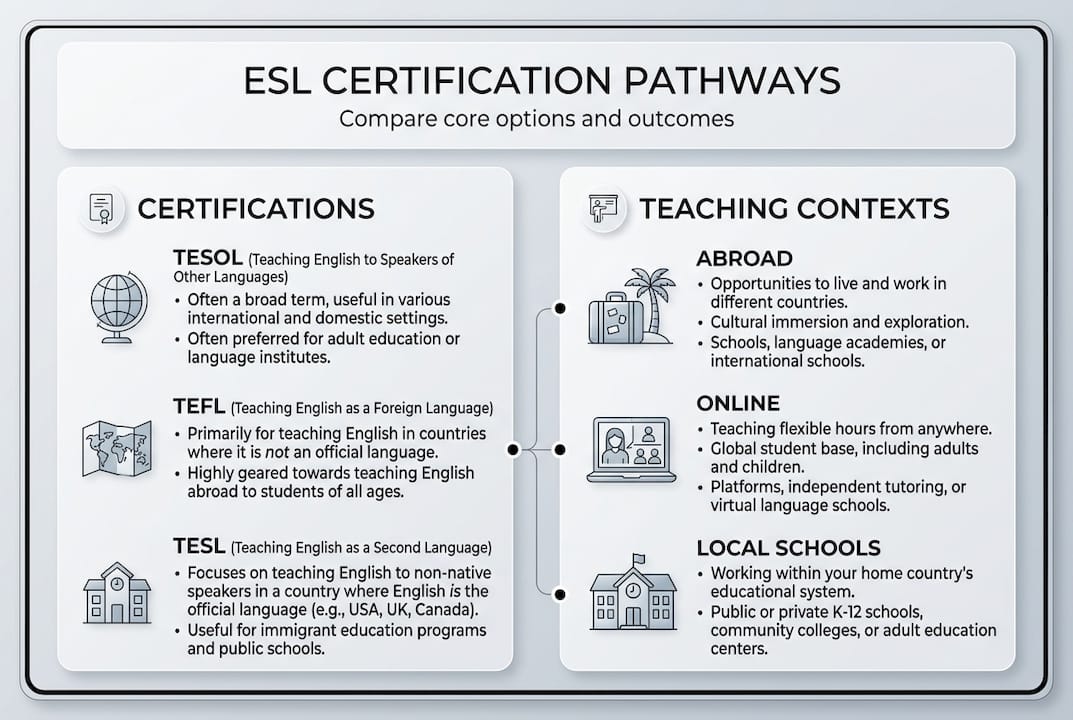
These acronyms represent different teaching contexts and certification frameworks. Clarity on each term guides your training decisions and job search strategy.
| Term | Full Name | Teaching Context | Typical Location |
|---|---|---|---|
| ESL | English as a Second Language | English-speaking countries | USA, UK, Canada, Australia |
| EFL | English as a Foreign Language | Non-English-speaking countries | China, Japan, Spain, Brazil |
| TESL | Teaching English as a Second Language | ESL certification focus | English-speaking regions |
| TESOL | Teaching English to Speakers of Other Languages | Umbrella term for both ESL and EFL | Worldwide |
| TEFL | Teaching English as a Foreign Language | EFL certification focus | Non-English-speaking countries |
TESOL serves as a broader umbrella encompassing both ESL and EFL contexts. When you see TESOL certification, it typically qualifies you for teaching in either environment.
Practical implications for your career:
- Job postings: Positions in the US often specify ESL, while overseas roles use EFL or TEFL
- Certification choice: TESOL certificates provide maximum flexibility across contexts
- Salary expectations: ESL positions in English-speaking countries may offer different compensation than EFL roles abroad
- Visa requirements: Teaching in English-speaking nations often requires additional work authorization beyond certification
Pro Tip: If you’re uncertain about your preferred teaching location, pursue teaching TEFL qualifications with TESOL designation to keep all options open.
The certification you choose signals your intended teaching context to employers. TESL certificates emphasize ESL methodology, while TEFL focuses on foreign language contexts. TESOL bridges both, making it the most versatile choice for new teachers.
Why certification matters: The recommended path for ESL teachers
Aspiring ESL teachers should pursue accredited 120+ hour certifications with teaching practice components. This standard has become the baseline expectation across most teaching platforms and language schools.
The certification landscape breaks down into tiers:
| Certification Level | Hours | Components | Career Impact |
|---|---|---|---|
| Basic | 40-60 | Theory only | Limited job access, volunteer roles |
| Standard | 120 | Theory + grammar + methodology | Most online platforms, language schools |
| Advanced | 120+ with practicum | Observed teaching practice | Premium positions, higher pay |
| Professional | CELTA, Trinity Level 5 | Intensive practicum + assessment | Top-tier schools, management track |
Research shows 76% of online teaching platforms require 120+ hour certificates, with CELTA and Trinity Level 5 preferred for premium positions. The practicum component proves critical because it demonstrates actual classroom competence beyond theoretical knowledge.
Step-by-step certification pathway:
- Research accredited programs: Verify recognition by employers in your target region
- Confirm hour requirements: Minimum 120-hour courses with practicum meet most employer standards
- Evaluate practicum options: Look for observed teaching with feedback from qualified trainers
- Check specialization offerings: Some programs include business English, young learners, or exam preparation
- Review completion timelines: Self-paced online courses range from 4 weeks to 6 months
- Verify certificate format: Ensure physical and digital certificates for visa applications
Comparing top TESOL courses reveals significant variation in practicum quality and employer recognition. The 120-hour TEFL course standard emerged as the industry baseline because it provides sufficient time to cover methodology, lesson planning, and classroom management.
Regional considerations matter. If you’re based in Texas, TEFL certification in Texas may offer local practicum opportunities. For maximum flexibility, an online TEFL course guide helps you compare remote options with virtual teaching practice.
Pro Tip: Before enrolling, confirm whether your target employers accept online certification. Most do, but some countries require in-person training components for visa sponsorship.
Understanding TESOL exam pathways clarifies assessment formats and pass requirements. Most reputable programs use continuous assessment rather than single high-stakes exams, evaluating your teaching performance throughout the course.
Inside the ESL classroom: Teaching methods, strategies, and the student journey
Blending communicative methods with grammar instruction produces optimal results in ESL teaching. This balanced approach addresses both fluency and accuracy, meeting diverse learner needs.
Effective ESL instruction incorporates:
- Communicative Language Teaching (CLT): Students practice real-world communication through role-plays, discussions, and task-based activities
- Grammar-Translation: Explicit grammar instruction with native language support where appropriate
- Task-Based Learning: Students complete meaningful tasks that require English use, such as planning events or solving problems
- Content-Based Instruction: Teaching English through subject matter like history or science
The daily reality of ESL teaching varies by context. In physical classrooms, you manage diverse proficiency levels, cultural backgrounds, and learning styles simultaneously. Online teaching requires different skills: managing technology, maintaining engagement through screens, and adapting materials for digital delivery.
Student profiles in ESL settings include:
- Recent immigrants building foundational English for daily life
- International students preparing for academic programs
- Working professionals needing English for career advancement
- Refugees developing language skills for integration
- Children of non-English-speaking families in public schools
“Successful ESL teachers recognize that language learning intertwines with identity, culture, and personal goals. Your role extends beyond vocabulary and grammar to supporting students’ broader integration and success.”
Practical classroom management strategies from effective ESL teaching methods emphasize clear routines, visual supports, and scaffolded instruction. Establishing predictable lesson structures helps students focus on language rather than navigating classroom procedures.
Boosting student outcomes requires targeted approaches. Oral proficiency teaching tips highlight the importance of maximizing student talk time, providing error correction that builds confidence, and creating low-anxiety speaking opportunities.
For new teachers, classroom management tips address common challenges like mixed-level classes, student motivation, and behavior management across cultural contexts. A practical teaching checklist ensures you cover essential elements in every lesson: clear objectives, varied activities, comprehension checks, and meaningful practice.
Pro Tip: Record yourself teaching and review the footage. You’ll notice patterns in your questioning techniques, wait time, and student engagement that aren’t apparent during live instruction.
Career paths and next steps: Applying your ESL credential
ESL certification opens diverse career pathways across geographic locations and teaching contexts. Understanding these options helps you align certification choices with professional goals.
Job categories for ESL-certified teachers:
- Language schools abroad: Private institutions in non-English-speaking countries hiring native English speakers
- Online teaching platforms: Companies connecting teachers with students globally for virtual instruction
- Public school ESL programs: Positions in K-12 schools supporting English language learners
- University intensive English programs: Academic preparation courses for international students
- Corporate training: Business English instruction for companies with international operations
- Private tutoring: Independent teaching serving individual students or small groups
CELTA and Trinity Level 5 certifications remain preferred for premium positions offering higher salaries and better working conditions. These intensive programs require significant time investment but accelerate career progression.
Moving from certification to employment involves:
- Building your teaching portfolio: Document lesson plans, student feedback, and teaching videos from practicum
- Targeting job markets: Research visa requirements, salary ranges, and cost of living in preferred locations
- Networking strategically: Join online teaching communities, attend TESOL conferences, and connect with alumni
- Customizing applications: Tailor resumes and cover letters to specific school contexts and student populations
- Preparing for interviews: Practice teaching demonstrations and be ready to discuss methodology
Professional growth extends beyond initial certification. Specializations in young learners, business English, exam preparation, or academic English increase your marketability. Advanced credentials like the DELTA or master’s degrees in TESOL open pathways to teacher training, curriculum development, and program management.
Comparing options through resources like compare TESOL courses helps you evaluate which additional training aligns with career objectives. Some teachers pursue multiple specializations to diversify income streams, combining online teaching with in-person classes or private tutoring.
Pro Tip: Start building your professional network during certification. Your course cohort becomes a valuable resource for job leads, teaching ideas, and career advice throughout your teaching journey.
Accelerate your ESL teaching journey with accredited certification
Ready to transform your interest in ESL teaching into a qualified career? The path from curiosity to classroom competence starts with recognized certification that employers trust and students benefit from.
TEFL Institute provides accredited certification programs designed for aspiring ESL and TEFL teachers at every career stage. Whether you’re exploring teaching for the first time or enhancing existing qualifications with specialized training, accredited TEFL certifications offer structured pathways to classroom readiness. Programs include the essential 120-hour foundation, advanced diplomas, and niche specializations that align with your teaching goals and target student populations. Explore certification options that match your timeline, budget, and career objectives.
Frequently asked questions
Is ESL certification the same as TEFL or TESOL?
No, ESL describes the teaching field, while TEFL and TESOL are certification types. TESOL serves as an umbrella term covering both ESL and EFL contexts, making it the most versatile credential.
How many hours of training do I need to teach ESL online or abroad?
Most employers require at least 120 hours of accredited training with observed teaching practice. This standard ensures you’ve covered essential methodology and demonstrated classroom competence.
What kinds of jobs can I get with an ESL certificate?
ESL-certified teachers work in language schools, K-12 programs, online platforms, and private tutoring worldwide. CELTA and Trinity Level 5 holders access premium positions with higher compensation and better working conditions.
Do I need to speak another language to teach ESL?
No, most positions don’t require second language proficiency. ESL instruction occurs in English-speaking environments where teaching methods emphasize direct English communication without translation.
Is the demand for ESL teachers growing worldwide?
Yes, with over 1.5 billion English learners globally, qualified ESL teachers remain in high demand. This growth spans online platforms, international schools, and English-speaking countries with immigrant populations.