United Kingdom (UK)
 United States (US)
 Canada
 South Africa
 India
India Australia
 New Zealand
 China
China Russia
 Germany
 France
 Spain
Spain Netherlands
 Vietnam
 United Arab Emirates
 Italy
Italy Poland
 Thailand
 Türkiye









 Algeria


Certificate of achievement explained: value for TEFL teachers
Certificate of achievement explained: value for TEFL teachers

TL;DR:
- A certificate of achievement is a formal document recognizing the completion of a specific program or criteria but does not serve as a professional teaching license. It signals engagement with training but varies in value depending on accreditation and industry recognition. Carefully evaluating program credentials and understanding their distinctions from certifications and diplomas ensures better career and employment opportunities in TEFL.
Many aspiring English language teachers encounter a wall of credential terminology before they even step into a classroom. Terms like certificate of achievement, TEFL certification, and teaching diploma appear throughout course catalogs and job postings, yet they describe very different things. Choosing the wrong program, or misreading what a credential actually proves, can cost time, money, and job opportunities. This article breaks down exactly what a certificate of achievement is, how it fits within the broader landscape of TEFL qualifications, and what it means for your career as an English language educator.
Table of Contents
- Defining a certificate of achievement
- How certificates of achievement are used in TEFL and teacher education
- Certificate of achievement vs. certification vs. diploma: What’s the difference?
- What to check before choosing a TEFL certificate program
- Why careful credential evaluation matters more than ever for TEFL careers
- Take the next step toward recognized TEFL credentials
- Frequently asked questions
Key Takeaways
| Point | Details |
|---|---|
| Certificate of achievement basics | A certificate of achievement proves you completed a program or course, not that you’re fully qualified or licensed. |
| Not the same as certification | Professional certifications require additional assessment and are recognized qualifications for teaching roles. |
| Program choice matters | Always research and verify the legitimacy and recognition of programs issuing certificates of achievement. |
| Know next steps | Stack certificates of achievement with accredited certifications and ongoing learning for the strongest career impact. |
Defining a certificate of achievement
With the confusion in mind, let’s start with what a certificate of achievement actually means.
At its core, a certificate of achievement is a formal document issued by an educational institution or training provider to acknowledge that a learner has completed a specific program, course, or set of criteria. It is not a license to practice a profession. It is not equivalent to a university degree. It is a record of completion and, in some contexts, demonstrated learning within a defined scope.
“A certificate of achievement is a document that recognizes accomplishment; in education-related contexts it is typically used to acknowledge that a learner has completed a particular program or met stated criteria.”
In the field of English language teaching, certificates of achievement appear frequently. A teacher training organization may award one upon completion of a foundational TEFL course. A professional development provider may issue one after a short series of workshops. The document signals that the recipient engaged with and completed the program, but it does not always guarantee that the credential carries regulatory or employment weight.
Common misconceptions include:
- Assuming all certificates are equivalent in employer value
- Believing a certificate of achievement automatically qualifies someone to teach in regulated settings
- Confusing institutional completion certificates with externally accredited professional certifications
- Treating the credential as permanent evidence of ongoing competence rather than a point-in-time record
Understanding these distinctions before you invest in a program protects you from costly assumptions and supports smarter career decisions.
How certificates of achievement are used in TEFL and teacher education
Now that we have a working definition, let’s explore how these certificates function in real teaching qualification programs.
In the TEFL and TESOL sectors, certificates of achievement serve several practical roles. They mark milestones in a learner’s training journey, provide documentation for continuing professional development portfolios, and sometimes function as entry-level credentials that support applications for further study or employment screening.
Institutions that issue these credentials vary widely. Accredited training providers, universities, and online learning platforms all issue certificates at different stages and for different purposes. California Community Colleges regulations specify that in formal education and qualification settings, the term can refer to an institution-awarded credential confirming completion of an approved program, and rules may specify what may or may not be legally called a certificate of achievement. This kind of regulatory oversight varies by country and jurisdiction, which is why the credential carries different weight depending on where you intend to teach.
Here is how certificates of achievement typically appear throughout TEFL programs:
- Upon completion of individual course modules. Some programs issue certificates after each unit or module to mark progress and maintain learner motivation.
- At the end of a full course. Most foundational TEFL courses award a completion certificate once all assessed or required work is submitted and graded.
- For micro-credentials or niche training. Short courses focused on specific skills, such as teaching business English or preparing students for IELTS, may issue achievement certificates as standalone records.
- As part of stackable qualification pathways. Certificates earned across multiple courses may be recognized collectively toward a more advanced diploma or certification.
For teachers, these certificates serve as proof of ongoing learning. They document professional development activity and can strengthen a resume, particularly when applying for positions that value continuing education. Understanding how to succeed in TEFL courses often involves recognizing how each certificate earned contributes to a larger qualification strategy.
Exploring teaching qualification pathways helps you map how achievement certificates can feed into recognized certifications and advanced diplomas over time.

Pro Tip: When enrolling in any TEFL program, ask the provider explicitly whether the certificate issued upon completion is a standalone document or whether it is recognized as part of a formal qualification framework. This single question can save significant confusion later.
Certificate of achievement vs. certification vs. diploma: What’s the difference?
Many people assume all certificates have the same value. Here’s how achievement certificates compare to other popular education credentials.
The terminology gap between these three credential types is significant, and employers in the English language teaching industry are generally aware of it. Misunderstanding the differences can lead to applications for positions you are not yet qualified for, or to undervaluing credentials you already hold.
As UC San Diego Extended Studies explains, a certificate, including an achievement certificate, differs from a certification or professional license in a fundamental way: certificates document completion of education or training, while certifications involve demonstrating competence through professional or industry processes and typically require renewal.
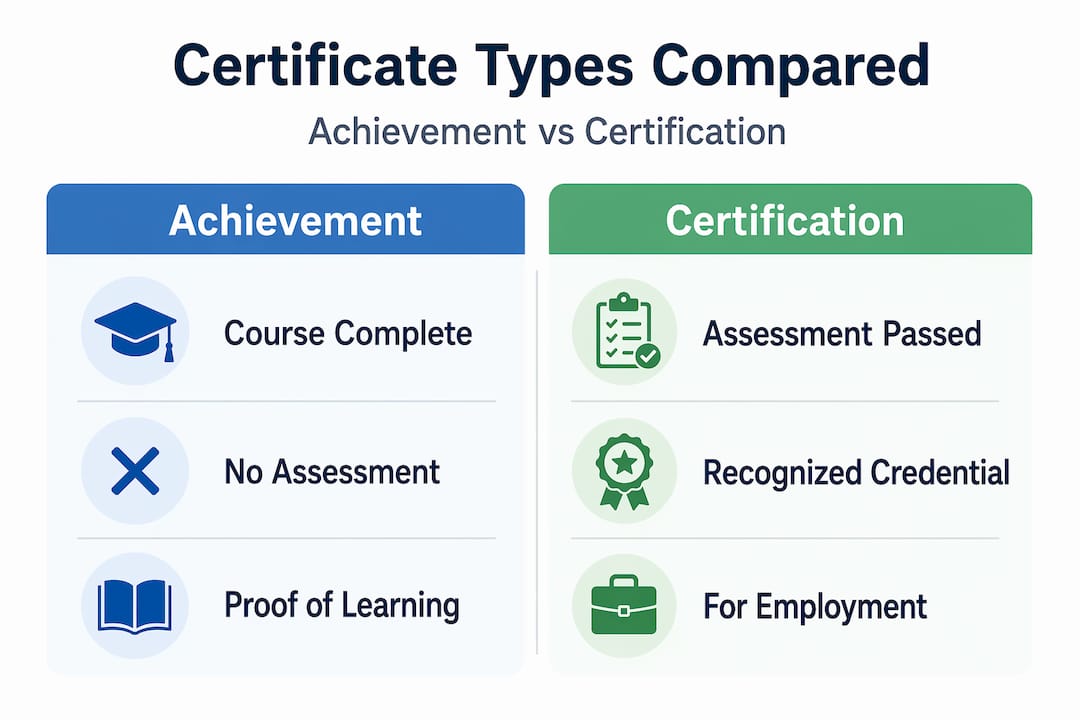
The following table outlines the core differences:
| Feature | Certificate of achievement | Professional certification | Diploma or degree |
|---|---|---|---|
| Issuing body | Course or program provider | External governing or industry body | University or accredited institution |
| Primary purpose | Documents course completion | Confirms professional competence | Indicates academic achievement |
| Assessment basis | Program completion criteria | Standardized competency tests | Academic coursework and exams |
| Renewal required | Typically no | Often yes, on a regular cycle | No |
| Career weight | Varies by employer and program | Recognized as professional status | High in academic and formal settings |
| Typical duration | Short-term to medium-term | Ongoing, with renewal periods | Multi-year academic programs |
For TEFL teachers specifically, this means:
- A certificate of achievement from a TEFL course confirms you completed training. It may or may not meet the minimum requirements for a specific teaching role.
- A TEFL certification, especially one that involves observed teaching practice and external assessment, carries more professional weight and is what most international schools and language centers require.
- A TEFL diploma represents advanced-level training and is typically associated with leadership roles, teacher training positions, or academic management.
To better understand how these credentials align with specific career goals, reviewing a resource like TESL certificates explained provides practical detail on what each level of credential signals to potential employers in the ESL sector.
Employers at reputable language schools and international institutions pay close attention to these distinctions. A certificate of achievement from an unaccredited provider will not typically carry the same weight as a certification from a regulated or widely recognized program. Knowing this before you enroll is essential.
What to check before choosing a TEFL certificate program
Once you understand the credentials, making a wise decision about where to study becomes essential.
Selecting the right program requires more than comparing prices or course lengths. The type of certificate or credential issued at the end of a program directly affects your employment prospects, and not all providers are transparent about what their credentials actually represent.
When evaluating any TEFL course, program evaluation guidance recommends paying close attention to what the credential proves, specifically whether it represents course completion or externally assessed teaching practice, and to the difference between terminology providers use versus formally regulated qualifications.
Before enrolling, confirm the following:
- Accreditation status. Is the program accredited by a recognized body? Accreditation signals that the program meets defined standards of quality and rigor. Resources on TEFL course accreditation explain what accreditation means in practice.
- Type of credential issued. Does the provider clearly state whether the document is a certificate of achievement, a professional certification, or something else?
- Employer recognition. Is the certificate accepted by employers in the countries or sectors where you want to teach?
- Assessment requirements. Does the program require assessed teaching practice, or does completion simply mean finishing online lessons?
- Contact hours. Many employers and visa authorities require a minimum of 100 to 120 contact hours for a TEFL qualification to be considered valid.
The following table summarizes signs that distinguish reputable programs from questionable ones:
| Indicator | Reputable program | Questionable program |
|---|---|---|
| Accreditation | Clearly stated, verifiable | Vague or absent |
| Credential terminology | Specific and accurate | Uses “certification” loosely |
| Teaching practice | Included and assessed | Optional or nonexistent |
| Contact hours | Clearly stated | Unclear or inflated |
| Employer recognition | Documented and verifiable | Unverified claims |
| Transparency | Full curriculum detail available | Limited program information |
Red flags include providers who use the word “certification” when they only issue a completion certificate, programs with no information about who accredits or endorses the qualification, and course descriptions that promise employment outcomes without disclosing the type of credential awarded.
Pro Tip: Contact prospective employers in your target country or teaching sector before enrolling in a program. Ask them directly which qualifications they recognize and accept. This real-world check ensures the credential you pursue will meet the actual requirements of the job you want. You can also use tools to verify TEFL accreditation independently before committing to a program.
Protecting your investment begins with asking the right questions. A credential that does not open doors in your target market has limited practical value, regardless of how it is presented in a course catalog.
Why careful credential evaluation matters more than ever for TEFL careers
The TEFL credential market has grown substantially, and with that growth has come a proliferation of programs that issue documents labeled as certificates without clarifying what those documents actually represent. This is the hard truth that most orientation materials and course brochures will not tell you directly.
Many new teachers operate under the assumption that any certificate from any program will be accepted universally. This is not accurate. Experienced hiring managers at language schools in markets such as South Korea, Japan, the UAE, and across Europe actively distinguish between a general completion certificate and a regulated professional certification. They understand the difference between a document that says “this person finished a course” and one that says “this person demonstrated assessed teaching competence to an externally verified standard.”
The oversight is understandable. The terminology is inconsistent across providers, and marketing language often obscures what a credential genuinely represents. However, the professional cost of this misunderstanding can be significant. Teachers who invest in programs that only issue basic completion certificates may find themselves needing to retrain when they encounter employers who require formally assessed certifications.
The more productive approach is to think about credentials as a progression rather than a single transaction. A certificate of achievement from a reputable foundational course is a legitimate starting point. Pairing it with assessed certification, and eventually advanced study, builds a profile that employers across markets recognize and trust. Resources on advanced TEFL for career growth outline how ongoing credential development positions teachers for promotion, specialized roles, and higher salary brackets.
The most overlooked reality is this: stackable credentials, meaning certificates and certifications earned progressively over time, often carry more combined weight than any single qualification. Employers see a pattern of sustained professional development. That pattern communicates both competence and commitment, which are qualities that matter in competitive hiring markets. A single certificate of achievement, however well-designed the program, rarely tells a complete story on its own.
Take the next step toward recognized TEFL credentials
If you’re ready to pursue meaningful teaching qualifications, here’s where to start.
Understanding the difference between a certificate of achievement and a professionally recognized TEFL certification is the first step toward making strategic decisions about your teaching career. Choosing a program that awards credentials with genuine employer recognition, assessed teaching practice, and clear accreditation documentation sets a stronger foundation than selecting based on convenience or cost alone.

TEFL Institute offers accredited TEFL courses designed to provide recognized qualifications that hold weight with employers across international markets. From foundational online programs to advanced diplomas and hybrid courses with observed teaching practice, the platform supports teachers at every stage of their professional development. Whether you are beginning your TEFL journey or building toward more senior roles, selecting a program that issues clearly defined, accredited credentials is one of the most consequential decisions you can make for your teaching career.
Frequently asked questions
Does a certificate of achievement qualify me to teach English abroad?
A certificate of achievement shows course completion, but many employers require a regulated TEFL certification that includes assessed teaching practice. The distinction matters because certifications confirm demonstrated competence, not just program participation.
Is a certificate of achievement the same as a TEFL certification?
No. A certificate of achievement confirms program completion, while TEFL certification is often regulated, requires assessed teaching, and is the standard employers actually require for hiring in most international teaching markets.
How do I know if a TEFL program’s certificate of achievement is recognized?
Check whether the program holds accreditation from a recognized body, review employer requirements in your target market, and look for transparent documentation about what the credential represents and how it is assessed.
What benefits does a certificate of achievement offer in my TEFL career?
It provides a formal record of learning that supports professional development portfolios and can strengthen applications for further study or entry-level teaching roles. As Collins Dictionary notes, such a document recognizes accomplishment and completion of a program or stated criteria.
Can certificates of achievement be stacked toward a higher qualification?
Yes, in many structured TEFL programs, certificates earned at the module or course level can contribute toward a broader qualification, such as a diploma or advanced certification, making them useful building blocks in a long-term career development plan.
Recommended
TEFL Institute guides

Italy
Jobs, pay and visa routes
Cambodia
Pay, requirements and visas
Dubai
Pay, requirements and visas
Portugal
Jobs, pay and visa routes
Thailand
Visas and teaching licences