
 United Kingdom (UK)
 United States (US)
 Canada
 South Africa
 India
India Australia
 New Zealand
 China
China Russia
 Germany
 France
 Spain
Spain Netherlands
 Vietnam
 United Arab Emirates
 Italy
Italy Poland
 Thailand
 Türkiye





 Algeria


TEFL Levels Explained: Choosing The Right Certification
TEFL Levels Explained: Choosing The Right Certification

Choosing a TEFL certification is one of the first major steps for aspiring English teachers dreaming of international work or online opportunities. The way TEFL levels are structured means your training can directly impact where and how you teach, from entry-level programs for beginners to advanced diplomas for ambitious professionals. Understanding TEFL levels is your passport to global teaching opportunities, helping you match your skills with the demands of schools and employers worldwide.
Table of Contents
- What TEFL Levels Mean For Certification
- Types Of TEFL Levels And Distinctions
- Training Hours And Course Requirements
- Career Outcomes And Employer Recognition
- Avoiding Common Mistakes With TEFL Levels
Key Takeaways
| Point | Details |
|---|---|
| Understand TEFL Levels | TEFL certification levels range from entry-level to advanced, each correlating with specific training hours and professional opportunities. |
| Choose Wisely | Selecting the appropriate TEFL level should align with your career goals and target job markets for optimal success. |
| Accreditation Matters | Ensure your TEFL certification is accredited and recognized internationally to enhance employability. |
| Avoid Common Pitfalls | Be cautious of unrecognized certifications, low-quality programs, and ensure practical teaching components are included in your training. |
What TEFL Levels Mean For Certification
Understanding TEFL certification levels is crucial for aspiring English language teachers planning international careers. Each certification level represents a different depth of training, professional credibility, and potential teaching opportunities across global job markets.
TEFL certification levels typically range from entry-level to advanced professional credentials. TEFL levels offer distinct professional pathways that enable teachers to progressively enhance their qualifications and marketability. These levels are categorized primarily by complexity, course duration, and depth of pedagogical training.
Key characteristics of TEFL certification levels include:
- Level 1: Basic introductory courses (40-100 hours)
- Level 2: Intermediate comprehensive training (100-150 hours)
- Level 3: Advanced professional certification (150-180 hours)
- Level 4: Specialized diploma programs (180-250 hours)
- Level 5: Graduate-level professional credentials (300+ hours)
Each level incrementally increases your teaching credentials, salary potential, and employability in international contexts. Entry-level certifications provide foundational knowledge, while advanced levels offer specialized training in areas like business English, online teaching methodologies, and curriculum development.
Professional TEFL certification is not just a credential—it’s a gateway to global teaching opportunities.
Teachers should strategically select certification levels based on their career goals, target teaching markets, and professional aspirations. An entry-level certification might suit someone exploring teaching, while a Level 5 diploma could be ideal for those seeking advanced international positions.
Here is a quick comparison of TEFL certification levels highlighting their main purposes and suitable candidates:
| TEFL Level | Primary Purpose | Ideal Candidates | Career Advantage |
|---|---|---|---|
| Level 1 | Introductory exposure | First-time teachers | Entry into teaching field |
| Level 2 | Broaden core skills | Aspiring career changers | Eligible for more job types |
| Level 3 | Professional qualification | Teachers seeking advancement | Access to international posts |
| Level 4 | Senior specialization | Experienced educators | Management and curriculum roles |
| Level 5 | Graduate-level expertise | Career TEFL professionals | Top-tier, high-salary positions |
Pro Tip: Research specific job market requirements in your desired teaching destination before selecting a TEFL certification level to maximize your employment potential.
Types Of TEFL Levels And Distinctions
Navigating the landscape of TEFL certification requires understanding the nuanced distinctions between different levels of training. Comprehensive TEFL level comparisons reveal a structured progression that allows educators to develop increasingly sophisticated teaching skills.
TEFL certification levels are typically categorized into distinct tiers that reflect complexity, depth of training, and professional opportunities:
- Level 1 (Entry-Level): Basic introductory certification
- 40-100 training hours
- Fundamental teaching methodology
- Suitable for initial teaching exploration
- Level 2 (Intermediate): More comprehensive training
- 100-150 training hours
- Deeper pedagogical understanding
- Enhanced classroom management skills
- Level 3 (Advanced Professional): Specialized professional certification
- 150-180 training hours
- Advanced teaching techniques
- Increased international job marketability
- Level 4 (Diploma): Graduate-level professional preparation
- 180-250 training hours
- Specialized curriculum development
- Preparation for senior teaching roles
- Level 5 (Expert): Highest professional credential
- 300+ training hours
- Comprehensive teaching expertise
- Equivalent to graduate-level qualifications
Each certification level represents a strategic investment in professional development. Entry-level certifications provide foundational skills, while advanced levels offer specialized training in areas like business English, online instruction, and curriculum design.
TEFL certification levels are not just academic credentials—they are passports to global teaching opportunities.
The progression through TEFL levels allows teachers to incrementally enhance their professional capabilities, salary potential, and international employability. Advanced certifications demonstrate a commitment to pedagogical excellence and open doors to more competitive teaching positions worldwide.

Pro Tip: Carefully evaluate your career goals and target teaching markets to select the most appropriate TEFL certification level for your professional trajectory.
Training Hours And Course Requirements
Understanding the training hours and course requirements is crucial for selecting the right TEFL certification. Course duration significantly impacts your teaching credentials, with each certification level demanding specific time commitments and academic rigor.
TEFL course requirements typically align with standard international training benchmarks:
- Minimum Standard Hours
- 100-120 hours: Basic international recognition
- 150-180 hours: Advanced professional standard
- 300+ hours: Expert-level comprehensive training
- Course Content Requirements
- Teaching methodology
- Lesson planning techniques
- Classroom management strategies
- Language acquisition theory
- Practical teaching practicums
Key Training Hour Breakdowns:
- Entry-Level Certification (40-100 hours)
- Fundamental theoretical training
- Basic pedagogical introduction
- Minimal practical teaching experience
- Intermediate Certification (100-150 hours)
- More extensive theoretical framework
- Enhanced classroom strategy training
- Limited practical teaching components
- Advanced Certification (150-250 hours)
- Comprehensive pedagogical training
- Extensive practical teaching modules
- Specialized instructional techniques
Professional TEFL certifications are not just about hours—they represent a commitment to educational excellence.
The complexity of training hours directly correlates with potential teaching opportunities. Longer, more comprehensive courses provide deeper pedagogical insights and demonstrate a more significant investment in professional development.
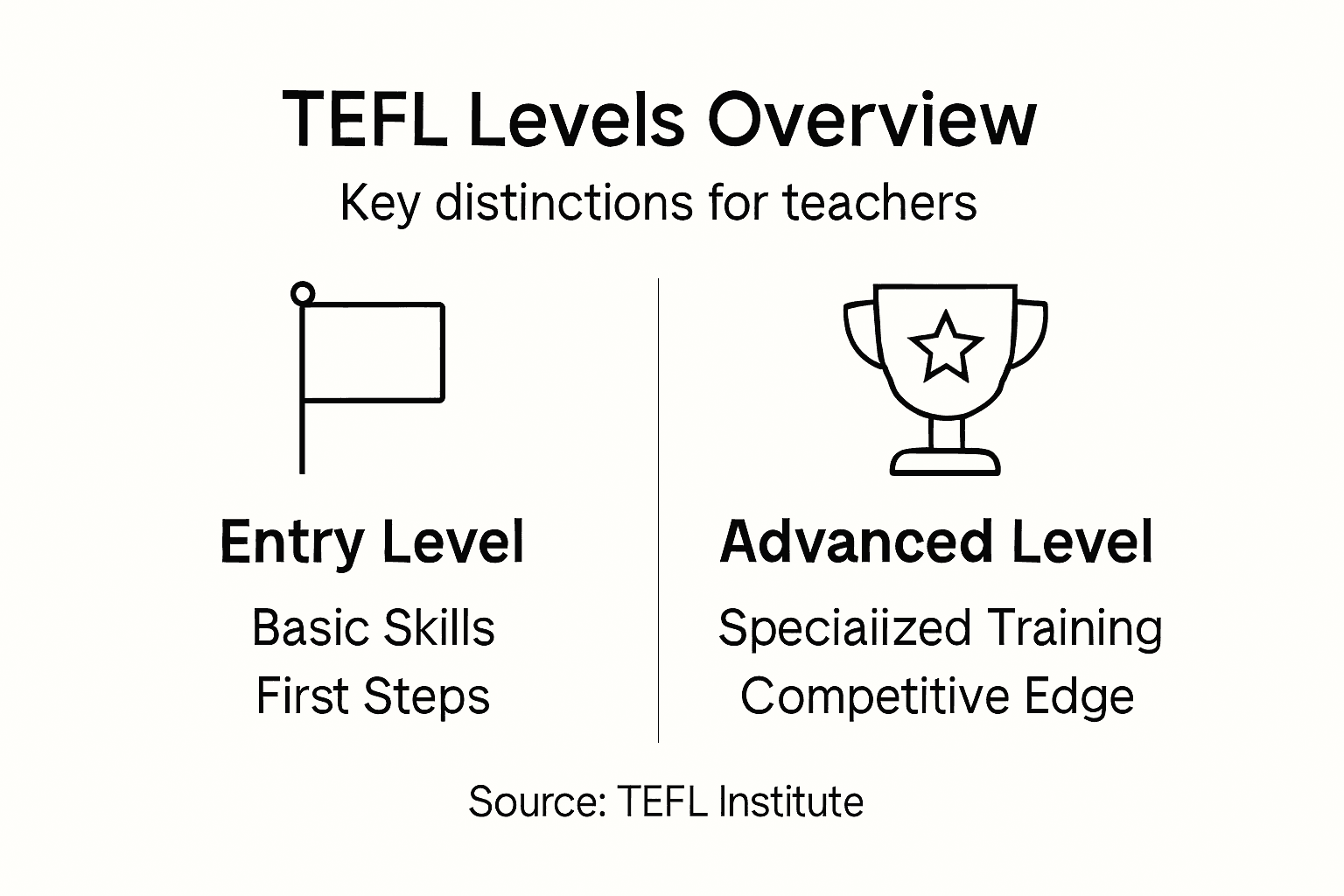
Modern TEFL programs increasingly incorporate online learning components, practical teaching practicum sessions, and specialized modules that extend beyond traditional classroom training. These additional elements ensure that teachers are prepared for diverse international teaching environments.
Pro Tip: Always verify the specific accreditation and recognition of your chosen TEFL certification to maximize your global teaching prospects.
Career Outcomes And Employer Recognition
The value of a TEFL certification extends far beyond academic credentials. Course selection directly impacts career opportunities in the competitive global English language teaching market, with employers placing significant weight on certification levels and training quality.
Global Career Opportunities by TEFL Certification Level:
- Entry-Level (40-100 hours)
- Online tutoring platforms
- Part-time language centers
- Volunteer teaching programs
- Limited international opportunities
- Intermediate (100-150 hours)
- Private language schools
- Small international language centers
- Some overseas teaching contracts
- Increased salary potential
- Advanced Professional (150-250 hours)
- International K-12 schools
- University language departments
- Corporate language training
- Competitive international positions
- Expert/Diploma Level (300+ hours)
- Premium international schools
- Senior academic positions
- Curriculum development roles
- Higher education teaching
Employer recognition varies significantly across different global markets. Some countries have strict qualification requirements, while others offer more flexible hiring standards. Key Factors in Employer Evaluation:
- Total training hours
- Practical teaching components
- Accreditation of certification
- Specialized training modules
- Demonstrated teaching skills
Certification is not just a document—it’s a passport to global teaching opportunities.
Advanced TEFL certifications provide substantial competitive advantages. Teachers with comprehensive training demonstrate commitment, pedagogical knowledge, and adaptability to potential employers. Higher-level certifications often correlate directly with increased salary potential and more diverse teaching opportunities.
International employers consistently seek candidates with robust training that goes beyond basic language skills. Specialized certifications in areas like business English, online instruction, and exam preparation can further distinguish job applicants in a crowded global market.
Below is a summary of typical TEFL career outcomes and what employers value at each certification level:
| Certification Level | Typical Job Sectors | Employer Focus |
|---|---|---|
| Entry (Level 1) | Online, volunteer | Flexibility, motivation |
| Intermediate (Level 2) | Language schools | Practical skills, training hours |
| Advanced (Level 3/4) | K-12, universities | Accreditation, teaching practicums |
| Expert (Level 5) | Premium schools, corporate training | Specializations, advanced pedagogy |
Pro Tip: Research specific country requirements and target your TEFL certification to maximize your international teaching potential.
Avoiding Common Mistakes With TEFL Levels
Making informed decisions about TEFL certification requires understanding potential pitfalls. Common TEFL course selection mistakes can significantly impact your teaching career trajectory and professional opportunities.
Critical Mistakes to Avoid:
- Overlooking Accreditation
- Choosing unrecognized certifications
- Ignoring international recognition standards
- Falling for cheap, low-quality programs
- Misunderstanding Level Requirements
- Selecting inappropriate certification complexity
- Underestimating job market expectations
- Failing to match certification to career goals
Red Flags in TEFL Certification Selection:
- No verifiable accreditation
- Unrealistically low course prices
- Lack of practical teaching components
- Minimal instructor interaction
- Generic, non-specialized curriculum
Most aspiring teachers make critical errors when selecting their TEFL certification. Some choose the cheapest option, while others select courses without understanding specific regional requirements. Key Evaluation Criteria include:
- Comprehensive curriculum depth
- International recognition
- Practical teaching components
- Specialized module offerings
- Industry-standard training hours
Not all TEFL certifications are created equal—choose wisely to protect your professional future.
International employers have become increasingly sophisticated in evaluating teaching credentials. They look beyond basic certification, seeking candidates with demonstrable skills, specialized training, and a clear understanding of modern pedagogical approaches.
Navigating the complex landscape of TEFL certification requires careful research, strategic planning, and a nuanced understanding of global teaching market dynamics. Prospective teachers must look beyond surface-level marketing and evaluate the substantive training offered by different certification levels.
Pro Tip: Always verify a TEFL course’s accreditation and speak with recent graduates before making your final certification decision.
Find Your Perfect TEFL Certification Level With Expert Guidance
Choosing the right TEFL certification level can feel overwhelming given the variety of options and the impact on your teaching career. Whether you are considering an entry-level course to begin your journey or an advanced diploma to unlock high-tier international teaching roles, understanding these distinctions is vital to your success. You want a program that matches your goals, respects your time investment, and maximizes your career potential.
At TEFL Institute, we offer a comprehensive range of online TEFL courses designed to fit your unique aspirations. From foundational certificates to advanced diplomas with practicum components, our flexible programs help you develop specialized skills and gain recognized credentials trusted worldwide. Don’t leave your future to chance—explore our course catalog now and take control of your teaching career with confidence. Visit TEFL Institute today and find the certification level that unlocks global opportunities for you.
Frequently Asked Questions
What are the different levels of TEFL certification?
TEFL certification levels typically range from Level 1 (40-100 hours) for basic introductory courses to Level 5 (300+ hours) for graduate-level professional credentials, with several intermediate levels in between.
How do I choose the right TEFL certification level for my career goals?
Select a TEFL certification level based on your teaching experience, career aspirations, and the specific requirements of the job market you are targeting. Entry-level certifications are suited for beginners, while higher levels are ideal for experienced educators seeking advanced positions.
What is the significance of training hours in TEFL certifications?
Training hours indicate the depth and comprehensiveness of the course. Generally, more hours correlate with higher skill development and better job market prospects, with 100-120 hours being the minimum for basic recognition and 300+ hours for expert-level credentials.
Why should I consider specialized TEFL certifications?
Specialized TEFL certifications, such as those in business English or online teaching methodologies, can enhance your marketability and open opportunities in specific teaching contexts, allowing you to stand out in a competitive global job market.