
 United Kingdom (UK)
 United States (US)
 Canada
 South Africa
 India
India Australia
 New Zealand
 China
China Russia
 Germany
 France
 Spain
Spain Netherlands
 Vietnam
 United Arab Emirates
 Italy
Italy Poland
 Thailand
 Türkiye











 Algeria


Allow three to six months. The TEFL course can take a few weeks, but police checks, degree legalisation, job interviews and visa processing take longer. Government programmes such as Japan’s JET and Korea’s EPIK run fixed annual application windows, so check those dates first if you are interested.
How to Plan for TEFL Abroad: Step-by-Step Success Guide
Updated 8 October 2026: planning timeline, visa and document guidance re-checked.
To plan for TEFL abroad, work backwards from your start date: allow about three to six months. Check the visa rules for your target country first, get a TEFL certificate of at least 120 hours, start your police check and document legalisation early, then apply for jobs and sign a written contract before you book flights. The paperwork, not the course, is what usually takes longest.

Most people plan TEFL in the wrong order. They buy a course, then pick a country, then discover the visa needs a degree they do not have or a document that takes eight weeks to legalise. This guide puts the steps in the order that avoids those surprises, with a simple timeline you can follow.
Key takeaways
- Choose your destination before your course. Visa rules decide what you need.
- A 120-hour TEFL certificate covers most first jobs; a regulated Level 5 helps for the Middle East and competitive roles.
- Start your police check and degree legalisation as soon as you know your country. They take the longest.
- Never travel on a verbal offer. Get a written contract that states pay, hours, housing and visa support.
- Budget for your first month before the first payslip arrives.
How long does it take to plan for TEFL abroad?
Allow three to six months from deciding to go to standing in your first classroom. The course itself can be done in weeks; the document chain and hiring cycle take longer, and some programmes recruit on fixed annual timelines.
| When | What to do |
|---|---|
| Six months out | Shortlist two or three countries and check their visa and degree rules |
| Five months out | Enrol on your TEFL course; order your police check |
| Four months out | Finish the course; start degree and certificate legalisation |
| Three months out | Apply for jobs; prepare a demo lesson |
| Two months out | Sign a written contract; submit the visa application |
| One month out | Book flights, arrange insurance and first month funds |
Step 1: Which country should you choose?
Choose a country your passport and degree can actually get you into, then weigh pay against cost of living. That one check rules out more options than any other.

- East Asia: strong demand and structured programmes; a bachelor’s degree is required for the work visa in Japan, South Korea, China and Taiwan.
- Southeast Asia: large private school markets in Vietnam and Thailand; a degree is needed for most work permits.
- Middle East: the highest packages, but degree attestation and often a Level 5 qualification are expected.
- Europe: easy for EU, EEA and Irish passport holders; hard for others because academies rarely sponsor permits.
- Latin America: often open to teachers without degrees, with lower pay.
The TEFL Salary Index gives dated pay figures by country, and the Visa Desk names the right permit for each.
Step 2: Which TEFL course do you need?
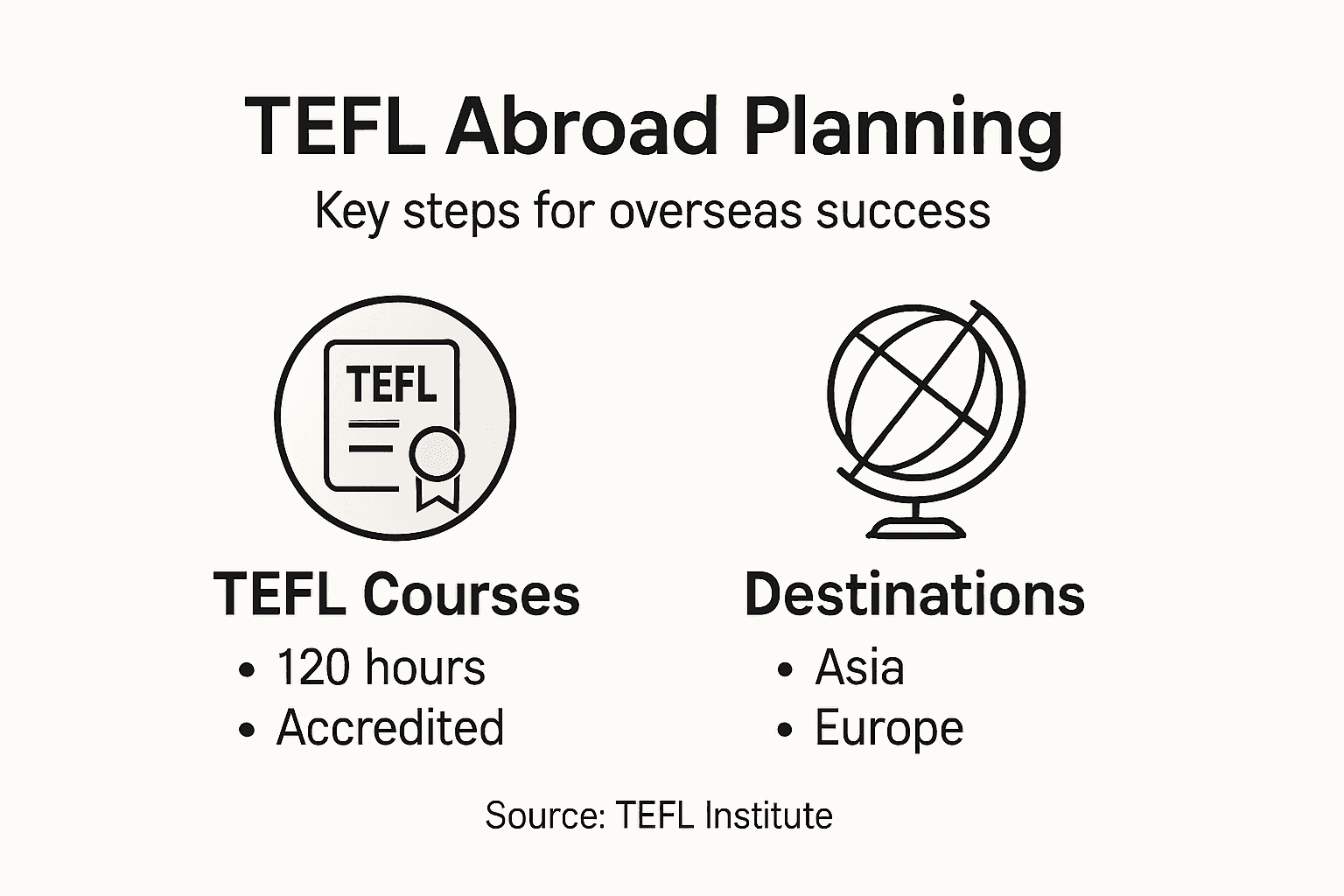
For most first jobs, a TEFL certificate of at least 120 hours is enough. If you are aiming at the Middle East, competitive schools or a longer career, a regulated Level 5 qualification is worth the extra study.
| Qualification | Size | Status | Best for |
|---|---|---|---|
| 120 Hour Advanced TEFL Course | 120 hours | Accredited | Most private schools and online platforms |
| 180 Hour Level 5 TEFL Diploma | 180 guided learning hours | Ofqual-regulated, 610/1571/4 | Middle East, competitive or long term roles |
| CELTA or Trinity CertTESOL | Intensive, with observed practice | Regulated Level 5 | People who can attend a training centre on fixed dates |
Our guide to the qualifications you need to teach English abroad sets out the degree and visa rules in more detail.
Step 3: What documents should you prepare, and when?
Prepare your police check, degree and TEFL certificate first, because many countries need them legalised before a visa can be issued. Start as soon as you know your country.
- Passport: valid for at least six months beyond your contract, with blank pages.
- Police check: UK applicants usually need an ACRO police certificate; US applicants usually need an FBI check. Our guide to DBS checks for teaching abroad explains which UK check to order.
- Degree and transcripts: often apostilled or attested.
- TEFL certificate: sometimes legalised too. See TEFL certificate legalisation explained.
- CV, photo and references: tailored to teaching roles.
The Paperwork Desk lists the exact documents for eight popular destinations.
Academic
The TEFL Institute Group
How to Land Your First TEFL Job
teflinstitute.comWatch on YouTube · The TEFL Institute Group
Step 4: How do you find and secure a teaching job?
Apply through school websites, reputable job boards and recruiters, interview by video, and accept only a written contract. Most schools hire after a video interview and a short demo lesson.
- Prepare a demo lesson. Our guide to passing a TEFL job interview has a ready made framework.
- Check the contract. Salary, teaching hours, housing, flights, health cover, holiday, contract length and who handles the visa.
- Research the school. Ask to speak to a current teacher, and check that the role comes with a proper work visa, not a tourist entry.
Step 5: How do you get legally and financially ready to go?
Submit your visa application as soon as you have a contract, arrange international health insurance, and save enough to cover your first month. Many schools pay at the end of the first month, so your savings carry you until then.
- Visa: follow your employer’s process exactly; most teaching visas are applied for before travel.
- Travel advice: check your government’s guidance, such as UK FCDO travel advice or the US State Department.
- Insurance: your home health cover usually stops at the border.
- Money: budget for flights, visa fees, a housing deposit and a month of living costs.
Ready to start planning?
The TEFL Institute Group is Europe’s largest TEFL trainer by teachers certified, with 161,000 teachers certified since 2017 and graduates in 80 countries. We are a Highfield Approved Centre (number 21335).
Start with the 120 Hour Advanced TEFL Course for most first jobs, or the 180 Hour Level 5 TEFL Diploma if your destination expects a regulated qualification.

Ola Flynn, Head of Marketing
Head of Marketing at The TEFL Institute Group; runs our webinars and information sessions, loves travel and sharing interns’ stories, and joined our interns in Thailand for orientation.
We love taking your call.

TEFL Institute guides
Plan for 2027
Germany
Freelance work and pay
Read the guide
Plan for 2027
Spain
Jobs, pay and visa routes
Read the guide
Plan for 2027
Czech Republic
Pay, visas and cities
Read the guide
Plan for 2027
South Korea
EPIK, hagwons and pay
Read the guide
Plan for 2027
Portugal
Jobs, pay and visa routes
Read the guide
Choose your destination before your course. Check whether your passport and degree meet that country’s visa rules, because those rules decide what you need. Many work visas in Asia and the Middle East require a bachelor’s degree, while Europe depends mainly on your citizenship.
Usually a passport valid for at least six months beyond your contract, a criminal record check, your degree and transcripts, your TEFL certificate, a teaching CV and references. Many countries require the police check, degree and certificate to be apostilled or attested, which can take several weeks.
In most countries, yes. Teaching visas are usually applied for before travel with your employer’s support, and arriving on a tourist entry to look for work can leave you unable to work legally. Always get a signed written contract that states pay, hours, housing and visa support.
Enough for flights, visa fees, a housing deposit and at least a month of living costs, because many schools pay at the end of the first month. The amount varies widely by country, so check local costs and whether your employer provides housing or reimburses flights.
A TEFL certificate of at least 120 hours covers most first jobs in private language schools and online. If you plan to teach in the Middle East, apply to competitive schools or stay long term, an Ofqual-regulated Level 5 TEFL Diploma gives you a qualification employers can verify.