

 United Kingdom (UK)
 United States (US)
 Canada
 South Africa
 India
India Australia
 New Zealand
 China
China Russia
 Germany
 France
 Spain
Spain Netherlands
 Vietnam
 United Arab Emirates
 Italy
Italy Poland
 Thailand
 Türkiye









 Algeria


English for Specific Purposes: A guide for ESL educators
English for Specific Purposes: A guide for ESL educators

TL;DR:
- ESP is a purpose-driven approach tailored to specific professional language needs.
- Needs analysis is essential for designing targeted, authentic ESP courses.
- Evidence shows ESP significantly improves domain-specific skills and career prospects.
Most teachers entering the ESL field assume that English is English. A grammar lesson works for everyone; vocabulary drills apply across contexts. English for Specific Purposes (ESP) challenges that assumption directly. A nurse learning to communicate diagnoses in English has fundamentally different needs than an engineer writing technical proposals or a hospitality worker managing guest complaints. ESP is the field that addresses this reality, and for educators seeking to specialize, understanding its principles, methodologies, and evidence base is essential for building a credible and effective teaching career.
Table of Contents
- What is English for Specific Purposes?
- ESP methodology: Needs analysis and curriculum design
- Evidence and impact: Does ESP work?
- Challenges and nuanced realities: What most guides miss
- A new era for ESP: Why specialist teaching is the future
- Advance your ESP teaching journey with TEFL Institute
- Frequently asked questions
Key Takeaways
| Point | Details |
|---|---|
| ESP defined | English for Specific Purposes tailors language instruction to real-world professional, academic, and occupational needs. |
| Needs analysis | ESP uses systematic needs analysis to design highly targeted curricula centered around learner goals. |
| Proven impact | Empirical studies show ESP delivers substantial gains in field-specific language skills. |
| Challenges exist | Shifting to ESP requires overcoming knowledge, materials, and collaboration hurdles for teachers. |
| Future of teaching | ESP is rapidly evolving—teachers who specialize are poised for greater impact and opportunities. |
What is English for Specific Purposes?
ESP is not simply advanced English instruction. It is a distinct, purpose-driven approach built around the real-world language demands of a particular profession, discipline, or context. According to EBSCO’s research on language and linguistics, ESP is a learner-centered approach to English language teaching that focuses on the language skills, discourse, genres, grammar, lexis, and register needed for specific academic, professional, or occupational contexts. That definition carries significant weight for anyone planning a teaching career in niche instruction.
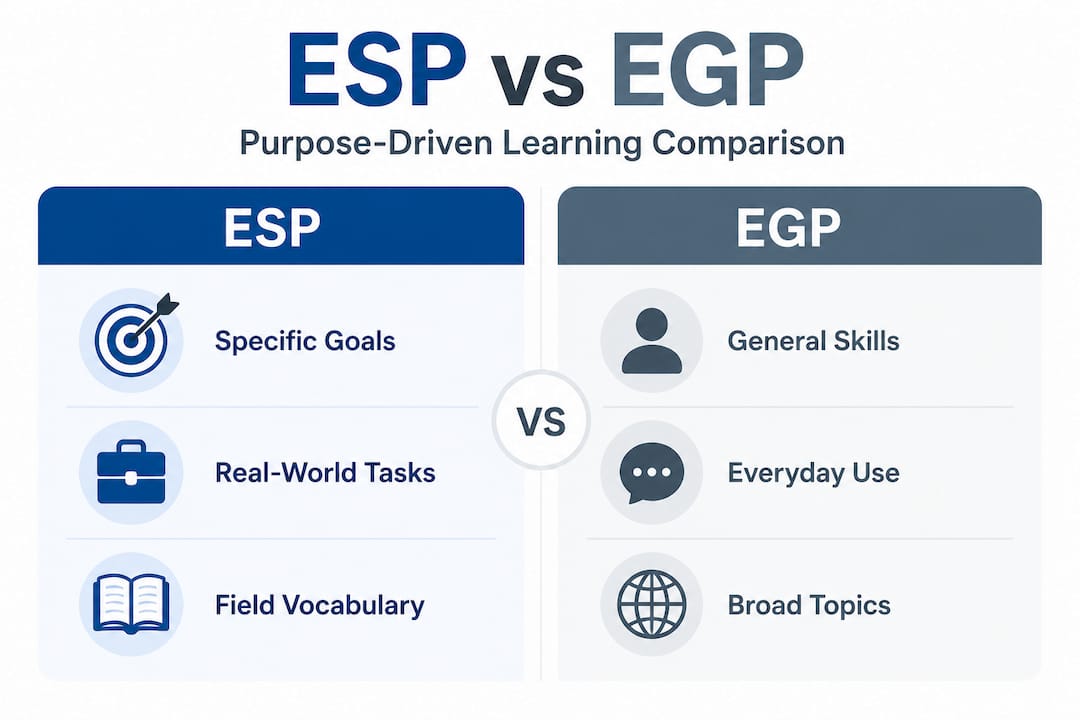
The core distinction between ESP and general English, often called EGP (English for General Purposes), lies in the learner’s objective. EGP focuses on broad communicative competence across everyday situations. ESP narrows that scope considerably, building language skills that are directly transferable to a defined context. You can read more about how this distinction shapes classroom practice in this ESP overview from TEFL Institute.
Key fields where ESP is applied
ESP operates across a wide range of professional and academic domains. The most established include:
- English for Medical Purposes (EMP): Clinical communication, patient interaction, medical documentation, and research reporting.
- English for Business and Economics (EBE): Negotiation, correspondence, presentations, financial reporting, and cross-cultural business discourse. The business English guide from TEFL Institute provides a strong foundation in this area.
- English for Academic Purposes (EAP): Essay writing, academic reading, lecture comprehension, and citation conventions for university-level learners.
- English for Science and Technology (EST): Technical writing, laboratory reports, and scientific discourse.
- English for Legal Purposes (ELP): Contract language, courtroom communication, and legal documentation.
- English for Hospitality and Tourism: Guest interaction, service communication, and cultural sensitivity training.
For a closer look at one of the most in-demand ESP contexts, the business English essential guide offers practical entry points for new educators.
How ESP differs from general English: A comparison
| Feature | General English (EGP) | English for Specific Purposes (ESP) |
|---|---|---|
| Learner goal | Broad communicative competence | Field-specific language mastery |
| Vocabulary | Everyday and varied | Domain-specific and technical |
| Grammar focus | Full grammar syllabus | Grammar relevant to target tasks |
| Text types | News, literature, conversation | Reports, emails, case notes, contracts |
| Course design | Standardized curriculum | Tailored to learner and context |
| Assessment | General proficiency tests | Task-based and contextual evaluation |
“ESP is not a language variety, but a learner-specific approach that prioritizes relevance over comprehensiveness.” This distinction is critical for educators designing curriculum, because an ESP course that teaches the wrong discourse for the target profession fails its learners regardless of language quality.
ESP methodology: Needs analysis and curriculum design
Now that you understand ESP’s purpose, let’s explore the methodology that makes it so effective: needs analysis. The core methodology of ESP is needs analysis, a systematic process to identify learners’ target situation needs. Without this step, even the most experienced teacher risks designing a course that misses the mark entirely.
Needs analysis involves gathering data from multiple sources to understand what learners currently know, what they need to achieve, and what language tasks they will perform in their target professional environment. The tools used in this process vary depending on the context, but commonly include:
- Learner surveys: Questionnaires that capture learners’ current language confidence, professional roles, and perceived skill gaps.
- Interviews with stakeholders: Conversations with employers, supervisors, or program directors who can describe real workplace language demands.
- Task observation: Watching professionals operate in their work environment to identify authentic language use patterns.
- Document analysis: Reviewing authentic workplace texts, such as medical records, technical manuals, or legal briefs, to map the vocabulary and genre conventions learners will encounter.
- Language audits: Assessing the specific types of communication (written, spoken, formal, informal) that occur in the target setting.
Consider a practical example. A teacher developing an ESP course for nurses working in English-speaking hospitals would conduct interviews with nursing managers to identify communication priorities. Observations might reveal that nurse-patient communication requires clear instruction-giving, empathetic language for sensitive conversations, and precise use of medical terminology without jargon that confuses patients. The resulting syllabus would then be built around these exact task types rather than a generic health vocabulary list.

Translating needs analysis into course design
Once needs analysis is complete, the data directly informs every component of the course. The syllabus reflects the language tasks learners will perform. Materials are drawn from authentic professional sources wherever possible. Assessment tasks mirror real workplace scenarios rather than standardized language tests.
The teaching qualification pathways available to aspiring educators often include guidance on how to integrate ESP principles into formal qualification programs, which is a practical advantage for teachers planning to enter specialist markets.
Pro Tip: Prioritize authentic workplace documents and real professional tasks when building ESP materials. A business email template used by an actual company is more instructionally valuable than a textbook example constructed for a classroom scenario.
Evidence and impact: Does ESP work?
Once methodology is established, aspiring educators often ask: does ESP actually produce measurable results? Here’s what the data shows. A systematic review of 149 SSCI studies conducted between 2014 and 2023 confirms positive outcomes in most ESP interventions, covering collocation awareness, reading comprehension, and academic writing performance.
The numerical findings are notable. ESP reading instruction produced a mean improvement of 4.42 score points higher than control groups receiving general English instruction. Effect size values, measured using Cohen’s d, ranged from 1.93 upward in multiple studies, which indicates a strong practical impact rather than a marginal statistical difference. In educational research, a Cohen’s d above 0.8 is considered large. Values approaching and exceeding 1.93 suggest ESP instruction generates substantial gains in targeted language skills.
What the evidence highlights about ESP effectiveness
- ESP interventions show the strongest results with undergraduate and graduate learners who have clearly defined professional goals.
- Collaborative and task-based learning methods consistently outperform lecture-based delivery in ESP contexts.
- Gains in domain-specific vocabulary retention are significantly higher when vocabulary instruction is embedded in professional tasks rather than isolated drills.
- ESP writing instruction produces transferable improvements in genre awareness, which benefits learners beyond the immediate course context.
- Learners in fields with clearly defined language demands, such as medicine and law, show greater measurable gains than those in fields with more diffuse language requirements.
For educators focusing on professional contexts, career-focused business English instruction represents one of the best-documented application areas with consistent outcome data. Additionally, practical business English tips for adult learners provide concrete strategies aligned with these findings.
The evidence also confirms that ESP is not equally effective in every context. When learner goals are vague, when needs analysis is skipped, or when materials are not authentic, outcomes decline sharply. This reinforces the importance of rigorous methodology rather than simply labeling a course “ESP” and expecting results.
Challenges and nuanced realities: What most guides miss
For those eager to implement ESP, it’s vital to consider nuanced challenges and misconceptions that might hold back teaching effectiveness. The practical difficulties of ESP instruction are rarely discussed in introductory resources, yet they directly affect how well educators can perform in specialist roles.
Research published in ESP Today Journal identifies six distinct challenge strands facing teachers who transition from general English (EGP) to ESP instruction:
- Emotional challenges: Anxiety about lacking subject matter expertise and uncertainty about professional identity as an ESP teacher.
- Knowledge challenges: Insufficient understanding of the target professional field, its discourse conventions, and its specialized vocabulary.
- Material challenges: Limited availability of authentic, professionally relevant teaching resources and the time required to develop original materials.
- Student challenges: Managing learners who often have greater subject matter expertise than the teacher, which can undermine classroom authority.
- Collaboration challenges: Building productive working relationships with subject matter experts, field professionals, and institutional stakeholders.
- Research challenges: Staying current with both language teaching methodology and developments in the target professional field.
Task-based needs analysis (TBNA), while considered best practice, brings its own complications. It is labor-intensive, often requires onsite observation that is not always logistically feasible, and currently lacks universally agreed-upon rules for sequencing identified tasks into a coherent syllabus. These are not reasons to avoid TBNA, but they do highlight why ESP teacher preparation must go beyond generic TEFL training.
Additional complexity arises from challenges applying ESP methodology in contexts where English is not the dominant language of professional practice, or where rapid field changes in technology and healthcare outpace curriculum updates. ESP for beginners and adolescents is possible but represents an atypical use case, as confirmed by language for specific purposes research. Most established programs target intermediate to advanced learners with concrete professional exposure.
Confusion between ESP and closely related approaches also causes issues. Content-Based Instruction (CBI) and Content and Language Integrated Learning (CLIL) share surface similarities with ESP but differ in their primary goals. CBI and CLIL prioritize content learning through a second language, while ESP prioritizes professional language development as the end goal. For teachers working with young learners or in bilingual education settings, the beginner teaching tips and global English teacher guide offer useful contextual guidance.
Pro Tip: If you are entering an ESP context for the first time, establish a working relationship with at least one subject matter expert in the target field before you finalize your syllabus. Their input will reveal language tasks that no textbook or general training program anticipates.
A new era for ESP: Why specialist teaching is the future
With the practical challenges and outcomes laid out, it’s worth examining why ESP represents a pivotal shift for teachers and what will distinguish leading educators in the years ahead.
ESP is not a recent invention. As documented in ASP Journal, ESP evolved as a practitioner-driven approach from the 1960s onward, emerging from increased globalization and the growing demand for English in science, technology, and international business. It was never conceived as a new variety of English, but as a teaching philosophy grounded in professional relevance. That distinction matters, because it frames ESP as a methodology that adapts continuously rather than a fixed curriculum.
Today, that adaptability is being tested and expanded by two major forces: artificial intelligence and accelerating global specialization. AI tools are beginning to support needs analysis by processing large quantities of professional texts to identify authentic language patterns at scale. This enhancement does not replace the teacher’s role but shifts it further toward interpretation, curriculum judgment, and authentic task design.
What most one-size-fits-all teacher training programs fail to address is the field-based, non-linguistic expertise that effective ESP instruction requires. A general TEFL certificate teaches you how to teach language. ESP demands that you also understand how professionals think, communicate, and function within their specific work environments. These are not the same competency set.
The educators who will lead in specialist contexts are those who invest in ongoing field relationships, update their materials regularly, and treat ESP niche skills as a continuing professional development priority rather than a one-time qualification milestone. The field rewards those who stay current and collaborate across disciplines.
Advance your ESP teaching journey with TEFL Institute
After exploring the realities and rising importance of ESP, here’s where you can take your next step toward specialized teaching.
TEFL Institute offers certification and specialization pathways designed to equip educators with the practical skills needed for niche instruction. Whether you are based in the US and exploring a TEFL certification in Texas or looking internationally, the platform provides structured routes into ESP-relevant teaching roles.
Educators seeking to deepen their specialist credentials can explore course extensions that focus on areas such as business, medical, and technical English. For those who want hands-on experience from the start, TEFL internships offer structured classroom exposure in real teaching environments. These programs provide the combination of theoretical grounding and applied practice that ESP instruction demands.
Frequently asked questions
How is ESP different from general English teaching?
ESP targets the vocabulary, grammar, and skills needed for specific professional or academic fields, while general English covers broad everyday language use. ESP equips learners with field-specific communication skills that differ significantly from standard EGP instruction in both content and discourse.
What is needs analysis in ESP?
Needs analysis is a systematic process used to identify what learners require linguistically to function in their target professional environment. The core methodology of ESP relies on this process to ensure that syllabi, materials, and assessments reflect real-world language demands rather than generic course structures.
Is ESP effective for beginner English learners?
ESP for beginners is possible but atypical, as research confirms that most ESP programs are designed for intermediate to advanced learners with defined professional contexts and language experience already in place.
Are ESP courses adaptable to fast-changing professional fields?
Yes, but adaptability requires deliberate effort. Rapid field changes in sectors like technology and healthcare demand that ESP teachers regularly update course materials and conduct fresh needs analyses to stay professionally relevant.
Can ESP improve employment prospects for learners?
ESP interventions have demonstrated measurable improvements in field-specific language ability and career readiness. A systematic review of 149 studies conducted between 2014 and 2023 confirms consistently positive outcomes across professional and academic ESP contexts.
Recommended
TEFL Institute guides

South Korea
EPIK, hagwons and pay
Dubai
Pay, requirements and visas
Vietnam
Work permits and requirements
Thailand
Visas and teaching licences
Spain
Jobs, pay and visa routes