

 United Kingdom (UK)
 United States (US)
 Canada
 South Africa
 India
India Australia
 New Zealand
 China
China Russia
 Germany
 France
 Spain
Spain Netherlands
 Vietnam
 United Arab Emirates
 Italy
Italy Poland
 Thailand
 Türkiye











 Algeria


Top ESL teaching methodologies: proven strategies for 2026
Top ESL teaching methodologies: proven strategies for 2026

Choosing the right teaching methodology is one of the most consequential decisions an ESL teacher makes. Many aspiring instructors enter the classroom armed with enthusiasm but uncertain which approach will actually move the needle on learner outcomes. The gap between traditional grammar-focused instruction and modern communication-centered methods is real, and it shows up in student fluency, engagement, and long-term retention. Seven core ESL methodologies shape most classrooms today, including the Grammar-Translation Method, Communicative Language Teaching, and Task-Based Learning. This guide breaks each one down and shows you how to apply them effectively.
Table of Contents
- Understanding core ESL teaching methodologies
- Traditional vs modern approaches: Strengths and limitations
- Blended and innovative strategies for today’s classroom
- Practical strategies for classroom application
- Measuring success: Research insights and classroom outcomes
- A fresh perspective: Why flexibility, not purity, wins in ESL teaching
- Get certified and access more proven resources
- Frequently asked questions
Key Takeaways
| Point | Details |
|---|---|
| Blend core methods | Combining CLT, TPR, and GTM delivers more balanced language development than any single method. |
| Adapt to your learners | Flexibly adjust your approach for different age groups, levels, and classroom contexts. |
| Research supports results | Empirical studies show blended models, extensive reading, and AI tools improve ESL learning outcomes. |
| Practical strategies matter | Simple tactics like maximizing student talk time and using visuals drive real results. |
| Continuous growth | Pair evidence-based methods with ongoing professional development to stay effective and confident. |
Understanding core ESL teaching methodologies
Before applying strategies, it is crucial to understand what the major methodologies are and how they differ from one another. Each approach carries its own assumptions about how language is acquired, what the teacher’s role should be, and what a successful lesson looks like.
Key ESL methodologies include the Grammar-Translation Method (GTM), Communicative Language Teaching (CLT), Task-Based Learning (TBL), Total Physical Response (TPR), the Audio-Lingual Method, the Direct Method, and the Natural Approach. Understanding effective ESL teaching methods starts with knowing what each one prioritizes.
Here is a quick comparison of the core methods:
| Method | Primary focus | Classroom activity | Best suited for |
|---|---|---|---|
| Grammar-Translation (GTM) | Grammar rules and written accuracy | Translation exercises, grammar drills | Exam prep, literacy skills |
| Communicative Language Teaching (CLT) | Real-world communication | Role plays, discussions, pair work | Fluency and confidence |
| Task-Based Learning (TBL) | Completing meaningful tasks | Projects, problem-solving activities | Intermediate to advanced learners |
| Total Physical Response (TPR) | Comprehension through movement | Commands, physical responses | Young learners, beginners |
| Audio-Lingual Method | Habit formation through repetition | Drills, pattern practice | Pronunciation, structure |
| Direct Method | Target language only | Immersive conversation, visuals | Immersion environments |
| Natural Approach | Comprehensible input | Listening, reading, low-pressure output | Early-stage learners |
Key features to keep in mind when reviewing these methods:
- GTM relies heavily on the learner’s first language for explanation and translation
- CLT treats communication as both the means and the goal of instruction
- TBL organizes lessons around tasks rather than language points
- TPR connects vocabulary to physical action, lowering the affective filter
- The Audio-Lingual Method builds patterns through repetition and reinforcement
- The Direct Method avoids translation entirely, using only the target language
Familiarity with ESL teaching terminology makes it easier to evaluate which method fits your learners and context.
Traditional vs modern approaches: Strengths and limitations
Now that the main approaches are clear, it is worth weighing their effectiveness in real learning environments. Traditional and modern methods each have measurable strengths, and the research tells a nuanced story.
GTM focuses on grammar and writing accuracy but consistently falls short on oral fluency. CLT, by contrast, prioritizes communication and produces stronger speaking outcomes. Research on GTM and CLT increasingly recommends hybrid models that draw from both traditions.

Here is how the two broad camps compare on key outcome measures:
| Outcome area | Traditional (GTM, Audio-Lingual) | Modern (CLT, TBL, TPR) |
|---|---|---|
| Grammar accuracy | High | Moderate |
| Oral fluency | Low | High |
| Learner engagement | Low to moderate | High |
| Vocabulary retention | Moderate | Moderate to high |
| Anxiety levels | Higher | Lower |
| Real-world readiness | Limited | Strong |
“Hybrid instructional models that combine grammar-focused and communication-centered methods consistently outperform single-method approaches in both accuracy and fluency measures.”
Traditional methods are not without value. GTM, for example, gives learners a strong metalinguistic foundation, which is particularly useful for test preparation and academic writing. The Audio-Lingual Method builds reliable pronunciation habits through structured repetition. The problem arises when either approach is used in isolation. A learner who can parse a sentence but cannot hold a conversation has not achieved communicative competence. For oral proficiency tips that bridge this gap, blending methods is the practical solution most experienced teachers recommend.
Modern approaches carry their own limitations. CLT can feel unstructured for learners who expect explicit grammar instruction. TBL requires careful scaffolding to prevent learners from defaulting to their first language. Knowing these trade-offs helps you make informed decisions rather than simply following trends.
Blended and innovative strategies for today’s classroom
With the pros and cons of each method in mind, the next question is how teachers can combine approaches for the best results. Blending is not guesswork. It is a deliberate, evidence-informed process.
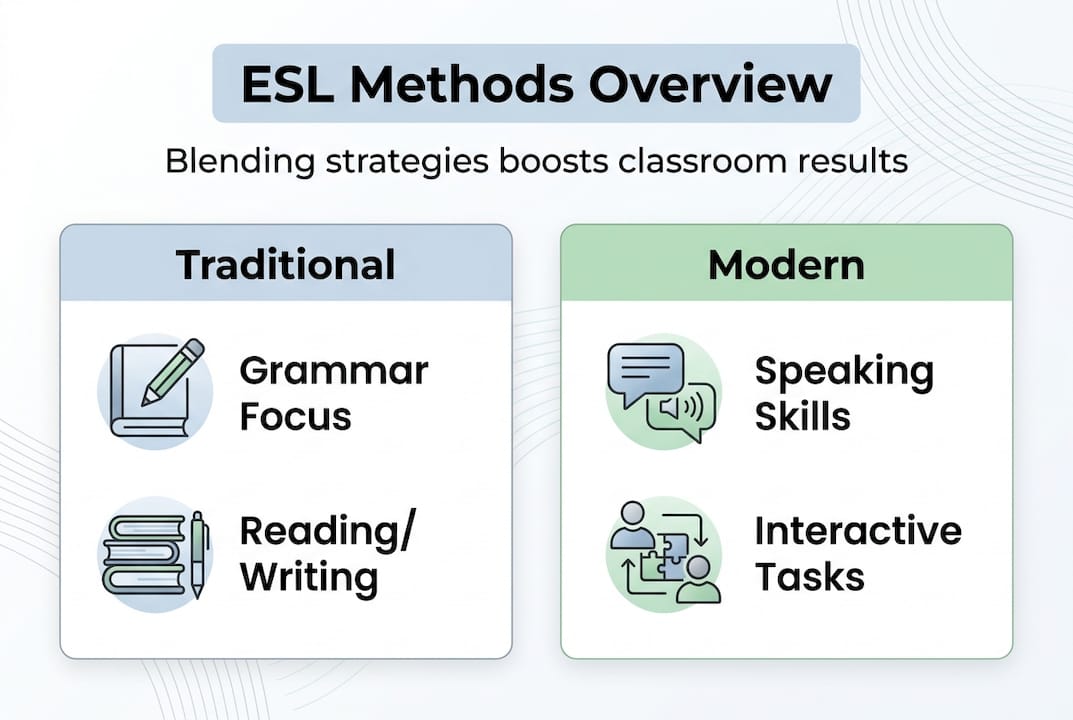
Blending CLT and TPR for engagement while incorporating GTM for accuracy is a well-supported strategy. Adding extensive reading (ER) and AI tools to this mix further strengthens outcomes, particularly for vocabulary growth and motivation. Proficiency gains data confirms that multi-method instruction outperforms single-method delivery across age groups.
Here is a practical numbered process for building a blended lesson plan:
- Identify your learners’ primary needs (fluency, accuracy, vocabulary, or confidence)
- Select a core method that addresses those needs (CLT for fluency, GTM for accuracy)
- Layer in a secondary method for variety and engagement (TPR for young learners, TBL for adults)
- Incorporate ER or digital tools such as AI-assisted practice apps for independent reinforcement
- Assess and adjust based on observable learner progress after each unit
For absolute beginners, TPR and the Natural Approach reduce anxiety while building comprehension. For young learners, movement-based activities and storytelling work well. Mixed-level groups benefit most from differentiated tasks within the same lesson framework. Using AI for ESL teaching can help personalize practice for learners at different levels without requiring separate lesson plans.
Pro Tip: When working with mixed-level groups, use visual scaffolding such as graphic organizers and sentence frames so that lower-level learners can participate in the same task as more advanced peers without feeling excluded.
Effective ESL lesson planning builds these blended elements into a coherent structure from the start rather than adding them as afterthoughts.
Practical strategies for classroom application
Blended methods deliver results when put into practice. Here is how you can apply them directly in your classroom starting with your next lesson.
Hiring windows close while you scroll.
Deadlines, salaries and visa notes for teaching jobs worldwide, checked against official sources and sent free every two weeks.
Get on the WirePractical ESL strategies that consistently improve participation and reduce learner anxiety include:
- Comprehensible input: Pitch language slightly above the learner’s current level to promote natural acquisition without overwhelming them
- Visuals and realia: Use real objects, images, and diagrams to make abstract vocabulary concrete and memorable
- Pair and group work: Structure activities so learners produce language together, increasing talking time and reducing teacher-centered instruction
- Consistent routines: Begin and end lessons with predictable structures so learners can focus cognitive energy on new content rather than logistics
- Scaffolding: Break complex tasks into smaller, manageable steps before asking learners to perform independently
Consider a simple TPR scenario. You call out the word “jump” and demonstrate the action. Learners respond physically before they are ever asked to produce the word verbally. This sequence, comprehension before production, mirrors natural language acquisition and significantly lowers the pressure beginners feel. ESL class activities built on this principle tend to generate higher participation rates.
Pro Tip: Aim for a student talking time (STT) ratio of at least 70% per lesson. Record a short segment of your class and count the seconds learners are speaking versus the seconds you are speaking. The result is often surprising and immediately actionable.
Strong ESL classroom management tips support these strategies by creating the conditions in which learners feel safe enough to take communicative risks. Without that psychological safety, even the best methodology will underperform. Monitoring ESL proficiency benchmarks helps you set realistic targets for each learner group.
Measuring success: Research insights and classroom outcomes
Knowing what is working requires more than intuition. Here is what the research and real classrooms reveal about method effectiveness.
Empirical data consistently links blended ESL models to measurable proficiency gains. Extensive reading produces effect sizes ranging from g = 0.3 to g = 0.8 depending on implementation quality, which is a meaningful improvement by educational research standards. AI-supported instruction shows large effect sizes on both proficiency and learner motivation, though researchers emphasize that teacher-led instruction remains essential for optimal results.
For young English Language Learners (ELLs), structured ESL program models outperform unstructured immersion in early literacy outcomes. The data is clear: intentional method selection, not simply exposure to English, drives progress.
Practical takeaway: Use these benchmarks to set specific, measurable goals for your class. If you introduce an ER program, track vocabulary test scores over six weeks. If you integrate an AI practice tool, survey learner motivation before and after. Data does not need to be complex to be useful. A simple pre and post assessment aligned to your chosen method gives you actionable feedback.
The ESL teaching checklist available through TEFL Institute is a practical tool for monitoring whether your classroom strategies align with evidence-based benchmarks. Using it regularly keeps your instruction grounded in what the research supports rather than habit or convenience.
A fresh perspective: Why flexibility, not purity, wins in ESL teaching
The most persistent myth in ESL teacher training is that mastery means finding the one correct method and applying it consistently. The evidence does not support that view. Hybrid approaches consistently outperform single-method instruction, and the reason is straightforward: real learners do not fit neatly into any one pedagogical framework.
The teachers who produce the strongest outcomes are not the ones who follow CLT or GTM most faithfully. They are the ones who observe their learners closely, identify what is not working, and adjust without ego. That kind of responsiveness requires a broad methodological toolkit, not a narrow one.
This matters especially for new teachers who feel pressure to pick a method and commit. Experimentation is not a sign of uncertainty. It is a sign of professional growth. Every classroom is a data set. When a TPR activity falls flat with adult professionals but energizes a group of ten-year-olds, that is information. Use it.
For further reading on enhancing classroom skills, the principle holds: the most effective instructors treat methodology as a toolkit, not a rulebook.
Get certified and access more proven resources
To keep growing as an ESL teacher, supplement your practice with ongoing learning and quality resources. A strong methodological foundation is built over time, and formal TEFL certification gives you both the theoretical grounding and the practical frameworks to apply what you have learned here.
TEFL Institute offers a range of certifications and TEFL resources designed to support teachers at every stage of their career. Whether you are preparing for your first classroom or refining an established practice, structured training accelerates your development. If you are based in the UK, TEFL courses in Newcastle offer a practical, in-person option. Already certified? Explore course extensions to deepen your expertise in specific methodologies and learner contexts.
Frequently asked questions
Which ESL teaching methodology is best for beginners?
TPR pairs language with physical actions, making it particularly effective for beginners by reducing anxiety and building comprehension before requiring verbal output. It is a reliable starting point for new learners of any age.
How can I blend different ESL teaching methods effectively?
Combine CLT for communication practice, TPR for physical engagement, and GTM for grammar accuracy within a single lesson plan, selecting the proportion of each based on your learners’ specific needs and current proficiency level.
Does research really back up the effectiveness of these methodologies?
Yes. Studies show significant gains in proficiency and vocabulary when blended ESL models are used, with extensive reading and AI tools both demonstrating measurable positive effects in controlled research settings.
How can technology enhance ESL teaching methodologies?
AI tools show large effects on student proficiency and motivation when integrated with teacher-led instruction, making them a valuable addition to any blended methodology rather than a standalone replacement.
Recommended
- Top ESL teaching methodologies to enhance classroom skills | TEFL Institute
- Online ESL teaching types: A guide for educators in 2026 | TEFL Institute
- Boost ESL teaching success with lesson planning in 2026 | TEFL Institute
- Online ESL class setup guide for effective teaching in 2026 | TEFL Institute
- Making Learning Fun: Engaging Activities for Your Kids – The Zoofamily
Modern classrooms are neurodiverse classrooms, and our Neurodiversity in TEFL course shows you how to adapt each of these methodologies so every learner keeps up.
TEFL Institute guides

Japan
JET, ALT and eikaiwa pay
Cambodia
Pay, requirements and visas
Mexico
Jobs, pay and cities
Dubai
Pay, requirements and visas
South Korea
EPIK, hagwons and pay