

 United Kingdom (UK)
 United States (US)
 Canada
 South Africa
 India
India Australia
 New Zealand
 China
China Russia
 Germany
 France
 Spain
Spain Netherlands
 Vietnam
 United Arab Emirates
 Italy
Italy Poland
 Thailand
 Türkiye









 Algeria


ESL Classroom Setup Guide: Strategies for Effective Teaching
ESL Classroom Setup Guide: Strategies for Effective Teaching
TL;DR:
- Classroom environment assessment is essential for optimizing lighting, acoustics, seating flexibility, and technology access.
- Seating arrangements should align with lesson modes such as input, practice, production, and reflection.
- Integrating affordable technology and continuous verification improves engagement, listening, and overall ESL learning outcomes.
ESL Classroom Setup Guide: Strategies for Effective Teaching
The physical layout of an ESL classroom carries more instructional weight than most teachers initially realize. A poorly lit room with fixed rows of desks can suppress participation, reduce listening accuracy, and signal to students that communication is a one-way process. Conversely, a thoughtfully arranged space with good acoustics and accessible technology actively supports language acquisition at every stage of a lesson. This guide walks through four structured steps: assessing your environment, selecting seating arrangements, integrating technology, and verifying results. Each step is grounded in current research and designed to give you practical, actionable strategies you can apply immediately.
Table of Contents
- Assessing your classroom: Environment variables and readiness
- Selecting seating arrangements to match lesson goals
- Integrating technology and environmental enhancements
- Verifying setup effectiveness and continuous improvement
- A practical perspective: What works and what doesn’t in classroom setup
- Further your ESL teaching skills with expert courses
- Frequently asked questions
Key Takeaways
| Point | Details |
|---|---|
| Assess your classroom | A thorough evaluation of environmental and technology factors sets the stage for productive ESL learning. |
| Match seating to lessons | Using different arrangements for input, practice, collaboration, and reflection maximizes student engagement. |
| Enhance with technology | Integrating audio, visual, and digital tools can boost cognitive and emotional involvement. |
| Verify and adjust setups | Regular feedback and teacher intentionality ensure your setup continually supports learning goals. |
Assessing your classroom: Environment variables and readiness
Before rearranging a single desk, effective ESL teachers conduct a deliberate assessment of their classroom environment. This step is not optional. The quality of lighting, acoustics, seating flexibility, and technology access all shape how well students can focus, listen, and produce language. Skipping this assessment means making layout decisions without understanding the constraints and opportunities the room already presents.
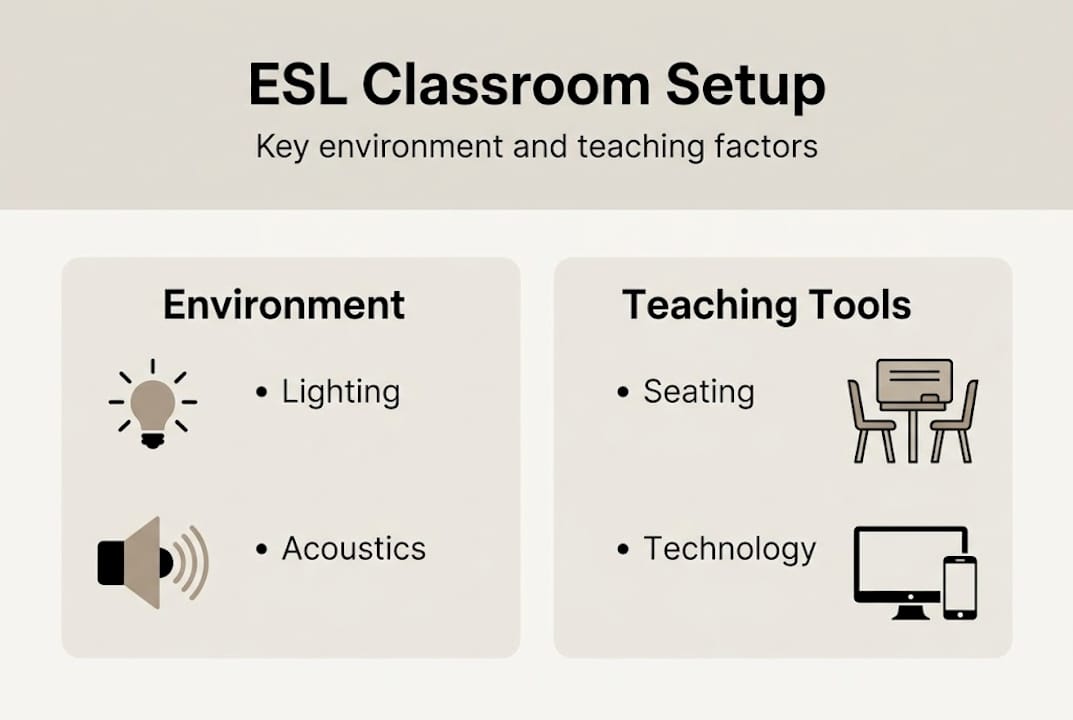
A useful framework is to evaluate four core variables: lighting, acoustics, seating flexibility, and technology access. Natural lighting reduces eye strain and supports alertness, while harsh fluorescent lighting can create fatigue during extended reading or writing tasks. Acoustic quality determines how clearly students hear the teacher and each other, which is especially critical in ESL settings where unfamiliar phonemes and intonation patterns require precise auditory input. Seating flexibility refers to whether furniture can be reconfigured quickly, and technology access covers everything from a reliable Wi-Fi connection to a projector or interactive whiteboard.
| Environmental factor | Impact on ESL learning | Readiness check |
|---|---|---|
| Lighting | Affects alertness, reading ease, and eye contact | Natural vs. fluorescent; dimmable options |
| Acoustics | Determines listening clarity and spoken output quality | Echo levels, background noise, wall absorption |
| Seating flexibility | Enables varied group configurations | Fixed vs. movable furniture |
| Technology access | Supports multimedia input and interactive practice | Projector, Wi-Fi, speakers, devices |
Research supports this assessment approach. Flexible seating and technology integration are associated with higher cognitive and emotional engagement, along with improved language outcomes, compared to traditional classroom contexts. Teachers who align their physical environment with these findings start at a clear advantage.
Acoustics deserve particular attention. An MDPI study on EFL listening found that seat and room acoustic quality are directly linked to listening scores in high-stakes testing conditions. This means even a modest improvement in acoustic quality, such as adding soft furnishings or closing a noisy corridor door, can have a measurable effect on student performance.
Beyond the data, it is worth reading practical guidance on classroom management tips that address environmental factors as part of a broader approach to organization. Building a positive classroom culture starts with the physical space students walk into.
Common mistakes in environmental preparation include:
- Ignoring echo in large or tiled rooms, which distorts spoken input for students
- Placing desks so that some students face away from natural light sources, causing glare
- Failing to test audio equipment before a listening lesson
- Assuming fixed furniture cannot be modified, when low-cost solutions like stackable chairs often exist
- Overlooking the acoustic impact of open windows in noisy urban settings
Take 15 minutes before the semester begins to walk through your room with these variables in mind. Note what you can control and what requires institutional support. That distinction will guide your planning throughout the steps that follow.
Selecting seating arrangements to match lesson goals
Once the classroom environment has been assessed, the next step is selecting seating arrangements that align with specific lesson goals. One of the most practical frameworks for this decision is organizing seating by lesson mode: input, practice, production, and reflection. Each mode serves a different communicative function, and the physical arrangement of the room should support that function directly.
During input phases, when the teacher introduces new vocabulary, grammar structures, or listening content, a traditional row or horseshoe arrangement works well. Students face the teacher and the board, minimizing distractions and maximizing focus on the source of new language. During practice phases, pair seating allows students to apply new structures in controlled exchanges, such as substitution drills or sentence completion activities. For production phases, small group clusters or circles encourage negotiation of meaning, collaborative storytelling, and debate, all of which require students to face each other rather than the front. Reflection phases, including peer feedback or self-assessment, are best supported by quiet pair or individual arrangements.
Seating by lesson mode rather than a single all-day arrangement is one of the most underused strategies in ESL classrooms. It is also one of the most evidence-supported.
| Seating arrangement | Best lesson mode | Key benefit |
|---|---|---|
| Rows | Input | Focused attention on teacher and board |
| Pairs side by side | Practice | Controlled, structured exchanges |
| Small groups (clusters) | Production | Collaborative language use |
| Circle or horseshoe | Reflection / Discussion | Equal contribution, peer interaction |
| Individual desks apart | Assessment / Self-reflection | Reduced distraction, independent thinking |
To adapt arrangements across a single lesson, follow this numbered sequence:
- Begin in rows or horseshoe for teacher-led input. Keep transition time in mind before the lesson starts.
- Signal a shift to pairs by using a consistent cue, such as a clap pattern or a phrase like “Turn to your partner.”
- Move to group clusters for production tasks by assigning roles before students rearrange furniture.
- Return to pairs or individual seating for reflection or written follow-up.
- Close in a circle or horseshoe for any whole-class discussion or feedback session.
Pro Tip: Minimize transition time by labeling desk positions on the floor with colored tape. Students learn quickly where each configuration goes, cutting transition time from two minutes to under 30 seconds.
Student-centered classrooms depend on seating that matches student activity rather than teacher convenience. Flexible seating, where supported by flexible learning environments research, is linked to improved cognitive and emotional engagement. However, it requires deliberate teacher management to be effective. See 5 steps for classroom management for guidance on handling transitions without losing instructional momentum.
Integrating technology and environmental enhancements
With seating arrangements optimized for each lesson phase, the next step is layering in technology and environmental enhancements that extend the room’s instructional capacity. These additions do not need to be expensive. Many of the most effective upgrades are low-cost, straightforward to implement, and immediately impactful for ESL learners.
Technology tools and environmental upgrades worth prioritizing include:
- Portable Bluetooth speakers: Dramatically improve audio quality for listening activities, especially in rooms with hard floors or high ceilings that cause echo
- Interactive whiteboards or large-screen TVs: Enable visual vocabulary presentations, video-based input, and real-time collaborative writing
- Student response apps (such as Kahoot, Mentimeter, or Padlet): Support low-anxiety participation and give teachers instant feedback on comprehension
- Dimmable or warm-spectrum lighting: Reduces fatigue during extended reading tasks and creates a more focused atmosphere for reflective activities
- Acoustic panels or heavy curtains: Absorb echo in rooms where background noise affects listening clarity
- Flexible desk configurations: Lightweight, stackable furniture that supports the seating changes described in the previous section
Integrated technology alongside flexible seating and appropriate lighting produces higher cognitive and emotional engagement in EFL contexts. These are not isolated variables; they work together. A room with good seating but poor audio undermines listening tasks, while excellent acoustics paired with static rows limits collaborative output.
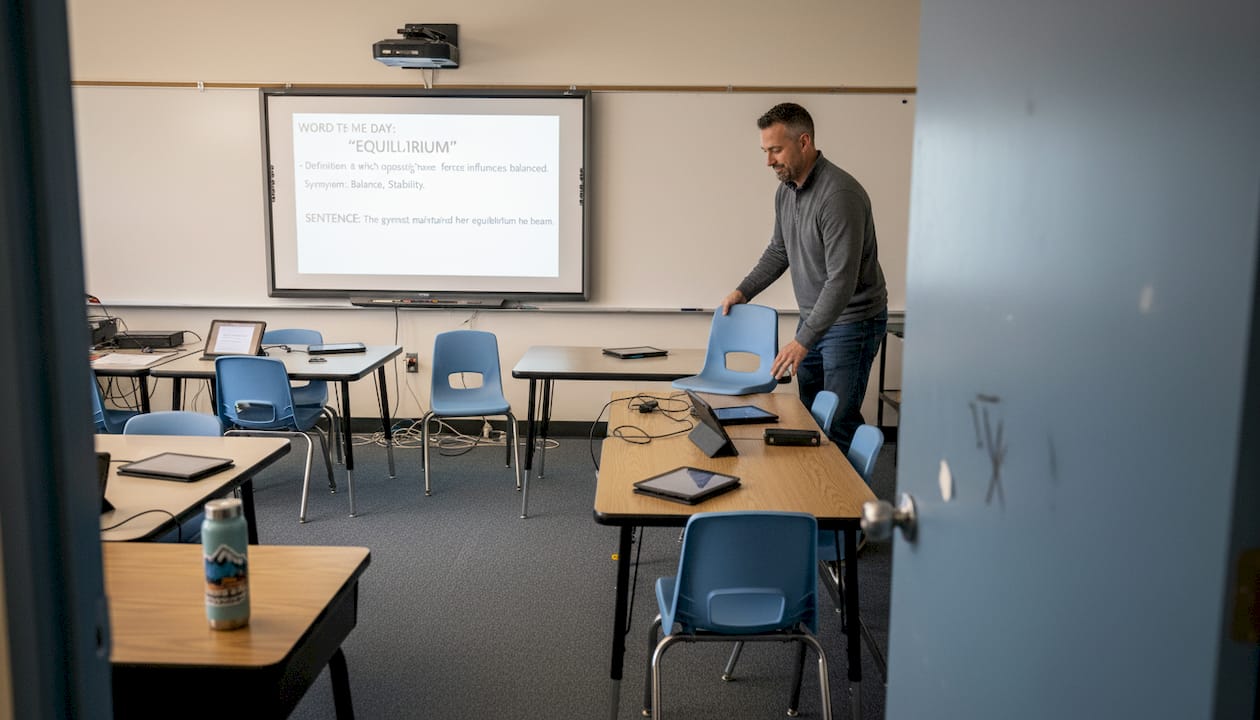
On the acoustic side specifically, room acoustic quality has a direct measurable effect on EFL listening performance. Practical treatments include placing bookshelves along hard walls, using carpets or rugs where possible, and positioning a portable speaker near the center of the room rather than at the front to distribute audio more evenly across all seats.
For teachers working in online or hybrid formats, the principles are parallel. Review the online ESL class setup guide to see how acoustic and visual quality translate to digital environments. Staying current with emerging digital tools is also worthwhile; ESL teaching trends for 2026 outlines how technology integration continues to reshape classroom practice.
A positive learning environment is not built by technology alone, but technology, when well-chosen and properly maintained, removes friction from instruction and keeps students engaged with the language rather than distracted by poor audio or unreadable visuals.
Pro Tip: Before any listening-intensive lesson, play a short audio clip and walk to the back corners of the room. If you cannot hear it clearly from every seat, reposition the speaker or adjust the volume before students arrive. This 60-second check prevents comprehension gaps that are difficult to identify once a lesson is underway.
Verifying setup effectiveness and continuous improvement
After implementing environmental changes, seating arrangements, and technology upgrades, teachers need a structured method for confirming that the setup is producing the intended results. Without this verification step, improvements become assumptions. The goal is to gather concrete evidence of what is working and make targeted adjustments based on what is not.
Use the following numbered checklist to evaluate your classroom setup after the first two to three weeks of use:
- Engagement check: Are students maintaining eye contact with the teacher and peers during discussions? Are participation rates consistent across seating zones, or do students in certain areas participate less?
- Comfort check: Are students showing signs of physical discomfort, such as shifting frequently, leaning on desks, or avoiding certain seats? These signals often point to lighting or acoustic issues.
- Listening effectiveness check: Track comprehension scores on listening tasks over time. Consistent errors on questions related to specific audio content may indicate acoustic problems in certain parts of the room. Acoustic quality is directly linked to listening performance, making this a data-driven check worth maintaining.
- Technology functionality check: Confirm that all digital tools load without significant delay, audio plays at appropriate volume levels, and visual displays are visible from all seating positions.
- Student feedback collection: Use a brief anonymous survey or exit ticket at the end of the first unit asking students to rate the classroom environment for comfort, audibility, and ease of seeing instructional materials.
| Verification step | Method | Frequency |
|---|---|---|
| Engagement observation | Teacher walkthrough during activity | Weekly |
| Comfort signals | Visual scan during independent work | Weekly |
| Listening comprehension | Track task scores over time | Per unit |
| Technology check | Pre-lesson audio-visual test | Before each lesson |
| Student feedback | Anonymous survey or exit ticket | Monthly or per unit |
Student feedback is particularly valuable because students experience the room from a fixed vantage point for an entire lesson, while the teacher moves around. Their perspective surfaces issues that observation alone may miss, such as a heating unit that produces distracting noise or a window that creates glare on the whiteboard at a specific time of day.
Iterating on setup means revisiting seating configurations, adjusting speaker placement, or requesting maintenance support based on what the data and feedback reveal. Explore classroom ideas for engagement to supplement physical setup improvements with activity-based strategies. Combining environmental optimization with differentiated learning strategies ensures the space supports a range of learner needs simultaneously.
One important limitation to note: flexible setups require intentional use to produce results. A reconfigured room that is not paired with lesson-appropriate activities and clear student expectations will not automatically produce better outcomes. The setup enables learning; it does not replace effective instruction.
A practical perspective: What works and what doesn’t in classroom setup
The research on classroom environments is encouraging, but it carries a caution that practitioners should take seriously. Evidence for flexible seating and specific physical design choices is not uniform. A 2025 Springer study on innovative learning spaces found that teachers may recognize the possibilities of versatile spaces, yet those spaces can still fail to produce the intended collaborative or student-centered outcomes without deliberate, aligned instructional use.
This is an important distinction. A room with clustered desks and a smartboard is not inherently more effective than a traditional classroom. What makes the difference is whether the teacher designs activities that require and reward the collaborative affordances that setup provides. Teachers who rearrange furniture without rethinking their lesson structure often find that students revert to passive behavior regardless of where the desks are positioned.
The practical lesson here is that setup and pedagogy must be treated as a unit. When planning a lesson, start by identifying the lesson mode, then select the appropriate seating arrangement, then verify that the technology and acoustic environment support that mode. This sequence prevents the common mistake of treating classroom setup as a one-time task rather than an ongoing instructional decision.
Engagement activities like ESL class games are far more effective when the room is arranged to support movement, collaboration, and visibility. Physical setup is the foundation; everything else builds on it. For institutional support and additional resources, ESL teacher support offers guidance for teachers navigating these decisions across diverse contexts.
Further your ESL teaching skills with expert courses
Applying the strategies in this guide is a strong starting point, but deep professional development accelerates classroom effectiveness significantly. TEFL Institute offers accredited courses that connect environmental design principles to broader pedagogical frameworks, giving teachers the skills to make every instructional decision, including classroom setup, with confidence.

Whether you are new to ESL or expanding your credentials, TEFL Institute provides flexible, professionally recognized programs for every career stage. Teachers in urban centers can explore TESOL certification in NYC or TEFL courses in Salt Lake City as location-specific pathways. The skills you build through formal training translate directly into more intentional, evidence-informed classroom practice from day one.
Frequently asked questions
What is the most effective seating arrangement for ESL classrooms?
The most effective arrangement depends on the lesson phase: rows work best for input, pairs suit structured practice, and group clusters or circles support production and reflection. Matching seating to lesson mode is more effective than relying on a single layout throughout the day.
How do classroom acoustics affect language learning?
Better acoustics lead directly to higher listening scores and improved comprehension in ESL settings. Room acoustic quality is measurably linked to EFL listening performance in real-world testing conditions.
Should every ESL classroom use flexible seating?
Flexible seating can improve engagement, but its impact depends on how the teacher uses it. A Springer study on learning spaces found that versatile spaces do not automatically produce collaborative outcomes without deliberate instructional alignment.
What technology is most helpful for ESL classroom setup?
Audio enhancements, visual display tools, and interactive digital apps are especially valuable. Integrated classroom technology alongside flexible seating and appropriate lighting is consistently associated with higher cognitive and emotional engagement in EFL contexts.
Recommended
TEFL Institute guides

Estonia
Jobs, pay and work routes
Thailand
Visas and teaching licences
Spain
Jobs, pay and visa routes
China
Z visa, pay and cities
Taiwan
Buxibans, pay and visas