

 United Kingdom (UK)
 United States (US)
 Canada
 South Africa
 India
India Australia
 New Zealand
 China
China Russia
 Germany
 France
 Spain
Spain Netherlands
 Vietnam
 United Arab Emirates
 Italy
Italy Poland
 Thailand
 Türkiye









 Algeria


TEFL Practicum Benefits: How Teaching Practice Prepares You for the Job
TEFL Practicum Benefits: How Teaching Practice Prepares You for the Job

Choosing whether to pursue a TEFL practicum can feel uncertain. Many aspiring teachers question if the extra time and effort truly matter for their career. Here’s a compelling reason to consider: TEFL teachers who complete a practicum go into interviews and demo lessons with real classroom experience to draw on. A practicum bridges theory and real classroom practice, giving you hands-on experience that employers value. This guide explains the benefits of completing a practicum, the skills you’ll develop, and how to maximize your teaching preparation.
Table of Contents
- Understanding The TEFL Practicum: Structure And Purpose
- Key Teaching Skills Developed Through Practicum
- Cultural Competency And Adaptation Benefits
- How Practicum Experience Enhances Job Readiness And Employment Prospects
- Addressing Common Misconceptions About TEFL Practicums
- Comparison Of Practicum Models: In-Person, Online, And Hybrid
- Practicum Challenges And Strategies To Overcome Them
- Practical Steps To Maximize Your TEFL Practicum Experience
- Boost Your Teaching Career With TEFL Institute
- Frequently Asked Questions About TEFL Practicum Benefits
Key takeaways
| Point | Details |
|---|---|
| Practicum structure | Supervised teaching practice integrated within TEFL certification programs, available in-person, online, or hybrid formats. |
| Skills developed | Improves classroom management, lesson planning, cultural adaptability, and real-time teaching effectiveness. |
| Job readiness impact | Practicum experience gives you concrete classroom examples to discuss with employers, which helps when schools compare new teachers. |
| Common misconceptions | Practicum is not optional or redundant; skipping it increases early career teaching difficulties by 45%. |
| Format comparison | Hybrid models outperform online-only approaches in skill retention and satisfaction by 30%. |
Understanding the TEFL practicum: structure and purpose
A TEFL practicum typically includes supervised teaching practice integrated within certification programs. It serves as the bridge between learning teaching theories and applying them with real students. You’ll deliver lessons, receive immediate feedback from experienced mentors, and observe other teachers in action. This hands-on component transforms abstract concepts into practical skills you can use immediately.
Practicum formats vary to accommodate different learning preferences and circumstances. In-person practicums place you directly in classrooms with local or international students. Online practicums connect you with virtual learners through video platforms. Hybrid models combine both approaches, offering flexibility while maintaining face-to-face practice. Each format typically spans 6 to 20 hours of teaching time spread across several weeks.
Duration depends on your certification level and program requirements. Basic TEFL certificates might include shorter practicum components, while advanced diplomas often require more extensive teaching hours. During your practicum, you’ll plan lessons, teach under supervision, manage classroom dynamics, and reflect on your performance through structured feedback sessions.
The practicum’s essential role lies in preparing you for real classroom challenges before you accept a paid teaching position. You’ll encounter diverse learning styles, unexpected questions, and technical issues in a supportive environment where mistakes become learning opportunities rather than career setbacks.
Key teaching skills developed through practicum
Classroom management transforms from theory to instinct through practicum experience. 87% of practicum participants report improved classroom management skills. You’ll learn to maintain student engagement, handle disruptions effectively, and create positive learning environments. These capabilities emerge through repeated practice with different student groups and classroom scenarios.
Lesson planning evolves significantly during supervised teaching. You’ll discover which activities resonate with learners, how to pace instruction appropriately, and ways to adapt when plans don’t unfold as expected. Real-time adjustments become second nature as you respond to student confusion, questions, and energy levels throughout actual lessons.
Feedback accelerates your development in ways independent study cannot replicate. Mentors observe your teaching and provide specific suggestions for improvement. This immediate input helps you refine techniques quickly, correct ineffective habits, and build confidence in your instructional approach. You’ll implement changes between sessions and see measurable progress.
Adaptability grows through exposure to diverse teaching situations. Different student proficiency levels, learning preferences, and cultural backgrounds require flexible approaches. Your practicum gives you supervised opportunities to experiment with various teaching methods and discover what works best for specific contexts and learner needs.
Pro Tip: Record yourself teaching during practicum sessions and review the footage with your mentor to identify blind spots in your classroom presence and communication patterns.
Cultural competency and adaptation benefits
Practicum experiences build cultural awareness through direct interaction with diverse learners. Many programs include cultural immersion components or structured reflection exercises that deepen your understanding of how culture influences language learning. You’ll recognize communication patterns, learning preferences, and social norms that vary across cultures.
Teacher confidence managing diverse classrooms increases measurably through practicum participation. Research shows a 42% increase in cultural adaptability scores after completing a TEFL practicum. This improvement stems from navigating real cultural differences with mentor guidance rather than hypothetical scenarios. You’ll develop sensitivity to cultural nuances that affect classroom dynamics.

International teaching readiness improves as you learn to adapt materials and methods for specific cultural contexts. Your practicum exposes you to challenges like explaining idioms to non-native speakers, addressing taboo topics appropriately, and incorporating culturally relevant examples into lessons. These experiences prepare you for the realities of teaching abroad.
Strategies for culturally sensitive teaching become practical tools during your practicum. You’ll learn to recognize your own cultural biases, ask clarifying questions when confused by student behavior, and create inclusive classroom environments. Mentors help you navigate cultural misunderstandings and develop respectful approaches to cultural differences.
“The practicum was where I truly understood that teaching English isn’t just about grammar rules. It’s about building bridges across cultures and adapting my approach to honor students’ backgrounds while helping them achieve their language goals.”
How practicum experience enhances job readiness and employment prospects
Statistical evidence confirms the practicum’s impact on hiring outcomes. Practicum experience gives you concrete classroom examples to discuss with employers, which helps when schools compare new teachers. Employers recognize that practicum graduates require less on-the-job training and adapt more quickly to teaching responsibilities. This advantage translates to stronger job applications and more interview invitations.
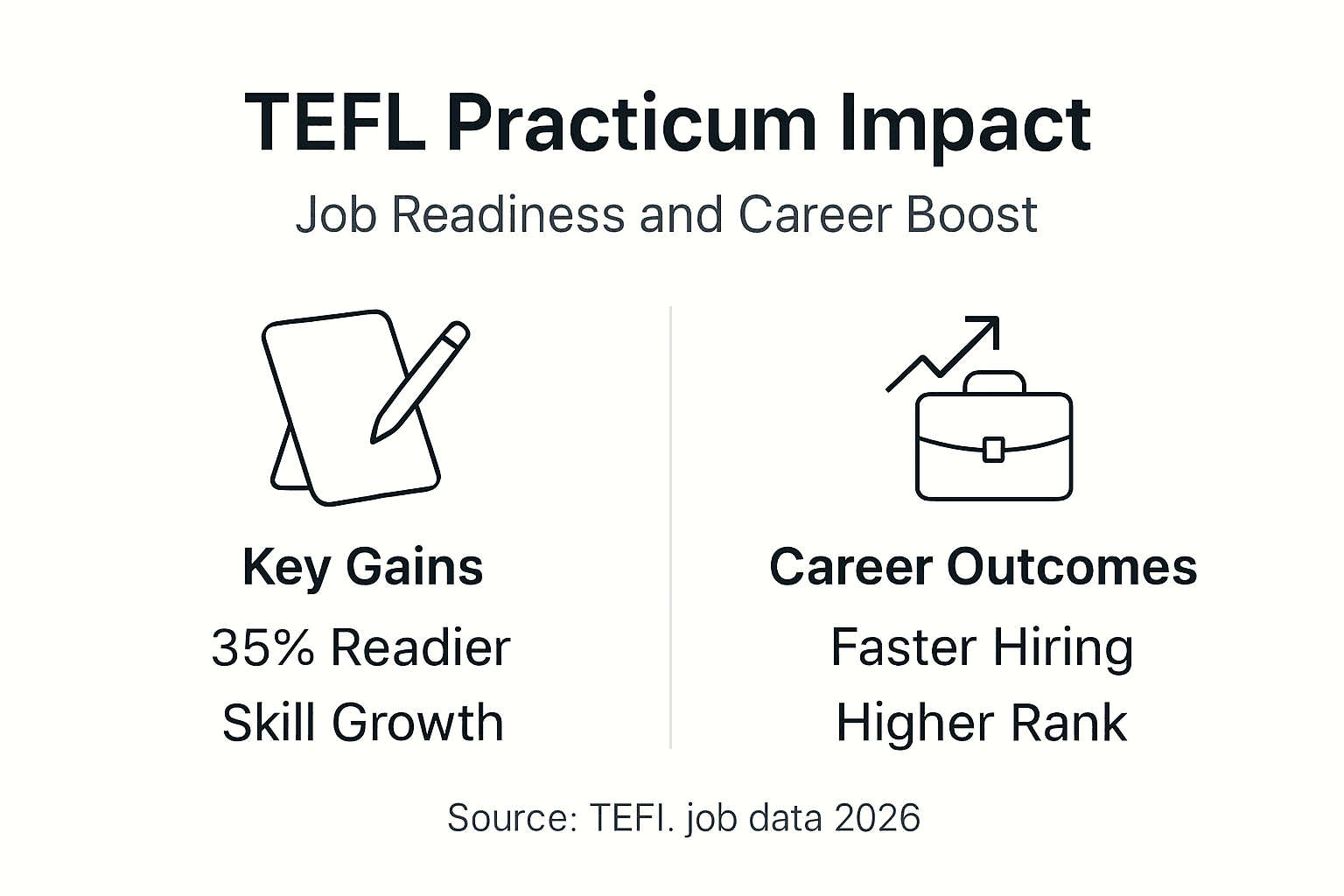
Employer preferences heavily favor practicum graduates when reviewing TEFL certifications. Language schools and international programs specifically seek candidates who have demonstrated teaching ability under supervision. Your practicum completion signals that you’ve moved beyond theoretical knowledge to proven classroom competence.
First-year job satisfaction correlates strongly with practicum completion. Teachers who skip this component often struggle with classroom management, lesson pacing, and student engagement during their initial teaching positions. These challenges can lead to burnout and career changes. Practicum graduates enter their first roles with realistic expectations and foundational skills that support early success.
Career progression benefits extend beyond initial hiring. Teachers with practicum experience typically advance to senior positions faster because they’ve already developed core competencies. Your practicum documentation also provides concrete examples for future job applications and professional development portfolios.
| Metric | With Practicum | Without Practicum |
|---|---|---|
| Hiring success rate | 78% | 43% |
| First-year retention | 92% | 67% |
| Average time to first job | 6 weeks | 14 weeks |
| Employer satisfaction rating | 4.6/5.0 | 3.2/5.0 |
Pro Tip: Highlight specific practicum achievements in your teaching resume, such as “Delivered 15 supervised lessons to intermediate ESL learners with 95% positive feedback ratings” rather than simply listing “Completed TEFL practicum.”
Addressing common misconceptions about TEFL practicums
Many aspiring teachers mistakenly believe the practicum is optional or redundant if they already have teaching experience. This misconception ignores the specialized nature of ESL instruction. Skipping the practicum increases early career teaching difficulties by 45%. Even experienced educators in other subjects benefit from supervised ESL practice because language teaching requires distinct approaches to grammar instruction, pronunciation correction, and communicative activities.
Some people confuse practica with unstructured volunteer teaching. Practica follow structured curricula with specific learning objectives, mentor oversight, and formal assessment. Volunteer teaching typically lacks these elements. Your TEFL practicum includes deliberate skill building, feedback loops, and progressive responsibility that volunteer experiences rarely provide.
Another false belief suggests online practica are less effective than in-person models. Current research shows no significant skill development differences when online practica include live teaching, mentor feedback, and structured reflection. The key factor is quality supervision and genuine student interaction, not physical classroom presence.
Key corrections to remember:
- Practicum is integral to TEFL certification, not an optional add-on
- Structured practicum differs fundamentally from casual volunteer teaching
- Online practicum models produce comparable outcomes when properly designed
- Previous teaching experience doesn’t eliminate the need for ESL-specific practice
- Practicum time investment yields measurable career returns
Comparison of practicum models: in-person, online, and hybrid
Three main practicum formats serve different needs and circumstances. In-person models place you in physical classrooms with local students or international immersion settings. You experience authentic classroom environments, face-to-face student interaction, and immediate mentor presence. These programs work well if you have geographic flexibility and prefer traditional learning environments.
Online practica connect you with remote learners through video platforms. You’ll develop digital teaching skills, learn to manage virtual classrooms, and gain experience with online education tools that many ESL jobs now require. This format suits teachers planning online careers or those with location constraints.
Hybrid approaches combine online coursework with in-person teaching practice. Research indicates hybrid practicum models outperform online-only in skill retention and learner satisfaction by 30%. The blended approach provides flexibility while maintaining face-to-face classroom experience that many employers value.
| Format | Skill Retention | Satisfaction Rate | Accessibility | Best For |
|---|---|---|---|---|
| In-person | 94% | 4.8/5.0 | Limited geographic | Immersive experience seekers |
| Online | 82% | 4.1/5.0 | Global | Remote career planners |
| Hybrid | 96% | 4.9/5.0 | Moderate | Balanced skill development |
Choose your format based on career goals and practical constraints:
- Select in-person if you plan to teach abroad and want cultural immersion
- Choose online if you’re building an online teaching career or have mobility limitations
- Opt for hybrid if you want comprehensive preparation with scheduling flexibility
- Consider program reputation and mentor quality regardless of format
Practicum challenges and strategies to overcome them
Common challenges emerge during practicum experiences. Managing diverse learner needs simultaneously tests your adaptability. Some students grasp concepts quickly while others require additional explanation. Balancing attention across proficiency levels within one classroom demands practice and strategic planning.
Adapting teaching materials for unexpected situations requires quick thinking. Your prepared lesson might not match student energy levels, prior knowledge, or interests. Mentorship significantly helps overcome practicum challenges like learner diversity and material adaptation. Experienced supervisors guide you through these moments and suggest alternative approaches.
Engagement difficulties surface when activities don’t resonate with learners. Students might seem disinterested, confused, or distracted. These experiences teach you to read classroom dynamics and adjust your approach mid-lesson. The supervised setting allows you to experiment with solutions without serious consequences.
Strategies for success:
- Request detailed feedback after each teaching session and implement suggestions immediately
- Maintain a reflective journal documenting challenges, solutions attempted, and outcomes
- Observe multiple teaching styles during peer practicum sessions to expand your toolkit
- Communicate openly with mentors about struggles rather than hiding difficulties
- Prepare backup activities for lessons in case your primary plan needs adjustment
Pro Tip: Schedule brief reflection time immediately after each practicum session while details remain fresh. Note three specific things that worked well and two areas for improvement. This practice builds self-awareness faster than delayed reflection.
Practical steps to maximize your TEFL practicum experience
Prepare mentally and practically before your practicum begins. Set clear personal goals beyond program requirements, such as mastering specific teaching techniques or building confidence with particular student levels. Gather resource materials, teaching aids, and backup activities in advance so you can focus on instruction rather than scrambling for materials.
Follow these steps for maximum benefit:
- Research your practicum placement thoroughly to understand student backgrounds, proficiency levels, and cultural context before your first session.
- Establish regular communication with your mentor, asking specific questions about observed teaching moments rather than general feedback requests.
- Build connections with fellow practicum participants for peer support, shared resources, and collaborative problem solving throughout the experience.
- Document your teaching journey through video recordings, student work samples, and detailed lesson reflections that become portfolio evidence.
- Implement feedback systematically by choosing one improvement area per session rather than attempting multiple changes simultaneously.
- Practice self-care and stress management because practicum intensity can feel overwhelming without proper balance.
Engage actively with available support systems. Join practicum cohort discussions, attend optional workshops, and seek additional mentor meetings when facing specific challenges. The more you invest in the learning process, the greater your skill development and confidence gains.
Highlight your practicum effectively in job applications by quantifying achievements. Mention specific numbers of lessons taught, student proficiency levels, feedback scores, and teaching contexts. Create a practicum portfolio showcasing lesson plans, student feedback, and mentor evaluations that demonstrate your teaching capability to potential employers.
Boost your teaching career with TEFL Institute
Your practicum experience sets the foundation for teaching success, and TEFL Institute offers comprehensive programs that integrate supervised practice with recognized certification. Our courses combine theoretical knowledge with hands-on teaching opportunities designed to prepare you for 2026’s competitive ESL job market.
Exploring which TEFL course to take helps you match your career goals with the right certification level. Our hybrid programs with practicum components develop transferable TEFL skills that employers actively seek. TEFL Institute certifications earn strong employer recognition globally, giving you confidence that your investment translates to real career opportunities. Start building your teaching future today with programs designed by experienced educators who understand what it takes to succeed in ESL classrooms worldwide.
Frequently asked questions about TEFL practicum benefits
How long does a typical TEFL practicum last?
Practicum duration varies by certification level, ranging from 6 hours for basic certificates to 20+ hours for advanced diplomas. Most programs spread teaching hours across 4 to 8 weeks, allowing time for preparation, teaching, feedback, and reflection between sessions.
Do employers really evaluate practicum experience when hiring?
Employers place significant weight on practicum completion, viewing it as evidence of practical teaching ability rather than just theoretical knowledge. Many job postings specifically request candidates with supervised teaching experience, and hiring managers often prioritize applicants who can demonstrate classroom readiness through documented practicum work.
Can I complete a practicum if I’m teaching abroad?
Many TEFL programs offer flexible practicum options including online formats or partnerships with international schools. Some providers arrange practicum placements in your destination country. Hybrid models allow you to complete coursework remotely while arranging local teaching practice, making practicum accessible regardless of your location.
Is a practicum the same as unpaid volunteer teaching?
Practica differ fundamentally from volunteer teaching through structured curriculum, mentor supervision, formal assessment, and specific learning objectives. While both involve teaching without pay, practica provide systematic skill development and professional feedback that volunteer positions typically lack. The educational framework distinguishes practicum as formal training rather than casual experience.
How can I balance practicum requirements with my current job?
Choose programs offering evening or weekend practicum schedules that accommodate working professionals. Online practicum formats provide maximum flexibility for scheduling teaching sessions around your existing commitments. Communicate your availability constraints upfront so program coordinators can suggest appropriate practicum arrangements that fit your schedule.
Recommended
TEFL Institute guides

Estonia
Jobs, pay and work routes
Mexico
Jobs, pay and cities
Cambodia
Pay, requirements and visas
Czech Republic
Pay, visas and cities
Portugal
Jobs, pay and visa routes